
The reliable operation of mechanical transmissions under high load and speed is a cornerstone of modern engineering. Among various gear types, the helical gear stands out due to its superior performance characteristics. The inherent design of a helical gear, with its teeth cut at an angle to the axis of rotation, provides a gradual engagement process. This results in multiple teeth being in contact at any given time, leading to smoother and quieter power transmission compared to spur gears, along with a significantly higher load-carrying capacity. These advantages make helical gears indispensable in demanding applications such as automotive transmissions, industrial gearboxes, wind turbines, and aerospace systems. However, this performance is critically dependent on the integrity of the contacting tooth surfaces. Under severe operating conditions, inadequate lubrication between the meshing teeth can lead to surface distress, including pitting, scuffing, and ultimately, catastrophic failure. Therefore, a deep understanding of the lubrication regime within the tooth contact is paramount for predicting durability and optimizing the design of helical gear pairs.
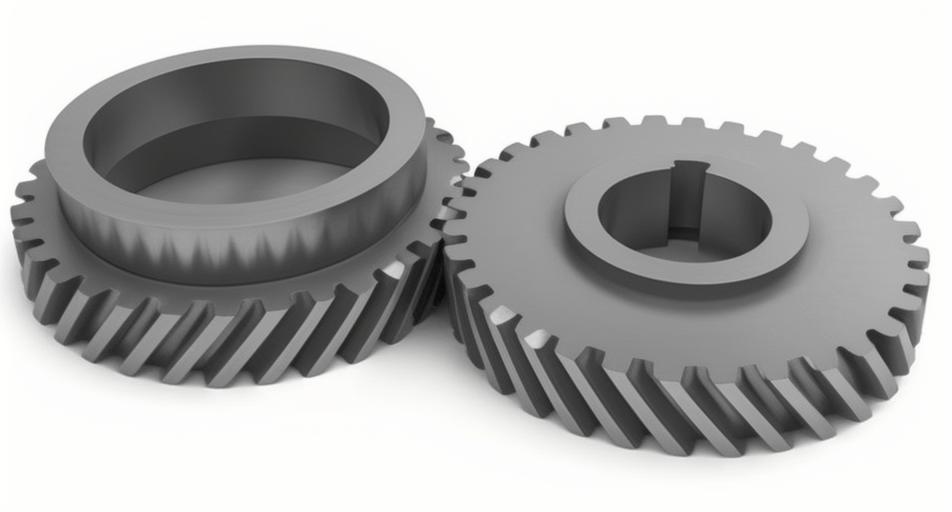
For decades, the analysis of lubrication in gear contacts has been framed within the context of Elastohydrodynamic Lubrication (EHL) theory. This discipline studies the formation of a thin lubricant film between two elastic bodies in non-conformal contact, such as gear teeth or rolling element bearings, where pressures are high enough to significantly elastically deform the surfaces and increase the lubricant’s viscosity. Traditional EHL models for helical gears have often relied on the assumption of perfectly smooth contacting surfaces to simplify the complex numerical solution. While these smooth-surface models provide invaluable insights into the macroscopic trends of pressure and film thickness, they fall short of representing reality. In practical engineering, all manufactured surfaces, including those of high-precision helical gears, possess a degree of roughness resulting from processes like grinding, honing, or shaving. The amplitude of this surface roughness is frequently of the same order of magnitude as the calculated EHL film thickness. This convergence places the actual contact condition squarely in the realm of mixed lubrication, a regime where load is carried partly by the pressurized fluid film and partly by direct asperity contact between the surface roughness peaks. The presence of roughness drastically alters the pressure distribution, film thickness profile, and subsurface stress field, directly influencing friction, wear, and fatigue life. Consequently, developing a transient analysis model capable of simulating mixed EHL for helical gears, incorporating real three-dimensional surface topography, is not merely an academic exercise but an engineering necessity for accurate life prediction and design refinement.
This work presents a comprehensive numerical investigation into the transient mixed elastohydrodynamic lubrication of a helical gear pair. The core of our approach is to simplify the complex contact between the evolving tooth surfaces during meshing into a more tractable, yet physically representative, model: a three-dimensional, infinite line-contact problem that evolves in time. We develop a complete mathematical framework that integrates the time-varying geometry of helical gear engagement with advanced mixed lubrication theory. Critically, we abandon the ideal smooth-surface assumption and incorporate measured three-dimensional roughness profiles from actual machining processes. Using a unified numerical approach that seamlessly handles both fluid-film and asperity-contact regions, we obtain complete numerical solutions for the pressure and film thickness throughout the entire meshing cycle of a single tooth pair. This allows us to systematically compare the lubrication performance under idealized smooth conditions against that under real rough surface conditions, revealing the profound impact of surface topography on the operational state of the helical gear contact.
Methodology: Geometric, Lubrication, and Numerical Models
1. Geometric Analysis of Helical Gear Meshing
The first step in our analysis is to accurately characterize the continuously changing contact conditions as a pair of helical gear teeth move through the mesh. For an involute helical gear pair, the contact line on the theoretical plane of action is a straight line inclined at the base helix angle, $\beta_b$. As the gears rotate, this contact line translates across the face width. At the beginning and end of engagement for a single tooth pair, the contact line is short; it reaches a maximum length and remains constant in the central region of engagement if the face width is sufficient.
To model this as a transient line-contact EHL problem, we consider discrete instants in time along the path of contact. For each instant, the contact geometry at the midpoint of the instantaneous contact line is analyzed. The local radii of curvature for the driving and driven gear teeth, $\rho_1$ and $\rho_2$, are calculated based on the involute geometry and the instantaneous position of the contact point. The equivalent radius of curvature, $R_x$, which governs the macroscopic contact geometry in the direction of entrainment (x-direction), is given by:
$$R_x = \frac{\rho_1 \rho_2}{\rho_1 + \rho_2}$$
The variation of $R_x$ during meshing is crucial, as it directly affects the Hertzian contact half-width and pressure.
The surface velocities are also time-dependent. The entrainment or rolling velocity, $U$, which is the average of the surface velocities in the direction tangential to the contact, is a key parameter driving fluid into the contact zone. For a helical gear pair, it can be expressed as a function of the pinion’s rotational speed $\omega_1$, base helix angle $\beta_b$, and the instantaneous contact position. The sliding velocity, $U_s$, the difference between the two surface velocities, is critical for determining friction and flash temperature rise. These time-varying parameters for a sample helical gear pair are summarized in the following analysis.
| Parameter | Symbol | Value / Description |
|---|---|---|
| Number of teeth (Pinion/Gear) | $Z_1 / Z_2$ | 18 / 39 |
| Normal module | $m_n$ | 7 mm |
| Base helix angle | $\beta_b$ | 19.95° |
| Normal pressure angle | $\alpha_n$ | 20° |
| Center distance | $a$ | 156 mm |
| Face width | $B$ | 32 mm |
| Start of active profile angle | $\varphi_s$ | 5.45° |
| End of active profile angle | $\varphi_e$ | 36.25° |
2. The Mixed Elastohydrodynamic Lubrication Model
To simulate the mixed lubrication condition, we employ a unified modeling approach. This model uses a single set of equations valid across the entire spectrum of lubrication regimes—from full-film EHL to boundary lubrication and even dry contact. The governing system of equations is solved over the entire computational domain, with the solution itself revealing whether a given point is in a fluid-pressure region or an asperity-contact region.
The heart of the model is the unified Reynolds equation, which governs the fluid flow in the thin gap. For a three-dimensional, transient, isothermal line contact, it is expressed as:
$$\frac{\partial}{\partial x}\left(\frac{\rho h^3}{12 \eta^*}\frac{\partial p}{\partial x}\right) + \frac{\partial}{\partial y}\left(\frac{\rho h^3}{12 \eta^*}\frac{\partial p}{\partial y}\right) = U \frac{\partial (\rho h)}{\partial x} + \frac{\partial (\rho h)}{\partial t}$$
where $p$ is the pressure (fluid or contact), $h$ is the film thickness, $\eta^*$ is the effective viscosity, $\rho$ is the lubricant density, $U$ is the entrainment velocity, and $t$ is time. The effective viscosity $\eta^*$ accounts for non-Newtonian behavior using the Eyring model:
$$\frac{1}{\eta^*} = \frac{1}{\eta} \frac{\tau_0}{\tau} \sinh\left(\frac{\tau}{\tau_0}\right)$$
where $\tau_0$ is the Eyring stress and $\tau$ is the shear stress.
The film thickness equation incorporates geometry, elastic deformation, and surface roughness:
$$h(x,y,t) = h_0(t) + \frac{x^2}{2R_x} + v(x,y,t) + \delta_1(x,y,t) + \delta_2(x,y,t)$$
Here, $h_0(t)$ is the central rigid film thickness, $\frac{x^2}{2R_x}$ represents the macro-geometric gap, $v$ is the total elastic deformation of the surfaces, and $\delta_1$ and $\delta_2$ are the real three-dimensional roughness profiles of the two contacting helical gear tooth surfaces.
The elastic deformation $v$ is calculated by integrating the pressure over the domain using the Boussinesq solution for a semi-infinite elastic solid, which in discretized form is efficiently solved via the Discrete Convolution and Fast Fourier Transform (DC-FFT) method:
$$v(x,y,t) = \frac{2}{\pi E’} \iint_{\Omega} \frac{p(\xi,\zeta)}{\sqrt{(x-\xi)^2 + (y-\zeta)^2}} d\xi d\zeta$$
where $E’$ is the effective elastic modulus: $\frac{2}{E’} = \frac{1-\nu_1^2}{E_1} + \frac{1-\nu_2^2}{E_2}$.
The system is closed by the force balance equation, ensuring the integrated pressure supports the applied load $w(t)$ at each timestep:
$$w(t) = \iint_{\Omega} p(x,y,t) \, dx \, dy$$
The lubricant’s piezoviscous and density-pressure relationships are described by standard empirical equations, such as the Roelands viscosity model and a common density-pressure equation.
| Parameter | Symbol | Value |
|---|---|---|
| Ambient dynamic viscosity | $\eta_0$ | 0.0454 Pa·s |
| Pressure-viscosity coefficient | $\alpha$ | 2.275e-8 Pa⁻¹ |
| Ambient density | $\rho_0$ | 866 kg/m³ |
| Effective elastic modulus | $E’$ | 2.19e11 Pa |
| Pinion speed | $N_1$ | 1000 rpm |
| Transmitted power | $P$ | 100 kW |
3. Numerical Solution Procedure
The coupled system of equations is solved using a highly efficient numerical procedure. The computational domain in the x-y plane is defined to be sufficiently larger than the nominal Hertzian contact area to ensure full pressure decay at the boundaries. A typical domain is $X_{in} = -4.5a$ to $X_{out} = 1.5a$ and $Y = \pm 1.5a$, where $a$ is the time-varying Hertzian half-width. The domain is discretized using a uniform grid of 256 × 256 nodes.
The solution process for each timestep (each mesh position of the helical gear) is iterative:
- Initialization: Start with an initial pressure guess (e.g., Hertzian pressure) and film thickness.
- Reynolds Equation Solver: The unified Reynolds equation is discretized using a finite difference method. The resulting system is solved using a method like the Gauss-Seidel successive over-relaxation technique, with very low relaxation factors for stability.
- Elastic Deformation: The surface deformation $v$ due to the current pressure field is computed using the DC-FFT algorithm, which is critical for handling the convolution with the real 3D roughness efficiently.
- Film Thickness Update: The film thickness equation is updated with the new deformation and the known roughness profiles $\delta_1$ and $\delta_2$.
- Load Balance: The integrated pressure is compared to the applied load for that helical gear mesh position. The rigid separation $h_0(t)$ is adjusted iteratively until global force balance is achieved.
- Convergence Check: Steps 2-5 are repeated until the pressure field and load balance converge to a specified tolerance (e.g., $10^{-6}$).
This process is repeated for a sequence of points representing the complete meshing cycle of the helical gear tooth pair, from initial engagement to final disengagement.
Results and Discussion: The Impact of Real Roughness
Applying the described model to the specified helical gear pair provides a detailed view of the transient mixed EHL behavior. The analysis tracks a single tooth pair through ten key instants from meshing-in to meshing-out.
1. Time-Varying Macro-Parameters
The geometric and kinematic parameters defining the equivalent line contact change significantly during the helical gear meshing cycle. As the contact point moves from the root of the driving pinion towards its tip, the equivalent radius of curvature, $R_x$, increases monotonically. Concurrently, the entrainment velocity $U$ also increases. The sliding velocity $U_s$, responsible for friction and shear heating, changes sign at the pitch point and varies in magnitude throughout the cycle. These variations directly influence the fundamental EHL parameters: the Hertzian contact half-width $a$ and the maximum Hertzian pressure $p_h$.
$$a = \sqrt{\frac{8 w R_x}{\pi E’}}, \quad p_h = \sqrt{\frac{w E’}{2 \pi R_x}}$$
As $R_x$ increases, $a$ increases while $p_h$ decreases. This means the helical gear tooth contact near the root (meshing-in) experiences a smaller but more heavily stressed contact patch, while near the tip (meshing-out), the contact is wider and the maximum pressure is lower.
2. Comparison: Smooth vs. Rough Surface EHL Characteristics
The most significant findings emerge from comparing the results for perfectly smooth surfaces with those incorporating real measured roughness. Two typical machined surfaces are considered: a ground surface with a Root-Mean-Square (RMS) roughness of approximately 0.6 μm and a honed surface with a lower RMS roughness of about 0.35 μm.
At a given meshing instant (e.g., near meshing-out), the smooth surface model predicts a classic EHL pressure spike and a smoothly varying, horseshoe-shaped film thickness contour with a central constriction. No direct metal-to-metal contact occurs in this idealized case.
In stark contrast, the solutions for rough surfaces are dramatically different. The three-dimensional pressure and film thickness distributions are no longer smooth but are heavily modulated by the underlying roughness topography. The pressure distribution mirrors the roughness peaks, with localized pressure concentrations far exceeding the nominal smooth-surface Hertzian maximum. Correspondingly, the film thickness distribution shows deep valleys where asperities are close to contact. Crucially, in regions where the local gap falls below zero, direct asperity contact occurs. The load is now shared between the fluid film and these contacting asperities. The honed surface, with its lower amplitude roughness, exhibits smaller asperity pressure concentrations and a larger proportion of the load carried by the fluid film compared to the ground surface. This is visually evident in pseudo-3D plots of the pressure field, where the honed surface shows more numerous but lower peaks, while the ground surface shows fewer but more severe, isolated high-pressure zones corresponding to its larger-scale asperities.
3. Transient Evolution of Lubrication Performance
Tracking key performance metrics throughout the helical gear meshing cycle reveals the dynamic impact of roughness. We analyze the central film thickness (an average over the core contact region to avoid edge effects), the film thickness ratio $\lambda$ (ratio of central film thickness to composite RMS roughness), the real contact area ratio $A_c$ (fraction of nominal area in asperity contact), and the contact load ratio $W_c$ (fraction of total load carried by asperities).
Film Thickness & Film Thickness Ratio ($\lambda$): For the smooth surface, the central film thickness follows a trend influenced primarily by the entrainment velocity and load, generally increasing during the mesh cycle. When roughness is introduced, the calculated “average” film thickness becomes lower and exhibits oscillations around a mean value. More importantly, the film thickness ratio $\lambda$ provides a direct measure of lubrication safety. A $\lambda > 3$ typically indicates full-film lubrication, while $\lambda < 1-3$ indicates mixed lubrication. For our helical gear case, the smooth surface model predicts $\lambda$ values suggesting adequate lubrication. However, the rough surface models show $\lambda$ values consistently in the mixed lubrication regime ($\lambda < 2$). The honed helical gear surface maintains a higher $\lambda$ than the ground surface throughout the cycle, indicating relatively better lubrication conditions.
Contact Area & Load Ratios ($A_c$, $W_c$): These metrics quantify the severity of asperity interaction. As expected, $A_c$ and $W_c$ are zero for the smooth surface. For the rough surfaces, they are non-zero and vary during meshing. The ground helical gear surface, with its higher roughness, consistently shows a larger fraction of the nominal contact area in direct metal-to-metal contact ($A_c$) and carries a larger portion of the total load through these asperities ($W_c$) compared to the honed surface. This implies higher local contact stresses, increased frictional losses, and a greater propensity for surface-initiated fatigue and wear for the ground gear pair. The following table summarizes the comparative performance at a representative mesh position.
| Surface Condition | RMS Roughness | Avg. Film Thickness | Film Ratio $\lambda$ | Contact Area Ratio $A_c$ | Contact Load Ratio $W_c$ |
|---|---|---|---|---|---|
| Smooth | 0 μm | ~0.79 μm | ∞ | 0% | 0% |
| Honed | ~0.35 μm | ~0.35 μm | ~1.0 | ~5-10% | ~10-20% |
| Ground | ~0.60 μm | ~0.46 μm | ~0.77 | ~10-20% | ~20-35% |
The transient analysis further shows that the most critical phase for the helical gear is not necessarily at the point of highest load (which often occurs in the middle of the mesh). The meshing-in and meshing-out phases, where the film thickness from smooth theory might be lower due to geometric and kinematic factors, are exacerbated by roughness. During meshing-out in our example, the film thickness for the rough cases drops significantly, leading to a minimum in $\lambda$ and peaks in $A_c$ and $W_c$. This suggests that these transition regions are potential hotspots for lubrication failure and initial pitting in real helical gears.
Conclusions
This study successfully establishes and implements a comprehensive three-dimensional, transient mixed elastohydrodynamic lubrication model tailored for the analysis of helical gears. By simplifying the complex tooth contact into a time-varying infinite line-contact problem and incorporating real three-dimensional surface roughness topography, the model bridges a significant gap between classical smooth-surface EHL theory and practical gear engineering reality.
The key conclusions drawn from this investigation are as follows:
- The model is effective: The developed framework, utilizing a unified Reynolds equation approach and efficient numerical solvers like DC-FFT, is capable of generating full numerical solutions for the complete meshing cycle of a helical gear pair under mixed lubrication conditions.
- Roughness is a dominant factor: The assumption of smooth surfaces is shown to be highly non-conservative and misleading. Real surface roughness profoundly alters the lubrication state of a helical gear contact. It drastically reduces the effective separating film, introduces severe localized pressure concentrations, and forces the contact into a mixed lubrication regime where a substantial portion of the load is carried by direct asperity interaction.
- Manufacturing process matters: The quality of surface finish, dictated by the manufacturing process (e.g., grinding vs. honing), has a first-order impact on predicted performance. A finer finish (lower RMS roughness) results in a higher film thickness ratio ($\lambda$), smaller real contact area ($A_c$), and lower asperity load share ($W_c$). This unequivocally indicates that investing in superior surface finishing processes for helical gears, such as honing or superfinishing, directly translates to improved lubrication safety, reduced friction, and potentially longer fatigue life.
- Critical meshing phases identified: Transient analysis reveals that the conditions at the beginning and end of tooth engagement are particularly severe under mixed lubrication. These phases, where smooth-film predictions may already be low, experience the most significant degradation in film ratio and increase in asperity contact due to surface roughness, marking them as critical regions for design scrutiny and potential failure initiation.
In summary, the performance and durability of helical gears cannot be accurately predicted using smooth-surface EHL models alone. The integration of real surface topography into transient mixed EHL analysis is essential for a realistic assessment of contact conditions, providing a powerful tool for the design, optimization, and life prediction of high-performance helical gear transmissions. Future work may extend this model to include thermal effects, non-Newtonian rheology more explicitly, and micro-geometry modifications to further enhance the predictive fidelity for helical gear applications.