
In the field of mechanical power transmission, gears are fundamental components whose reliability directly impacts the performance of entire systems. Among the various failure modes, contact fatigue initiated by subsurface cracks is a primary concern, often leading to pitting, spalling, or even tooth fracture. Understanding the mechanisms governing the initiation and, more critically, the propagation of these fatigue cracks is essential for designing durable and reliable gear transmissions. This study focuses on a specific type of cylindrical gear characterized by a variable hyperbolic circular-arc-tooth-trace (VH-CATT). Compared to conventional involute spur or helical gears, this novel cylindrical gear design offers advantages such as improved meshing performance, higher contact ratio, enhanced load-carrying capacity, and the absence of additional axial thrust forces. While prior research has explored its curvature characteristics, contact behavior, and manufacturing methods, a detailed investigation into its contact fatigue crack propagation mechanisms remains scarce. Therefore, this work aims to elucidate the crack propagation behavior in this special cylindrical gear under contact fatigue conditions, providing insights that can guide its design optimization and promote its broader engineering application.
The unique geometry of the VH-CATT cylindrical gear stems from its generation principle, which is analogous to the method used for hypoid gears. The tooth trace in the width direction is a circular arc, while the tooth profile at the central section is a standard involute. Other sections comprise an envelope of a variable hyperbola family. The mathematical model of the tooth surface is derived from the coordinate transformation between the cutter and the workpiece. For the generating gear, the position vector and unit normal vector in the cutter coordinate system \( O_cx_cy_cz_c \) are given first. For the straight blade part:
$$ \mathbf{r}_i^{(c)}(u) = \left[ u \sin\alpha, \quad \mp \left( u \cos\alpha + R_T \right), \quad \pm \frac{\pi m}{4} \right]^T $$
$$ \mathbf{n}_i^{(c)} = \cos\alpha \, \mathbf{i}_c – \sin\alpha \, \mathbf{k}_c $$
And for the tip fillet part:
$$ \mathbf{r}_{ir}^{(c)}(u) = \left[ \pm (R_T – mh_a^* – r^*) \tan\alpha \cos\beta – r^* \sin\beta \sin\alpha, \quad 0, \quad \pm (R_T – mh_a^* – r^*) + r^* \cos\beta \right]^T $$
$$ \mathbf{n}_{ir}^{(c)} = \cos\alpha \, \mathbf{i}_c – \sin\alpha \, \mathbf{k}_c $$
Through coordinate transformation matrices \(\mathbf{M}_{di}, \mathbf{M}_{1i}, \mathbf{L}_{di}, \mathbf{L}_{1i}\), the working tooth surface equation in the gear coordinate system \(O_dx_dy_dz_d\) is obtained as:
$$
\begin{aligned}
x_{di} &= A \cos\theta_i – (R_T \cos\theta_i + u \sin\alpha + R_i) \cos\phi_i + R_T \cos\theta_i \\
y_{di} &= -A \sin\theta_i + (R_T \cos\theta_i + u \sin\alpha + R_i) \sin\phi_i – R_T \sin\theta_i \\
z_{di} &= \pm A \\
\text{where } A &= u \cos\alpha \mp \frac{\pi m}{4} \\
\tan\theta_i &= \frac{\pm \left( R_T \sin\phi_i – (R_T \cos\phi_i + R_i) \tan\phi_i \right)}{u \cos\alpha \mp \frac{\pi m}{4}}
\end{aligned}
$$
This complex geometry results in point contact between mating teeth. To analyze the contact stress field, which is the driver for fatigue crack initiation, we model the contact as an elliptical area. The principal relative radii of curvature in the profile direction (\(R_y\)) and the tooth trace direction (\(R_x\)) at any contact point are combined from the pinion (p) and gear (g) surfaces:
$$
\frac{1}{R_x} = \frac{1}{R_{xp}} + \frac{1}{R_{xg}} = K_{xp} + K_{xg}, \quad
\frac{1}{R_y} = \frac{1}{R_{yp}} – \frac{1}{R_{yg}} = K_{yp} – K_{yg}
$$
The semi-axes \(a\) (major) and \(b\) (minor) of the contact ellipse under a given load \(\omega\) are then calculated using the classic Hertzian formulas, where \(E’\) is the equivalent elastic modulus, and \(k_a, k_b\) are coefficients dependent on the elliptical integral of the first kind \(K(e)\) and the second kind \(E(e)\), related to the eccentricity \(e\) and the geometrical parameters \(A = 0.5(1/R_x + 1/R_y)\) and \(B = 0.5|1/R_x – 1/R_y|\):
$$
a = k_a \sqrt[3]{\frac{3\omega}{2E'(A+B)}}, \quad
b = k_b \sqrt[3]{\frac{3\omega}{2E'(A+B)}}, \quad
k_a = \left[ \frac{2E(e)}{\pi(1-e^2)} \right]^{1/3}, \quad
k_b = k_a \sqrt{1-e^2}
$$
Based on this model, the contact ellipse trajectory and the maximum contact stress \(P_H\) over a meshing cycle can be determined. For our analysis, a specific gear pair with the parameters listed in Table 1 was designed and modeled.
| Design Parameter | Pinion | Gear |
|---|---|---|
| Number of Teeth, Z | 29 | 21 |
| Module, m (mm) | 4 | 4 |
| Tooth Trace Radius, \(R_T\) (mm) | 200 | 200 |
| Face Width, B (mm) | 40 | 40 |
| Pressure Angle, \(\alpha\) (deg) | 20 | 20 |
| Elastic Modulus, E (GPa) | 210 | 210 |
| Poisson’s Ratio, \(\mu\) | 0.3 | 0.3 |
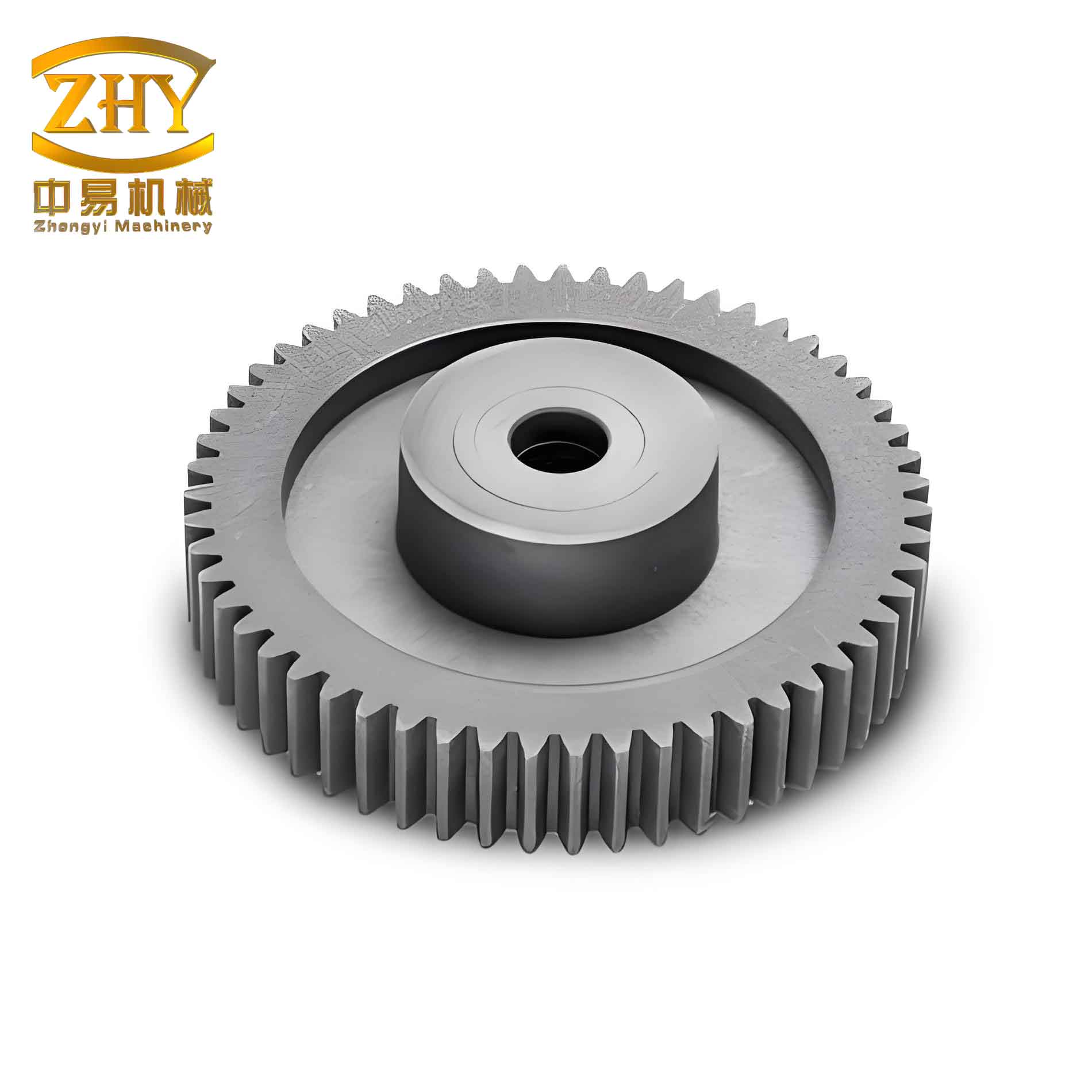
Finite element analysis of this cylindrical gear pair confirms that the highest contact stresses occur within the single-tooth contact region. The numerical contact ellipse model aligns well with FE results, validating its accuracy for identifying high-stress zones. Our analysis pinpointed the initial point of single-tooth engagement as the most critical location for contact fatigue crack initiation due to the smallest contact ellipse and highest load density at that point. This critical location on the pinion’s convex flank was the focus for subsequent crack propagation studies.
To simulate the propagation of a contact fatigue crack from this critical site, we employed the eXtended Finite Element Method (XFEM). This method is particularly suited for modeling discontinuities like cracks without requiring the mesh to conform to the crack geometry. The approximation for the displacement field \(\mathbf{u}^h\) around a crack incorporates standard nodal functions \(N_i(\mathbf{X})\), a jump function \(H(\mathbf{X})\) across the crack face, and crack-tip enrichment functions \(F_l(\mathbf{X})\):
$$
\mathbf{u}^h(\mathbf{X}) = \sum_{i \in N} N_i(\mathbf{X}) \mathbf{u}_i + \sum_{j \in S} N_j(\mathbf{X}) H(\mathbf{X}) \mathbf{a}_j + \sum_{k \in T} N_k(\mathbf{X}) \left( \sum_{l=1}^{4} F_l(\mathbf{X}) \mathbf{b}_k^l \right)
$$
where \(\mathbf{u}_i\) are standard degrees of freedom, and \(\mathbf{a}_j\), \(\mathbf{b}_k^l\) are added degrees of freedom for enriched nodes. A semi-circular initial crack with a radius of 0.2 mm was embedded perpendicular to the tooth surface tangent at the identified danger point on the pinion tooth. A cyclic torque was applied to simulate the repeated loading during gear meshing. The crack propagation was governed by the maximum principal stress criterion, with a damage threshold set for the material.
The simulated crack propagation path in the VH-CATT cylindrical gear revealed a distinct pattern. The crack initially grew symmetrically in an arc shape opposite to the direction of the tooth trace curvature. It first extended slowly towards the tooth core, then this growth stagnated. The primary direction of propagation shifted towards the gear faces (along the tooth width). After reaching near the face, the crack then progressed again towards the tooth core, ultimately leading to tooth fracture. The angle between the crack path and the tooth surface tangent was approximately 50°.
We systematically investigated the influence of key design and operational parameters on the crack propagation rate. The crack growth along the tooth width (\(da/dN\)) and towards the tooth core (\(db/dN\)) were tracked against load cycles. Table 2 summarizes the crack growth trends under varying tooth trace radius \(R_T\), module \(m\), and applied torque \(T\).
| Varying Parameter | Effect on Crack Growth Rate along Width (\(da/dN\)) | Effect on Crack Growth Rate towards Core (\(db/dN\)) |
|---|---|---|
| Tooth Trace Radius \(R_T\) (Increasing) | Decreases | Increases |
| Module \(m\) (Increasing) | Increases | Increases |
| Applied Torque \(T\) (Increasing) | Increases | Increases |
The results indicate that a larger tooth trace radius (i.e., a flatter tooth trace curvature) is beneficial in retarding the crack growth across the face width, which dominates the total fatigue life. Conversely, larger module sizes and higher loads uniformly accelerate crack propagation in both directions.
A critical aspect of predicting crack growth is analyzing the stress intensity factor (SIF) at the crack front, which quantifies the stress field singularity. For three-dimensional cracks, the SIFs for Mode I (opening), Mode II (sliding), and Mode III (tearing) are denoted \(K_I\), \(K_II\), and \(K_III\). We utilized an M-integral method within a combined ABAQUS/FRANC3D framework to calculate these factors for different crack sizes, from the initiation stage (0.2 mm) through the long crack growth stage.
The M-integral for two equilibrium states (1) and (2) is defined over a volume \(V\) surrounding the crack front:
$$
M^{(1,2)} = \int_V \left[ \sigma_{ij}^{(1)} \frac{\partial u_i^{(2)}}{\partial x_j} + \sigma_{ij}^{(2)} \frac{\partial u_i^{(1)}}{\partial x_j} – W^{(1,2)} \delta_{1j} \right] \frac{\partial q}{\partial x_j} \, dV
$$
where \(W^{(1,2)} = \sigma_{ij}^{(1)}\epsilon_{ij}^{(2)} = \sigma_{ij}^{(2)}\epsilon_{ij}^{(1)}\) is the interaction strain energy density, and \(q\) is a weight function. The SIFs are then extracted from the M-integral values related to appropriate auxiliary fields:
$$
\begin{aligned}
K_I &= \sqrt{\frac{E’}{2} M^{(1,I)} A_q} \\
K_{II} &= \sqrt{\frac{E’}{2} M^{(1,II)} A_q} \\
K_{III} &= \sqrt{\frac{E’}{2(1+\nu)} M^{(1,III)} A_q}
\end{aligned}
$$
where \(E’ = E\) for plane stress and \(E’ = E/(1-\nu^2)\) for plane strain, and \(A_q\) is the virtual crack extension area. Analysis of the SIFs along the crack front revealed that during the initial and short-crack stage (crack size < 0.3 mm), \(K_I\), \(K_{II}\), and \(K_{III}\) were of comparable magnitude, indicating a multi-axial stress state. However, as the crack entered the long-crack propagation stage, \(K_I\) became dominant and increased significantly, while \(K_{II}\) and \(K_{III}\) remained low or even decreased. This confirms that the propagation of contact fatigue cracks in this cylindrical gear is primarily driven by Mode I (opening mode).
The influence of module \(m\), tooth trace radius \(R_T\), and initial crack angle \(\alpha_0\) on the Mode I SIF at the crack front during different growth stages was studied. Key findings are summarized below:
- Module (\(m\)): In the long-crack stage, a larger module leads to higher \(K_I\) values both along the tooth width and towards the core direction, making larger gears more susceptible to rapid crack growth once a long crack is established.
- Tooth Trace Radius (\(R_T\)): A larger \(R_T\) effectively reduces the \(K_I\) at the crack front during the long-crack propagation stage. For \(R_T = 300\) mm, the SIF was notably lower than for \(R_T = 100\) or \(200\) mm.
- Initial Crack Angle (\(\alpha_0\)): For pre-set cracks at 90° and 135° to the surface, the 90° crack showed higher initial \(K_I\). However, during long-crack growth, the 135° crack developed higher \(K_I\) values in both directions, suggesting a potentially more aggressive propagation path for steeply inclined initial flaws.
In conclusion, this investigation into the contact fatigue crack propagation characteristics of the VH-CATT cylindrical gear has yielded significant insights. We established a validated numerical model for contact ellipse analysis, identified the single-tooth engagement point as the critical crack initiation site, and successfully simulated the full crack propagation path using XFEM. The propagation is characterized by an initial phase towards the core, followed by dominant growth across the tooth width, and final fracture towards the core. The crack growth life is largely determined by the width-wise propagation phase. The stress intensity factor analysis confirmed Mode I dominance during propagation and quantified the effects of key parameters: larger modules increase \(K_I\), larger tooth trace radii decrease \(K_I\) in the long-crack stage, and steeper initial crack angles can lead to higher \(K_I\) during sustained growth. These findings provide a valuable foundation for optimizing the design of this promising cylindrical gear to enhance its resistance to contact fatigue failure, thereby improving the reliability and service life of transmission systems that employ it.