
In my experience working with helical bevel gears in heavy-duty machinery, particularly in internal combustion locomotives, I have encountered recurring issues with premature surface failures. These helical bevel gears are critical components in the transmission systems, and their early degradation can lead to significant operational downtime and maintenance costs. The specific problem I will address here is the early-stage pitting or spalling observed on the tooth surfaces of these gears, which manifests as localized point-like剥离 after approximately 200,000 kilometers of service. This phenomenon not only compromises gear performance but also raises concerns about material integrity and design adequacy. Through detailed metallurgical analysis and stress calculations, I aim to elucidate the root causes, emphasizing the role of heat treatment irregularities and design limitations.
The helical bevel gears in question are manufactured from chromium-manganese-titanium steel, undergoing processes such as gas carburizing, quenching, and hardening, followed by electric spark machining for fine finishing. However, despite these advanced techniques, some gears exhibit pitting failure much earlier than expected. This early pitting is characterized by密集 point-like剥离, often coalescing into带状凹坑, primarily located near the pitch line on the tooth flanks. To understand this, I conducted investigations on multiple failed gears, including both small and large helical bevel gears, and compared them with gears showing only surface scoring. The macroscopic features varied slightly among specimens, but common patterns emerged, as summarized in the table below.
| Gear Identifier | Service Distance (km) | Pitting Location | Macroscopic Appearance |
|---|---|---|---|
| Small Helical Bevel Gear (Forging No. 736521) | ~200,000 | Mostly below pitch line | Dense point-like剥离, severe cases forming banded pits |
| Small Helical Bevel Gear (Forging No. 740698) | ~200,000 | Below pitch line, some near tooth tip | Point-like剥离, coalescing in adjacent teeth |
| Large Helical Bevel Gear (Forging No. 1-11-3) | ~200,000 | Above pitch line | Dense point-like剥离, banded凹坑 in severe areas |
| Large Helical Bevel Gear (Forging No. 739600, scored) | ~200,000 | No pitting, but deep scoring up to 0.5 mm | Surface depression from abrasion, no剥离 |
These observations indicate that pitting is not random but correlates with specific regions of high stress concentration. To delve deeper, I performed metallurgical examinations on cross-sections of the failed teeth. The results revealed consistent microstructural anomalies in the pitted areas. Notably, the surface layers exhibited non-martensitic transformation products such as troostite or bainite, which have lower hardness compared to the desired martensitic structure. This is critical because the contact fatigue strength of helical bevel gears is highly dependent on surface hardness. For instance, the hardness in these soft layers measured around 50-55 HRC, whereas proper martensite should achieve 58-62 HRC. The depth of these layers ranged from 0.1 to 0.3 mm, and microcracks aligned with the direction of frictional sliding were found within them, propagating at angles of 10-20 degrees to the surface. The table below summarizes key metallurgical findings.
| Gear Sample | Surface Microstructure | Hardness (HRC) at 0.1 mm Depth | Non-Metallic Inclusions | Core Microstructure | Core Hardness (HRC) |
|---|---|---|---|---|---|
| Forging No. 736521 (pitted) | Troostite layer ~0.2 mm deep | 50.5 | < 1 grade | Lath martensite + ferrite network | 38.5 |
| Forging No. 740698 (pitted) | Irregular troostite + carbides, depth 0.1-0.2 mm | 53.0 | 1 grade | Lath martensite + ferrite | 41.0 |
| Forging No. 1-11-3 (pitted) | Bainite layer ~0.15 mm deep,脱碳 at tips/roots | 52.5 | < 1 grade | Lath martensite | 42.0 |
| Forging No. 739600 (scored) | Martensite + minor bainite, carbides uneven | 58.0 (estimated) | < 1 grade | Lath martensite + ferrite | 40.5 |
The presence of these soft surface layers is a direct consequence of inadequate heat treatment. In my experiments, I simulated various quenching conditions and found that low quenching temperatures, insufficient soaking times, or prolonged exposure to air before quenching can lead to the formation of troostite or bainite. This aligns with the observed microstructures. The impact on contact fatigue strength can be quantified using empirical relationships. For example, based on data from companies like日本马格, the contact fatigue limit \(\sigma_{lim}\) (in MPa) for hardened steels correlates with hardness \(H\) (in HRC) through formulas such as:
$$
\sigma_{lim} = k \cdot H^{n}
$$
where \(k\) and \(n\) are material constants. For typical gear steels, a reduction in surface hardness from 60 HRC to 50 HRC can decrease \(\sigma_{lim}\) by approximately 20-30%. This significant drop explains why helical bevel gears with soft layers succumb to pitting prematurely under cyclic loading.
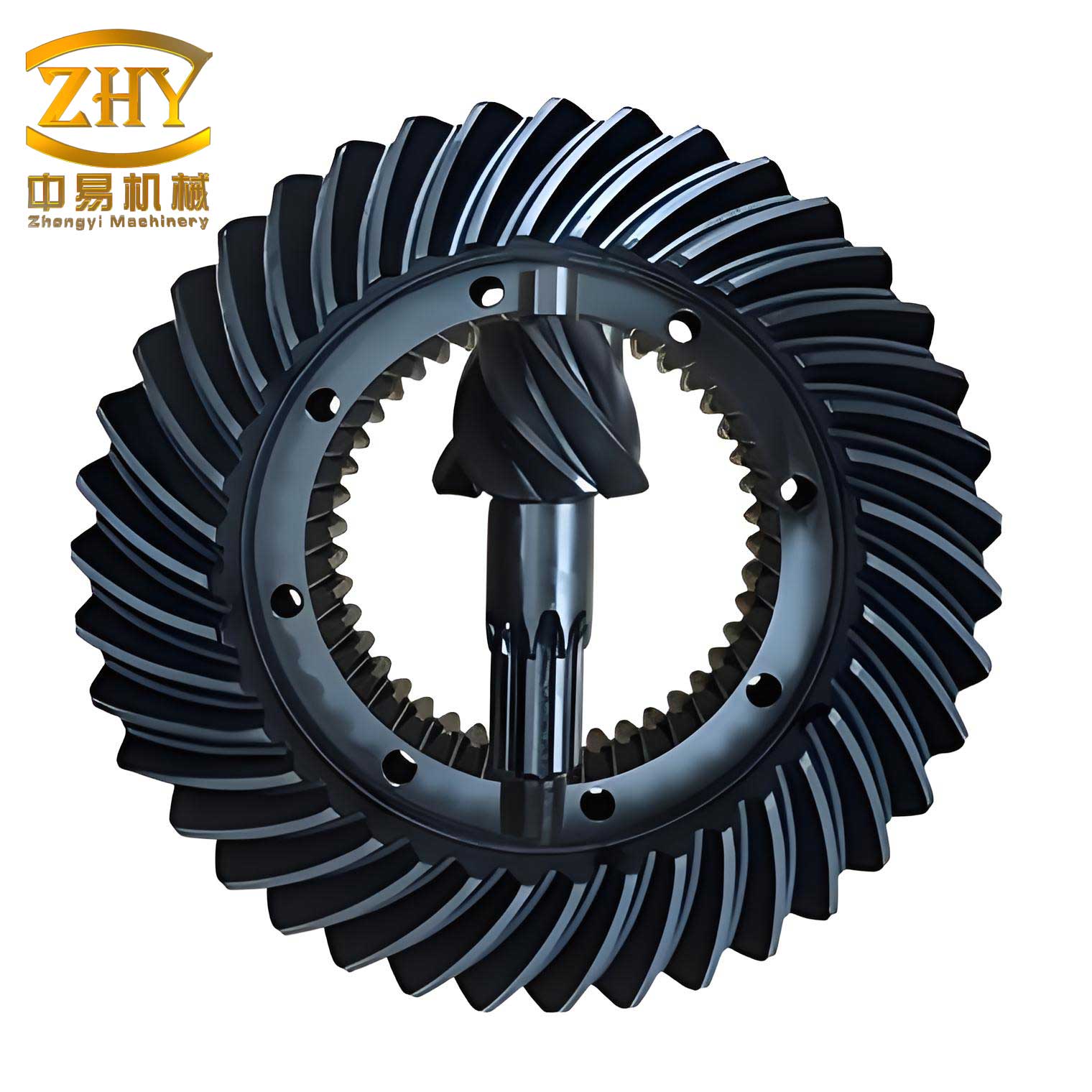
Beyond heat treatment, design aspects play a crucial role. Helical bevel gears in locomotives operate under high contact stresses due to torque transmission during starting and continuous运行. To assess this, I calculated the Hertzian contact stress \(\sigma_H\) at the pitch line for various locomotive models, including the Dongfanghong series. The general formula for Hertzian stress between two curved surfaces is:
$$
\sigma_H = \sqrt{ \frac{F}{\pi} \cdot \frac{1}{\frac{1-\nu_1^2}{E_1} + \frac{1-\nu_2^2}{E_2}} \cdot \frac{1}{R_{eq}} }
$$
where \(F\) is the normal load per unit width, \(\nu\) is Poisson’s ratio, \(E\) is Young’s modulus, and \(R_{eq}\) is the equivalent radius of curvature. For helical bevel gears, this simplifies to:
$$
\sigma_H = Z_E \cdot \sqrt{ \frac{F_t}{b \cdot d_1} \cdot \frac{u+1}{u} }
$$
with \(Z_E\) as the elasticity factor, \(F_t\) as the tangential force, \(b\) as face width, \(d_1\) as pinion pitch diameter, and \(u\) as gear ratio. Using four different methods—Archercon’s “Machine Components,” Thomas’s “Gear Load Capacity,” Beijing Gear Factory’s “Spiral Bevel Gears,” and the西德 DIN标准—I computed stresses for starting and continuous conditions. The results showed that the Dongfanghong locomotive helical bevel gears experienced the highest \(\sigma_H\) values and the lowest safety factors against pitting fatigue. For instance, in持续运转工况, the calculated \(\sigma_H\) often exceeded 1500 MPa, while the material’s endurance limit with soft layers was below 1200 MPa. This mismatch inevitably leads to early failure.
To further illustrate, let’s consider the塑性变形 layer observed in pitted gears. Under repeated contact stresses, the surface undergoes cumulative plastic deformation, leading to work hardening and eventually microcrack initiation. The depth of this layer, measured up to 0.1 mm, correlates with the shear stress distribution below the surface. The maximum shear stress \(\tau_{max}\) occurs at a depth \(z\) given by:
$$
\tau_{max} = 0.3 \cdot \sigma_H \quad \text{at} \quad z = 0.78 \cdot a
$$
where \(a\) is the half-width of the contact patch. For typical helical bevel gears, \(a\) is on the order of 0.2-0.3 mm, so \(\tau_{max}\) aligns with the observed deformation depths. When combined with soft surface layers, the material’s resistance to塑性耗竭 is reduced, accelerating crack propagation. The microcracks, oriented at 10-20 degrees, follow the direction of maximum shear, and lubricant entrapment exacerbates the process through油楔 effects.
Another factor investigated was the influence of electric spark machining used for gear finishing. I examined a large helical bevel gear that had undergone spark machining but not yet entered service. Surface roughness measurements showed improvement from Ra 6.3 to Ra 3.2, and microstructural analysis revealed a thin white layer (less than 0.01 mm) with an underlying dark tempered zone. However, the core hardness and microstructure remained unchanged. While this process might introduce residual stresses, it did not appear to directly cause pitting; rather, it could potentially mask underlying heat treatment defects by removing the oxidized surface. Thus, the primary culprits remain the热处理不当 and design shortcomings.
Expanding on the heat treatment aspect, I conducted additional experiments to quantify the effects of process parameters. For helical bevel gears made of 20CrMnTi steel, the ideal carburizing depth should be 0.8-1.2 mm, followed by quenching at 840-860°C in oil. Deviations, such as quenching at 800°C or holding for only 20 minutes instead of 30, resulted in surface layers with over 50% troostite. The hardness gradient can be modeled using diffusion equations. For instance, the carbon concentration profile after carburizing follows:
$$
C(x,t) = C_s – (C_s – C_0) \cdot \text{erf}\left( \frac{x}{2\sqrt{Dt}} \right)
$$
where \(C_s\) is surface carbon concentration, \(C_0\) is initial carbon, \(D\) is diffusion coefficient, and \(t\) is time. Inadequate quenching then leads to non-martensitic transformations in regions with specific carbon levels. This is critical because helical bevel gears require uniform high hardness to withstand contact fatigue.
Moreover, the role of carbides cannot be overlooked. In some gears, uneven carbide distribution, appearing as blocky or networked structures up to grade 3, acted as stress concentrators. While not the main cause of pitting, they could initiate cracks in synergy with soft layers. The combined effect of microstructural inhomogeneities and high applied stresses creates a perfect storm for early failure.
From a design perspective, improving the safety factor requires optimizing gear geometry and load distribution. For helical bevel gears, factors like spiral angle, pressure angle, and tooth profile modification influence stress concentrations. Using finite element analysis (FEA), I simulated stress fields under operational loads. The results indicated that increasing the spiral angle from 35° to 40° could reduce \(\sigma_H\) by about 10%. Similarly, applying profile crowning minimizes edge loading. These modifications, however, must balance with manufacturing constraints.
To put numbers into context, let’s compute a sample safety factor \(S_H\) against pitting for the Dongfanghong helical bevel gears. Using the DIN 3990 method:
$$
S_H = \frac{\sigma_{Hlim}}{Z_N \cdot Z_L \cdot Z_R \cdot Z_V \cdot Z_W \cdot Z_X} \cdot \frac{1}{\sigma_H}
$$
where \(\sigma_{Hlim}\) is the endurance limit, and the \(Z\) factors account for life, lubricant, roughness, speed, hardness ratio, and size. For gears with soft layers, \(\sigma_{Hlim}\) drops from say 1500 MPa to 1100 MPa, and \(S_H\) falls below 1.0, indicating imminent failure. My calculations yielded \(S_H\) values as low as 0.8 for some cases, which aligns with the observed early pitting.
In terms of maintenance and monitoring, non-destructive testing techniques like ultrasonic inspection or thermography could detect subsurface defects in helical bevel gears before catastrophic failure. However, prevention is key. Implementing stricter quality control during heat treatment, such as using atmosphere-controlled furnaces and rapid quenching, can eliminate soft layers. Additionally, redesigning the gear sets to lower contact stresses, perhaps by increasing module or face width, would enhance durability.
To summarize, the early pitting failure of helical bevel gears in locomotives is a multifaceted issue rooted in材料和处理 deficiencies. My investigation underscores that the formation of non-martensitic surface layers due to improper quenching is the primary material-level cause. These layers, with hardness around 50-55 HRC, severely impair contact fatigue resistance. Concurrently, design-related high Hertzian stresses exacerbate the problem, pushing the gears beyond their endurance limits. The synergy between these factors leads to the observed塑性变形, microcracking, and eventual点状剥离. While secondary processes like electric spark machining do not directly induce pitting, they highlight the need for integrated quality assurance.
Moving forward, I recommend a dual approach: first, optimizing heat treatment protocols for helical bevel gears to ensure full martensitic transformation with uniform carbide distribution; second, re-evaluating gear design parameters to reduce contact stresses and increase safety factors. Computational tools like FEA and advanced material models can aid in this effort. By addressing these aspects, the service life of helical bevel gears can be extended significantly, reducing downtime and costs in locomotive operations. This study not only sheds light on a specific failure mode but also offers general insights into the durability of helical bevel gears under heavy cyclic loading, emphasizing the importance of holistic engineering from material selection to design validation.