
In my extensive experience with heavy-duty machinery components, the gear shaft stands as a critical element, transmitting torque and motion under significant loads. The failure of such a component, particularly through longitudinal cracking, represents a serious reliability concern that demands thorough investigation. This article details my first-hand analysis of longitudinal cracking incidents in 18CrNiMo7-6 steel bevel gear shafts, a high-performance carburizing steel commonly specified for demanding applications. The primary objective was to identify the root cause of the cracking, which manifested after grinding operations, and to develop effective countermeasures. Through a methodical process involving material characterization, process review, and metallurgical examination, I was able to pinpoint the failure mechanism and implement successful corrective actions.
The gear shafts in question were manufactured for a heavy-duty reducer. The production sequence was as follows: cutting, forging, first normalizing, rough machining, second normalizing, finish machining, carburizing and quenching, turning of the carburized layer, and finally grinding. The cracking was observed longitudinally along the shaft after the grinding stage. The carburizing and quenching were performed in an HS-17 sealed multi-purpose furnace with a carbon potential control accuracy of ±0.05%. My investigation began with a hypothesis that either material defects or thermal processing irregularities were to blame.
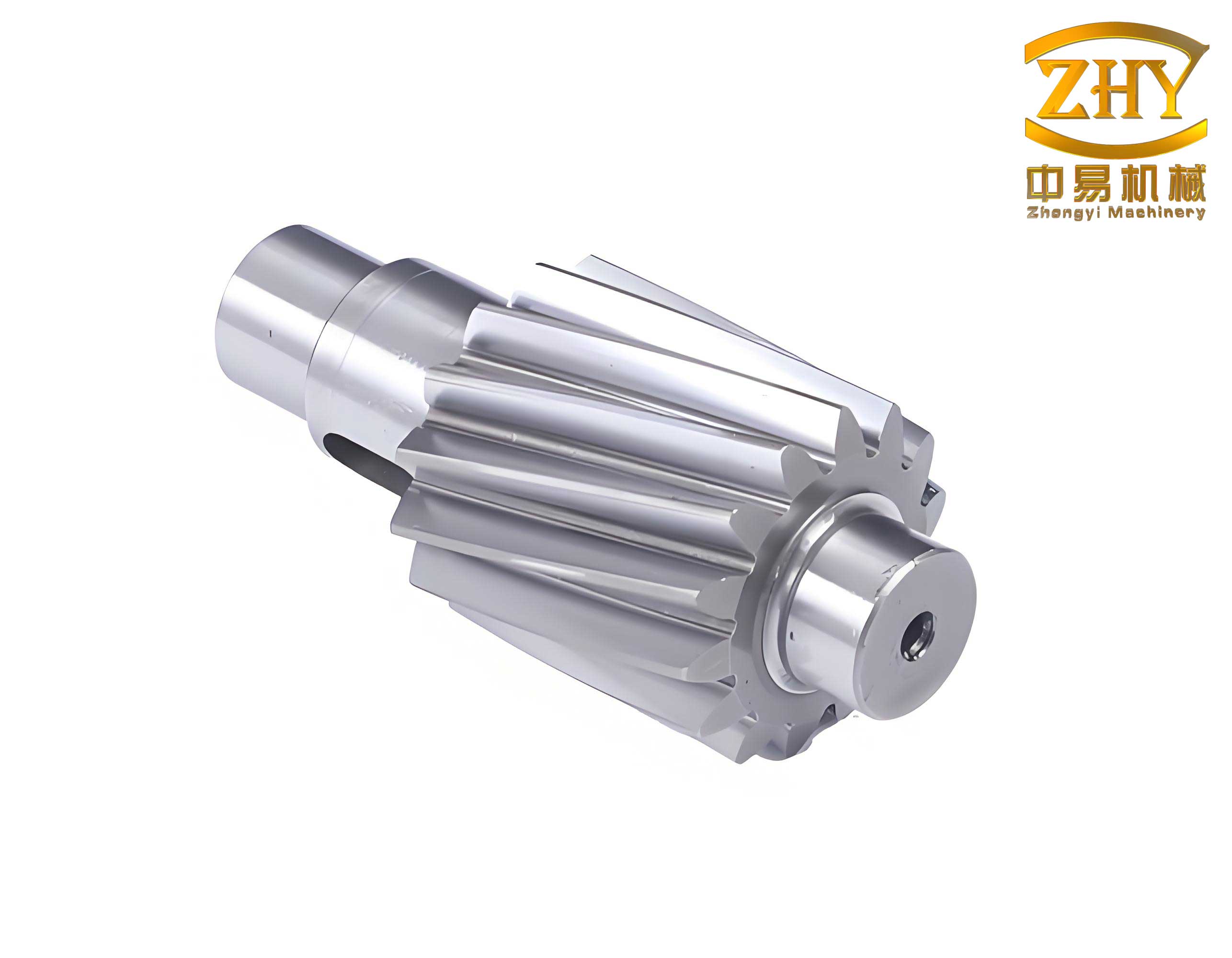
My initial step was to conduct a full material verification. A sample from a cracked gear shaft was subjected to chemical analysis using optical emission spectroscopy. The results, compared against the standard GB/T 3077-1999 for alloy structural steels, are summarized in Table 1. The composition was well within specification, ruling out gross compositional error as a direct cause. Furthermore, macroscopic examination and assessment of non-metallic inclusions according to GB/T 10561-1989 revealed no significant anomalies such as segregation, porosity, or excessive inclusion content. This preliminary finding shifted my focus towards the heat treatment processes.
| Element | C | Si | Mn | P | S | Cr | Mo | Ni | Cu | Al |
|---|---|---|---|---|---|---|---|---|---|---|
| Measured Value | 0.18 | 0.22 | 0.69 | 0.006 | 0.002 | 1.69 | 0.29 | 1.55 | 0.05 | 0.020 |
| GB/T 3077-1999 | 0.15-0.21 | ≤0.40 | 0.50-0.90 | ≤0.025 | ≤0.020 | 1.50-1.80 | 0.25-0.35 | 1.40-1.70 | ≤0.30 | ≤0.04 |
Next, I evaluated the results of the carburizing and quenching treatment. Surface hardness on the tooth section of the failed gear shaft measured between 58.4 and 58.9 HRC, meeting the technical requirement of 58-62 HRC. To understand the through-hardness profile, a transverse slice approximately 15 mm thick was sectioned from the cracked gear shaft. Hardness was measured at various depths from the surface along three lines (A, B, C), starting 5 mm from the surface and at 5 mm intervals inward. The hardness distribution data is presented in Table 2 and plotted conceptually. The data revealed a concerning pattern: both the surface and the core exhibited high hardness (up to 43.5 HRC), while the lowest hardness (approximately 37 HRC) was found near the mid-radius (R/2) position. This “U-shaped” hardness profile is atypical for a properly case-hardened component and suggested deeper microstructural issues.
| Distance from Surface (mm) | Hardness at Line A (HRC) | Hardness at Line B (HRC) | Hardness at Line C (HRC) | Approximate Radial Position |
|---|---|---|---|---|
| 5 | 41.2 | 40.8 | 41.5 | Near Case |
| 10 | 38.5 | 37.8 | 38.9 | Sub-Surface |
| 15 | 37.0 | 36.8 | 37.3 | ~R/2 |
| 20 | 38.0 | 37.5 | 38.4 | Between R/2 and Core |
| 25+ (Core) | 42.1 | 43.5 | 42.8 | Core |
The metallographic examination provided definitive evidence. Samples were taken from the surface (carburized case) and the core of the gear shaft tooth. The microstructure was evaluated per JB/T6141.3-1992. The surface layer showed a fine martensitic structure with retained austenite and a small amount of carbides, all rated at an acceptable level 1. The core microstructure, however, was comprised predominantly of lath martensite. This finding was critical. The presence of martensite throughout the entire cross-section, including the core, indicated that the gear shaft had been fully through-hardened during quenching. For a component of this diameter (approximately 140 mm), this is a direct consequence of the extremely high hardenability of 18CrNiMo7-6 steel combined with an aggressive quench.
To formalize the stress state analysis, I considered the fundamental principles of thermal and transformation stresses during quenching. The development of stress can be related to the temperature gradient (ΔT) and the volume change associated with the martensitic transformation. The thermal stress (σ_th) is proportional to the temperature difference and the material’s properties:
$$ \sigma_{th} \propto E \cdot \alpha \cdot \Delta T $$
where \( E \) is Young’s modulus, \( \alpha \) is the coefficient of thermal expansion, and \( ΔT \) is the temperature difference between surface and core. The transformation stress (σ_tr) arises from the volumetric expansion (ΔV/V) during martensite formation:
$$ \sigma_{tr} \propto E \cdot \frac{\Delta V}{V} $$
In a through-hardening scenario for a gear shaft, the sequence of events is as follows. The surface cools rapidly and transforms to martensite first, creating a hardened shell. As the core later cools and transforms, its expansion is constrained by the already rigid surface layer. This generates high compressive stresses in the core and high tensile stresses at the surface. Upon final cooling to room temperature, thermal contraction stresses superimpose, but for a high-hardenability steel in a fast quench, the transformation stresses dominate the final residual stress profile.
The specific quenching parameters for this gear shaft were: immersion in fast bright quenching oil with strong agitation for 15 minutes, followed by slow cooling for 20 minutes. The shaft’s non-carburized sections were coated with anti-carburizing paint prior to treatment. My analysis concluded that this cooling regimen was too severe for this specific steel and cross-section. The fast oil quench minimized the temperature gradient (ΔT), effectively allowing the entire gear shaft cross-section to cool through the martensite start (M_s) temperature nearly simultaneously. This resulted in the observed through-hardened microstructure.
The final residual stress state in this fully hardened gear shaft, prior to any post-quench machining, would consist of tensile stresses at both the surface and the core, balanced by compressive stresses in the mid-radius region. This correlates directly with the hardness profile: areas of high hardness (surface and core) correspond to regions under tensile stress, while the softer mid-radius zone is under compressive stress. The equilibrium of these internal stresses is delicate. The subsequent turning operation, which removed the surface layer (including the carburized case on other areas and the base material on the shaft), disrupted this equilibrium. Material with high strength and high tensile stress was removed, and the diameter was reduced. The internal stresses re-distributed, and the tensile stress at the new surface could easily exceed the material’s fracture strength, leading to a longitudinal crack—the path of least resistance for stress relief. This explains why the gear shaft cracking occurred after the turning/grinding operations and not immediately after quenching.
Based on this failure mechanism analysis, I proposed and implemented two primary corrective measures aimed at preventing through-hardening in future productions of this gear shaft.
1. Modification of Quenching Process Parameters: The goal was to create a steeper thermal gradient to ensure the surface transforms while the core does not, achieving a traditional case-hardened structure with a tough, lower-strength core. The revised protocol included:
- Pre-cooling: Introducing an air-cooling step for 1-3 minutes after exiting the carburizing furnace and before oil quenching. This allows the surface temperature to drop significantly, increasing ΔT.
- Quenchant and Agitation: Maintaining the use of quenching oil but eliminating the “strong cooling” initial agitation phase. A milder, more uniform agitation was specified.
- Extended Slow Cooling: Increasing the duration of the slow cooling stage within the oil to further control the cooling rate of the core.
The cooling rate (dT/dt) is the critical controlled variable. The aim was to reduce the cooling rate for the core below the critical cooling rate for martensite formation in this steel, which can be conceptually represented as ensuring:
$$ \left( \frac{dT}{dt} \right)_{core} < V_{critical} $$
where \( V_{critical} \) is the minimum cooling rate required to form 100% martensite.
2. Adjustment of Steel Chemistry: While 18CrNiMo7-6 has excellent hardenability, it can be excessive for components with moderate section sizes like this gear shaft. In collaboration with the material supplier, I recommended a slight modification to the alloy composition for future batches intended for similar geometries. The objective was to moderately reduce the hardenability by lowering the content of key hardenability-enhancing elements like Chromium (Cr) and Manganese (Mn), while keeping within a modified specification that still met core strength requirements. A comparative target is shown in Table 3.
| Element | Standard 18CrNiMo7-6 | Suggested Modified Grade for Gear Shafts | Purpose of Adjustment |
|---|---|---|---|
| C | 0.15-0.21 | 0.16-0.20 | Minor adjustment, maintain case properties. |
| Cr | 1.50-1.80 | 1.40-1.65 | Reduce hardenability contributor. |
| Mn | 0.50-0.90 | 0.50-0.75 | Reduce hardenability contributor. |
| Mo | 0.25-0.35 | 0.25-0.35 | Maintain for tempering resistance. |
| Ni | 1.40-1.70 | 1.40-1.70 | Maintain for toughness. |
The implementation of these changes proved highly effective. Subsequent production runs of the gear shaft utilizing the modified quenching practice (and eventually the adjusted steel chemistry for new orders) completely eliminated the occurrence of longitudinal cracking. Post-treatment hardness traverses on sample gear shafts now showed the desired profile: a high-hardness surface case (58-62 HRC) gradually decreasing to a much lower core hardness (25-35 HRC), confirming the absence of through-hardening. Microstructural examination of these successful components revealed a martensitic case transitioning to a microstructure of bainite and/or fine ferrite-pearlite in the core, which possesses higher ductility and better stress accommodation capabilities.
In conclusion, my detailed investigation into the longitudinal cracking of 18CrNiMo7-6 steel gear shafts demonstrated that the primary cause was not a material defect but a process-induced condition of full through-hardening due to an unsuitable quenching severity for the component’s geometry. The exceptionally high hardenability of the steel, when combined with a fast oil quench, led to martensite formation throughout the gear shaft cross-section. This created a unfavorable internal stress state characterized by high surface and core tensile stresses. Machining operations then acted as a trigger, causing stress re-distribution and catastrophic brittle fracture along the longitudinal axis. The solution involved a dual approach: first, revising the thermal processing to control cooling rates and prevent core martensite formation, and second, considering a tailored material specification with slightly reduced hardenability for such applications. This case underscores a vital principle in heat treatment of high-performance gear shafts: the necessity of a holistic view that carefully balances material selection, component design, and precise control of both heating and cooling parameters to achieve optimal performance and reliability.