
As a researcher focused on advanced mechanical transmission systems, my work often delves into the intricate behavior of harmonic drive gears. These remarkable systems, founded on the principles of elastic thin-shell deformation, offer unparalleled advantages in precision, compactness, and high torque capacity. In this article, I present a detailed study on a critical aspect of their design, particularly for modern compact variants: the initial pre-deformation force within the flexspline.
The unique operation of a harmonic drive gear relies on the controlled elastic deflection of a thin-walled, cup-shaped component known as the flexspline. This component, typically with slightly fewer teeth than the rigid circular spline, is deformed by an elliptical wave generator inserted into its bore. This forced deformation creates the conjugate meshing action essential for the drive’s high reduction ratio. However, this very process imposes a state of stress on the flexspline even before any external load is applied—a state defined by the pre-deformation force. My investigation centers on understanding this force, especially as we push the boundaries of design towards shorter, stiffer flexsplines for enhanced performance in robotics and aerospace applications.
Working Principle and the Genesis of Pre-deformation Force
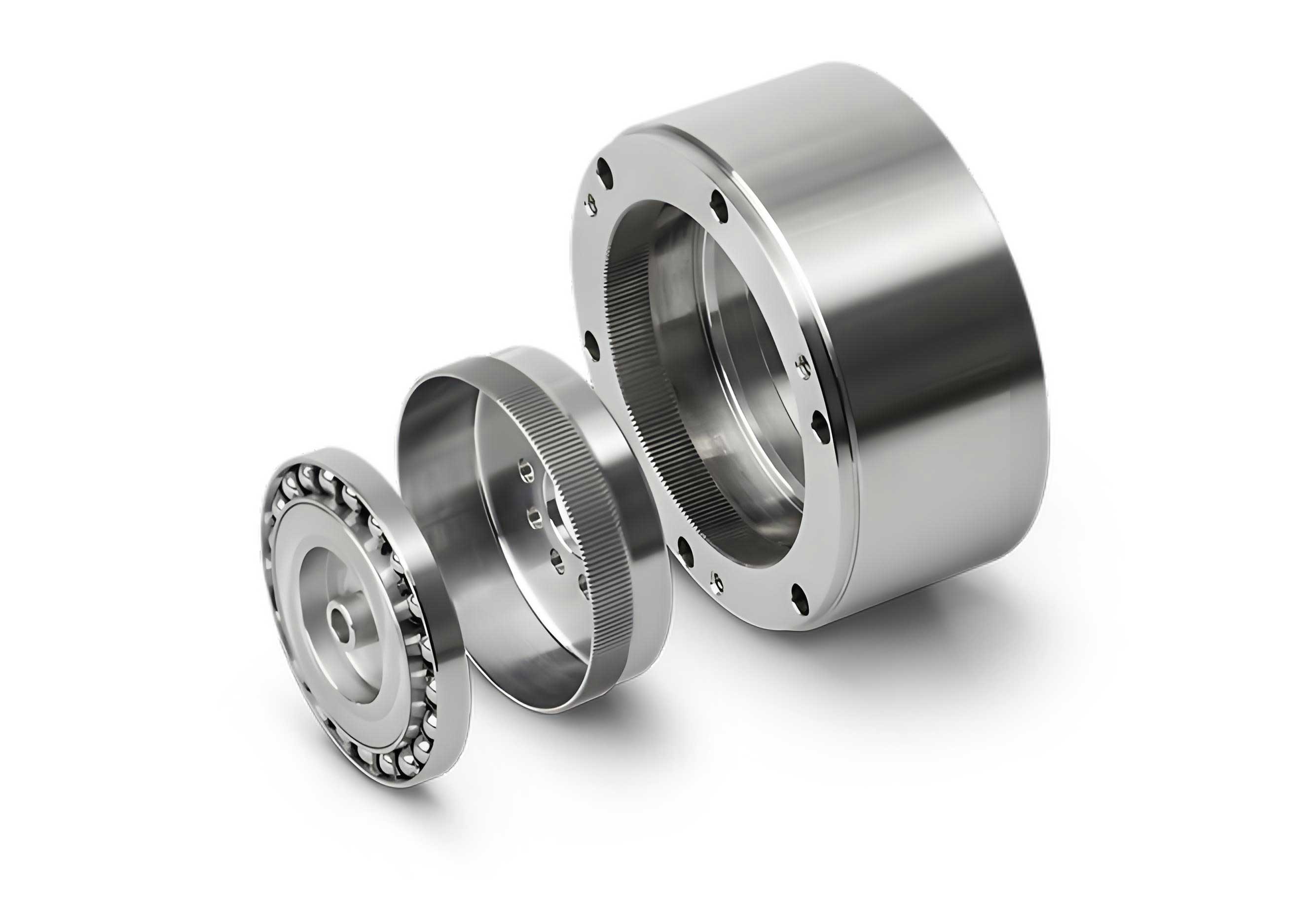
The core assembly of a harmonic drive gear consists of three primary elements: the rigid circular spline, the flexible spline (flexspline), and the wave generator. In its free state, the flexspline is perfectly circular. The act of assembling the wave generator—whose major axis diameter is slightly larger than the nominal inner diameter of the flexspline—forces the flexible component into an elliptical shape. This is the origin of the pre-deformation force. The teeth located at the major axis of the ellipse engage fully with the circular spline, while those at the minor axis are completely disengaged. The regions in between are in varying states of mesh engagement or disengagement.
This continuous, cyclic deformation subjects the flexspline to a complex, asymmetric stress state, making it the life-limiting component of the entire harmonic drive gear assembly. Consequently, optimizing its stress profile is paramount for ensuring reliability and longevity. The trend towards “short-cup” flexsplines, characterized by a reduced length-to-diameter ratio ($L_x = L / d_z$), aims to increase torsional stiffness, reduce size and weight, and potentially increase the number of simultaneously engaged teeth. However, this geometric shift exacerbates the stress condition. In a standard harmonic drive gear with $L_x$ between 0.8 and 1.3, the dominant stress component is circumferential bending, allowing for simplified ring-based analysis. For a short-cup design where $L_x$ approaches or falls below 0.5, axial bending stresses become significant and cannot be neglected, leading to a sharp and concerning increase in the pre-deformation force and associated stresses. Understanding and managing this force is therefore critical for the successful deployment of compact harmonic drive gear systems.
Methodology: Finite Element Analysis of the Flexspline
To accurately analyze the pre-deformation state, I employed the Finite Element Method (FEM), a powerful computational tool for solving complex structural mechanics problems. Direct analytical modeling of the toothed cylindrical shell is exceedingly complex. Therefore, a common and effective practice is to simplify the flexspline into an equivalent smooth cylindrical shell for stress analysis, as the small module and high tooth count allow this approximation without significant loss of generality for global deformation behavior.
For this study, I considered a harmonic drive gear with a 2-wave (elliptical) cam wave generator. The analysis was based on the following standard assumptions from thin-shell theory: (1) the wave generator is treated as an ideal rigid body; (2) the length of the neutral axis of the cylindrical shell remains constant during deformation; and (3) the elastic deformations of the flexspline are considered small.
Geometric Model and Parameterization
Leveraging the double symmetry of the deformed shape, I constructed a quarter-model of the flexspline to reduce computational expense. The critical geometric parameters of the cup-shaped flexspline are defined in the table below. A baseline set of values was established for a representative harmonic drive gear.
| Symbol | Description | Baseline Value (mm) | Derivation / Note |
|---|---|---|---|
| $m$ | Module | 0.4 | – |
| $z$ | Number of Teeth | 200 | – |
| $d_z$ | Flexspline Pitch Diameter | $m \cdot z = 80.0$ | $d_z = m z$ |
| $X_r$ | Addendum Modification Coefficient | 3.85 | – |
| $d_f$ | Dedendum Diameter | 77.08 | $d_f = d_z – 2m(1.35 – X_r)$ |
| $H_0$ | Wall Thickness under Tooth Root | 0.8 | Defined as $0.6 + T/2$ |
| $R_0$ | Inner Radius of Cup Body | 37.74 | $R_0 = d_f/2 – H_0$ |
| $T$ | Cup Body Wall Thickness | 0.4 | Primary Variable |
| $L$ | Cup Body Length | 64.0 | $L = L_x \cdot d_z$ |
| $L_x$ | Length-to-Diameter Ratio | 0.8 | Primary Variable $L_x = L / d_z$ |
| $w_0$ | Wave Generator Radial Deformation | 0.4 | – |
| $R_1, R_2, R_3$ | Fillet Radii (Bottom, Flange, Tooth transition) | 3.0 | Secondary Variables |
The equivalent smooth radius for the toothed section ($R_{aa}$) was calculated to account for the added stiffness of the tooth ring. The material was modeled as linear-elastic steel with Young’s modulus $E = 2.1 \times 10^5$ N/mm² and Poisson’s ratio $\nu = 0.3$. The FEM model was built and meshed using high-order 3D solid elements (SOLID186, SOLID187 in ANSYS) to capture the complex stress gradients accurately. Boundary conditions simulating the symmetry planes and the enforced elliptical displacement from the rigid wave generator were applied.
Results and Discussion: Influence of Geometric Parameters
My systematic analysis involved varying key geometric parameters one at a time while holding others at their baseline values. The primary output of interest was the total reaction force generated at the interface with the wave generator, which equates to the global pre-deformation force ($F_r$) required to hold the flexspline in its elliptical shape. The trends revealed clear hierarchies in parameter influence.
Primary Influencing Factors
The two most significant factors affecting the pre-deformation force in a harmonic drive gear are the cup body wall thickness ($T$) and the length-to-diameter ratio ($L_x$).
1. Wall Thickness ($T$): As intuitively expected, increasing the wall thickness drastically increases the flexspline’s circumferential bending stiffness. The relationship is strongly non-linear and exponential in nature. A thicker wall resists the imposed elliptical deformation more forcefully, leading to a rapid rise in $F_r$.
2. Length-to-Diameter Ratio ($L_x$): This parameter reveals a critical design insight. For $L_x > 1.0$, the pre-deformation force plateaus at a relatively stable value. As the flexspline is shortened ($L_x$ decreases below 0.8), $F_r$ begins to increase. This increase becomes dramatically steep when $L_x$ falls below approximately 0.5. This non-linear escalation is attributed to the loss of the “long-beam” bending behavior and the onset of significant shell-like deformation where axial membrane and bending stresses compound the circumferential stresses, greatly increasing the overall structural stiffness against the wave generator’s displacement.
| Geometric Parameter | Trend of Influence on $F_r$ | Magnitude of Influence | Physical Reason |
|---|---|---|---|
| Wall Thickness ($T$) | Sharp, non-linear increase with $T$ | Very High | Increased circumferential bending stiffness. |
| Length-Diameter Ratio ($L_x$) | Sharp increase for $L_x < 0.5$; gradual decrease to a plateau for $L_x > 1.0$. | Very High | Transition from ring/beam bending to complex shell deformation. |
| Fillet Radii ($R_1$, $R_2$, $R_3$) | Minor, non-monotonic fluctuations. | Low | Local stress relief has negligible impact on global structural stiffness. |
Secondary Influencing Factors
The radii of the transitional fillets ($R_1$, $R_2$, $R_3$) showed minimal influence on the global pre-deformation force. While these fillets are crucial for reducing local stress concentrations and improving fatigue life—a vital concern for any harmonic drive gear—they do not significantly alter the overall stiffness of the cup body against the imposed elliptical deformation. Their effect on $F_r$ was negligible and within the expected numerical variance of the finite element analysis.
Regression Analysis for Predictive Modeling
To move from qualitative trends to quantitative design guidance, I performed regression analysis on the data for the two primary factors. The goal was to derive mathematical expressions that could predict the pre-deformation force based on wall thickness and length-to-diameter ratio for this class of harmonic drive gear.
Wall Thickness ($T$) Relationship
The relationship between $T$ and $F_r$ was best captured by an exponential model, indicating a rapid stiffening effect. The fitted function was:
$$ F_r(T) = \alpha \cdot e^{\beta T} $$
where for the studied configuration, the regression yielded $\alpha = 34.10$ N and $\beta = 1.93$ mm⁻¹. The fit was excellent, confirming the strong exponential dependence. The root mean square error (RMSE) of this regression was minimal, validating the model.
Length-to-Diameter Ratio ($L_x$) Relationship
The relationship for $L_x$ was more complex. Both a reciprocal (hyperbolic) model and a higher-order polynomial provided good fits, each with different utility.
Hyperbolic Model: This model offers a simpler, two-parameter form suitable for $L_x$ values not extremely close to zero.
$$ \frac{1}{F_r(L_x)} = a + \frac{b}{L_x} $$
The regression provided $a = 0.0180$ N⁻¹ and $b = -0.0040$ (dimensionless), with a satisfactory RMSE.
Polynomial Model: A fourth-order polynomial provided a superior fit across the entire studied range, capable of capturing the plateau and the steep rise at low $L_x$.
$$ F_r(L_x) = p_1 L_x^4 + p_2 L_x^3 + p_3 L_x^2 + p_4 L_x + p_5 $$
The coefficients obtained were:
$$ p_1 = 1914.8, \quad p_2 = -6070.4, \quad p_3 = 7215.6, \quad p_4 = -3847.0, \quad p_5 = 858.5 $$
(all units consistent to yield $F_r$ in Newtons). This polynomial model had the lowest RMSE, making it the most accurate descriptive equation for the calculated data.
These regression equations serve as valuable tools for initial sizing and sensitivity analysis in the design of a compact harmonic drive gear, allowing engineers to estimate the pre-load conditions and associated stresses early in the design process.
Conclusion
Through a detailed finite element investigation, this study has elucidated the critical factors governing the pre-deformation force in the flexspline of a harmonic drive gear, with a specific focus on short-cup designs. The analysis conclusively identifies the cup body wall thickness ($T$) and the length-to-diameter ratio ($L_x$) as the dominant geometric parameters influencing this force. The increase in force with wall thickness follows an exponential trend, while the relationship with length-to-diameter ratio is highly non-linear, characterized by a severe escalation in force for ratios below 0.5. Transition fillets, while important for durability, have a negligible effect on the global pre-deformation force.
The derived regression models—exponential for wall thickness and hyperbolic/polynomial for length-to-diameter ratio—provide a mathematical foundation for predicting this critical force. These findings are instrumental for the optimization-driven design of modern harmonic drive gear systems, enabling engineers to balance the competing demands for compactness (low $L_x$), stiffness, and low internal pre-stress to enhance the performance and longevity of the transmission. This work underscores the intricate mechanics of the harmonic drive gear’s core component and provides a pathway toward more reliable and efficient compact designs.