
As a critical transmission component in mechanical systems, the reliability and performance of cylindrical gears are profoundly impacted by contact fatigue failure, a process inherently governed by the initiation and propagation of subsurface cracks. The entire lifecycle of contact fatigue damage, from initial pitting to severe spalling or even tooth fracture, follows the fundamental laws of crack nucleation, growth, and ultimate failure. Understanding this mechanism is therefore paramount for enhancing gear durability and operational safety. This study focuses on a novel cylindrical gear with Variable Hyperbolic Circular-Arc-Tooth-Trace (VH-CATT), characterized by point contact and an arcuate tooth trace. Compared to conventional involute spur or helical gears, the VH-CATT cylindrical gear offers superior meshing performance, higher load capacity, and greater transmission efficiency without inducing additional axial forces.
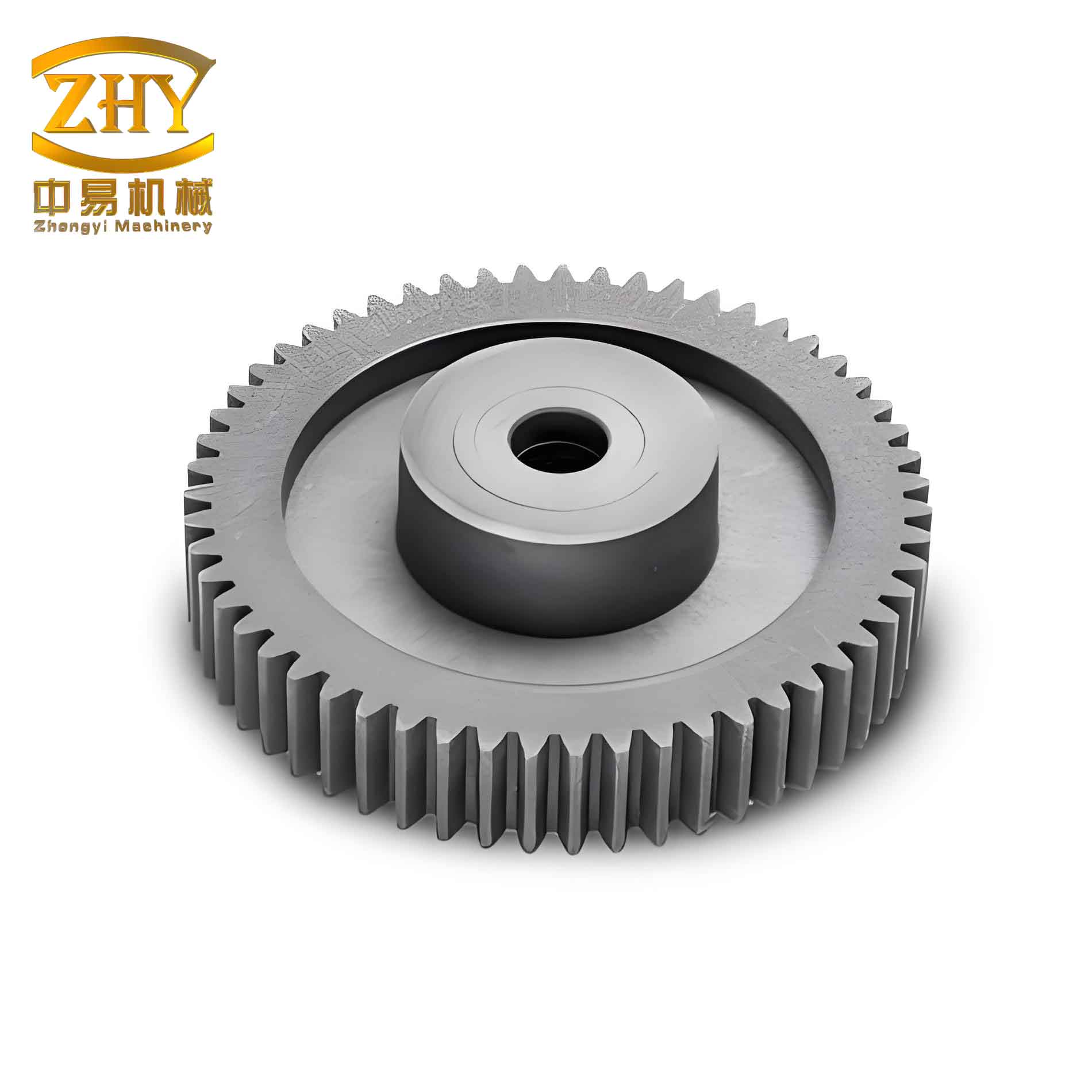
Despite extensive research on its curvature characteristics, contact behavior, and manufacturing methods, the mechanism governing contact fatigue crack propagation in this innovative cylindrical gear remains largely unexplored. This gap motivates our investigation. We aim to elucidate the crack propagation behavior under contact fatigue, which is essential for guiding the design optimization of the VH-CATT cylindrical gear to retard crack growth and prevent premature failure. Our methodology integrates theoretical modeling, finite element analysis, and advanced fracture mechanics. We first establish a numerical model to determine the contact ellipse and identify high-risk zones for crack initiation on the tooth flank of the cylindrical gear. Subsequently, we employ the eXtended Finite Element Method (XFEM) to simulate the three-dimensional propagation path of pre-existing cracks. Finally, we develop a Stress Intensity Factor (SIF) analysis model to quantitatively assess the influence of key design parameters—such as module, tooth trace radius, and initial crack angle—on the crack driving force, specifically the Mode-I SIF.
Mathematical Foundation and Contact Analysis of the VH-CATT Cylindrical Gear
The VH-CATT cylindrical gear is generated via a machining process analogous to that of hypoid gears, utilizing a rotating cutter head with dual blades. The mathematical model of its tooth surface is derived through coordinate transformation between the tool and workpiece systems. In the workpiece coordinate system \( O_dx_dy_dz_d \), the position vector \( \mathbf{r}_i^{(d)} \) and unit normal vector \( \mathbf{n}_i^{(d)} \) for the tooth surface are expressed as:
$$
\begin{aligned}
\mathbf{r}_i^{(d)}(u_i, \theta_i, \phi_i) &= \mathbf{M}_{di}(\phi_i) \mathbf{M}_{i1}(\theta_i) \mathbf{r}_i^{(c)}(u_i) \\
\mathbf{n}_i^{(d)}(u_i, \theta_i, \phi_i) &= \mathbf{L}_{di}(\phi_i) \mathbf{L}_{i1}(\theta_i) \mathbf{n}_i^{(c)}(u_i)
\end{aligned}
$$
where \( u_i \) and \( \theta_i \) are the blade geometry and rotation parameters, \( \phi_i \) is the work rotation angle, and \( \mathbf{M} \) and \( \mathbf{L} \) are coordinate transformation matrices. The explicit tooth surface equations in Cartesian coordinates for the working flank and the fillet transition are given by:
Working Flank:
$$
\begin{aligned}
x_{di} &= A \cos\theta_i – R_T \cos\phi_i + (R_i \pm u_i \sin\alpha)\cos\phi_i – R_i \\
y_{di} &= -A \sin\theta_i – R_T \sin\phi_i – (R_i \pm u_i \sin\alpha)\sin\phi_i \\
z_{di} &= A \\
A &= u_i \cos\alpha \pm R_T \sin\alpha \\
\theta_i &= \arcsin\left(\frac{R_T \phi_i – R_i \tan\alpha \pm \left(m\frac{\pi}{4}\right)}{u_i \pm R_T}\right)
\end{aligned}
$$
Fillet Transition:
$$
\begin{aligned}
x_{dri} &= B \cos\theta_i – (r^* \cos\alpha \cos\beta + R_T)\cos\phi_i + [R_i + (h_a^* m – r^*) \sin\beta]\sin\alpha \sin\phi_i \\
y_{dri} &= -B \sin\theta_i – (r^* \cos\alpha \cos\beta + R_T)\sin\phi_i – [R_i + (h_a^* m – r^*) \sin\beta]\sin\alpha \cos\phi_i \\
z_{dri} &= B \\
B &= r^* \cos\alpha \sin\beta – (h_a^* m – r^*) \cos\beta \\
\theta_i &= \arctan\left(\frac{\cos\alpha \sin\theta_i}{\cos\theta_i}\right) \mp \alpha \\
\phi_i &= \frac{R_T \theta_i – R_i \tan\alpha \pm (R_T \phi_i – r^* \cos\alpha)}{R_i}
\end{aligned}
$$
The point-contact nature of the VH-CATT cylindrical gear pair results in an elliptical contact area. The principal relative curvatures at the contact point, along the tooth trace (\(K_x\)) and the profile direction (\(K_y\)), are calculated from the principal curvatures of the pinion (\(K_x^p, K_y^p\)) and gear (\(K_x^g, K_y^g\)):
$$
\begin{aligned}
A &= \frac{1}{2}\left(\frac{1}{R_x^p} + \frac{1}{R_x^g} + \frac{1}{R_y^p} + \frac{1}{R_y^g}\right) \\
B &= \frac{1}{2}\left[\left(\frac{1}{R_x^p} – \frac{1}{R_y^p}\right)^2 + \left(\frac{1}{R_x^g} – \frac{1}{R_y^g}\right)^2 + 2\left(\frac{1}{R_x^p} – \frac{1}{R_y^p}\right)\left(\frac{1}{R_x^g} – \frac{1}{R_y^g}\right)\cos 2\psi\right]^{1/2}
\end{aligned}
$$
where \( R_x = 1/K_x \) and \( R_y = 1/K_y \). The semi-major axis \(a\) and semi-minor axis \(b\) of the contact ellipse under a normal load \(\omega\) are then given by the Hertzian theory:
$$
a = \kappa_a \sqrt[3]{\frac{3\omega}{2E^*(A+B)}}, \quad b = \kappa_b \sqrt[3]{\frac{3\omega}{2E^*(A+B)}}
$$
where \(E^*\) is the equivalent elastic modulus, and \(\kappa_a\), \(\kappa_b\) are coefficients related to the ellipticity \(e=\sqrt{1-(b/a)^2}\). A numerical model based on these equations was established. The design parameters for the analyzed cylindrical gear pair are listed in Table 1.
| Design Parameter | Pinion | Gear |
|---|---|---|
| Number of Teeth, \(Z\) | 21 | 29 |
| Module, \(m\) (mm) | 4 | 4 |
| Tooth Trace Radius, \(R_T\) (mm) | 200 | 200 |
| Face Width, \(B\) (mm) | 40 | 40 |
| Pressure Angle, \(\alpha\) (°) | 20 | 20 |
| Elastic Modulus, \(E\) (GPa) | 210 | 210 |
| Poisson’s Ratio, \(\mu\) | 0.3 | 0.3 |
Finite Element Analysis (FEA) of a five-tooth segment model was performed to obtain the time-varying contact stress and trajectory. By converting the maximum contact pressure \(P_H\) from FEA into an equivalent load \(\omega = (2\pi/3) P_H a b\) and feeding it into the numerical contact model, the theoretical contact ellipse trajectory was derived. Comparison showed that the contact ellipse from the numerical model, although slightly smaller in area, followed the same trend as the FEA results, validating the model’s accuracy. Analysis confirmed that the single-tooth engagement region, particularly the initial entry point, experiences the highest load intensity due to the smallest contact ellipse area, making it the most critical location for contact fatigue crack initiation in this cylindrical gear.
Modeling Crack Propagation Using the XFEM Approach
To investigate the crack growth behavior, a semi-elliptical surface crack with a depth of 0.2 mm was pre-inserted normal to the tooth surface at the identified critical location on the pinion’s convex flank. The eXtended Finite Element Method (XFEM) was employed, as it allows for modeling discontinuous crack growth without remeshing. In XFEM, the displacement approximation \(\mathbf{u}^h(\mathbf{X})\) for a cracked body incorporates enrichment functions to account for the discontinuity across the crack face and the singularity at the crack tip:
$$
\begin{aligned}
\mathbf{u}^h(\mathbf{X}) = &\sum_{i \in N} N_i(\mathbf{X}) \mathbf{u}_i + \sum_{j \in S} N_j(\mathbf{X}) H(\mathbf{X}) \mathbf{a}_j \\
&+ \sum_{k \in T} N_k(\mathbf{X}) \left( \sum_{l=1}^{4} \Phi_l(\mathbf{X}) \mathbf{b}_k^l \right)
\end{aligned}
$$
where \(N_i(\mathbf{X})\) are standard nodal shape functions, \(\mathbf{u}_i\) are standard nodal degrees of freedom (DOFs). \(H(\mathbf{X})\) is the Heaviside enrichment function defining the jump across the crack face, with \(\mathbf{a}_j\) as the corresponding enriched DOFs. \(\Phi_l(\mathbf{X})\) are the crack-tip enrichment functions describing the asymptotic crack-tip fields in linear elastic fracture mechanics, with \(\mathbf{b}_k^l\) as the associated enriched DOFs. The crack geometry is tracked using level set functions. A cyclic torque of 140 N·m was applied to the pinion to simulate the periodic loading during meshing, and crack propagation was governed by the maximum principal stress criterion with a damage threshold of 100 MPa.
The simulated crack propagation path for the VH-CATT cylindrical gear exhibited a distinct symmetric, arc-shaped trajectory opposing the direction of the tooth trace. The crack initially extended slowly towards the tooth core, then primarily propagated along the face width direction. Upon reaching the gear flank edge, it subsequently grew again towards the tooth core until final fracture. The angle between the crack path and the tooth surface tangent was approximately 50°. The propagation life was found to be predominantly determined by the crack growth stage along the face width direction.
Parametric Study on Crack Propagation Rates
The influence of key geometric and operational parameters on the crack propagation rate was systematically investigated using the XFEM model. The propagation length along the face width (\(L_w\)) and towards the tooth core (\(L_c\)) were recorded against load cycles.
Effect of Tooth Trace Radius \(R_T\): Three values of tooth trace radius for the cylindrical gear were analyzed: 100 mm, 200 mm, and 300 mm. The results, summarized in Table 2, indicate that a larger \(R_T\) reduces the propagation rate along the face width but increases the rate towards the tooth core. A smaller \(R_T\) (higher tooth trace curvature) promotes crack growth primarily along the width.
| Tooth Trace Radius, \(R_T\) (mm) | Trend in Face Width Rate, \(dL_w/dN\) | Trend in Tooth Core Rate, \(dL_c/dN\) |
|---|---|---|
| 100 | Highest | Lowest |
| 200 | Medium | Medium |
| 300 | Lowest | Highest |
Effect of Module \(m\): The study considered modules of 1.5 mm, 2 mm, 3 mm, 4 mm, and 5 mm. As shown in Table 3, both propagation rates \(dL_w/dN\) and \(dL_c/dN\) increase with the module. Furthermore, the stable crack length achieved in the tooth core direction before the width-dominated growth phase also increases with module size.
| Module, \(m\) (mm) | Trend in \(dL_w/dN\) | Trend in \(dL_c/dN\) | Stable Core Length |
|---|---|---|---|
| 1.5 – 3 | Similar (Low) | Similar (Low) | Short |
| 4 | Medium | Medium | Medium |
| 5 | High | High | Long |
Effect of Applied Torque \(T\): Analyses under torques of 140 N·m, 250 N·m, and 360 N·m revealed that higher torque levels increase both propagation rates and the stable crack length in the core direction. Additionally, crack initiation (the onset of measurable growth) occurs earlier under higher loads, as fewer load cycles are required.
Analysis of Stress Intensity Factors and Driving Forces
To quantitatively analyze the crack driving force, a combined ABAQUS/FRANC3D model was developed to compute the stress intensity factors (SIFs) along the front of a semi-elliptical crack. The interaction integral (M-integral) method was used to extract the mixed-mode SIFs (\(K_I\), \(K_{II}\), \(K_{III}\)). The M-integral for a 3D crack front segment is defined as:
$$
M^{(1,2)} = \int_V \left[ \sigma_{ij}^{(1)} \frac{\partial u_i^{(2)}}{\partial x_j} + \sigma_{ij}^{(2)} \frac{\partial u_i^{(1)}}{\partial x_j} – W^{(1,2)} \delta_{1j} \right] \frac{\partial q}{\partial x_j} \, dV
$$
where superscripts (1) and (2) denote the actual and auxiliary fields, \(W^{(1,2)}\) is the interaction strain energy density, and \(q\) is a weight function. The SIFs are then related to the M-integral by:
$$
\begin{pmatrix}
K_I^{(a)} \\ K_{II}^{(a)} \\ K_{III}^{(a)}
\end{pmatrix}
=
\frac{E}{2(1-\nu^2)}
\begin{pmatrix}
M^{(1,2_I)} \\ M^{(1,2_{II})} \\ M^{(1,2_{III})}
\end{pmatrix}
$$
The evolution of SIFs at the crack front’s apex (core direction) and shoulder (width direction) was analyzed for a crack growing from its initial size (0.2 mm deep) through the long-crack stage. The key finding is that during the propagation stage (crack depth > 0.3 mm), the Mode-I SIF (\(K_I\)) becomes the dominant component, continuously increasing in both directions. The Mode-II and Mode-III SIFs remain relatively small and stable. This confirms that the crack propagation in this cylindrical gear under contact fatigue is primarily driven by tensile-opening mode (Mode-I) loading.
Parametric Effects on Mode-I SIF: The influence of module \(m\), tooth trace radius \(R_T\), and initial crack angle \(\beta\) (measured from the tooth surface) on the Mode-I SIF was analyzed for specific crack geometries representing different growth stages, as defined in Table 4.
| Stage | Semi-Major Axis, \(a\) (mm) | Semi-Minor Axis, \(b\) (mm) | Description |
|---|---|---|---|
| Initial | 0.2 | 0.2 | Initiation |
| Short Crack | 0.5 | 0.9 | Early Propagation |
| Long Crack Start | 1.2 | 2.1 | Transition to Width Growth |
| Long Crack | 5.0 | 2.7 | Established Propagation |
The results are summarized below:
1. Effect of Module \(m\): For the long crack stage (\(a=5.0\) mm, \(b=2.7\) mm), a larger module results in higher \(K_I\) values at both the crack apex and shoulder. While SIFs are similar for small cracks across different modules, they diverge significantly as the crack grows longer.
2. Effect of Tooth Trace Radius \(R_T\): During the transition from short to long crack growth, a smaller \(R_T\) leads to higher \(K_I\). However, in the established long crack stage, the SIF for \(R_T = 300\) mm becomes significantly lower than for \(R_T = 100\) mm or 200 mm, indicating that a larger tooth trace radius can effectively reduce the crack driving force in the long crack propagation phase of this cylindrical gear.
3. Effect of Initial Crack Angle \(\beta\): Comparing cracks with \(\beta = 90^\circ\) (vertical) and \(\beta = 135^\circ\), the vertical crack has a higher initial \(K_I\). However, during the long crack stage, the \(135^\circ\)-angled crack develops a higher \(K_I\) in both the width and core directions, suggesting a potentially faster propagation rate once the crack is well-established.
Conclusions
This study provides a comprehensive investigation into the contact fatigue crack propagation characteristics of the novel VH-CATT cylindrical gear. By integrating contact mechanics, advanced fracture simulation via XFEM, and stress intensity factor analysis, we have derived the following key conclusions:
- Critical Crack Initiation Site: The initial point of single-tooth engagement on the cylindrical gear’s flank is identified as the most critical location for contact fatigue crack initiation, due to the highest load intensity resulting from the smallest contact ellipse area at that meshing position.
- Crack Propagation Path and Life: The contact fatigue crack in the VH-CATT cylindrical gear propagates along a symmetric, arc-shaped path opposing the tooth trace direction. The fatigue life is predominantly governed by the crack growth phase along the face width direction after an initial stable growth phase towards the tooth core.
- Influence of Geometric Parameters:
- Module (\(m\)): Larger modules increase the crack propagation rates in both the face width and tooth core directions. In the long crack stage, they also result in higher Mode-I stress intensity factors, indicating a greater crack driving force.
- Tooth Trace Radius (\(R_T\)): A larger \(R_T\) (lower curvature) decreases the face width propagation rate but increases the core direction rate. Crucially, a sufficiently large \(R_T\) (e.g., 300 mm) can significantly reduce the Mode-I SIF in the long crack stage, offering a potential design strategy to retard crack growth in this cylindrical gear.
- Dominant Fracture Mode: The propagation of contact fatigue cracks in this cylindrical gear is primarily driven by Mode-I (tensile-opening) loading, as evidenced by the dominance and continuous increase of the \(K_I\) factor during the crack growth stage.
- Effect of Initial Flaw Orientation: While a vertically oriented initial crack (\(\beta = 90^\circ\)) presents a higher initial driving force, an angled crack (\(\beta = 135^\circ\)) can develop a higher \(K_I\) during long crack propagation, influencing the eventual growth rate.
These findings elucidate the failure mechanism and provide quantitative insights into the influence of key design parameters on the contact fatigue crack propagation behavior of the VH-CATT cylindrical gear. This knowledge is essential for optimizing the geometry of this advanced cylindrical gear to enhance its resistance to contact fatigue and improve its service life in demanding power transmission applications.