
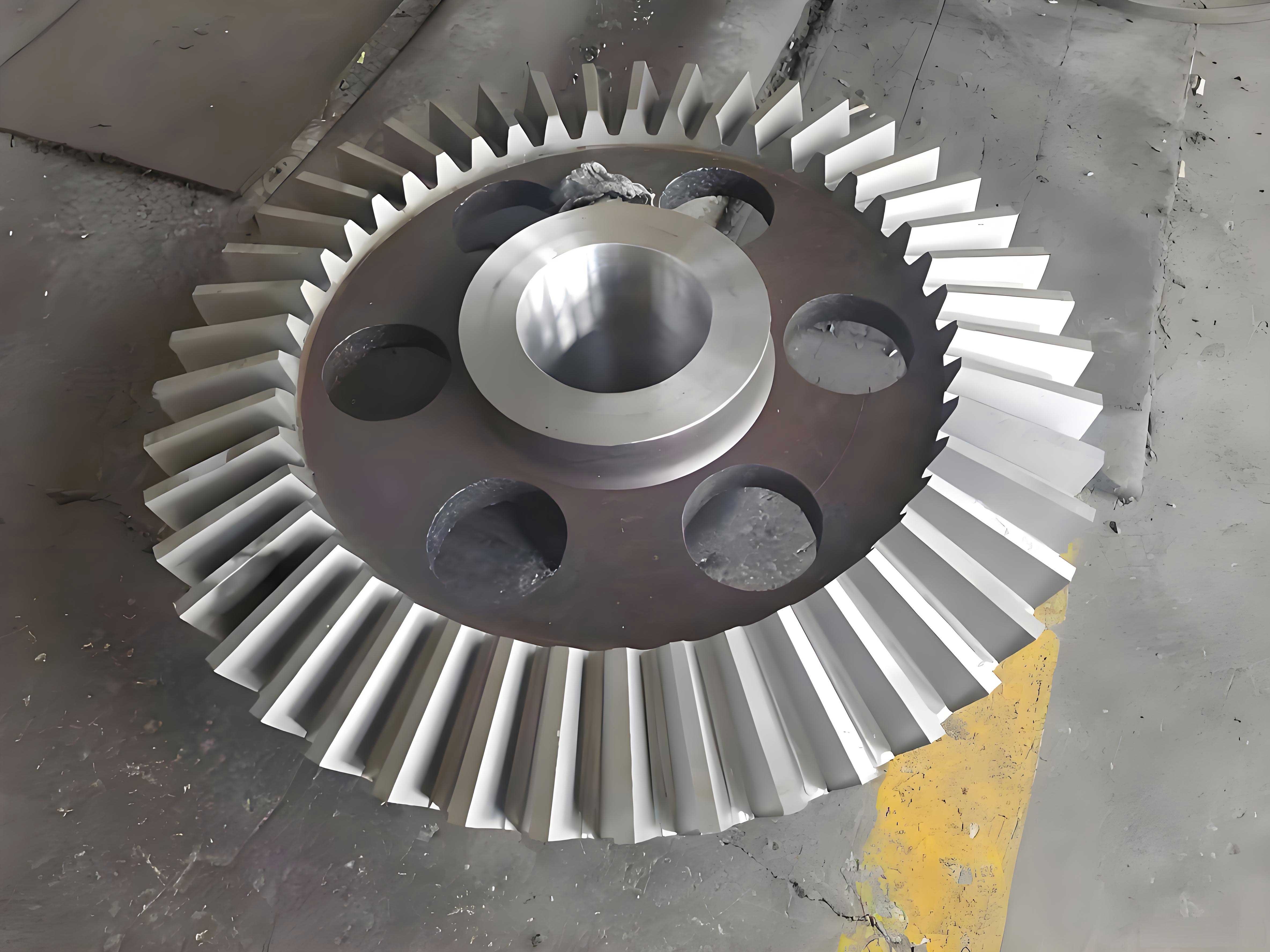
The pursuit of lightweight and high-strength automotive components for improved fuel efficiency and reduced emissions has intensified the focus on advanced manufacturing techniques for power transmission parts. Among these, the miter gear, a specific type of straight bevel gear with a 1:1 ratio, is a critical component in vehicle differential systems, facilitating torque transfer between perpendicular axes. Traditional manufacturing methods for miter gears, such as machining from solid blanks or hot forging, often involve significant material waste, high energy consumption, or inferior mechanical properties. Warm forging, conducted at temperatures typically between recrystallization and room temperature, presents a compelling alternative by balancing the formability advantages of hot forging with the dimensional accuracy and surface finish benefits of cold forging. Specifically, warm closed-die forging offers the potential for near-net-shape production of complex geometries like miter gears, minimizing subsequent machining and enhancing material utilization. This study investigates the optimal process parameters for the warm closed-die forging of an automotive differential miter gear through integrated computational simulation and experimental validation.
The core of this investigation utilizes the finite element method (FEM) software DEFORM-3D, a powerful tool for simulating metal forming processes. The physical phenomenon of plastic deformation during forging is governed by a set of constitutive equations. The relationship between flow stress, strain, strain rate, and temperature is critical and can be described by a commonly used model such as the Arrhenius-type equation:
$$\sigma_f = A \cdot (\varepsilon)^n \cdot (\dot{\varepsilon})^m \cdot \exp\left(\frac{Q}{RT}\right)$$
where $\sigma_f$ is the flow stress, $\varepsilon$ is the strain, $\dot{\varepsilon}$ is the strain rate, $T$ is the absolute temperature, $A$ is a material constant, $n$ is the strain-hardening exponent, $m$ is the strain-rate sensitivity exponent, $Q$ is the activation energy for deformation, and $R$ is the universal gas constant. The software numerically solves these equations alongside conditions for contact, friction, and heat transfer to predict material flow, forming loads, stress/strain distribution, and potential defects.
To systematically identify the optimal warm forging conditions, a Design of Experiments (DOE) approach was employed. Based on prior industrial experience and technical literature, three key process parameters were selected as factors: Workpiece (Billet) Heating Temperature (A), Die Preheating Temperature (B), and Ram Speed (C). Each factor was assigned three levels, creating a three-factor, three-level experimental space. The selected material for the miter gear was AISI-4340 (equivalent to 40CrNi2Mo steel), a medium-carbon, low-alloy steel known for its good hardenability and strength, making it suitable for high-stress automotive components like differential miter gears. The orthogonal array L9 (3^4) was chosen for its efficiency in evaluating the main effects of each factor with a minimal number of simulation runs. The experimental design and the corresponding forming load results from DEFORM-3D simulations are summarized in Table 1.
| Run No. | Factor Combination | A: Billet Temp. (°C) | B: Die Temp. (°C) | C: Ram Speed (mm/s) | Forming Load (N) ×10⁶ |
|---|---|---|---|---|---|
| 1 | A₁B₁C₁ | 800 | 200 | 100 | 2.07 |
| 2 | A₁B₂C₂ | 800 | 250 | 150 | 2.08 |
| 3 | A₁B₃C₃ | 800 | 300 | 200 | 2.02 |
| 4 | A₂B₁C₂ | 850 | 200 | 150 | 2.08 |
| 5 | A₂B₂C₃ | 850 | 250 | 200 | 2.00 |
| 6 | A₂B₃C₁ | 850 | 300 | 100 | 1.92 |
| 7 | A₃B₁C₃ | 900 | 200 | 200 | 1.94 |
| 8 | A₃B₂C₁ | 900 | 250 | 100 | 1.60 |
| 9 | A₃B₃C₂ | 900 | 300 | 150 | 1.67 |
The analysis of the orthogonal experiment involves calculating the mean response for each level of every factor. The effect of a factor level is its average performance. For example, the mean forming load for Billet Temperature at level A₃ (900°C) is calculated as:
$$ \bar{A}_3 = \frac{L_{A_3B_1C_3} + L_{A_3B_2C_1} + L_{A_3B_3C_2}}{3} = \frac{1.94 + 1.60 + 1.67}{3} = 1.737 \times 10^6 \text{ N} $$
Similar calculations are performed for all factor levels. A more rigorous statistical analysis, such as Analysis of Variance (ANOVA), was conducted to determine the significance of each factor’s influence on the forming load. The ANOVA calculates the Sum of Squares (SS) for each factor and the total variance. The F-ratio, which is the ratio of the mean square of a factor to the mean square of the error, tests the null hypothesis that the factor has no significant effect. The results of this significance analysis are presented in Table 2.
| Factor | Degrees of Freedom (df) | Sum of Squares (SS) | Mean Square (MS) | F-Ratio | p-value | Significance |
|---|---|---|---|---|---|---|
| A: Billet Temp. | 2 | 0.087 | 0.0435 | 7.448 | 0.118 | Most Significant |
| B: Die Temp. | 2 | 0.022 | 0.0110 | 1.908 | 0.344 | Significant |
| C: Ram Speed | 2 | 0.006 | 0.0030 | 0.469 | 0.681 | Less Significant |
| Error | 2 | 0.012 | 0.0058 | – | – | – |
| Total | 8 | 0.127 | – | – | – | – |
The analysis clearly indicates that the Billet Heating Temperature (Factor A) has the most pronounced effect on the forming load required for the miter gear, exhibiting the highest F-ratio. Higher billet temperatures significantly reduce the flow stress of the material (as indicated by the $\exp(Q/RT)$ term in the constitutive equation), thereby lowering the forging load. The Die Preheating Temperature (Factor B) also shows a measurable influence; a warmer die reduces heat transfer from the workpiece, maintaining its formability and slightly lowering loads. The Ram Speed (Factor C) has the least significant effect within the tested range for this miter gear geometry. Consequently, the optimal parameter combination for minimizing forming load and ensuring complete die filling is identified as A₃B₂C₁: Billet Temperature = 900°C, Die Preheating Temperature = 250°C, and Ram Speed = 100 mm/s.
With the optimal parameters determined, a detailed numerical simulation of the complete miter gear forging process was performed using DEFORM-3D. The 3D model of the closed-die set, consisting of an upper punch (convex), a lower punch, and a die cavity, was imported. The AISI-4340 billet was defined as a plastic body with approximately 100,000 tetrahedral elements, while the dies were treated as rigid bodies. The shear friction model was applied with a coefficient of 0.3. The simulation provided comprehensive insights into the forming mechanics.
The forming load versus punch stroke curve offers a macroscopic view of the process difficulty. The curve can be segmented into two distinct phases, which can be conceptually related to the geometry of the miter gear. In the initial phase, the load increases moderately and almost linearly. This corresponds to the bulk upsetting and initial radial flow of material to fill the smaller, toe-end of the miter gear teeth. The deformation is primarily compressive, and the material flows freely into the available cavity space. The relationship in this phase can be approximated by a linear function of the contact area $A_c$ and the average flow stress $\bar{\sigma}_f$:
$$ F_{\text{early}} \propto A_c \cdot \bar{\sigma}_f $$
The second phase is characterized by a sharp, non-linear increase in load. This occurs during the final filling stage, particularly at the larger, heel-end of the miter gear teeth and in the corners of the die cavity (flash land, if modeled). Material flow becomes severely constrained, leading to a dramatic rise in triaxial compressive stresses and deformation resistance. The load in this stage escalates rapidly according to a power-law relationship as the remaining unfilled volume $V_u$ approaches zero:
$$ F_{\text{late}} \propto \bar{\sigma}_f \cdot \exp(k \cdot \frac{1}{V_u}) $$
where $k$ is a constant related to die geometry and friction. Minimizing this final steep rise is crucial for reducing press tonnage requirements and die wear.
The velocity field analysis reveals the metal flow pattern essential for completely filling the intricate teeth of the miter gear. In the early stages, the velocity vectors are predominantly axial (along the press direction), as the billet is compressed to fill the height of the cavity. As the process continues, the flow direction shifts radically. Material begins to flow radially outward from the centerline to fill the tooth profiles. The velocity is highest at the tip regions of the miter gear teeth, especially at the heel-end, where the material must travel the farthest. This radial flow is critical for achieving a sound forging without defects like underfilling or laps. The continuity equation for incompressible plastic deformation governs this flow:
$$ \nabla \cdot \vec{v} = 0 $$
where $\vec{v}$ is the velocity vector field. The simulation visualizations confirm that this condition is satisfied, with material flowing smoothly from regions of high pressure (center) to fill the empty tooth cavities.
The effective (Von Mises) stress field indicates the intensity of the deviatoric stress component responsible for shape change. During the forging of the miter gear, stress concentrations naturally develop in areas with the most severe shape constraints. Initially, high stress is observed at the fillet radii of the toe-end teeth, where plastic deformation initiates. As the heel-end teeth begin to form, the maximum stress zone migrates to their root regions. The final stage shows the highest effective stress concentrated at the heel-end tooth roots and, potentially, in the flash area. The Von Mises stress $\sigma_e$ is calculated from the stress tensor $\sigma_{ij}$:
$$ \sigma_e = \sqrt{\frac{3}{2} s_{ij}s_{ij}} = \sqrt{\frac{1}{2}\left[(\sigma_{11}-\sigma_{22})^2 + (\sigma_{22}-\sigma_{33})^2 + (\sigma_{33}-\sigma_{11})^2 + 6(\sigma_{12}^2+\sigma_{23}^2+\sigma_{31}^2) \right]} $$
where $s_{ij}$ are the components of the deviatoric stress tensor. These high-stress zones in the miter gear are potential locations for ductile fracture or accelerated die wear and must be considered in die design.
The effective strain field quantifies the magnitude of plastic deformation. The distribution is non-uniform, which is typical in complex forgings like a miter gear. The highest accumulated strain is found in the surface layers of the heel-end tooth roots, where material undergoes severe shear and compression as it is forced into the final corners of the die. The core of the miter gear hub experiences lower strain. This gradient affects the final microstructure and hardness distribution. The effective plastic strain increment $d\bar{\varepsilon}^p$ is related to the plastic strain rate tensor:
$$ d\bar{\varepsilon}^p = \sqrt{\frac{2}{3} d\varepsilon_{ij}^p d\varepsilon_{ij}^p} $$
The integration of this increment over the deformation history gives the total effective strain field observed in the simulation. Understanding this field is vital for predicting grain flow lines and the resultant mechanical properties of the forged miter gear.
To validate the simulation predictions, a physical process trial was conducted on a toggle-type mechanical press. The forging die set was manufactured according to the CAD model used in the simulation. The optimal parameters from the DOE (900°C billet, 250°C dies, 100 mm/s nominal press speed) were strictly followed. The billet, made of AISI-4340 steel, was heated in an induction furnace and transferred to the preheated dies. The forged miter gear component was successfully produced in a single stroke. The physical part exhibited excellent geometric conformance, with all tooth profiles completely filled and sharp features well-defined. No visible defects such as folds or underfills were present. A comparative analysis between the simulated final geometry and the physical part showed a high degree of correlation, confirming the accuracy of the DEFORM-3D model in predicting the form filling behavior for this miter gear. The measured forming load during the trial also aligned closely with the simulated load-stroke curve, particularly noting the characteristic sharp load increase at the end of the stroke, validating the process mechanics captured by the simulation.
This integrated study successfully demonstrates a methodology for developing a robust warm closed-die forging process for an automotive miter gear. The orthogonal experiment efficiently identified the primary influencing factors, with Billet Heating Temperature being the most critical for controlling forming load. The subsequent high-fidelity DEFORM-3D simulation under optimal conditions provided deep insights into the multi-stage forming mechanics, including metal flow patterns, stress/strain distributions, and the evolution of forming load. These insights are invaluable for designing robust dies, selecting appropriate press capacity, and predicting final part quality for the miter gear. The successful physical trial provided conclusive validation, confirming that the simulated optimal parameters can be directly applied to industrial production. This approach significantly reduces the traditional trial-and-error costs and development time associated with bringing a new forged component like a precision miter gear to market, establishing a solid theoretical and practical foundation for the application of warm closed-die forging technology in manufacturing high-performance automotive gearing components.