
As a critical component in power transmission systems, the reliable operation of helical gear pairs is paramount for numerous industrial applications. Their widespread use in demanding environments, such as wind turbines and heavy machinery, subjects them to harsh operating conditions including high loads, prolonged operation, and variable speeds. These factors inevitably lead to progressive wear and eventual failure. Catastrophic gear failure often manifests as severe vibration, elevated noise, a sharp increase in the wear rate, and can culminate in tooth fracture, posing significant safety risks and economic losses. A primary challenge lies in the fact that gears operate within enclosed gearboxes, making direct visual inspection impractical without shutdown. Therefore, developing robust methodologies for monitoring the wear state and accurately assessing the remaining useful life of helical gears is of utmost importance for predictive maintenance and avoiding unscheduled downtime.
The evolution of wear in gears is not merely a surface phenomenon but a complex process influenced by the intrinsic properties of the gear material and extrinsic operational conditions. The initial surface quality, including the presence of manufacturing defects or early-stage damage, plays a crucial role in determining the wear trajectory. In this investigation, we focus on a common precursor to failure: initial pitting defects on the tooth flank. Pitting, a form of contact fatigue wear, initiates due to subsurface shear stresses exceeding the material’s endurance limit, leading to the formation of small pits. Understanding how such a pre-existing defect alters the contact mechanics, influences the wear progression from run-in to severe wear, and ultimately impacts the dynamic response of the gear system is critical.
Two primary condition monitoring techniques are vibration analysis and oil analysis. Vibration analysis captures the dynamic response of the gearbox, where developing faults modulate the vibration signature, producing characteristic changes in time-domain statistics and frequency spectra. Oil analysis, particularly ferrography, provides direct evidence of the wear process by examining the quantity, size, shape, and composition of wear debris suspended in the lubricant. This study employs an integrated approach, utilizing both vibration monitoring and analytical ferrography to track the wear evolution of a helical gear pair with an artificially introduced initial pit defect under varying load conditions. The goal is to delineate the wear patterns, identify transitional markers between different wear stages, and establish a correlation between the physical wear state and the extracted condition indicators.
1. Contact Mechanics and Wear Fundamentals in Helical Gears
The meshing action of a helical gear involves complex rolling and sliding contact across the tooth flank. The contact stress distribution is non-uniform along both the profile direction (from root to tip) and the face width direction. The nominal maximum contact stress for smooth surfaces can be estimated using the Hertzian contact theory for parallel cylinders. For a helical gear, the contact zone is an ellipse, and the maximum subsurface shear stress, which drives pitting failure, is located at a depth related to the semi-width of the contact ellipse.
The basic Hertzian contact pressure (pH) for gear teeth is given by:
$$p_H = \sqrt{\frac{F E_{eq}}{\pi L \rho_{eq}}}$$
where $F$ is the normal load per unit face width, $E_{eq}$ is the equivalent Young’s modulus $\left(\frac{2}{1-\nu_1^2/E_1 + 1-\nu_2^2/E_2}\right)^{-1}$, $L$ is the length of the contact line (which varies during meshing for helical gears), and $\rho_{eq}$ is the equivalent radius of curvature $\left(1/\rho_1 \pm 1/\rho_2\right)^{-1}$ at the point of contact.
The introduction of a surface defect, such as a pit, drastically alters this stress field. The pit acts as a stress concentrator, creating localized regions where the stress intensity can be several times higher than the nominal Hertzian stress. Furthermore, it disrupts the elastohydrodynamic lubrication (EHL) film, leading to boundary or mixed lubrication conditions within and around the defect. This promotes adhesive wear and accelerates surface fatigue. The defect also becomes a trap for wear debris; hard particles entrapped in the pit can cause severe abrasive wear on the mating surface, leading to a cascading degradation effect. The wear process typically progresses through distinct regimes, which can be characterized by the wear rate:
- Run-in Wear: Initial high wear rate due to the removal of asperities and surface conformity.
- Steady-State Wear: A period of low and relatively constant wear rate.
- Accelerated Wear: Wear rate increases rapidly due to the onset of surface distress (e.g., pitting, scuffing).
The progression from one regime to another can be triggered or accelerated by the presence of a stress concentrator like an initial pit.
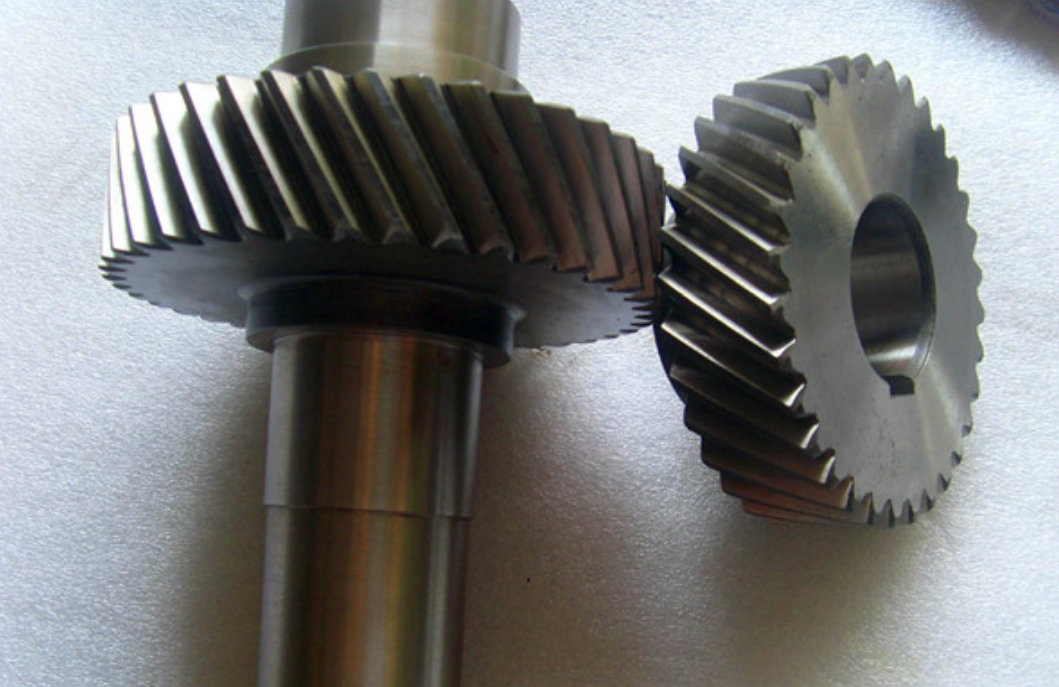
2. Experimental Design and Methodology
To investigate the influence of an initial defect, a controlled wear test program was executed on a custom-built back-to-back helical gear test rig. The rig primarily consists of a circulating power loop with a test gearbox and a slave gearbox, connected by torque shafts. A loading mechanism applies a static torque to the loop, simulating the operational load on the test helical gear pair.
2.1. Gear Specimen and Defect Seeding
The test specimens were case-hardened steel helical gears. A single, well-defined artificial pit defect was introduced onto the flank of one driving gear tooth. The defect was designed to simulate a natural incipient pit: a hemispherical cavity with a diameter of 1.0 mm and a depth of 0.5 mm, created using micro-milling. This deterministic defect allows for repeatable experiments and clear observation of its evolution.
2.2. Monitoring and Data Acquisition
Vibration Monitoring: An accelerometer was mounted on the bearing housing of the test gearbox. Vibration signals were continuously acquired at a high sampling rate using a data acquisition system and analyzed in both the time and frequency domains.
Oil Analysis: A continuous oil circulating system with an in-line sampling port was implemented. Oil samples were drawn at regular intervals without stopping the test. Analytical ferrography was performed on these samples. The oil was diluted and passed over a ferrogram slide placed in a magnetic field, causing ferrous wear particles to deposit in chains according to size. These slides were then analyzed under an optical microscope to quantify and qualify the wear debris.
2.3. Experimental Matrix
Three distinct experiments (A, B, and C) were conducted to isolate the effects of the defect and the loading condition. The parameters are summarized in Table 1.
| Test ID | Gear Condition | Load Profile | Speed (rpm) | Primary Objective |
|---|---|---|---|---|
| A | Healthy (No Defect) | Constant Load (400 N·m) | 1200 | Baseline for normal helical gear wear progression. |
| B | With Initial Pit | Constant Load (400 N·m) | 1200 | Investigate defect evolution under constant stress. |
| C | With Initial Pit | Step Load (50 N·m for 60h, then 400 N·m) | 1200 | Study combined effect of defect and a severe load step. |
3. Results and Analysis: Wear Progression and Symptom Evolution
The integrated data from vibration and ferrography revealed a clear narrative of wear evolution, particularly for the defective helical gears.
3.1. Vibration Response Analysis
The time-domain vibration amplitude served as a primary indicator of mechanical disturbance. Table 2 contrasts the peak-to-peak vibration levels at key stages.
| Test & Stage | Description | Typical Peak (mV) | Max Amplitude Observed (mV) | Signal Characteristic |
|---|---|---|---|---|
| A: Healthy, Run-in | Smooth operation | ~6 | 10.05 | Periodic, near-sinusoidal modulation. |
| A: Healthy, 160h | Steady-state wear | ~10 | 15.58 | Modulated, some small impulses. |
| B: Defective, Early | Under constant load | ~6-10 | ~15 | Increased instability vs. Test A. |
| C: Defective, Low Load | First 60h at 50 N·m | ~6 | 9.02 | Less stable sinusoidal pattern. |
| C: Defective, Post Step | After load increase to 400 N·m | ~9 | 15.58 | Distorted waveform, loss of smooth modulation. |
| C: Defective, Severe Wear | Late stage, before fracture | ~15 | 21.96 | Chaotic, large impulsive events. |
| C: Defective, Post-Fracture | Tooth breakage occurred | ~30 | 41.20 | Extreme, high-energy impacts. |
Key Observations:
1. The initial pit defect under low load (Test C early stage) did not significantly increase the vibration amplitude compared to a healthy gear, but it did introduce noticeable instability in the waveform, breaking the smooth periodic pattern.
2. Under constant moderate load (Test B), the defective helical gear exhibited a shortened steady-state period. The vibration levels showed a more rapid upward trend compared to Test A.
3. The load step was a major accelerant. In Test C, increasing the load caused an immediate ~50% jump in typical peak amplitude and transformed the signal character.
4. The final stages of wear for the defective helical gear were marked by a dramatic increase in amplitude (2-5 times baseline) and the appearance of large, impulsive events in the time-domain signal, indicative of severe surface damage and impending fracture.
3.2. Ferrographic (Wear Debris) Analysis
Ferrography provided direct physical evidence of the wear modes active during each phase. The density, size distribution, and morphology of wear particles evolved distinctly.
| Experimental Phase | Debris Concentration | Dominant Particle Size | Particle Morphology | Inferred Wear Mechanism |
|---|---|---|---|---|
| All Tests: Run-in | High | Mostly small, some large | Rubbing platelets, some cutting curls. | Normal abrasive/adhesive wear, asperity removal. |
| Test A (Healthy): Steady-State | Low & Stable | Predominantly fine (< 5 µm) | Small, thin platelets. | Mild oxidative or mild adhesive wear. |
| Test B (Defective): Mid-Life | Moderate, increasing | Increasing proportion of >15 µm particles | Thick flakes, some irregular chunks. | Onset of fatigue spalling and micro-pitting. |
| Test C: After Load Step | High spike, then moderate | Many large (>20 µm) particles | Large, severe sliding blocks, spherical particles. | Severe adhesive/scuffing wear, possible rolling contact fatigue. |
| Defective Gears: Terminal Stage | Very High | Numerous >50 µm particles, “chunks” | Large, thick fatigue flakes with rough edges; long, striated sliding particles. | Macro-scale pitting, spalling, and severe abrasive wear. Debris chains form. |
Key Observations:
1. The run-in stage produced a high debris concentration for all tests, but the defective gear under constant load (Test B) generated slightly more large particles initially, likely from the rough edges of the machined pit.
2. During steady-state, the healthy helical gear (Test A) produced a consistent, low level of fine debris. The defective gear (Test B) never achieved this stability; the debris concentration and size remained higher and showed an upward trend.
3. The load step in Test C acted like a secondary run-in period but was more severe. The particle generation spiked, with a significant number of large particles indicative of sudden surface breakdown.
4. The terminal wear phase was uniquely characterized by the presence of “chunk” particles (large, blocky debris from spalled material) and severe sliding particles (long, striated particles from gross sliding contact). The formation of dense debris chains on the ferrogram was a visual hallmark of this critical stage.
4. Discussion: Wear Mechanism Synthesis and State Assessment
The data collectively reveals the accelerated wear trajectory of a helical gear with an initial surface defect. The pit creates a localized stress concentration factor ($K_t$), significantly increasing the local contact stress ($\sigma_{local}$) compared to the nominal Hertzian stress:
$$\sigma_{local} = K_t \cdot p_H$$
where $K_t$ can be 3 or higher for a sharp-edged defect. This elevated stress promotes rapid plastic deformation and crack initiation at the defect rim.
Initially, under low loads, the system compensates. The defect may be partially “run-in,” and wear debris may fill the pit, temporarily reducing stress concentration. This corresponds to the moderately unstable but not yet severe vibration and ferrography signals. However, this state is metastable. Under sustained or increased load, the entrapped debris becomes abrasive, and micro-cracks propagate. The wear regime transitions from mild, stable wear to a progressive fatigue wear mode centered on the defect.
The defect acts as a nucleus for pitting growth. As adjacent pits coalesce, they create a larger, irregular spall. This process dramatically alters the tooth profile and the meshing kinematics. The resulting time-varying mesh stiffness excites the gear system, leading to the large vibration impulses observed. The wear rate ($w$) is no longer constant but accelerates, which can be loosely modeled as a function of the current damage state ($D$) and load ($L$):
$$\frac{dw}{dt} \propto L^m \cdot f(D)$$
where $m$ is a load exponent (often ~3 for rolling contact fatigue) and $f(D)$ increases non-linearly with accumulated damage $D$.
Condition Assessment Framework:
Based on this study, a multi-parameter assessment approach is recommended for monitoring helical gears suspected of having initial damage:
1. Early Stage (Incubation): Characterized by stable vibration amplitude but increased waveform instability or “jitter.” Ferrography shows a persistent, slightly elevated level of particles >15 µm. This stage calls for increased vigilance.
2. Mid Stage (Progressive Damage): Vibration amplitude shows a clear upward trend (>25% increase from baseline). RMS or kurtosis values increase. Ferrography shows a rising trend in concentration count (PC) and large particle percentage. The presence of fatigue flakes (>20 µm) is a key diagnostic marker.
3. Late Stage (Imminent Failure): Vibration signals exhibit large, periodic impulses and a significant rise in overall level (e.g., >100% increase). Ferrography reveals “chunk” particles and dense debris chains. This stage warrants immediate shutdown planning.
The load step experiment (Test C) crucially demonstrates that a sudden increase in operational load can cause an immediate transition from a seemingly stable early stage into a rapid progression through mid and late stages. This highlights the particular vulnerability of a defective helical gear to transient overload events.
5. Conclusion
This integrated experimental investigation elucidates the wear evolution and provides a state assessment methodology for helical gears with initial tooth surface pitting defects. The principal conclusions are:
- An initial pit defect acts as a potent stress concentrator and a catalyst for wear, fundamentally altering the wear progression of a helical gear. While it may not drastically increase initial vibration amplitude under light load, it introduces dynamic instability and shortens the effective steady-state wear period, leading to premature onset of accelerated wear.
- The wear process transitions from a benign run-in to a defect-driven progressive fatigue mechanism. This is clearly evidenced in ferrography by the early and persistent presence of fatigue flakes and later by large spall particles, preceding major vibration events.
- Operational load is a critical accelerating factor. A significant load increase can trigger an immediate escalation in both wear debris generation (size and quantity) and vibration response, rapidly advancing the defective helical gear towards failure.
- A combined monitoring approach is essential. Vibration analysis effectively captures the macro-dynamic consequences of evolving damage (increasing amplitude, impulses), while ferrography provides direct, early micro-scale evidence of the active wear mechanisms (fatigue, abrasion). The correlation between the emergence of specific particle types (e.g., large fatigue chunks) and the subsequent appearance of high-energy vibration impulses offers a robust framework for diagnosing the severity of wear and predicting remaining useful life in helical gear transmission systems.
This work underscores the importance of surface quality control in gear manufacturing and provides a data-driven basis for setting condition alerts and maintenance thresholds for gears operating under high-risk conditions.