
Gears are fundamental components in mechanical transmission systems, widely employed across various industrial sectors due to their high transmission accuracy, efficiency, precise speed ratios, and stable operation. Among different types, cylindrical gears, particularly spur gears, are extensively used for their simplicity and reliability. However, under complex working conditions, gear teeth are susceptible to failures, with tooth root bending fatigue being a predominant issue. The bending stress at the gear tooth root is critical, as the gear’s service life is inversely proportional to the sixth power of the maximum bending stress. Thus, accurate calculation of bending strength is paramount for enhancing durability and preventing catastrophic failures like tooth fracture. Traditional methods, such as the Lewis formula, rely on empirical approximations and cannot fully capture stress distributions. Finite element analysis (FEA) has become a standard numerical tool, yet it involves time-consuming mesh generation and geometric inaccuracies due to piecewise polynomial approximations. In recent years, isogeometric analysis (IGA) has emerged as a promising alternative, integrating Computer-Aided Design (CAD) geometry directly into analysis using Non-Uniform Rational B-Splines (NURBS). This paper presents an IGA-based approach for bending strength analysis of cylindrical gears, demonstrating its precision and efficiency through comparisons with traditional formulas and FEA.
The significance of cylindrical gears in machinery cannot be overstated. They transmit motion and power between shafts, often under heavy loads and high speeds. Bending stress concentration at the tooth root, exacerbated by cyclic loading, leads to crack initiation and propagation, ultimately resulting in tooth breakage. Accurate stress evaluation helps in optimizing gear design, material selection, and maintenance schedules. Historically, gear design relied on analytical formulas derived from beam theory. The Lewis formula, proposed in the late 19th century, models the gear tooth as a cantilever beam and calculates bending stress based on geometric parameters. While foundational, it oversimplifies stress distributions and neglects factors like load dynamics and geometric discontinuities. Subsequent modifications introduced correction coefficients for load distribution, material properties, and stress concentrations, yet these still involve approximations. With advancements in computational mechanics, FEA enabled detailed stress analysis by discretizing gear geometry into finite elements. However, FEA requires mesh generation, which can be labor-intensive and may introduce geometric errors, especially for complex curvatures like gear tooth profiles. Moreover, mesh refinement for accuracy increases computational cost. Isogeometric analysis addresses these limitations by using NURBS basis functions, which exactly represent CAD geometries and provide higher-order continuity. IGA unifies design and analysis, eliminating the need for mesh regeneration and improving accuracy. This study applies IGA to cylindrical gears, focusing on bending strength under static loading, and validates results against established methods.
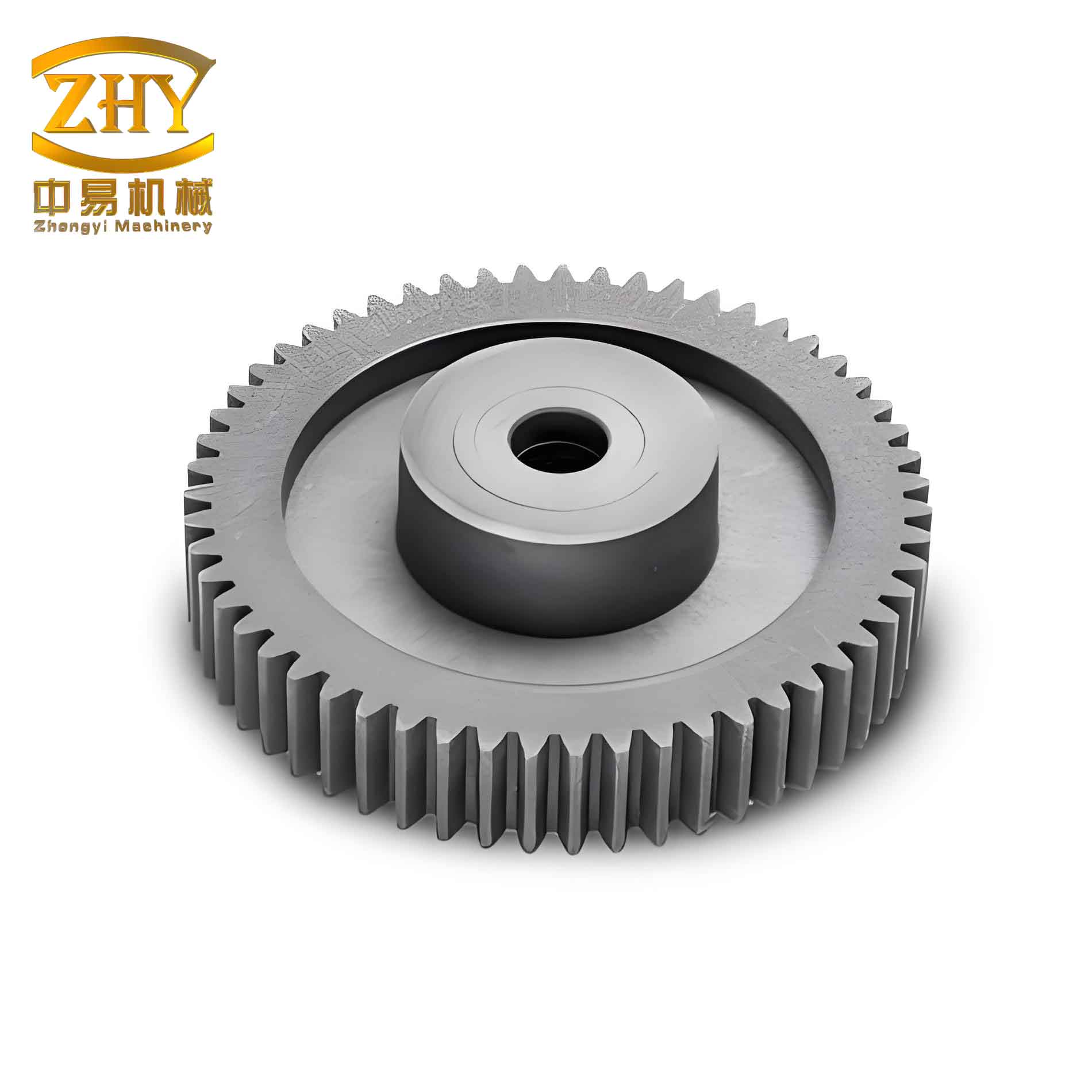
Research on gear bending strength has evolved significantly. Early work by Lewis established the basic framework, but it assumed load application at the tooth tip and a parabolic stress distribution. Later studies incorporated factors like fillet radius, load sharing, and dynamic effects. For instance, Filiz and Eyercioglu used FEA to analyze stress under different loading conditions, proposing refined formulas. Vijayarangan and Ganesan explored dynamic stresses in three-dimensional gear models using FEA, highlighting the impact of moving loads. In parallel, numerical methods like boundary element methods were applied to gear stress analysis. However, these approaches still depend on discretization that may not precisely capture gear geometry. On the other hand, isogeometric analysis, introduced by Hughes et al., has gained traction in various engineering fields. IGA utilizes NURBS, which are standard in CAD, for both geometry representation and analysis discretization. This ensures exact geometry representation, even for intricate shapes like gear teeth. Previous applications of IGA include structural mechanics, fluid-structure interaction, and contact problems. For gears, Beinstingel et al. used IGA for gear mesh stiffness evaluation, demonstrating accuracy. Chen et al. applied IGA to gear contact analysis, but focused on nonlinear aspects. Our work extends IGA to linear elastic bending analysis of cylindrical gears, providing a detailed comparison with traditional and FEA methods.
The foundation of isogeometric analysis lies in NURBS, which offer flexible representation of curves and surfaces. A NURBS surface is defined by control points, weights, knot vectors, and basis functions. Mathematically, a NURBS surface $S(\xi, \eta)$ is given by:
$$ S(\xi, \eta) = \sum_{i=1}^{n} \sum_{j=1}^{m} R_{i,j}^{p,q}(\xi, \eta) P_{i,j} $$
where $P_{i,j}$ are control points, $R_{i,j}^{p,q}(\xi, \eta)$ are the rational basis functions defined as:
$$ R_{i,j}^{p,q}(\xi, \eta) = \frac{N_{i,p}(\xi) M_{j,q}(\eta) w_{i,j}}{\sum_{k=1}^{n} \sum_{l=1}^{m} N_{k,p}(\xi) M_{l,q}(\eta) w_{k,l}} $$
Here, $N_{i,p}(\xi)$ and $M_{j,q}(\eta)$ are B-spline basis functions of degrees $p$ and $q$ in the $\xi$ and $\eta$ directions, respectively, and $w_{i,j}$ are weights. The knot vectors $\Xi = \{\xi_1, \xi_2, \ldots, \xi_{n+p+1}\}$ and $\mathcal{H} = \{\eta_1, \eta_2, \ldots, \eta_{m+q+1}\}$ parameterize the domain. For cylindrical gears, we use quadratic NURBS ($p=q=2$) to model the two-dimensional gear cross-section, ensuring smooth representation of tooth profiles.
To create a suitable gear model for IGA, we start with CAD modeling. Using parameters typical for cylindrical gears, such as module, number of teeth, pressure angle, and profile shift coefficients, we generate an involute gear profile. The gear model is constructed in CAD software (e.g., CATIA), and a two-dimensional section is extracted. The control points, knot vectors, and weights are then derived to reconstruct the gear geometry in an IGA framework. This process preserves the exact geometry, avoiding approximation errors common in FEA mesh generation. The basic geometric parameters for the cylindrical gear used in this study are summarized in Table 1.
| Parameter | Symbol | Value | Unit |
|---|---|---|---|
| Module | $m_n$ | 2 | mm |
| Number of Teeth | $Z$ | 30 | – |
| Face Width | $b$ | 15 | mm |
| Pressure Angle | $\alpha_n$ | 20 | ° |
| Addendum Coefficient | $h_a$ | 1 | – |
| Dedendum Coefficient | $c$ | 0.25 | – |
| Profile Shift Coefficient | $x_n$ | 0 | – |
Isogeometric analysis follows a procedure similar to finite element analysis but employs NURBS basis functions for discretization. The governing equation for linear elasticity is the equilibrium equation, which in weak form leads to a stiffness matrix and force vector. In IGA, the displacement field is approximated using the same NURBS basis functions as the geometry:
$$ \mathbf{u}(\xi, \eta) = \sum_{A=1}^{N} R_A(\xi, \eta) \mathbf{u}_A $$
where $R_A$ are the NURBS basis functions, $\mathbf{u}_A$ are control point displacements, and $N$ is the number of basis functions. The stiffness matrix $\mathbf{K}$ is computed by integrating over the physical domain:
$$ \mathbf{K} = \int_{\Omega} \mathbf{B}^T \mathbf{D} \mathbf{B} \, d\Omega $$
Here, $\mathbf{B}$ is the strain-displacement matrix derived from derivatives of $R_A$, and $\mathbf{D}$ is the constitutive matrix for linear isotropic material. For cylindrical gears made of steel, typical material properties are Young’s modulus $E = 210$ GPa and Poisson’s ratio $\nu = 0.3$. The force vector $\mathbf{F}$ accounts for applied loads. Boundary conditions include fixing the gear bore to prevent rigid body motion and applying a load at the tooth tip. In this study, a static load equivalent to a torque of $30$ kN·m is applied, resulting in a normal force $F_n$ at the tooth tip. The force components are calculated as:
$$ F_t = \frac{2T}{d} $$
$$ F_n = \frac{F_t}{\cos \alpha} $$
where $F_t$ is the tangential force, $T$ is the torque, $d$ is the pitch diameter, and $\alpha$ is the pressure angle. For our gear, with $d = m_n Z = 60$ mm, we get $F_t = 1000$ N and $F_n \approx 1064.17$ N at $\alpha = 20^\circ$. This force is applied as a distributed load on the tooth tip control points in the IGA model.
The IGA implementation is carried out in MATLAB, utilizing the GeoPDEs toolbox or similar IGA libraries. The gear domain is parameterized into elements based on knot spans. Refinement is achieved by knot insertion, which enhances analysis accuracy without altering geometry. After assembling the global stiffness matrix and applying boundary conditions, the linear system $\mathbf{K} \mathbf{u} = \mathbf{F}$ is solved for displacements. Stress is then post-processed from strains using Hooke’s law. The maximum bending stress occurs at the tooth root, and its value is compared with other methods.
To evaluate the IGA results, we compare them with traditional bending stress calculations and finite element analysis. The traditional method uses the Lewis formula with correction factors. The basic Lewis formula for bending stress $\sigma_F$ is:
$$ \sigma_F = \frac{F_t}{b m_n} Y_{Fa} Y_{Sa} K $$
where $Y_{Fa}$ is the form factor, $Y_{Sa}$ is the stress correction factor, and $K$ is the load factor. For our gear, using standard values $Y_{Fa} = 2.52$, $Y_{Sa} = 1.625$, and $K = 1.1$, the calculated stress is:
$$ \sigma_F = \frac{1000}{15 \times 2} \times 2.52 \times 1.625 \times 1.1 = 150.15 \text{ MPa} $$
This value serves as a reference, though it may overestimate stress due to simplifications.
For finite element analysis, we use ANSYS Workbench. The gear model is meshed with quadratic elements to match the order of IGA. Two meshing schemes are employed: a coarse mesh with element size 0.2 mm (9,060 elements) and a fine mesh with size 0.1 mm (18,452 elements). Material properties are set as in IGA. Boundary conditions fix the gear bore, and the same normal force is applied at the tooth tip. The FEA results yield maximum bending stresses of 137.7 MPa for the coarse mesh and 139.1 MPa for the fine mesh. The stress contours show concentration at the tooth root, similar to IGA.
Isogeometric analysis of the cylindrical gear model gives a maximum bending stress of 141.3 MPa. The stress distribution is smooth due to the $C^1$ continuity of quadratic NURBS, whereas FEA results exhibit some discontinuities from $C^0$ Lagrange elements. Table 2 summarizes the stress values from different methods, highlighting IGA’s position between traditional and FEA results.
| Method | Maximum Stress (MPa) | Remarks |
|---|---|---|
| Traditional Formula | 150.15 | Based on Lewis formula with corrections |
| FEA (Coarse Mesh) | 137.7 | 9,060 elements, quadratic order |
| FEA (Fine Mesh) | 139.1 | 18,452 elements, quadratic order |
| Isogeometric Analysis | 141.3 | NURBS-based, exact geometry |
The comparison reveals that IGA provides a stress value closer to the fine FEA mesh, indicating convergence. Traditional methods tend to overestimate stress for safety, while FEA requires mesh refinement to approach IGA accuracy. Importantly, IGA achieves this without meshing, reducing preprocessing time. Table 3 shows the time breakdown for each method, underscoring IGA’s efficiency.
| Method | Meshing/Modeling Time | Analysis Time | Total Time |
|---|---|---|---|
| FEA (Coarse) | 20.3 | 2.5 | 22.8 |
| FEA (Fine) | 29.9 | 4.3 | 34.2 |
| IGA | 0 (included in modeling) | 3.4 | 3.4 |
In IGA, modeling time is part of the CAD process, which is reusable, whereas FEA requires separate meshing for each analysis. The total time for IGA is significantly lower, especially for iterative design processes. This efficiency stems from the seamless integration of design and analysis, a core advantage of isogeometric methods.
Further discussion on the stress fields reveals that IGA produces smoother stress contours due to higher-order basis functions. The $C^1$ continuity of quadratic NURBS ensures differentiable stress across element boundaries, whereas FEA with Lagrange elements shows abrupt changes. This smoothness is beneficial for accurate fatigue life prediction, as stress gradients influence crack propagation. For cylindrical gears, where stress concentrations at fillets are critical, IGA’s precise geometry representation captures these regions more accurately. Additionally, IGA allows for easy refinement through knot insertion, enabling adaptive analysis without remeshing.
The application of isogeometric analysis to cylindrical gears extends beyond bending strength. Potential future work includes dynamic analysis, contact simulation, and optimization. For instance, IGA can model gear meshing with exact tooth profiles, improving contact stress calculations. Coupling IGA with multibody dynamics could simulate real operating conditions. Moreover, IGA’s ability to handle complex geometries makes it suitable for gears with modifications like profile shifting or crowning. As computational resources grow, three-dimensional IGA of cylindrical gears will become feasible, capturing effects like helix angles and edge loading.
In conclusion, isogeometric analysis offers a robust framework for evaluating bending strength in cylindrical gears. By leveraging NURBS basis functions, IGA maintains geometric exactness, enhances stress field smoothness, and reduces preprocessing time compared to finite element analysis. Our study demonstrates that IGA results align closely with refined FEA and provide a more accurate alternative to traditional formulas. The method’s efficiency and precision make it valuable for gear design and optimization, contributing to longer service life and reliability of mechanical systems. Future research should focus on extending IGA to nonlinear material behavior, transient loads, and full three-dimensional gear models, further solidifying its role in advanced engineering analysis.
The mathematical foundation of IGA involves solving the linear elasticity equations over a NURBS-mapped domain. The weak form of the equilibrium equation, after applying Galerkin discretization, leads to the linear system mentioned earlier. For isotropic materials, the constitutive matrix $\mathbf{D}$ in plane stress is:
$$ \mathbf{D} = \frac{E}{1-\nu^2} \begin{bmatrix} 1 & \nu & 0 \\ \nu & 1 & 0 \\ 0 & 0 & \frac{1-\nu}{2} \end{bmatrix} $$
For plane strain, it adjusts accordingly. In our gear analysis, we assume plane stress due to the thin gear slice. The strain-displacement matrix $\mathbf{B}$ for a control point $A$ is:
$$ \mathbf{B}_A = \begin{bmatrix} \frac{\partial R_A}{\partial x} & 0 \\ 0 & \frac{\partial R_A}{\partial y} \\ \frac{\partial R_A}{\partial y} & \frac{\partial R_A}{\partial x} \end{bmatrix} $$
where derivatives are computed via the Jacobian of the NURBS mapping. Integration is performed over parametric space using Gaussian quadrature. The accuracy of IGA depends on the order of NURBS and refinement level. For cylindrical gears, quadratic NURBS balance accuracy and computational cost.
To illustrate the stress calculation, consider the von Mises stress $\sigma_{vM}$, often used for ductile materials like steel:
$$ \sigma_{vM} = \sqrt{\sigma_{xx}^2 + \sigma_{yy}^2 – \sigma_{xx}\sigma_{yy} + 3\tau_{xy}^2} $$
where $\sigma_{xx}$, $\sigma_{yy}$, and $\tau_{xy}$ are stress components from IGA. In bending, the principal stress at the tooth root is often maximum, aligning with the bending direction.
In summary, isogeometric analysis proves effective for cylindrical gears, combining CAD fidelity with analytical rigor. As industry demands higher performance and lighter designs, tools like IGA will become essential for precise stress evaluation and durability assessment.