
As a pivotal component in mechanical transmission systems, the cylindrical gear is ubiquitously employed across various industrial sectors. Compared to alternative transmission methodologies, gear drive systems are renowned for their high transmission accuracy and efficiency, precise transmission ratios, broad power transmission ranges, and operational smoothness. In practical applications, however, gears often operate under complex and demanding conditions, making them susceptible to failure. When a gear tooth is under load, the maximum bending stress is invariably concentrated at the tooth root. Under repeated cyclic loading, fatigue cracks initiate at this critical location, propagate gradually, and can ultimately lead to bending fracture. Furthermore, a sudden impact load can cause immediate tooth breakage. Therefore, the accurate calculation of bending stress at the gear tooth root is of paramount importance. Traditional calculation methods, often based on empirical formulas, are increasingly revealing their limitations and inherent uncertainties, struggling to authentically reflect the stress variation and deformation distribution within the tooth. Consequently, applying modern numerical analysis techniques to investigate the bending strength of gear teeth holds significant practical value.
Currently, the most widely used method for solving gear tooth root bending strength is the Finite Element Method (FEM). Nevertheless, several challenges persist in its simulation process. In traditional FEM, the shape functions used to approximate the geometric model boundaries are often Lagrange interpolation polynomials. These functions typically offer only C0 continuity, which is insufficient for accurately describing complex curved surfaces, leading to inherent geometric approximation errors.
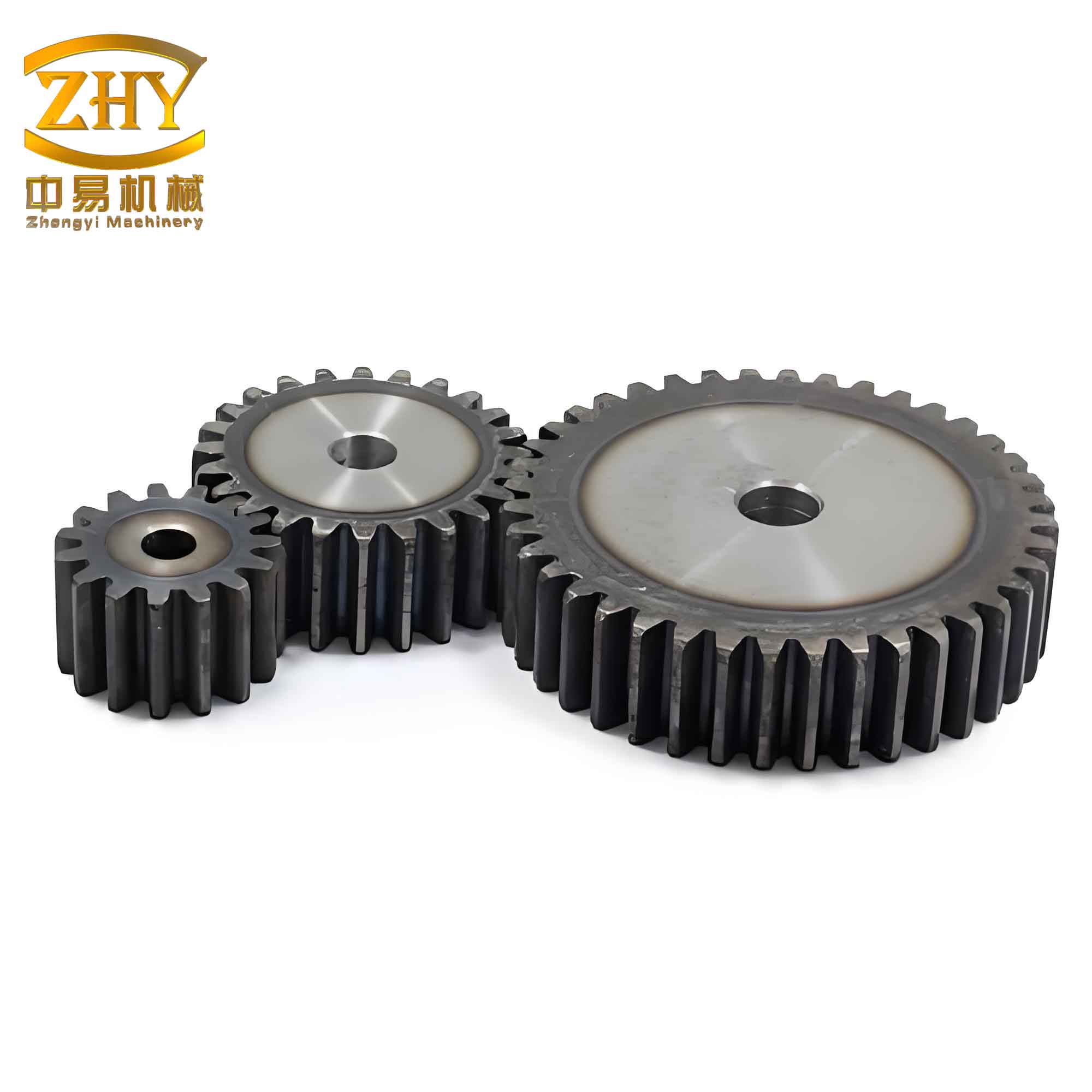
Isogeometric Analysis (IGA), introduced as a novel numerical approximation technique, presents substantial advantages over classical FEM in the field of structural mechanics. For stress analysis of cylindrical gear bending strength, IGA utilizes high-order Non-Uniform Rational B-Spline (NURBS) basis functions instead of the Lagrangian basis functions of traditional FEM. This approach enables the exact geometric description of the complex profile of a cylindrical gear model, eliminating the geometric error stemming from piecewise polynomial boundary approximation in FEM, thereby significantly enhancing the precision of analysis results. Simultaneously, IGA directly utilizes the CAD geometric model. When described using NURBS basis functions, the model requires no additional mesh generation or geometry cleanup, substantially improving analysis efficiency. While FEM has been extensively researched and applied in analyzing cylindrical gear root bending strength, IGA, despite its advantages in accuracy and efficiency, is still in its nascent stages of adoption for such complex 3D engineering structures. Its operational workflow is not yet as streamlined as that of established FEM software. Future development could involve innovating IGA technology by leveraging the existing theoretical foundation of FEM, anticipating greater advancements for IGA in the field of cylindrical gear structural mechanics analysis.
Related Work Overview
Cylindrical Gear Bending Strength Analysis
Research on calculating the bending strength of cylindrical gear teeth has consistently been a crucial topic within the gear manufacturing industry. Traditional analysis is grounded in empirical formulas, whose limitations are becoming increasingly apparent. To achieve more precise calculations of root bending stress under load, scholars have conducted extensive research on factors influencing cylindrical gear tooth bending strength and the problem of bending fracture.
Lewis pioneered the concept of the form factor and, based on the cantilever beam theory from applied mechanics, treated the gear tooth as a cantilever beam to derive the seminal Lewis formula for calculating tooth root bending strength. Subsequent researchers have built upon this foundation. Some applied the boundary method to root stress calculation, proposing new simplified formulas. Others performed Finite Element Analysis on 2D single-tooth models under simulated contact, distributed force, and concentrated force loading conditions, deriving new calculation formulas. Studies have also considered moving line loads and impact loads for 3D finite element analysis of cylindrical gear root bending strength. Beyond analytical and numerical methods, approaches like utilizing BP neural networks to predict the bending fatigue strength limit stress of gears have shown high accuracy within the training sample parameter range. Furthermore, software tools like SolidWorks combined with ANSYS Workbench Fatigue Tool have been used for bending fatigue simulation of spur cylindrical gears, yielding meaningful conclusions. As research deepens, the calculation accuracy for cylindrical gear tooth root bending stress continues to improve. However, these methods have not fully achieved a precise description of the cylindrical gear tooth profile, which hinders the further enhancement of calculation accuracy and efficiency for cylindrical gear bending stress.
Isogeometric Analysis
Since its proposal, Isogeometric Analysis has remained a research hotspot in computational mechanics. Numerous scholars have contributed significantly to its application and development. IGA has now been successfully applied in various domains including structural mechanics, fracture mechanics, fluid-structure interaction, and contact problems. For instance, researchers have modeled Kirchhoff-Love shell elements based on NURBS basis functions and performed isogeometric analysis on different models, proving its applicability. Others have combined the Scaled Boundary Finite Element Method with IGA to address problems in linear elastic fracture mechanics. A NURBS-based isogeometric fluid-structure interaction method has been proposed and successfully applied to arterial blood flow modeling and simulation. Significantly for cylindrical gears, IGA has been employed to develop an effective and accurate method for evaluating the current state of gear mesh stiffness, validated successfully against existing research and software tools. Furthermore, isogeometric analysis has been used for planar frictionless contact analysis, specifically performing isogeometric contact analysis on a pair of single-tooth contacting complete gears. This research falls under the application of IGA technology in nonlinear analysis, whereas this article focuses on implementing isogeometric analysis for the mechanical performance of planar cylindrical gear structures, belonging to the application of IGA technology in two-dimensional linear elastic analysis. Additionally, IGA finds applications in other fields such as thermodynamics, biomechanics, and electromagnetics.
Construction of a Cylindrical Gear Analysis-Suitable Model Based on NURBS
NURBS, a more flexible spline form proposed based on B-splines, allows for more precise description of geometric models. To construct a NURBS surface, information such as knot vectors in two parametric directions, control points, and weight factors must be provided. The B-spline basis functions are then calculated and substituted into the NURBS surface equation. For a NURBS surface, the equation is:
$$S(\xi, \eta) = \sum_{i=1}^{n}\sum_{j=1}^{m} R_{i,j}^{p,q}(\xi, \eta) P_{i,j}$$
where the NURBS basis function $R_{i,j}^{p,q}(\xi, \eta)$ is given by:
$$R_{i,j}^{p,q}(\xi, \eta) = \frac{N_{i,p}(\xi) M_{j,q}(\eta) w_{i,j}}{\sum_{k=1}^{n}\sum_{l=1}^{m} N_{k,p}(\xi) M_{l,q}(\eta) w_{k,l}}$$
Here, $\Xi = \{\xi_1, \xi_2, …, \xi_{n+p+1}\}$ is the knot vector in the $\xi$ direction, $H = \{\eta_1, \eta_2, …, \eta_{m+q+1}\}$ is the knot vector in the $\eta$ direction, $w_{i,j}$ are the weights, and $P_{i,j}$ are the control points.
This article employs quadratic NURBS surfaces to construct a two-dimensional cylindrical gear model suitable for analysis. The process begins by creating a CAD model of a cylindrical gear based on the principle of involute generation. CATIA V5R20 is used as the parametric modeling software for the 3D spur cylindrical gear. The basic geometric parameters for the cylindrical gear model are listed in Table 1.
| Name | Parameter | Value | Unit |
|---|---|---|---|
| Normal Module | $m_n$ | 2 | mm |
| Number of Teeth | $Z$ | 30 | – |
| Face Width | $b$ | 15 | mm |
| Pressure Angle at Pitch Circle | $\alpha_n$ | 20 | Deg |
| Addendum Coefficient | $h_a^*$ | 1 | – |
| Dedendum Coefficient | $c^*$ | 0.25 | – |
| Profile Shift Coefficient | $x_n$ | 0 | – |
The resulting 3D cylindrical gear geometric model is shown in the figure above. Subsequently, the lower end face of the cylindrical gear is extracted and saved in a text format. The 2D cylindrical gear model is then reconstructed using the control points and knot vector information contained within the file, resulting in the final 2D cylindrical gear model suitable for analysis.
Cylindrical Gear Bending Strength Analysis Based on the Isogeometric Method
The fundamental principle of Isogeometric Analysis is the isoparametric concept, making its basic framework similar to that of the classical Finite Element Method. Ultimately, both methods yield analogous analysis results. The key distinction lies in the fact that IGA employs spline theory from CAD (such as B-splines, NURBS) as basis functions. These basis functions are non-interpolatory and non-negative, meaning the control points of the geometric model may not lie within the actual physical domain. The basic workflow for the isogeometric analysis of cylindrical gear tooth root bending strength is illustrated in Figure 3.
MATLAB is selected as the computational software to implement the isogeometric analysis for cylindrical gear bending strength. The analysis of cylindrical gear tooth root bending strength falls under linear static analysis. To perform this analysis using IGA, the material properties of the cylindrical gear are first defined. The control points at the center hole of the cylindrical gear are selected as fixed boundary conditions. A control point at the tip of one tooth is chosen as the load application point. The uniform load is decomposed into tangential and radial components, which are applied to the selected tooth tip control point. The analysis-suitable cylindrical gear model is then imported. The solution domain of the cylindrical gear model is partitioned into subdomains and parameterized. Simultaneously, a knot insertion technique is used for mesh refinement. The isoparametric concept is introduced, and the basis functions for the cylindrical gear model are computed. Each isogeometric element is traversed to compute its stiffness matrix, which are then assembled into a global stiffness matrix. The previously defined loads and boundary conditions are incorporated, and the system is solved to obtain the final analysis results. Finally, the isogeometric stress contour plot for the cylindrical gear model is output. The analysis indicates that the maximum bending stress for this cylindrical gear occurs at the left tooth root, with a value of 141.3 MPa.
Results Analysis and Discussion
Traditional Cylindrical Gear Bending Stress Calculation
The most widely applied method for calculating cylindrical gear bending strength is based on the Lewis formula. This foundation has been subsequently developed through a series of modifications and verifications, incorporating various correction factors.
The Lewis formula is grounded in material mechanics. It uses the inscribed parabola method to determine the location of the critical section, assumes the total load acts at the tooth tip, and calculates the bending stress at the dangerous section of the cylindrical gear tooth. As the bending stress is constant across the section of a parabolic beam when the load is applied at its apex, the line connecting the points where the inscribed parabola touches the tooth profile can be considered the critical section for the cylindrical gear tooth. The maximum bending stress is evaluated at this section. This method established the classic theoretical foundation for subsequent cylindrical gear bending strength analysis. However, due to insufficient accuracy, later research introduced various correction factors to the Lewis formula to account for the effects of load and material strength. The modified Lewis formula incorporating these factors is often simplified as:
$$\sigma_F = \frac{F_t}{b m} \cdot \frac{6(\frac{h}{m}) \cos\alpha}{(\frac{s}{m})^2 \cos\alpha} = \frac{F_t}{b m} \cdot Y_{Fa}$$
where $Y_{Fa}$ is the tooth form factor. Including the application factor $K$ and the stress correction factor $Y_{Sa}$, the maximum bending stress for the cylindrical gear can be simplified as:
$$\sigma_F = \frac{K F_t Y_{Fa} Y_{Sa}}{b m}$$
The load acting on the tooth is calculated based on the torque transmitted by the gear pair. The tangential force $F_t$ acts on the transverse plane and is determined by the power transmitted:
$$F_t = \frac{2T}{d}$$
The normal force $F_n$, assumed to act uniformly at the tooth tip, is derived from the tangential force $F_t$ and the pressure angle $\alpha$:
$$F_n = \frac{F_t}{\cos\alpha}$$
Assuming a torque of 30 kN·m is applied to a single tooth of the cylindrical gear, this is equivalent to applying a uniform line load $F_n$ of 1064.17 kN at a pressure angle of 20° on one side of the tooth tip. Using the basic cylindrical gear parameters from Table 1, with an application factor $K=1.1$, tooth form factor $Y_{Fa}=2.52$, and stress correction factor $Y_{Sa}=1.625$, the calculated maximum bending stress at the cylindrical gear tooth root using Eq. (4) is 150.15 MPa.
Finite Element Analysis Results
The finite element software ANSYS Workbench is used to perform bending strength stress analysis on the cylindrical gear. The material is defined with an elastic modulus $E=2.1 \times 10^5$ MPa and a Poisson’s ratio $\mu=0.3$. The cylindrical gear model is first meshed using a free mesh method, with two global element sizes of 0.2 mm and 0.1 mm. The first mesh results in 9,060 elements (linear), and the second, more refined mesh results in 18,452 elements (quadratic). Boundary constraints are applied by fixing the central hole of the cylindrical gear, preventing displacement and rotation in the x and y directions. A static structural analysis is performed, applying the same load conditions as in the IGA method. The calculated maximum bending stresses at the cylindrical gear tooth root are 137.7 MPa for the first mesh and 139.1 MPa for the second mesh, respectively. The stress contour plots for the two finite element analyses are shown in Figures 6 and 7 (referenced conceptually).
Comparison of Results from the Three Methods
Comparing the stress distribution from the quadratic finite element analysis and the isogeometric analysis: In the contour plots, red indicates the point of maximum stress, known as the critical point. For all three analyses on the cylindrical gear, this point is located at the tooth root. Observing the color gradient across the gear face, the overall trend shows a progression from yellow-green at the outer tooth boundary to light blue, with similar regions of stress magnitude variation across the methods. This consistency further eliminates偶然性, confirming the validity of all three experimental results for the cylindrical gear.
It is noticeable that while the stress variation regions are similar between the two FEM analyses, the color distribution in the FEM results shows more apparent discrete jumps. In contrast, the stress transition in the IGA result is smoother overall. This is because the NURBS surface basis functions used to construct the cylindrical gear isogeometric model typically offer higher continuity (e.g., C1), whereas the Lagrangian basis functions used in FEM meshing usually provide only C0 continuity. The higher-order continuity of IGA basis functions allows for a better description of geometric boundaries. This mitigates mesh distortion issues that can arise in FEM due to insufficient geometric model contour accuracy. Therefore, with comparable element sizes, the IGA method produces a smoother and more continuous stress field, which holds deeper practical significance for analysis.
For a quantitative comparison focused on the cylindrical gear tooth root, the maximum stress values from the three methods are compared in Table 2.
| Method | Maximum Stress at Critical Point (MPa) |
|---|---|
| Traditional Root Bending Stress Calculation | 150.15 |
| FEM Analysis (First Mesh) | 137.7 |
| FEM Analysis (Second Mesh) | 139.1 |
| Isogeometric Analysis (IGA) | 141.3 |
Table 2 reveals that as the FEM mesh is refined, the maximum stress at the critical point of the cylindrical gear gradually increases and converges towards the IGA result. This is because IGA can be conceptually viewed as an FEM analysis with an infinitely fine mesh, i.e., infinite element resolution. Therefore, as the number of elements in the FEM mesh increases, the calculated maximum bending stress for the cylindrical gear converges toward the IGA value. Furthermore, the traditional calculation result is slightly higher than those from the three numerical experiments. This overestimation occurs because the Lewis formula is an approximate calculation based on the simplified cantilever beam assumption from material mechanics. It cannot effectively handle the sudden change in cross-section at the cylindrical gear tooth root, leading to a less precise but overly conservative (safe) result.
Although this conclusion is drawn from analyzing the maximum critical point on the cylindrical gear tooth root, the consistent color region transitions across the three stress contour plots allow it to be generalized to the entire model analysis.
While FEM is currently the most effective and widely adopted numerical simulation method for solving cylindrical gear tooth root bending strength in practical engineering, it still faces challenges such as inefficient and time-consuming mesh generation. Statistics from some organizations indicate that in the FEM process, geometry cleanup and mesh model reconstruction alone can consume over 50% of the total time, with the actual analysis accounting for only about 20%. When solving high-precision, large-scale cylindrical gear models, FEM analysis can encounter issues of low computational efficiency and high cost.
Beyond differences in practical effectiveness, the total analysis time is another significant distinction between FEM and IGA for cylindrical gear analysis. Since IGA does not require mesh regeneration from the model, it avoids the complex meshing process of FEM, significantly reducing analysis time. The specific analysis durations for the three cylindrical gear experiments are compared in Table 3. This further validates the conclusion that IGA offers higher analysis efficiency than FEM for this type of problem.
| Method | Meshing Time | Solving Time | Total Time |
|---|---|---|---|
| FEM (First Mesh) | 20.3 | 2.5 | 22.8 |
| FEM (Second Mesh) | 29.9 | 4.3 | 34.2 |
| Isogeometric Analysis (IGA) | N/A | 3.4 | 3.4 |
Conclusion
This article applies Isogeometric Analysis to the bending strength analysis of a planar cylindrical gear model. The analysis results are compared with the analytical solution from the traditional gear bending stress formula and the maximum bending stress calculated using ANSYS finite element software. The comparison verifies the accuracy of the Isogeometric Analysis method for cylindrical gears. By contrasting the total analysis time of the Finite Element Method and Isogeometric Analysis, the higher efficiency of the IGA method for cylindrical gear analysis is confirmed. Future work will focus on extending the Isogeometric Analysis method to three-dimensional cylindrical gear bending strength analysis and to the contact analysis process of cylindrical gears.