
As an engineer and researcher deeply involved in the field of precision machinery, I have observed the rapid growth of industrial robotics globally, particularly in China, where it is regarded as a strategic sector under initiatives like “Made in China 2025.” The RV reducer, a critical component in robotic joints, remains a bottleneck for domestic manufacturing due to its complex design and high precision requirements. In this article, I will explore the key issues hindering the mass production of RV reducers in China, drawing from existing research and practical insights. The focus will be on four main challenges: the lack of national standards, specialized manufacturing equipment, wear and lubrication problems, and intelligent inspection and assembly systems. Throughout, I will emphasize the term “RV reducer” to highlight its centrality, and I will incorporate tables and mathematical formulas to summarize technical aspects. The goal is to provide a comprehensive analysis that can guide future industrial and academic efforts.
The RV reducer, a type of cycloidal pin-wheel planetary gear reducer, combines involute planetary gear transmission with a small-tooth-difference cycloidal drive. It offers advantages such as compact size, high rigidity, low backlash, large transmission ratio, and high load capacity, making it ideal for industrial robots and CNC machines. However, despite over two decades of research in China, mass production remains elusive, with domestic products often lagging in performance and lifespan compared to foreign counterparts like those from Japanese companies. This gap stems from several intertwined technical and infrastructural hurdles.
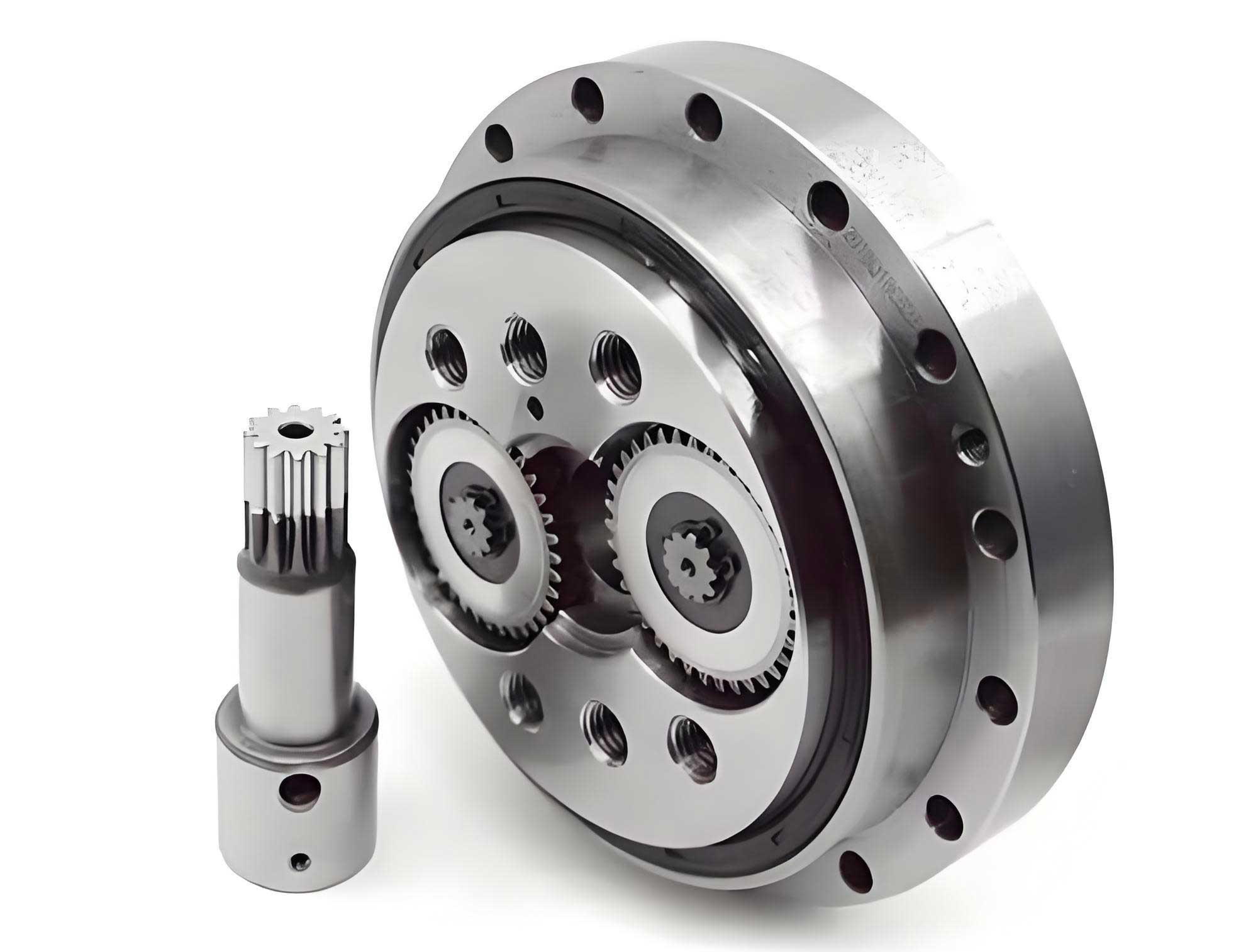
To understand the current state, let me first review domestic research on RV reducers. Studies have covered areas like meshing theory, transmission accuracy, dynamic characteristics, transmission efficiency, and meshing stiffness. For instance, in meshing theory, researchers have derived general equations for the cycloidal gear profile, considering modifications such as equidistant and shift-distance corrections. A universal equation for the cycloidal gear tooth profile can be expressed as:
$$ x = (R_p – r_p) \cos(\theta) + a \cos((1 – i)\theta) – \Delta x $$
$$ y = (R_p – r_p) \sin(\theta) – a \sin((1 – i)\theta) – \Delta y $$
Here, $R_p$ is the pin circle radius, $r_p$ is the pin radius, $a$ is the eccentricity, $i$ is the transmission ratio, $\theta$ is the rotation angle, and $\Delta x$ and $\Delta y$ represent modification terms. This equation accounts for various design parameters that influence the performance of the RV reducer. Research has also explored the parametric design of tooth profiles and the optimization of modification amounts to enhance transmission smoothness and reduce wear.
In terms of transmission accuracy, studies have analyzed errors stemming from manufacturing and assembly processes. A probabilistic model for transmission error in RV reducers can be given by:
$$ \Delta \phi = \sqrt{ \sum_{k=1}^{n} \left( \frac{\partial f}{\partial e_k} \sigma_{e_k} \right)^2 } $$
where $\Delta \phi$ is the output angular error, $e_k$ are error sources like pin circle radius error or cycloidal gear modification errors, and $\sigma_{e_k}$ are their standard deviations. This highlights the sensitivity of the RV reducer to dimensional tolerances. Dynamic analyses have used finite element methods and multi-body dynamics simulations to study natural frequencies and vibration modes. For example, the equation of motion for an RV reducer system can be written as:
$$ M \ddot{x} + C \dot{x} + K x = F(t) $$
with $M$, $C$, and $K$ being mass, damping, and stiffness matrices, respectively. These studies reveal that factors like bearing stiffness and shaft flexibility critically affect the dynamic response of the RV reducer.
Despite these academic advances, practical implementation for mass production faces significant barriers. Below, I delve into the four key problems, using tables and formulas to elucidate each.
1. Lack of National Standards for Design, Manufacturing, and Inspection
The absence of unified national standards for RV reducers in China creates inconsistencies in quality and interoperability. Without standardized specifications for dimensions, tolerances, materials, and testing procedures, manufacturers develop proprietary standards, leading to fragmentation. This hampers the supply chain and makes it difficult to compare products. A national standard should cover aspects like gear geometry, backlash limits, load ratings, and efficiency metrics. For instance, backlash in an RV reducer is crucial for robotic precision and can be defined as:
$$ \beta = \frac{360}{N} \left( \sum \delta_i \right) $$
where $\beta$ is the backlash in arcminutes, $N$ is the number of teeth, and $\delta_i$ are individual tooth errors. Standardizing such parameters would ensure consistency. Table 1 summarizes potential areas for standardization in RV reducer production.
| Area | Standardization Needs | Impact on Mass Production |
|---|---|---|
| Design | Tooth profile equations, modification limits, material grades | Ensures compatibility and performance predictability |
| Manufacturing | Tolerances for key parts (e.g., cycloidal gears, pins) | Reduces assembly issues and improves yield rates |
| Inspection | Test methods for transmission error, efficiency, lifespan | Facilitates quality control and benchmarking |
| Assembly | Procedures for preload adjustment and lubrication | Enhances reliability and reduces variability |
The development of such standards requires collaboration between academia, industry, and government bodies. Recent efforts, like the drafting of a national standard for precision cycloidal reducers, are steps forward but progress slowly due to technical complexities and limited data from mass production.
2. Specialized Manufacturing Equipment for Key Components
The RV reducer’s high precision demands micron-level accuracy in components like cycloidal gears, pin housings, crankshafts, and support plates. General-purpose machine tools, even high-end imports, are often inadequate for batch production due to low efficiency and cumulative errors. For example, cycloidal gears are typically cut using slow wire electrical discharge machining (EDM), which introduces errors from wire deflection and step accumulation. The tooth profile error $\epsilon_t$ can be modeled as:
$$ \epsilon_t = \sum_{j=1}^{m} \delta_j + \Delta_{wear} $$
where $\delta_j$ are incremental errors per cut, and $\Delta_{wear}$ accounts for tool wear. This results in poor meshing and reduced lifespan of the RV reducer. Specialized equipment, such as dedicated hobbing or grinding machines for cycloidal gears, is essential. These machines use generating methods that improve consistency and efficiency. The hobbing process for cycloidal gears involves a theoretical gear train relationship:
$$ \frac{\omega_c}{\omega_h} = \frac{Z_h}{Z_c} $$
where $\omega_c$ and $\omega_h$ are angular velocities of the cycloidal gear and hob, and $Z_h$ and $Z_c$ are their tooth numbers. However, designing such equipment requires advanced knowledge of cycloidal geometry and dynamics. Table 2 compares different manufacturing methods for cycloidal gears in RV reducers.
| Method | Precision (μm) | Efficiency (parts/hour) | Suitability for Mass Production |
|---|---|---|---|
| Slow Wire EDM | 5-10 | 1-2 | Low (prototyping only) |
| Form Grinding | 2-5 | 3-5 | Moderate (requires frequent dressing) |
| Generative Hobbing | 1-3 | 10-20 | High (ideal for batches) |
| Additive Manufacturing | 20-50 | Varies | Low (for research only) |
Investing in specialized equipment could reduce costs per unit and improve the competitiveness of domestic RV reducers. However, the high initial investment and need for custom tooling (e.g., cycloidal hobs or grinding wheels) pose challenges. Research into cost-effective manufacturing technologies is thus critical for the RV reducer industry.
3. Wear and Lubrication Issues
Wear is a major factor limiting the lifespan of RV reducers, particularly at contact points like pins, cycloidal gear teeth, and needle bearings in crankshafts. Domestic RV reducers often exhibit rapid wear due to suboptimal surface finishes, material properties, and lubrication. The wear rate $W$ can be described by Archard’s equation:
$$ W = k \frac{F_n L}{H} $$
where $k$ is a wear coefficient, $F_n$ is the normal load, $L$ is the sliding distance, and $H$ is the material hardness. In an RV reducer, the sliding-rolling contact in the cycloidal drive complicates this, as the contact stress $\sigma_c$ follows Hertzian theory:
$$ \sigma_c = \sqrt{ \frac{F_n E^*}{\pi R^*} } $$
with $E^*$ as the equivalent elastic modulus and $R^*$ as the equivalent radius of curvature. Poor lubrication exacerbates wear, especially since RV reducers use grease lubrication due to their sealed structure, leading to heat buildup. The temperature rise $\Delta T$ can be approximated by:
$$ \Delta T = \frac{P_{loss}}{h A} $$
where $P_{loss}$ is power loss from friction, $h$ is the heat transfer coefficient, and $A$ is the surface area. This heat accelerates grease degradation and component wear. To address this, studies on wear mechanisms and lubricant selection are needed. Table 3 lists common wear points in an RV reducer and potential mitigation strategies.
| Component | Wear Mechanism | Potential Solutions |
|---|---|---|
| Cycloidal Gear Teeth | Pitting and abrasion from cyclic contact | Surface hardening (e.g., nitriding), optimized tooth profile |
| Pins | Fretting and fatigue wear | Use of coated pins, improved alignment |
| Crankshaft Needle Bearings | High-speed rolling contact fatigue | Advanced bearing materials, better grease circulation |
| Housing Interfaces | Micro-motion and corrosion | Sealing improvements, corrosion-resistant alloys |
Furthermore, lubrication grease must have high thermal stability and anti-wear additives. Research into synthetic greases with solid lubricants (e.g., MoS2) could enhance the performance of RV reducers. Experimental validation of wear models under realistic loading conditions is essential to guide material and lubrication choices.
4. Intelligent Inspection and Assembly Systems
The RV reducer’s statically indeterminate structure, with multiple interdependent parts, requires precise assembly to achieve backlash under 1 arcminute. Random assembly of components within tolerance ranges often leads to cumulative errors and low yield rates. An intelligent system that measures each part and selects optimal combinations based on digital models can improve this. The assembly error $\Delta_A$ can be expressed as a function of part deviations:
$$ \Delta_A = f(\delta_1, \delta_2, \ldots, \delta_n) $$
where $\delta_i$ are deviations of individual components. Using optimization algorithms like genetic algorithms, one can maximize the number of compliant assemblies. For example, the objective function for selecting parts might be:
$$ \text{Minimize } |\Delta_A – \Delta_{target}| $$
subject to tolerance constraints. Such systems rely on a digital twin of the RV reducer, incorporating dimensional data from coordinate measuring machines (CMMs) or optical scanners. Table 4 outlines a framework for intelligent assembly of RV reducers.
| Step | Process | Technology Used |
|---|---|---|
| 1. Part Measurement | Record actual dimensions of each component (e.g., cycloidal gear, pins, housing) | CMM, laser scanning, vision systems |
| 2. Data Storage | Assign unique IDs and store dimensions in a database | SQL databases, cloud storage |
| 3. Optimization | Use algorithms to find part combinations that minimize cumulative error | Genetic algorithms, Monte Carlo simulation |
| 4. Assembly Guidance | Direct workers or robots to pick specific parts for assembly | AR interfaces, automated pick-and-place |
| 5. Verification | Test assembled RV reducer for backlash, efficiency, and noise | Integrated test benches, sensors |
Implementing such a system requires investment in digital infrastructure and software, but it can significantly increase yield. Studies show that selective assembly can boost合格品 rates from 55% to 90% for RV reducers. This approach aligns with Industry 4.0 trends, enabling traceability and continuous improvement in manufacturing.
In addition to these four challenges, other factors like material science and thermal management play roles. For instance, the choice of steel alloys for cycloidal gears affects both machining and wear resistance. Heat treatment processes like carburizing or induction hardening must be optimized to balance toughness and hardness. The residual stress $\sigma_{res}$ after heat treatment can influence fatigue life and is given by:
$$ \sigma_{res} = E \alpha \Delta T $$
where $E$ is Young’s modulus, $\alpha$ is the thermal expansion coefficient, and $\Delta T$ is the temperature change during quenching. Computational models can help predict these effects for RV reducer components.
Moreover, the integration of RV reducers into robotic systems requires consideration of external loads and environmental conditions. The dynamic torque $T_d$ on an RV reducer in a robot joint can be estimated as:
$$ T_d = J \ddot{\theta} + B \dot{\theta} + T_{load} $$
with $J$ as inertia, $B$ as damping, and $T_{load}$ as the external load. This affects the design criteria for mass-produced RV reducers, necessitating robust testing protocols.
To summarize, the mass production of RV reducers in China is hindered by a combination of standardization gaps, equipment limitations, wear problems, and assembly inefficiencies. Addressing these issues requires a multidisciplinary approach, combining mechanical engineering, materials science, and digital technologies. Future research should focus on developing affordable specialized machines, establishing comprehensive standards, and advancing lubrication science. Collaboration between universities and manufacturers will be key to transferring theoretical knowledge into practical solutions.
In conclusion, as someone engaged in this field, I believe that overcoming these challenges is essential for the autonomy of China’s robotics industry. The RV reducer is not just a component but a symbol of precision manufacturing capability. By tackling the key problems outlined above, we can pave the way for high-quality, cost-effective domestic RV reducers that compete globally. The journey involves continuous innovation and persistence, but the rewards—a stronger industrial base and technological leadership—are well worth the effort.