
The planetary roller screw assembly represents a pivotal advancement in high-performance electromechanical actuation, offering superior load capacity, stiffness, and longevity compared to traditional ball screw systems. Among its variants, the Differential Planetary Roller Screw Mechanism (DPRSM) presents a particularly ingenious design that merges threaded engagement with a grooved-ring drive to achieve unique kinematic properties. This analysis delves into the structural configuration, motion principles, and dynamic response of a novel DPRSM. We establish its three-dimensional model and perform comprehensive virtual prototyping to simulate its kinematic behavior and analyze the dynamic contact forces under varying operational loads. The insights gained provide a foundational understanding of its operational characteristics and performance limits.
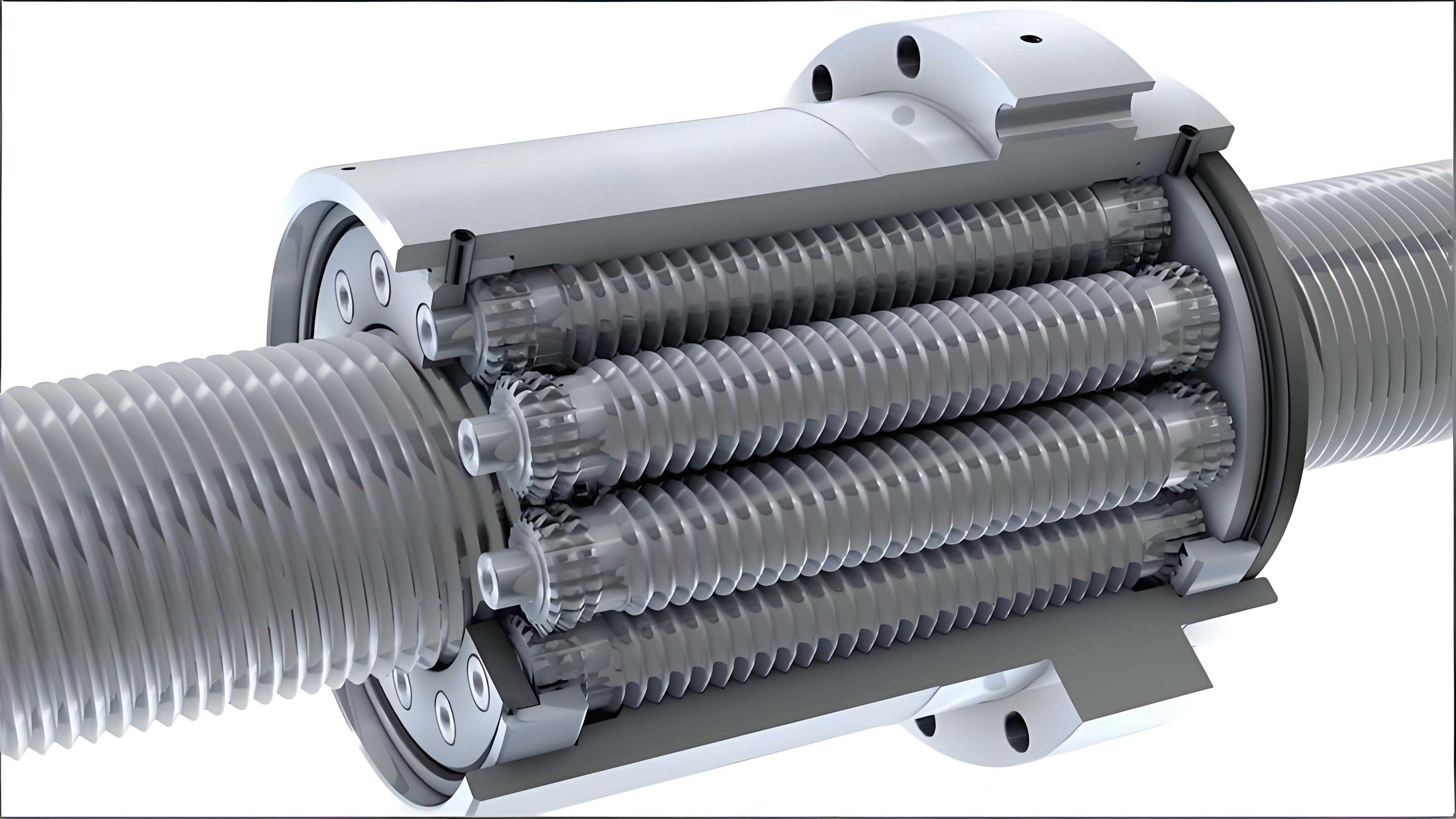
The core innovation of the differential planetary roller screw assembly lies in its segmented roller design. Unlike a standard planetary roller screw assembly where the roller has a uniform thread along its length, the DPRSM roller is divided into two distinct functional segments. The first segment features a threaded profile designed to mesh with the central screw. The second segment, however, is engineered with a ring-groove profile that engages with corresponding grooves inside the nut. This ring-groove interface has a zero helix angle, functioning analogously to an internal ring gear in a planetary gear set. It constrains the roller’s orientation, ensuring its axis remains parallel to the screw axis during operation, thus preventing tilt and ensuring pure rolling motion.
The transition between the threaded and grooved segments on the roller is critical to avoid spatial interference during assembly and operation. The design must account for the phase difference between multiple rollers arranged circumferentially. The axial distance \(L_i\) between the midpoints of the two functional segments on the i-th roller is governed by the following relationships, which depend on the hand of the thread on the roller’s threaded segment relative to the screw:
When the thread hands are opposite (recommended for maximizing engaged thread surface and load distribution):
$$ L_i = L_0 + (i – 1) \frac{\theta}{2\pi} P_s $$
When the thread hands are the same:
$$ L_i = L_0 + (i – 1) \frac{3\theta}{2\pi} P_s $$
where \(L_0\) is the distance for the first roller, \(\theta\) is the angular separation between roller axes around the screw, and \(P_s\) is the lead of the screw. The opposite-hand design is preferred as it minimizes the non-functional blank section on the roller, allowing more thread flanks to participate in load sharing, thereby enhancing the life of the planetary roller screw assembly.
The fundamental motion principle of this differential planetary roller screw assembly parallels that of a standard system but with a key twist introduced by the grooved segment. When the screw rotates as the input member, friction drives the rollers. Each roller consequently revolves around its own axis (spin) and, guided by the cage, orbits around the screw axis (revolution). Crucially, the engagement at the grooved segment with the nut, having no helix angle, does not inherently produce axial motion. The axial displacement of the roller is solely driven by its threaded engagement with the rotating screw. This displacement is then transmitted to the nut via the grooved interface, resulting in the linear output motion of the nut. The presence of two different effective leads on the roller (one finite, one zero) creates the “differential” effect, yielding a net nut translation that is a fraction of the screw’s nominal lead.
| Parameter | Screw | Roller (Threaded Segment) | Roller (Grooved Segment) | Nut |
|---|---|---|---|---|
| Pitch Diameter (mm) | 14.6 | 3.2 | 1.6 | – |
| Lead / Groove Spacing (mm) | 1.0 | 1.0 | 1.0 | 1.0 |
| Number of Rollers | 6 | |||
A kinematic model is developed to quantify this relationship. Let \(R_s\), \(R_{r1}\), and \(R_{r2}\) be the pitch radii of the screw, the threaded segment of the roller, and the grooved segment of the roller, respectively. Let \(\omega_s\), \(\omega_r\), and \(\omega_g\) denote the angular velocities of the screw, the roller’s revolution (orbit), and the roller’s spin about its own axis. The tangential velocity at the screw-roller mesh point \(v_B = R_s \omega_s\). The spin velocity of the roller \(v_g = (R_s + R_{r1}) \omega_g\). From the geometry of the roller’s motion as a planetary element, the velocity ratio is:
$$ \frac{v_g}{v_B} = \frac{R_{r2}}{R_{r1} + R_{r2}} $$
Solving for the roller’s spin velocity yields:
$$ \omega_g = \omega_s \frac{R_s R_{r2}}{(R_{r1} + R_{r2})(R_s + R_{r1})} $$
The axial translation velocity of the nut, \(v_n\), arises from the relative motion between the screw’s rotation and the roller’s spin at their threaded interface:
$$ v_n = \frac{(\omega_s – \omega_g) P_s}{2\pi} $$
This can be expressed in the standard form \(v_n = \frac{\omega_s}{2\pi} P\), where \(P\) is the effective lead of the differential planetary roller screw assembly. Substituting the expression for \(\omega_g\) provides the final kinematic equation:
$$ P = \left[ 1 – \frac{R_s R_{r2}}{(R_{r1} + R_{r2})(R_s + R_{r1})} \right] P_s $$
This equation confirms that the effective lead \(P\) is always less than the screw’s physical lead \(P_s\), providing a built-in speed reduction and force multiplication. This is a defining characteristic of this type of differential planetary roller screw assembly.
| Relationship | Equation |
|---|---|
| Roller Spin Velocity | $$ \omega_g = \omega_s \frac{R_s R_{r2}}{(R_{r1} + R_{r2})(R_s + R_{r1})} $$ |
| Nut Translation Velocity | $$ v_n = \frac{(\omega_s – \omega_g) P_s}{2\pi} $$ |
| Effective Lead of the Assembly | $$ P = \left[ 1 – \frac{R_s R_{r2}}{(R_{r1} + R_{r2})(R_s + R_{r1})} \right] P_s $$ |
To validate the kinematic analysis and explore dynamic behavior, a detailed 3D model of the differential planetary roller screw assembly was constructed based on the parameters in Table 1. This model was imported into a multi-body dynamics simulation environment. For the kinematic simulation, appropriate joints were defined: a revolute joint for the screw input, cylindrical joints between rollers and screw, spherical or revolute joints at the roller ends guided by the cage, and a translational joint for the nut’s output. Driving the screw at a constant rotational speed confirmed the predicted motions. The simulation results showed the screw rotating about its fixed axis, the nut translating smoothly along its axis, and the rollers executing a compound motion of spin and orbit. The traces of roller centers confirmed their orbital path with a diameter equal to the sum of the screw and roller threaded-segment pitch radii, while their axial displacement graphs were straight lines, indicating constant velocity. These observations perfectly aligned with the derived kinematic model, verifying its correctness for this differential planetary roller screw assembly.
The transition from pure kinematics to dynamics involves modeling the contact forces that transmit load through the mechanism. A dynamic virtual prototype was built by replacing ideal kinematic joints with force-based contacts at the screw-roller and roller-nut interfaces. The Impact Function Method in the solver was employed to model these contacts. The contact force \(F\) is calculated as:
$$ F = MAX \left\{ 0, \ K(q_0 – q)^e – C \cdot \frac{dq}{dt} \cdot STEP(q, q_0-d, 1, q_0, 0) \right\} $$
where \(K\) is the stiffness coefficient, \(q\) is the penetration depth, \(q_0\) is the reference contact distance, \(e\) is the force exponent, \(C\) is the damping coefficient, and \(d\) is the penetration depth for full damping. A unidirectional force (representing an axial load) was applied to the nut, and the screw was driven with a constant angular velocity.
The dynamic response was analyzed under three different load conditions: 10 kN, 20 kN, and 30 kN. The primary focus was on the contact forces along the axis of motion (z-axis) and in the radial plane (x and y axes). For a single roller, the contact force between the screw and the roller’s threaded segment showed significant, aperiodic fluctuation. The mean force increased proportionally with the applied load, but the amplitude of fluctuation also grew. For instance, at 10 kN load, the force fluctuated between 0.92 and 2.84 kN (amplitude ~1.92 kN). At 30 kN, the range increased to 3.58–6.56 kN (amplitude ~2.98 kN). This irregular oscillation indicates repeated impacts and collisions within the threaded mesh, a phenomenon that becomes more severe with higher loads, potentially accelerating wear in the planetary roller screw assembly.
In contrast, the contact force between the roller’s grooved segment and the nut exhibited a more regular, periodic pattern. While the mean force and fluctuation amplitude also increased with load, the cyclic nature was clearly linked to the roller’s orbital period. This demonstrates a key advantage of the ring-groove design in the differential planetary roller screw assembly: it provides a more stable and predictable load transmission path compared to the threaded interface, which is prone to chatter under high stress. Plotting the radial (x and y) contact forces over a full orbital period revealed sinusoidal waveforms for both contact pairs, directly correlating with the revolution of the roller around the screw.
Examining the aggregate behavior of all six rollers in the planetary roller screw assembly under different loads is crucial for assessing load sharing. The sum of the average z-axis contact forces for all screw-roller pairs was calculated. As shown in Table 3, this sum closely matched the externally applied nut load, with errors consistently below 1.5%. This validates the accuracy of the dynamic simulation model. More importantly, the data for all rollers under each load condition showed that the force was distributed relatively evenly among them. However, the time-domain plots revealed that as the load increased, the fluctuation amplitude for each individual contact increased. This trend signifies that while the static load is shared, the dynamic loading—characterized by impacts—becomes more pronounced for every roller in the system at higher operational loads.
| Applied Load (kN) | Sum of Avg. Screw-Roller Contact Force (kN) | Error (%) | Sum of Avg. Roller-Nut Contact Force (kN) | Error (%) |
|---|---|---|---|---|
| 10 | 9.911 | 0.89 | 9.869 | 1.31 |
| 20 | 19.722 | 1.39 | 19.926 | 0.37 |
| 30 | 30.055 | 0.18 | 29.906 | 0.31 |
The analysis of the differential planetary roller screw assembly yields several critical conclusions. First, the kinematic model derived from the geometry of the two-segment roller design accurately predicts the mechanism’s motion, as confirmed by virtual prototyping. The effective lead is indeed a fraction of the screw’s lead, providing inherent reduction. Second, dynamic analysis reveals a fundamental difference in the behavior of the two contact interfaces. The threaded screw-roller interface is susceptible to irregular, high-amplitude force fluctuations that worsen with increasing load. This is a primary source of dynamic instability and wear initiation within the planetary roller screw assembly. Third, the ring-groove roller-nut interface provides significantly more regular and stable force transmission, highlighting a key benefit of the DPRSM design. Finally, while the static load is shared fairly evenly among rollers, the dynamic load (impact intensity) escalates for all rollers as the external load rises. Therefore, defining a maximum operational load is essential not just based on static strength but also to limit dynamic impact forces that can compromise the longevity and precision of the differential planetary roller screw assembly. This work establishes a foundation for further research into optimization of contact profiles, preload effects, and advanced failure mode analysis for this sophisticated actuation system.