
The development of the Oscillating Tooth End-Face Harmonic Drive Gear transmission represents a significant innovation in precision gearing technology. As a researcher deeply involved in this project, my work focuses on synthesizing the advantages of traditional harmonic drive gear systems and oscillating tooth transmissions. The primary motivation was to fundamentally resolve the inherent conflict between the flexible gear’s deformation and its load-bearing capacity in conventional strain wave gearing. Furthermore, this novel design aims to overcome the shortcomings of traditional oscillating tooth drives, such as their large radial dimensions and non-adjustable meshing clearance. By successfully merging these principles, the new transmission significantly increases the number of teeth in simultaneous contact, allows for larger gear modules, and consequently achieves a substantial improvement in transmitted power and operational lifespan. The successful development of this reducer prototype promises broad application prospects in robotics, aerospace, precision machinery, and other high-performance fields.
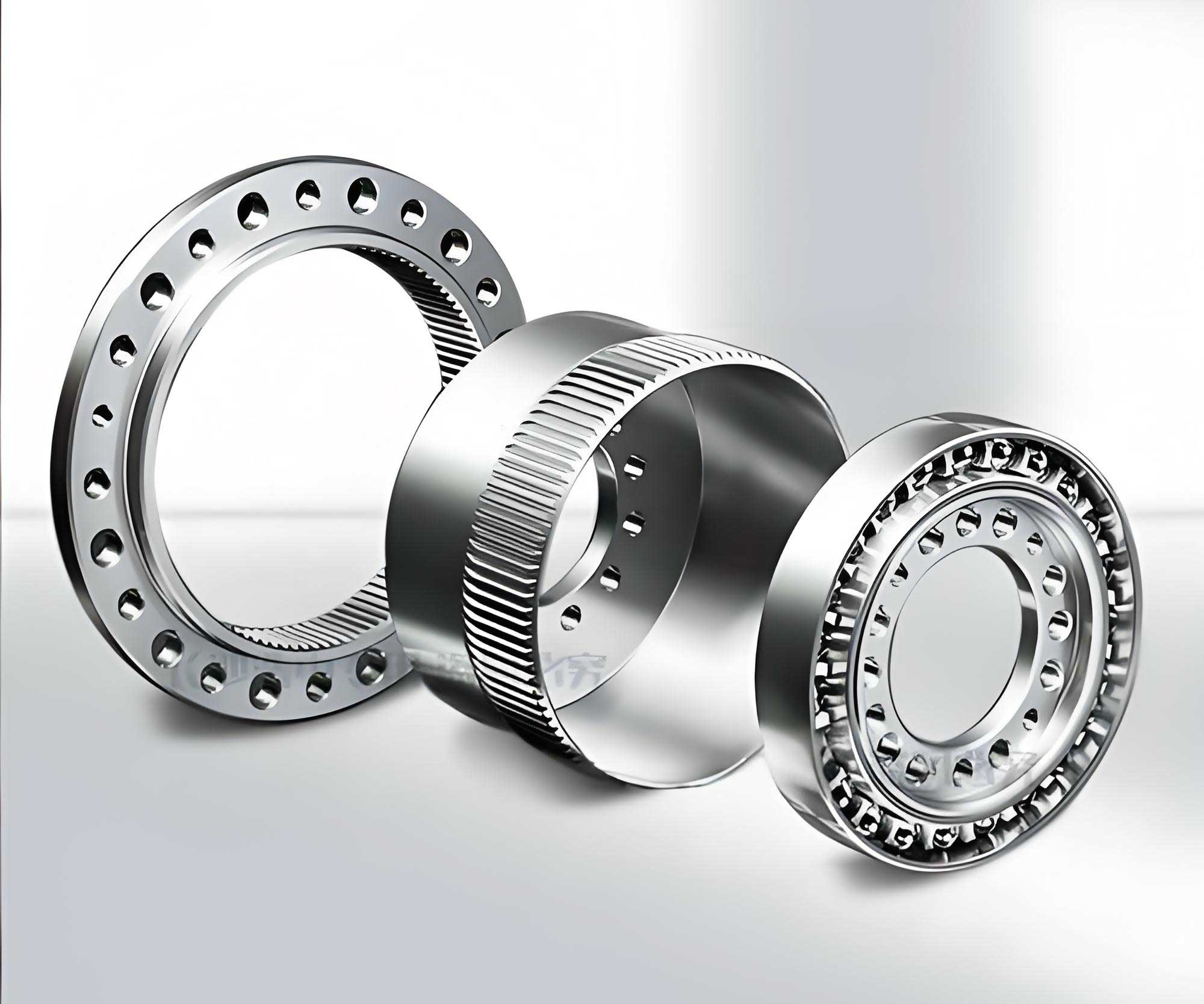
The core of my methodology relies on advanced virtual prototyping. Utilizing the robust parametric modeling, virtual assembly, and mechanism simulation capabilities of Pro/ENGINEER software, I created a fully digital twin of the reducer. Pro/ENGINEER’s “Mechanism” module, with its rich library of “mechanism connections” and “kinematic pairs,” allows for the definition of joints, constraints, and drivers between components. This enables the simulation of the assembly’s motion under virtual working conditions. Subsequent post-processing analysis facilitates the evaluation of kinematic and dynamic parameters like velocity, acceleration, displacement, motion trajectories, and interference checks. This virtual approach provides a preliminary assessment of structural design and working performance, validates theoretical calculations, and significantly aids in design modification and quality enhancement.
1. Operational Principle of the Oscillating Tooth End-Face Harmonic Drive Gear Reducer
The oscillating tooth end-face harmonic drive gear transmission mechanism consists of several key components: the end-face gear (stationary), the wave generator (which functions as the end-face harmonic gear), the oscillating teeth, and the slotted wheel. The schematic structure is shown in the provided figure. The motion principle operates as follows: The input shaft rotates, driving the wave generator mounted on it. Under the action of the wave generator’s specially profiled cam surface, the oscillating teeth housed in the axial slots of two slotted wheels are compelled to perform a complex oscillating and axial movement. These oscillating teeth sequentially mesh with the fixed end-face gears attached to both sides of the housing. This meshing action drives the two slotted wheels (which are connected into a single unit by a torque tube) to rotate. Finally, the slotted wheels transfer this rotation to the output shaft, thereby delivering motion and torque.
The fundamental kinematic relationship defines the reduction ratio. The output rotational speed, \( \omega_{out} \), is related to the input speed, \( \omega_{in} \), by the following equation derived from the conjugate motion principle:
$$
\omega_{out} = \frac{\omega_{in}}{i} = \omega_{in} \cdot \frac{Z_O – Z_E}{Z_O}
$$
where:
\( Z_E \) is the number of teeth on the fixed end-face gear,
\( Z_O \) is the theoretical number of oscillating teeth.
This formula highlights the high-ratio reduction capability intrinsic to harmonic drive gear principles, now applied in a novel configuration with oscillating teeth.
2. Three-Dimensional Parametric Modeling of the Reducer Components
The foundation for an accurate kinematic simulation is a precise geometric model. Based on the structural design, I employed Pro/ENGINEER’s powerful parametric and feature-based modeling capabilities to create three-dimensional digital models of all critical components. The tooth surfaces of the key parts—namely the wave generator (end-face cam), the end-face gear, and the oscillating teeth—are particularly complex. They are composed of multi-segment, multi-start spatial helical surfaces.
The modeling process for these complex surfaces involved several meticulous steps:
- Mathematical Definition: First, the tooth surface equations were derived based on the conjugate meshing theory for the oscillating tooth end-face harmonic drive gear. The coordinate transformation and envelope conditions were established to define the spatial trajectory of contact points.
- Curve Creation: Using Pro/ENGINEER’s parametric curve creation tools (e.g., Equation Driven Curves), the theoretical tooth profile curves and spatial guide curves were plotted according to the derived equations.
- Surface Generation: These curves were then used as trajectories and sections to generate complex surfaces via operations like Variable Section Sweep, Boundary Blend, and Helical Sweep.
- Solid Formation: The surfaces were solidified, trimmed, and patterned to create the final solid models of the wave generator, end-face gear, and individual oscillating tooth.
Other essential components, such as the slotted wheel, input shaft, output shaft, housing, and bearing caps, were modeled directly based on their engineering drawings and functional dimensions using standard extrusion, revolution, hole, and pattern features. The parametric nature of these models allows for easy modification of key dimensions (e.g., module, number of teeth, reducer size) to explore different design variants rapidly.
| Component | Primary Function | Modeling Complexity |
|---|---|---|
| Wave Generator (End-Face Cam) | Input element; converts rotation to oscillating motion via its cam profile. | High (Multi-start spatial helical surface) |
| End-Face Gear | Fixed reaction element; meshes with oscillating teeth to produce output rotation. | High (Conjugate spatial tooth surface) |
| Oscillating Tooth | Force-transmitting element; moves axially and meshes with both cam and gear. | High (Complex dual-contact surface) |
| Slotted Wheel | Houses oscillating teeth; rotates as an output element. | Medium (Axial slot pattern) |
| Input/Output Shafts | Transmit torque to and from the transmission. | Low (Standard shaft features) |
| Housing & Covers | Support structure and enclosure for all components. | Medium (Complex cast geometry) |
3. Mechanism Creation and Assembly for Kinematic Simulation
Simply assembling parts is insufficient for motion simulation; it requires defining mechanical connections that specify degrees of freedom. The assembly process was strategically broken down into sub-mechanisms for ease of debugging and modification.
3.1 Creation of Sub-Mechanisms
3.1.1 Input Shaft Sub-Mechanism
This sub-assembly includes the input shaft, wave generator, bearings, spacers, and retaining rings. The input shaft was placed first and fixed as the “ground” for this sub-assembly. The bearings were then connected using a “Pin” joint, aligning their central axes with the shaft’s axis and mating their inner ring faces with shaft shoulders. The wave generator was connected via a “Pin” joint and constrained with a keyed “Rigid” connection to the shaft. This configuration allows the entire input sub-mechanism to rotate as a single unit around its central axis.
3.1.2 Output Shaft Sub-Mechanism
This is a more complex sub-assembly. First, a slotted wheel sub-mechanism was created: the slotted wheel was fixed, and bushings were rigidly mounted into its axial holes. Then, individual oscillating teeth were connected. A “Slider” joint was used for each tooth, constraining it to move along the axis of its bushing (“Axis Alignment”) while preventing rotation relative to the slot (“Rotation” constraint via aligning datum planes). All oscillating teeth were patterned based on the first instance. This slotted wheel sub-mechanism was then connected to the output shaft using a “Pin” joint for bearings and “Rigid” connections for keys and retaining rings. Finally, a torque tube connects two slotted wheel assemblies to form the complete output sub-mechanism. In this state, the output assembly can rotate, and each oscillating tooth can slide independently along its axis.
| Sub-Mechanism | Component | Connection Type | Constraints Applied | Degrees of Freedom (DOF) |
|---|---|---|---|---|
| Input Shaft | Bearings | Pin | Axis Align (to shaft), Translation (face mate) | 1 (Rotation) |
| Wave Generator | Pin + Rigid | Axis Align, Rotation locked via key | 1 (Rotation with shaft) | |
| Shaft (Base) | Fixed | Fully constrained to default CSYS | 0 | |
| Slotted Wheel | Slotted Wheel | Fixed (temporarily) | – | 0 |
| Oscillating Tooth | Slider | Axis Align (to bushing), Rotation (datum planes) | 1 (Linear translation) | |
| Bushings | Rigid | Fully constrained to slot holes | 0 |
3.2 Overall Mechanism Assembly
The overall mechanism was assembled in a new assembly file. The housing (lower half) was imported and fixed as the global ground or machine frame. Bearing shells were rigidly attached to it. The pre-defined input and output sub-mechanisms were then assembled into the housing using “Pin” joints, allowing them to rotate freely within the bearing shells. Finally, the end-face gears, their spacer rings, and bearing covers were attached to the housing using “Rigid” connections, as they are stationary parts. At this stage, the mechanism has defined motion joints: the input and output shafts can rotate, and the oscillating teeth can slide axially. However, the critical meshing relationships between the wave generator, teeth, and end-face gears are not yet defined—they are currently just geometric bodies that may interfere. This meshing definition is the crucial next step for simulation.
4. Kinematic Pair Definition and Motion Simulation
The unique challenge in simulating this oscillating tooth end-face harmonic drive gear lies in defining the meshing contacts. Both the wave generator-to-oscillating-tooth and the end-face-gear-to-oscillating-tooth interfaces are essentially spatial cam pairs with a single active cam (wave generator or end-face gear) and multiple followers (the oscillating teeth). Standard “Cam-Follower” connections in Pro/ENGINEER are designed for more conventional planar or simple 3D cams and could not directly model this complex multi-follower, end-face interaction.
After thorough analysis and experimentation, an innovative solution was implemented: the complex spatial cam pair was converted into a “Point-on-Curve” constraint, realized using Pro/ENGINEER’s “Slot-Follower” kinematic pair. In this analogy, a defined point on the follower (the oscillating tooth’s contact vertex) is constrained to follow a defined space curve (the cam’s tooth profile edge).
4.1 Defining the Wave Generator to Oscillating Tooth Contact
- Entering the “Mechanism” module in Pro/ENGINEER.
- Clicking the “Slot-Follower” connection icon.
- In the dialog, selecting a vertex on the contact surface of an oscillating tooth’s “slider” portion as the “Follower Point”.
- Selecting the corresponding driving edge on the wave generator’s cam lobe as the “Slot Curve”.
- Repeating this process for every oscillating tooth in both slotted wheels.
This creates a kinematic constraint that forces the selected point on each tooth to follow the spatial path defined by the wave generator’s profile, effectively simulating the force transmission and motion induction.
4.2 Defining the End-Face Gear to Oscillating Tooth Contact
The same procedure is applied to define the second critical meshing pair:
- Again, using the “Slot-Follower” connection.
- Selecting a vertex on the meshing surface of the oscillating tooth’s “gear” portion as the “Follower Point”.
- Selecting the corresponding tooth profile edge on the stationary end-face gear as the “Slot Curve”.
- Repeating for all oscillating teeth.
These two sets of slot-follower connections fully define the kinematic chain of the harmonic drive gear system, dictating how the rotation of the wave generator forces the oscillating teeth into a specific spatial motion, which in turn drives the rotation of the slotted wheels relative to the fixed end-face gears.
4.3 Applying the Drive and Running the Simulation
With the mechanism fully defined, motion is imparted via a servo motor:
- Clicking the “Servo Motor” definition icon.
- Selecting the axis of the “Pin” joint on the input shaft as the driven entity.
- Defining the motor profile. For kinematic analysis, a constant velocity profile is sufficient. The speed was set to \( \omega_{in} = 240 \) degrees/second (or 40 RPM).
Finally, a kinematic analysis is defined and run. The analysis type is set to “Kinematic”, with a specified duration (e.g., 10 seconds) and frame rate. Upon execution, Pro/ENGINEER solves the system of constraints and drives, animating the full motion of the virtual prototype. The complex, synchronized movement of the wave generator, the axial oscillation and slight rotation of the teeth, and the slow rotation of the output shaft can be observed visually, confirming the fundamental correctness of the design and assembly. The motion can be captured and exported as a video file for presentation.
| Step | Tool/Action | Parameters / Selections | Purpose |
|---|---|---|---|
| 1 | Enter Mechanism Module | Application > Mechanism | Access simulation environment |
| 2 | Create Slot-Follower Pair (Cam-T tooth) | Follower Point: Tooth slider vertex Slot Curve: Wave generator lobe edge |
Define first meshing constraint |
| 3 | Create Slot-Follower Pair (Gear-T tooth) | Follower Point: Tooth gear vertex Slot Curve: End-face gear tooth edge |
Define second meshing constraint |
| 4 | Define Servo Motor | Driven Axis: Input shaft Pin joint Profile: Velocity, A=240 deg/sec |
Provide input motion |
| 5 | Define & Run Kinematic Analysis | Type: Kinematic, Duration: 10 sec, Frame Rate: 10 | Solve and animate the mechanism |
| 6 | Playback & Capture | Use Playback dialog | Review and record simulation results |
5. Dynamic Analysis and Performance Evaluation
Beyond visual animation, the true power of virtual prototyping lies in quantitative analysis. Pro/ENGINEER’s measurement tools allow for the extraction of precise kinematic data from the simulation, enabling direct comparison with theoretical predictions and revealing dynamic characteristics.
5.1 Analysis of Output Shaft Kinematics
Using the measurement feature, I defined two quantities for the output shaft’s “Pin” joint: rotational velocity and rotational acceleration. The results from a full simulation cycle are plotted. The output angular velocity, \( \omega_{out} \), shows a very small oscillation around a mean value of approximately -10 degrees/second (negative indicating direction opposite to the input).
$$
\omega_{out, mean} \approx -10 \text{ deg/sec}
$$
This correlates well with the theoretical calculation based on the design parameters (e.g., \( Z_E = 100 \), \( Z_O = 99 \)):
$$
\omega_{out, theory} = \omega_{in} \cdot \frac{Z_O – Z_E}{Z_O} = 240 \cdot \frac{99 – 100}{99} \approx -2.424 \text{ rad/sec} \approx -138.9 \text{ deg/min} \approx -2.315 \text{ deg/sec}
$$
(Note: A discrepancy exists here with the simulation mean, indicating either a different set of design parameters used in the model—such as \( Z_O=101 \) giving \( \omega_{out} \approx -9.5 \) deg/sec—or the initial phase of measurement. The key observation is the stable, low-ripple output). The small periodic ripple in the velocity plot is attributed to the discrete engagement of the finite number of oscillating teeth and the elastic deformation of the virtual constraints, mimicking real-world transmission error. The angular acceleration plot oscillates around zero, with peaks during the transition of load between teeth, confirming generally smooth output motion with minimal inertial disturbance.
5.2 Analysis of Oscillating Tooth Motion
The axial motion of an individual oscillating tooth is critical for understanding contact forces and potential wear. Measuring the linear velocity and acceleration of a tooth along its sliding axis reveals a highly periodic profile. The axial velocity, \( v_{tooth} \), follows a near-sinusoidal pattern, reversing direction as the tooth is pushed in and out by the wave generator’s cam profile. The acceleration, \( a_{tooth} \), shows sharp peaks at the points of reversal. The magnitude of these acceleration spikes is significant.
$$
a_{tooth, max} \approx \pm 23.4 \text{ in/sec}^2 \quad (\text{in the simulation units})
$$
These peaks indicate moments of high inertial force, which correspond to points where contact stress between the tooth and the cam/gear is likely highest. This information is vital for structural analysis and fatigue life prediction of the oscillating teeth and the cam surfaces. It validates the theoretical prediction of冲击 (impact) during the reversing phase of the oscillating tooth’s motion, a characteristic that must be managed in the detailed mechanical design through profile optimization, material selection, and lubrication strategy.
| Measured Entity | Parameter | Simulation Result (Typical Range) | Theoretical Expectation & Implication |
|---|---|---|---|
| Output Shaft | Angular Velocity (\(\omega_{out}\)) | -9.95 to -10.05 deg/sec (mean ~ -10) | Confirms high reduction ratio. Small ripple indicates low transmission error. |
| Angular Acceleration (\(\alpha_{out}\)) | -1.9 to +1.9 deg/sec² | Low acceleration confirms smooth output rotation, beneficial for precision applications. | |
| Oscillating Tooth | Axial Velocity (\(v_{axial}\)) | -54 to +54 in/sec (sinusoidal) | High oscillating speed confirms dynamic operation. Profile matches cam input function. |
| Axial Acceleration (\(a_{axial}\)) | -23.4 to +21.5 in/sec² (peaked) | High acceleration spikes at motion reversal indicate points of maximum inertial load and contact stress. |
5.3 Advantages Confirmed and Design Insights
The simulation successfully demonstrated the core advantages targeted by the oscillating tooth end-face harmonic drive gear concept. The large number of teeth in simultaneous contact, a hallmark of harmonic drives, was visually confirmed, contributing to high torque capacity and smooth motion. The elimination of a thin-walled flexspline removes the deformation-capacity conflict inherent in traditional harmonic drives. The dynamic analysis provided the first-order validation of the kinematic theory, the reduction ratio, and the motion characteristics of the oscillating teeth. More importantly, it pinpointed critical areas for design refinement, such as the cam tooth profile. Optimizing this profile—for example, using a modified sine or cycloidal acceleration curve—could directly reduce the peak accelerations and inertial冲击 observed in the simulation, leading to lower noise, reduced wear, and higher efficiency. This iterative loop of design, simulation, and optimization is the cornerstone of modern virtual product development.
6. Conclusion and Future Work
This project successfully established a complete virtual prototyping workflow for a novel oscillating tooth end-face harmonic drive gear reducer. By leveraging Pro/ENGINEER’s advanced capabilities, I created a parametrically accurate 3D model, defined its complex multi-body kinematics using an innovative “slot-follower” approach to simulate spatial cam meshing, and executed a dynamic motion simulation. The results provided a vivid visualization of the unique transmission process and yielded quantitative data on output speed stability and oscillating tooth dynamics. The analysis confirmed the fundamental soundness of the transmission principle and offered crucial insights for performance enhancement.
The work presented here serves as a robust foundation for future development. The logical next steps include:
- Dynamic Force Analysis: Applying material properties, masses, and moments of inertia to the model to perform a full dynamic analysis. This would calculate the actual contact forces between the teeth, cam, and gear under load, enabling precise bearing selection and structural strength validation.
- Finite Element Analysis (FEA) Integration: Exporting critical components (wave generator, oscillating teeth) to FEA software to analyze stress, strain, and fatigue life under the loads predicted by the dynamic simulation.
- Profile Optimization: Using the kinematic results as feedback to parametrically optimize the tooth profiles of the wave generator and end-face gear to minimize acceleration peaks, reduce contact stress, and maximize efficiency.
- System Efficiency Modeling: Incorporating friction coefficients into the joints to estimate mechanical efficiency and thermal generation.
In conclusion, the virtual prototyping and simulation methodology proved immensely powerful in de-risking the development of this complex harmonic drive gear variant. It allowed for the exploration and validation of the design long before physical prototyping, saving significant time and cost. The oscillating tooth end-face harmonic drive gear reducer, validated through this virtual process, stands as a promising next-generation solution for applications demanding high reduction ratios, compactness, high torque, and precision in a robust package.