
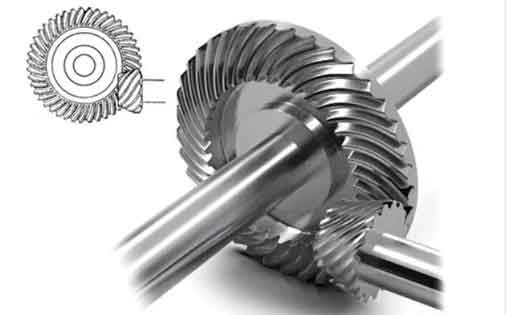
Spiral bevel gears are critical components in power transmission systems, renowned for their high load capacity, smooth operation, and efficiency. They are extensively used in automotive, aerospace, and heavy machinery industries. Traditional manufacturing of spiral bevel gears relies on specialized gear cutting machines, such as the Gleason No. 116 hypoid generator, which employs tilting methods for pinion machining. However, with the evolution of computer numerical control (CNC) technology, five-axis machining centers offer enhanced flexibility, accuracy, and efficiency for producing complex geometries. In this study, I present a novel kinematic transformation method that enables the machining of spiral bevel gears on a dual-table five-axis machining center by emulating the motion of a traditional tilting-type spiral bevel gear milling machine. This approach leverages coordinate system alignments and real-time motion conversion to achieve gear tooth profiles identical to those produced by conventional methods.
The core challenge lies in translating the intricate motions of a dedicated spiral bevel gear cutter to a generic five-axis machine tool. My method involves establishing kinematic models for both machine types, defining a common reference coordinate system aligned with the gear blank, and solving for the five-axis machine’s axis movements to replicate the relative tool-workpiece pose and motion. This process ensures that the cutterhead’s orientation and position relative to the gear blank remain consistent across both platforms, thereby preserving the tooth geometry. The transformation is performed in real-time by discretizing the cutting process into numerous states, computing corresponding axis positions, and generating CNC code for execution. Validation via VERICUT simulation confirms the feasibility and accuracy of this approach for machining spiral bevel gears.
To elucidate the methodology, I begin by detailing the kinematic model of the tilting-type spiral bevel gear milling machine, specifically the Gleason No. 116 model. This machine features multiple adjustable components: a cradle, eccentric drum, swivel, tilting body, cutterhead, bed saddle, rotary base, and work head. Each contributes to the relative motion between the cutterhead and the gear blank. I define a series of coordinate systems attached to these components to mathematically describe their interrelationships. The fixed coordinate system (Frame 0) is attached to the machine base, with its origin at the cradle axis. Subsequent frames are derived through sequential rotations and translations corresponding to machine settings like cradle angle \(Q_m\), eccentric angle \(\beta_m\), swivel angle \(\sigma_m\), and tilt angle \(\rho_m\). The cutterhead coordinate system (Frame 7) has its origin at the cutter tip circle center, with the z-axis normal to the cutter plane pointing toward the gear blank. Similarly, the gear blank coordinate system (Frame 11) is attached to the work head, incorporating adjustments such as machine center to back \(X_{b2}\), sliding base setting \(\delta_m\), horizontal offset \(X_2\), and vertical offset \(E\).
The transformation chain from the fixed frame to the cutterhead frame is expressed through homogeneous transformation matrices. For instance, the rotation matrix from Frame 5 to Frame 6 involves a fixed \(15^\circ\) rotation about the y-axis, and from Frame 6 to Frame 7 involves the tilt angle \(\rho_m\) about the z-axis. The composite transformation from Frame 0 to Frame 7 is:
$$ \mathbf{T}_0^7 = \mathbf{R}_0^1(Q_m) \mathbf{T}_1^2(K) \mathbf{R}_2^3(\beta_m) \mathbf{T}_3^4(-K) \mathbf{R}_4^5(\sigma_m) \mathbf{R}_5^6(15^\circ) \mathbf{R}_6^7(\rho_m) $$
where \(\mathbf{R}_i^j(\theta)\) denotes a rotation matrix about a specified axis by angle \(\theta\), and \(\mathbf{T}_i^j(d)\) denotes a translation along an axis by distance \(d\). The eccentric drum offset \(K\) is 111.125 mm for the Gleason No. 116. Similarly, the transformation from Frame 0 to the gear blank frame (Frame 11) is:
$$ \mathbf{T}_0^{11} = \mathbf{T}_0^8(X_{b2}) \mathbf{R}_8^9(90^\circ – \delta_m) \mathbf{T}_9^{10}(X_2) \mathbf{T}_{10}^{11}(E) $$
These transformations encapsulate the machine’s kinematic structure, enabling the calculation of the cutterhead’s pose relative to the gear blank for any given set of machine settings.
For the five-axis machining center with dual rotary tables (A and C axes), I establish a separate kinematic model. The machine fixed frame (Frame 0′) has its z-axis aligned with the spindle, pointing away from the workpiece. The cutterhead frame (Frame 2′) is attached to the spindle, with its origin at the cutter tip circle center and z-axis normal to the cutter plane pointing toward the gear blank. The workpiece is mounted on the rotary tables, and a reference frame (Frame 8′) is defined such that its origin coincides with the gear blank crossing point and its z-axis aligns with the gear blank axis, pointing from the cone apex to the base. This frame serves as the common reference or base coordinate system. The transformation from the cutterhead frame to the base frame on the five-axis machine is:
$$ \mathbf{T}_{2′}^{8′} = \mathbf{T}_{2′}^{1′}(z) \mathbf{R}_{1′}^{2′}(180^\circ) \mathbf{T}_{2′}^{3′}(x) \mathbf{T}_{3′}^{4′}(y) \mathbf{R}_{4′}^{5′}(-A) \mathbf{T}_{5′}^{6′}(-h) \mathbf{T}_{6′}^{7′}(H) \mathbf{R}_{7′}^{8′}(180^\circ) $$
where \(x, y, z\) are linear axis positions, \(A\) is the tilt angle of the rotary table, \(h\) is the machine constant (distance from A-axis to table top), and \(H\) is the sum of fixture height and gear blank installation height. The goal is to determine \(x, y, z, A,\) and the C-axis rotation \(C\) such that the relative cutterhead-gear blank pose and motion match those of the traditional machine.
To achieve this, I introduce an adjusted base coordinate system (Frame 12) in the traditional machine model. Frame 12 is derived by rotating Frame 11 about its z-axis by an angle \(\theta\) such that the x-axis of Frame 12 is perpendicular to the cutterhead’s z-axis (Frame 7’s z-axis). This ensures that the base frame’s orientation relative to the cutterhead is consistent with that in the five-axis machine, where the base frame’s x-axis is always perpendicular to the cutterhead’s z-axis due to machine construction. The angle \(\theta\) is solved from the condition:
$$ \mathbf{Z}_{7,12} \cdot \mathbf{X}_{12,12} = 0 $$
where \(\mathbf{Z}_{7,12}\) is the unit vector of the cutterhead z-axis expressed in Frame 12, and \(\mathbf{X}_{12,12}\) is the unit vector of Frame 12’s x-axis. This yields two potential solutions:
$$ \theta_1 = \arctan\left(\frac{e}{f}\right), \quad \theta_2 = \arctan\left(\frac{e}{f}\right) + \pi $$
with
$$ e = \sin \delta_m \sin \rho_m \left[ \sin \beta_m \sin(\sigma_m + Q_m) + \frac{1}{2} \sin \sigma_m \cos(\beta_m + Q_m)(\cos \rho_m – 1) \right] + \cos \delta_m \left( \cos^2 \frac{\pi}{12} \cos \rho_m – \sin^2 \frac{\pi}{12} \right) $$
$$ f = -\sin \rho_m \left[ \sin \beta_m \cos(\sigma_m + Q_m) + \frac{1}{2} \sin \sigma_m \sin(\beta_m + Q_m)(\cos \rho_m – 1) \right] $$
The correct \(\theta\) is selected by imposing the additional condition \(\mathbf{Z}_{7,12} \cdot \mathbf{Y}_{12,12} \leq 0\), ensuring uniqueness. With Frame 12 established, the angle between the cutterhead z-axis and the base frame z-axis is:
$$ \alpha = \arccos(\mathbf{Z}_{7,12} \cdot \mathbf{Y}_{12,12}) $$
Setting the five-axis machine’s A-axis angle to \(A = -\alpha\) aligns the cutterhead orientation relative to the base frame across both machines. Next, the cutterhead position relative to the base frame must be matched. The position vector from the base frame origin to the cutterhead origin in the traditional machine, expressed in Frame 12, is denoted as \(\mathbf{O}_{12}^{O_7}\). Equating this to the corresponding vector in the five-axis machine \(\mathbf{O}_{8′}^{O_{2′}}\) yields three scalar equations that solve for \(x, y, z\):
$$ x = E \sin \theta – X_{b2} \cos \theta \cos \delta_m + K \sin Q_m \sin \theta – K \cos Q_m \sin \delta_m \cos \theta + K \sin Q_m \cos \delta_m \cos \theta \cos \beta_m + K \cos Q_m \cos \delta_m \cos \theta \cos \beta_m $$
$$ y = -(H + h – X_2) \sin \alpha – E \cos \theta \cos \alpha – X_{b2} \sin \alpha \sin \delta_m \cos \theta – X_{b2} \cos \alpha \cos \delta_m + K \sin Q_m \cos \alpha \cos \theta – K \cos Q_m \sin \delta_m \cos \alpha \cos \theta – K \sin Q_m \sin \alpha \sin \delta_m + K \cos Q_m \sin \alpha \cos \delta_m \cos \beta_m + K \sin Q_m \cos \alpha \cos \delta_m \cos \theta \cos \beta_m + K \cos Q_m \cos \alpha \cos \delta_m \cos \theta \cos \beta_m $$
$$ z = (H + h – X_2) \cos \alpha – E \cos \theta \sin \alpha + X_{b2} \cos \alpha \sin \delta_m \cos \theta – X_{b2} \sin \alpha \cos \delta_m + K \sin Q_m \sin \alpha \cos \theta – K \cos Q_m \sin \delta_m \sin \alpha \cos \theta + K \sin Q_m \cos \alpha \sin \delta_m – K \cos Q_m \cos \alpha \cos \delta_m \cos \beta_m + K \sin Q_m \sin \alpha \cos \delta_m \cos \theta \cos \beta_m + K \cos Q_m \sin \alpha \cos \delta_m \cos \theta \cos \beta_m $$
These closed-form expressions provide the linear axis positions for the five-axis machine given the traditional machine settings \(Q_m, \beta_m, \sigma_m, \rho_m, \delta_m, X_{b2}, X_2, E,\) and \(K\).
The C-axis rotation handles the generating motion between the imaginary generating gear (cradle) and the gear blank. In the traditional machine, the ratio of cradle rotation \(\Delta Q\) to work rotation \(\Delta C\) is constant during cutting, defined by the gear ratio \(\eta\):
$$ \eta = \frac{\Delta Q}{\Delta C} = \frac{0.02 Z_t}{m_a} $$
where \(Z_t\) is the number of teeth on the gear being cut, and \(m_a\) is the gear ratio setting on the machine. For real-time transformation, the cutting process is discretized into \(n\) intervals between start cradle angle \(Q_1\) and end cradle angle \(Q_2\). The cradle increment per step is \(\Delta Q = (Q_2 – Q_1)/n\), and the corresponding work rotation increment on the five-axis machine is \(\Delta C = -\Delta Q / \eta\). However, because the base frame in the traditional machine rotates by \(\theta\) relative to the gear blank, an additional compensation is needed. For each step \(i\), the C-axis increment becomes:
$$ \Delta C_i = -\frac{\Delta Q}{\eta} – (\theta_i – \theta_{i-1}) $$
where \(\theta_i\) is the base frame rotation angle computed at step \(i\). This ensures that the relative rotational motion between cutterhead and gear blank is accurately replicated.
To demonstrate the method, I apply it to a practical example: machining a spiral bevel gear pinion with parameters listed in Tables 1 and 2. The machine settings for concave and convex flanks are given in Tables 3 and 4, and cutterhead parameters in Table 5. Using these inputs, I compute the five-axis machine trajectories for both flanks separately, generate G-code, and simulate the cutting process in VERICUT. The simulation model includes the gear blank, cutterhead, and machine kinematics, confirming that the tooth profiles match those produced by the traditional tilting method. The successful simulation validates the kinematic transformation approach for machining spiral bevel gears on five-axis centers.
| Parameter | Symbol | Value |
|---|---|---|
| Number of teeth | \(Z_t\) | 21 |
| Face width | \(B\) | 50.0000 mm |
| Mean spiral angle | \(\beta\) | 35.0000° |
| Mean cone distance | \(R_m\) | 160.1984 mm |
| Face angle | \(\delta_a\) | 39.2574° |
| Pitch angle | \(\delta\) | 35.9097° |
| Root angle | \(\delta_f\) | 32.5621° |
| Parameter | Symbol | Value |
|---|---|---|
| Face apex beyond crossing point | – | -3.2191 mm |
| Pitch apex beyond crossing point | – | 0 mm |
| Root apex beyond crossing point | – | -0.2939 mm |
| Pitch diameter | \(d_e\) | 217.2414 mm |
| Flank | Machine center to back \(X_{b2}\) (mm) | Sliding base setting \(\delta_m\) (°) | Horizontal offset \(X_2\) (mm) | Vertical offset \(E\) (mm) | Eccentric angle \(\beta_m\) (°) |
|---|---|---|---|---|---|
| Concave | 2.3302 (away) | 34.0748 | -7.9499 | 0 | 75.5315 |
| Convex | -6.6799 (toward) | 34.2470 | -7.8500 | 0 | 86.6479 |
| Flank | Cradle angle \(Q_m\) (°) | Swivel angle \(\sigma_m\) (°) | Tilt angle \(\rho_m\) (°) | Start cradle angle \(Q_1\) (°) | End cradle angle \(Q_2\) (°) | Gear ratio \(m_a\) |
|---|---|---|---|---|---|---|
| Concave | 112.3346 | 79.3098 | 5.8471 | 96.4084 | 126.2101 | 0.686298 |
| Convex | 105.9067 | 74.2995 | 6.5134 | 92.4273 | 120.4706 | 0.744805 |
| Cutter type | Nominal radius \(r_0\) (mm) | Inner blade tip radius \(r_x\) (mm) | Outer blade tip radius \(r_y\) (mm) | Blade edge width \(w\) (mm) | Inner blade angle \(\alpha_x\) (°) | Outer blade angle \(\alpha_y\) (°) | Blade height \(h_g\) (mm) |
|---|---|---|---|---|---|---|---|
| Outer cutter | 152.4000 | 142.5871 | 3.1410 | 21.9233 | 18.0846 | 19.7839 | 19.7839 |
| Inner cutter | 152.4000 | 161.8673 | 3.1422 | 21.9233 | 18.0846 | 19.7839 | 19.7839 |
The kinematic transformation method offers several advantages for manufacturing spiral bevel gears. First, it leverages the versatility of five-axis machining centers, which are more commonly available in modern workshops than dedicated gear cutters. Second, the real-time conversion allows for adaptive machining and potential integration with advanced CNC features like tool path optimization and compensation. Third, the approach can be extended to other gear types, such as hypoid gears, by adjusting the machine settings accordingly. However, challenges remain, including the need for precise calibration of machine parameters, handling of cutter wear, and ensuring surface finish quality. Future work could focus on error analysis, dynamic compensation, and integration with closed-loop control systems to enhance accuracy for high-performance spiral bevel gears.
In conclusion, I have developed a kinematic transformation framework that enables the machining of spiral bevel gears on five-axis machining centers by emulating the motions of traditional tilting-type gear cutting machines. The method establishes a common base coordinate system, solves for axis positions and orientations through coordinate transformations, and incorporates generating motion via gear ratio calculations. Simulation results confirm that the tooth profiles produced are consistent with those from conventional methods. This approach provides a flexible and efficient alternative for manufacturing spiral bevel gears, paving the way for broader adoption of multi-axis CNC technology in gear production. The ability to machine spiral bevel gears on standard five-axis centers can reduce reliance on specialized equipment, lower costs, and accelerate prototyping and production cycles in industries reliant on these critical components.