
In modern precision manufacturing, gear grinding serves as a critical process for achieving high accuracy and superior surface quality in gear production. Traditional methods, such as worm wheel grinding, rely on point contact principles, which result in limited effective grinding areas per generation cycle and potential issues like grinding cracks due to concentrated stress and heat. To address these limitations, this study explores a novel gear grinding approach based on line contact generation using staggered axis involute helical surfaces. By leveraging the line contact meshing mechanism, we aim to enhance the efficiency and quality of gear profile grinding, particularly for internal gears, which are challenging to process with conventional techniques.
The fundamental principle involves the line contact meshing of two involute helical surfaces under staggered axis conditions. Typically, helical gears with parallel axes achieve line contact, but when axes are staggered, point contact occurs. However, by constraining the meshing parameters, we can achieve line contact. Consider the meshing between a gear and an imaginary rack. The instantaneous contact line lies on the base cylinder’s tangent plane, and for line contact, the contact lines of both surfaces must coincide. Mathematically, this requires the base helix angles and base circle radii to satisfy specific relationships. For external gears, the axis intersection angle $\psi$ and center distance $a$ are given by:
$$ \psi = \beta_{bg} + \beta_{bw} $$
$$ a = r_{bg} + r_{bw} $$
where $\beta_{bg}$ and $\beta_{bw}$ are the base helix angles, and $r_{bg}$ and $r_{bw}$ are the base circle radii of the grinding wheel and workpiece, respectively. For internal gears, the conditions modify to:
$$ \psi = \beta_{bg} – \beta_{bw} $$
$$ a = r_{bw} – r_{bg} $$
This line contact mechanism significantly expands the effective grinding area compared to point contact methods, reducing the risk of grinding cracks by distributing the grinding force more evenly across the tooth surface.
To implement this in gear grinding, we establish a mathematical model for the grinding process. The coordinate systems include fixed and moving frames for both the workpiece and the grinding wheel. The workpiece fixed coordinate system $o_{ws}x_{ws}y_{ws}z_{ws}$ remains stationary, with $z_{ws}$ as the workpiece axis. The grinding wheel fixed system $o_{gs}x_{gs}y_{gs}z_{gs}$ has $z_{gs}$ as the wheel axis. The transformation matrices between these systems account for rotations and translations. The grinding wheel surface, represented as an involute helical surface, is parameterized by $\theta$ and $u$:
$$ \begin{aligned}
x &= r_b \cos \theta + u \cos \lambda_b \sin \theta \\
y &= r_b \sin \theta – u \cos \lambda_b \cos \theta \\
z &= p \theta – u \sin \lambda_b
\end{aligned} $$
where $r_b$ is the base radius, $\lambda_b$ is the base lead angle, and $p$ is the spiral parameter. The unit normal vector is:
$$ \mathbf{n} = (-\sin \lambda_b \sin \theta, -\sin \lambda_b \cos \theta, \cos \lambda_b) $$
The key grinding parameters include the installation axis intersection angle $\psi$, center distance $a$, and offset $\rho$. For internal gears, $\rho$ is determined by solving:
$$ \begin{aligned}
\rho &= r_w \cos \theta_w – r_g \cos \theta_g \cos \psi \\
r_w \sin \theta_w &= r_g \sin \theta_g \\
a &= r_w \sin \theta_w \cos \theta_g – r_w \cos \theta_w \sin \theta_g \cos \psi
\end{aligned} $$
where $r_w$ and $r_g$ are the pitch radii of the workpiece and grinding wheel, and $\theta_w$ and $\theta_g$ are their respective angles at the tangency point. For external gears, the equations adjust accordingly. The velocity ratio between the grinding wheel and workpiece must satisfy the meshing equation to maintain line contact. The relative velocity $\mathbf{v}_{wg}$ at the contact point must have no component along the common normal:
$$ \mathbf{v}_{wg} \cdot \mathbf{n} = 0 $$
This leads to the relationship:
$$ \omega_g = \frac{r_{bw} \cos \beta_{bw}}{r_{bg} \cos \beta_{bg}} \omega_w – \frac{\sin \beta_{bw}}{r_{bg} \cos \beta_{bg}} f $$
where $\omega_g$ and $\omega_w$ are the angular velocities, and $f$ is the feed rate. This ensures continuous line contact during gear profile grinding, minimizing localized heating and grinding cracks.
The theoretical grinding trajectory analysis involves calculating the contact points during a single generation cycle. The grinding wheel surface points $(\theta, u)$ are transformed into the workpiece moving coordinate system using transformation matrix $\mathbf{M}$:
$$ \Gamma(\theta, u, t) = \mathbf{M} \cdot \mathbf{r}(\theta, u) $$
The transformation matrix $\mathbf{M}$ combines rotations and translations:
$$ \mathbf{M} = \mathbf{M}_{wm,ws} \cdot \mathbf{M}_{ws,gs} \cdot \mathbf{M}_{gs,gm} $$
where each sub-matrix represents coordinate transformations. For instance, $\mathbf{M}_{gs,gm}$ accounts for the grinding wheel rotation and axial feed:
$$ \mathbf{M}_{gs,gm} = \begin{bmatrix}
\cos \phi_g & -\sin \phi_g & 0 & 0 \\
\sin \phi_g & \cos \phi_g & 0 & 0 \\
0 & 0 & 1 & l \\
0 & 0 & 0 & 1
\end{bmatrix} $$
with $\phi_g = \omega_g t$ and $l = f t$. The contact points must lie on the theoretical meshing plane $x = r_{bw}$ in the fixed coordinate system and satisfy the meshing equation. By discretizing the grinding wheel surface and solving for intersections, we obtain the effective grinding areas. For a single generation, the area is trapezoidal or triangular, significantly larger than the point contact case. The effective points are those within the tooth profile limits, while points outside indicate inefficiency or interference.
To illustrate, consider grinding an internal and an external gear with the following parameters:
| Parameter | Internal Gear | External Gear |
|---|---|---|
| Normal module (mm) | 4 | 4 |
| Normal pressure angle (°) | 20 | 20 |
| Number of teeth | 100 | 40 |
| Base helix angle (°) | 0 | 9.3913 |
| Pitch radius (mm) | 200 | 81.2341 |
| Axis intersection angle (°) | 18.7472 | 28.1385 |
| Center distance (mm) | 106.5666 | 157.5686 |
The grinding wheel parameters are:
| Parameter | Value |
|---|---|
| Number of teeth | 41 |
| Base helix angle (°) | 18.7472 |
| Base radius (mm) | 81.3719 |
| Pitch radius (mm) | 88 |
The single generation effective grinding area for the internal gear is approximately 241 mm², and for the external gear, 176 mm², demonstrating a substantial increase over point contact methods. In continuous generation, the grinding trajectories shift downward along the tooth flank due to the axial feed, ensuring full tooth width coverage without residual material, which is a common issue in traditional gear grinding that can lead to grinding cracks under cyclic loading.
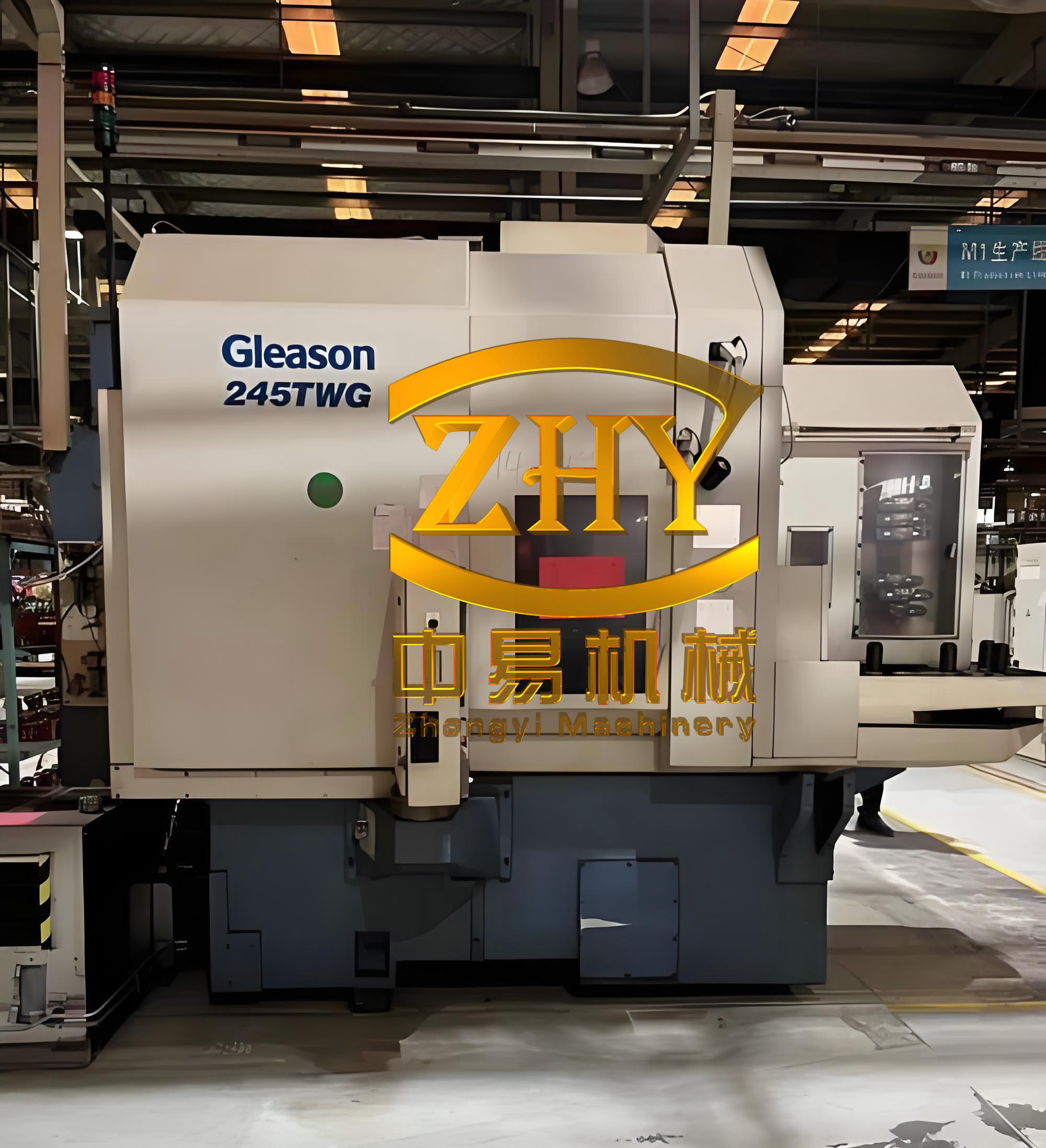
Grinding cracks are a critical concern in gear profile grinding, often resulting from thermal stress and localized material removal. The line contact approach reduces the specific grinding energy and heat concentration, thereby mitigating crack formation. By distributing the grinding force over a larger area, the proposed method enhances surface integrity and extends tool life. Additionally, the ability to process internal gears addresses a significant gap in conventional gear grinding techniques, which are often limited to external gears due to tool geometry constraints.
In conclusion, this study presents a theoretical foundation for line contact gear grinding using staggered axis involute helical surfaces. The mathematical model and parameter calculations ensure accurate implementation, while the grinding trajectory analysis confirms the expanded effective area and full tooth coverage. This method not only improves efficiency but also reduces the risk of grinding cracks, making it a promising advancement in gear profile grinding technology. Future work will focus on experimental validation and optimization for industrial applications.