
The planetary roller screw assembly (PRSA) represents a highly efficient and compact mechanical actuator, converting rotary motion into precise linear thrust. Its superior load-carrying capacity, stemming from multiple simultaneous thread contacts, makes it indispensable in demanding applications such as aerospace actuation, heavy-duty machining, and robotics. A critical aspect of its design and reliability analysis is understanding the load distribution among the numerous contacting thread pairs. An uneven distribution can lead to premature wear, reduced fatigue life, and catastrophic failure modes like thread crushing.
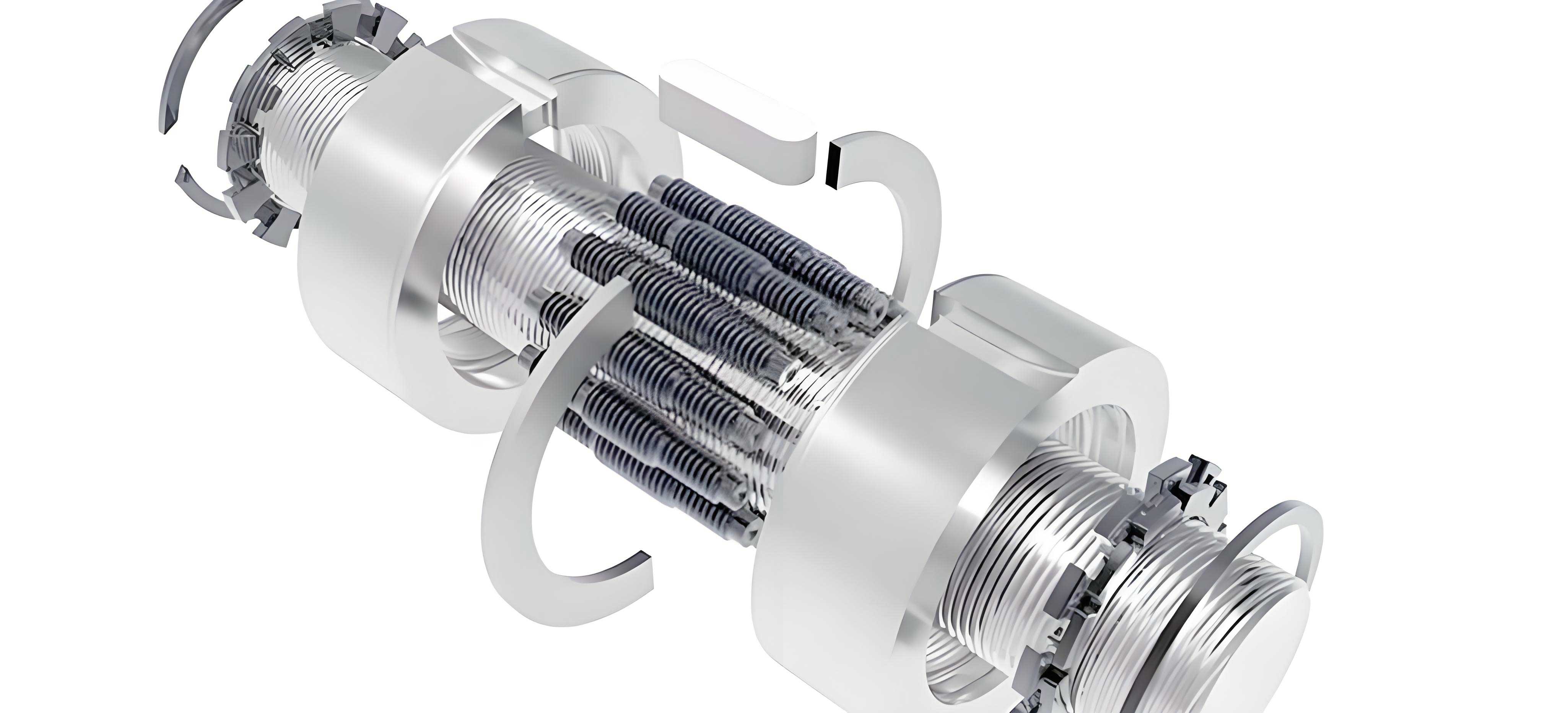
Traditional static models for analyzing load distribution in a planetary roller screw assembly often rely on the idealized assumption that the axes of the screw, rollers, and nut remain perfectly parallel. However, in practical scenarios, manufacturing tolerances, assembly misalignments, and operational deflections inevitably cause rollers to skew relative to the screw and nut. This skewness, characterized by small angular deviations, drastically alters the geometric clearance between mating threads. Consequently, the fundamental assumption of all thread pairs being in simultaneous contact breaks down, leading to partial “mesh-apart” conditions where some threads disengage. This phenomenon is a primary root cause for the severe unilateral crushing failure observed in planetary roller screw assembly components. Existing models, by neglecting this skew-induced mesh-apart, cannot accurately predict the true, often highly non-uniform, load distribution under real-world conditions, limiting their utility for robust design and failure prediction.
This article presents a novel and comprehensive analytical methodology for calculating the three-dimensional load distribution within a planetary roller screw assembly, explicitly accounting for roller skew and the resulting thread mesh-apart phenomenon. We develop a generalized static model, derive the governing equations considering variable contact states, and propose a robust multi-load-step solution algorithm. The validity of the method is established through comparison with detailed Finite Element Analysis (FEA). Finally, we systematically investigate the influence of roller skew angles on the meshing state and load distribution patterns within the planetary roller screw assembly.
Geometric Modeling of Roller Skew in a Planetary Roller Screw Assembly
The core structure of a planetary roller screw assembly comprises a central multi-start screw, a surrounding nut, and several planet rollers with single-start threads. The rollers are typically guided by an internal ring gear. Load is transmitted from the nut to the screw via the multi-point thread contacts along each roller.
To quantitatively describe roller skew, we define three coordinate systems for each roller (indexed by *q*): the global system *O-XYZ* (Z-axis along screw axis), the roller system *oq-xqyqzq* (zq-axis along ideal roller axis), and a local system *oPq-xPqyPqzPq*. The roller’s pose deviation is defined by two small skew angles: φq (rotation about the local xPq-axis) and ψq (rotation about the local yPq-axis). An offset vector εq may also be considered. The transformation from the roller system to the local system is given by:
$$
\mathbf{T}_q = \begin{bmatrix} \mathbf{H}_q & \mathbf{p}_q + \boldsymbol{\varepsilon}_q \\ \mathbf{0}^T & 1 \end{bmatrix}
$$
where Hq is the rotation matrix incorporating φq, ψq, and the roller’s phase angle Φq. pq is the nominal position vector.
Using the spatial meshing equations for the planetary roller screw assembly, the axial clearance for the *m*-th thread pair between the nut and roller, and between the screw and roller, can be calculated as functions of the skew parameters. The resulting clearance vector for the entire assembly is central to determining initial contact conditions.
Generalized Finite Element Model for Load Distribution with Skew
To compute the load distribution in a skewed planetary roller screw assembly, we employ a generalized finite element approach. The screw, nut, and roller bodies are discretized as a series of linear axial spring elements. The thread contacts are modeled as nonlinear gap-contact elements. Rigid links connect these elements at corresponding nodes.
The fundamental relationship between element deformations (δ) and nodal elastic displacements (u), considering initial gaps (ε), is:
$$
\boldsymbol{\delta} = \mathbf{A} \cdot \mathbf{u} – \boldsymbol{\varepsilon}
$$
Here, A is the connectivity or compatibility matrix for the undiscretized model. The equilibrium equation for the system is derived from the principle of virtual work:
$$
\mathbf{A}^T \cdot \mathbf{F}_e = \mathbf{F}_{ext}
$$
where Fext is the vector of external nodal forces (primarily the nut load), and Fe is the vector of internal element forces. For linear spring and contact elements, Fe = K · δ, where K is the global stiffness matrix. The stiffness of a thread contact element is not constant but depends on the contact force according to Hertzian theory. For a nut-roller contact pair *m*, the stiffness kNq,m is:
$$
k_{Nq,m} = \frac{16}{9} \frac{E_{Nq}^{2/3} R_{Nq,m}^{1/3}}{(\cos\lambda_{Nq,m} \cos\beta_{Nq,m})^{1/3} \chi_{Nq,m}^{1/3}} \cdot F_{Nq,m}^{1/3}
$$
A similar expression holds for screw-roller contacts. Critically, when a thread pair is in a mesh-apart state (not in contact), its contact force Fm = 0 and thus its stiffness km = 0. This necessitates modifying the global stiffness matrix K and compatibility matrix A by eliminating rows and columns corresponding to disengaged elements, forming reduced matrices K’ and A’. The final system equilibrium equation for a given contact state is:
$$
\left( \mathbf{A}’^T \mathbf{K}’ \mathbf{A}’ \right) \mathbf{u} = \mathbf{F}_{ext} + \mathbf{A}’^T \mathbf{K}’ \boldsymbol{\varepsilon}’
$$
Solving this yields the nodal displacements and, subsequently, the contact forces for all engaged threads in the planetary roller screw assembly. The key challenge is that the contact state (which threads are engaged) is unknown a priori and depends on the applied load and the skew-induced clearances.
Multi-Load-Step Solution Algorithm Accounting for Mesh-Apart
We propose a robust incremental solution algorithm to handle the nonlinearity arising from changing contact states in the planetary roller screw assembly. The nut load FN is applied in *nL* small increments ΔF. The algorithm proceeds as follows:
- Initialization: Calculate the initial geometric clearance vector εNSq for all thread pairs based on the roller skew angles (φq, ψq). Set initial contact forces to zero.
- Load Step Loop: For each load increment *l* = 1 to *nL*:
- Determine the current set of contacting thread pairs based on the clearances from the previous step. Threads with zero or negative clearance (after accounting for elastic deformation) are considered engaged.
- Assemble the reduced stiffness matrix K’ and compatibility matrix A’ considering only the engaged contact elements. The stiffness of disengaged elements is set to zero and they are removed from the system.
- Solve the equilibrium equation for the current load level F(l) = l · ΔF to obtain new nodal displacements u(l).
- Calculate new element deformations δ(l) and update the effective clearance for each thread pair: εeff(l) = εinitial – δ(l).
- Re-evaluate the contact state: If εeff, m(l) > 0, the *m*-th pair is disengaged; if εeff, m(l) ≤ 0, it is engaged.
- Check for a change in the number of engaged pairs compared to the start of the iteration. If a change occurred, update the contact state and iterate steps 2-5 within the same load increment until the contact state stabilizes.
- Proceed to the next load increment, using the final state from step *l* as the initial condition for step *l+1*.
- Output: After applying the full load FN, the algorithm outputs the final load distribution (FNq,m, FSq,m) and the precise identification of which thread pairs in the planetary roller screw assembly are engaged or disengaged.
This method effectively traces the progressive engagement of thread pairs as the external load compensates for initial skew-induced gaps.
| Component | Governing Equation / Expression | Description |
|---|---|---|
| Roller Pose | $$ \mathbf{T}_q = \begin{bmatrix} \mathbf{H}_q(\phi_q, \psi_q, \Phi_q) & \mathbf{p}_q + \boldsymbol{\varepsilon}_q \\ \mathbf{0}^T & 1 \end{bmatrix} $$ | Transformation matrix defining roller skew and offset. |
| Axial Clearance | $$ \boldsymbol{\delta} = \mathbf{A} \cdot \mathbf{u} – \boldsymbol{\varepsilon}_{NSq} $$ | Relationship between deformation, displacement, and initial geometric gap. |
| Contact Stiffness | $$ k_{c,m} = C \cdot \frac{E^{2/3} R^{1/3}}{(\cos\lambda \cos\beta)^{1/3}} \cdot F_{c,m}^{1/3} $$ | Hertzian-based nonlinear stiffness for thread contact pair *m*. |
| System Equilibrium | $$ \left( \mathbf{A}’^T \mathbf{K}’ \mathbf{A}’ \right) \mathbf{u} = \mathbf{F}_{ext} + \mathbf{A}’^T \mathbf{K}’ \boldsymbol{\varepsilon}’ $$ | Final linearized equation for a fixed contact state configuration. |
Model Validation and Analysis of Skew Effects
The proposed analytical method for the planetary roller screw assembly was validated against a detailed 3D nonlinear Finite Element Model (FEM). A single-roller case was analyzed under a 1000 N nut load, both with ideal alignment (φq=ψq=0) and with a skew of ψq = -0.8 arcminutes. The results showed excellent agreement. For the ideal case, the load distribution matched almost perfectly. For the skewed case, both models predicted the same reversal in load distribution trend and a significant increase in load non-uniformity, with a maximum error of 15.3%, attributable to simplifications in the analytical model regarding bending and shear deformations.
Influence of Skew Angle φq (in y-z plane)
Analyzing a multi-thread planetary roller screw assembly with nT=23 threads per side under FN=2000 N, the effect of skew angle φq (with ψq=0) was investigated. A non-zero φq causes the roller to tilt, making one end of its threads closer to the nut and the other end closer to the screw.
- When φq > 0, the load on the nut-side threads increases towards the roller’s trailing end (higher thread index *m*), while the load on the screw-side threads decreases towards the trailing end.
- Conversely, φq < 0 produces the opposite trend. Interestingly, a specific negative skew (e.g., φq = -1.0′) can sometimes improve load distribution uniformity compared to the ideal case by counteracting other inherent load distribution biases.
Influence of Skew Angle ψq (in x-z plane)
The effect of skew angle ψq (with φq=0) is more pronounced and critical for the planetary roller screw assembly. This skew directly promotes thread mesh-apart.
- For ψq > 0, the roller’s trailing-end threads move closer to the nut and away from the screw. This leads to a highly uneven distribution where nut-side loads concentrate on the trailing end and screw-side loads concentrate on the leading end.
- As |ψq| increases, the maximum thread contact force rises dramatically. Crucially, when |ψq| exceeds approximately 1.0 arcminute, clear mesh-apart occurs—several thread pairs carry zero load. Under such conditions, the maximum force on the few engaged threads can be up to 3 times greater than the maximum force in an ideally aligned planetary roller screw assembly. This extreme force concentration directly explains the unilateral crushing failure observed in practice.
Combined Skew (φq and ψq)
When both skew angles are present, the load distribution in the planetary roller screw assembly is predominantly governed by ψq, as it directly affects axial engagement. However, φq modifies this pattern. For instance, a negative φq can increase the load on the leading-end threads, which, when combined with a negative ψq, can either exacerbate or partially mitigate the load concentration depending on the specific combination.
| Step | Action | Objective |
|---|---|---|
| 1 | Compute initial gap vector εNSq from skew geometry. | Establish baseline no-load contact condition. |
| 2 | Divide total nut load FN into nL increments ΔF. | Enable gradual engagement of thread pairs. |
| 3 | For load step *l*: Identify engaged pairs (εeff ≤ 0). | Determine active contact configuration. |
| 4 | Assemble reduced matrices K’ and A’ for engaged system. | Form solvable linear system for current state. |
| 5 | Solve equilibrium for current total load F(l). | Obtain displacements and deformations. |
| 6 | Update effective gaps: εeff(l) = εinitial – δ(l). | Check for changes in contact state. |
| 7 | If contact state changed, return to Step 3 within same *l*. | Iterate to convergence for the load step. |
| 8 | If contact state stable, proceed to load step *l+1*. | Apply next load increment. |
| 9 | After final step, output load distribution Fm and contact state. | Final solution for the full load. |
Conclusion
This work successfully developed and validated a high-fidelity analytical method for computing the three-dimensional load distribution in a planetary roller screw assembly, explicitly considering the effects of roller skew and thread mesh-apart. The core achievements are:
- Comprehensive Skew Modeling: The method integrates a precise geometric model of roller skew (angles φq and ψq) into the load distribution analysis framework for the planetary roller screw assembly, overcoming the limitation of parallel-axis assumptions in prior models.
- Mesh-Apart Capability: Through the use of variable stiffness contact elements and a robust multi-load-step solution algorithm, the model dynamically determines which thread pairs are engaged or disengaged under load, providing a true picture of force transmission in a non-ideal planetary roller screw assembly.
- Quantified Skew Impact: The analysis reveals that skew angle ψq (tilting in the plane containing the roller and screw axes) is particularly detrimental. Magnitudes exceeding 1.0 arcminute can induce severe mesh-apart, leading to maximum thread contact forces approximately triple those in an aligned state. This quantitatively explains the mechanism behind unilateral thread crushing failures.
- Design Insight: While generally harmful, specific skew angles (e.g., a negative φq) can, in some configurations, partially improve load distribution uniformity, suggesting potential avenues for intentional tolerance compensation in the design or assembly of a planetary roller screw assembly.
This analytical tool provides a critical foundation for the accurate performance prediction, strength validation, and reliability-centered design of planetary roller screw assemblies operating under real-world conditions where misalignment is inevitable. It enables engineers to assess the sensitivity of their design to assembly tolerances and to establish rational skew limits to prevent overload and premature failure.