
In the realm of power transmission for critical applications such as aviation engines, the performance of gear pairs is paramount. Among the various types, straight bevel gears and their specific subtype, miter gears (with a 1:1 ratio and 90-degree shaft angle), are widely utilized for their ability to transmit power between intersecting shafts. The primary indicator of their meshing quality is the contact pattern—its shape, size, and location on the tooth flank under load. Traditional design and analysis often assume ideal, theoretical tooth surfaces. However, the actual manufactured tooth surface inevitably deviates from its theoretical form due to machining tolerances, tool wear, and heat treatment distortions. These deviations can significantly alter the contact pattern and stress distribution in service, potentially leading to premature failure, noise, and vibration. Therefore, a methodology capable of predicting the loaded contact behavior based on the real, as-manufactured tooth geometry is essential for ensuring reliability and performance. This article details a comprehensive engineering process for the loaded contact analysis of straight bevel and miter gears, starting from coordinate measurement data of the physical gear, through the reconstruction of a precise digital model, to finite element simulation and experimental validation.
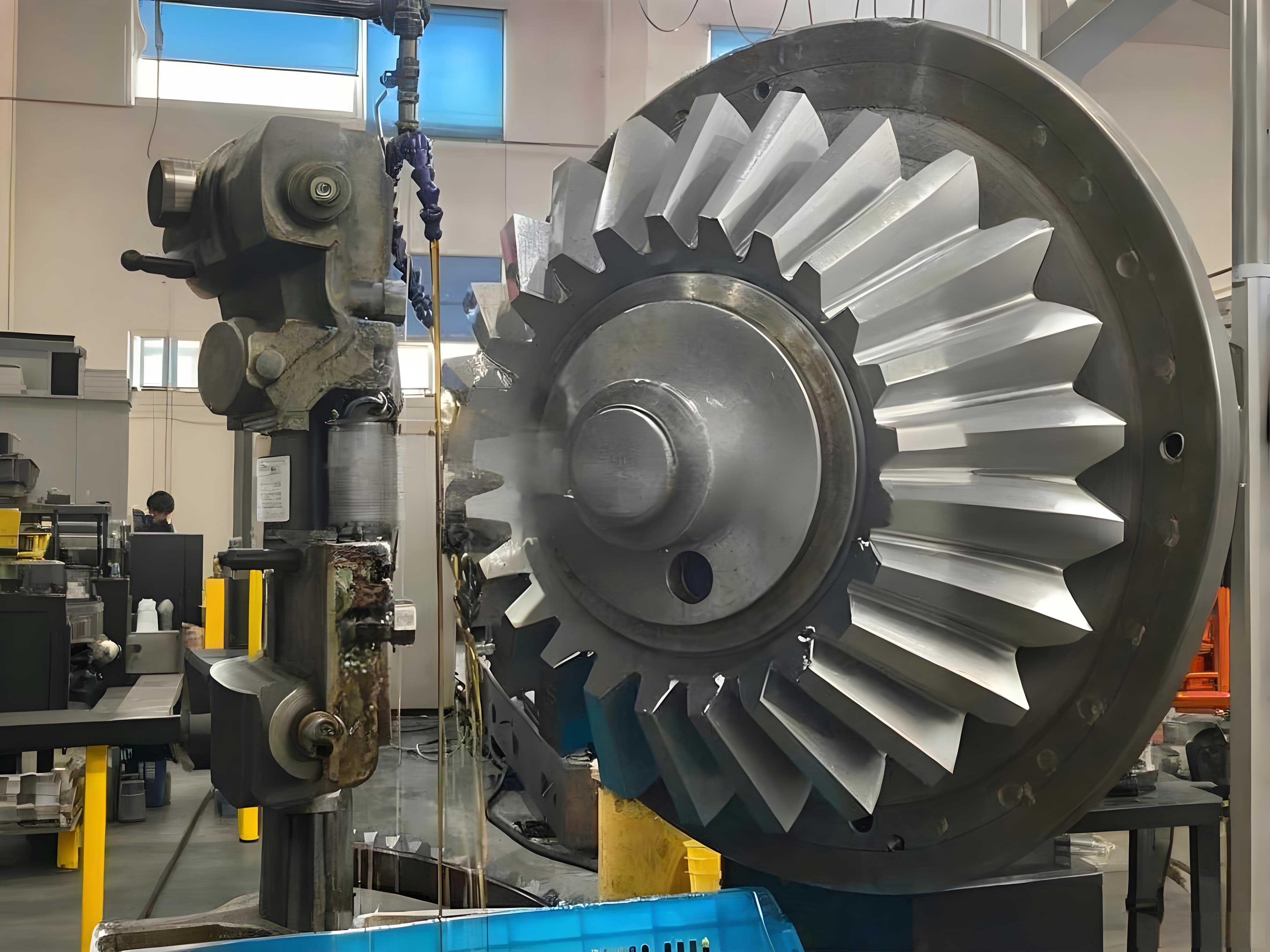
The foundational step in analyzing a real miter gear or any straight bevel gear is the accurate mathematical and geometric modeling of its actual tooth surfaces. This process, often called “gear reverse engineering” or “real tooth surface reconstruction,” begins with data acquisition. A Coordinate Measuring Machine (CMM) is employed to collect a dense cloud of discrete points from the tooth flanks of both the pinion and the gear. The raw measurement data is typically captured in the CMM’s own coordinate system, which must be transformed into a coordinate system suitable for subsequent meshing and finite element analysis (FEA). A common FEA-oriented coordinate system for bevel gear analysis is defined with the origin at the apex of the pitch cone, the X-axis coinciding with the gear axis (positive direction from the toe to the heel), the Z-axis along the radial direction pointing towards the tooth surface, and the Y-axis determined by the right-hand rule. If the source data from the CMM uses a different convention, a transformation is necessary. Assuming the position vector in the source CMM system is denoted as $\mathbf{r}_{\text{source}}$, the transformation to the FEA coordinate system vector $\mathbf{r}$ can be expressed via a homogeneous transformation matrix:
$$
\mathbf{r} = \begin{bmatrix}
0 & 0 & -1 & 0 \\
0 & -1 & 0 & 0 \\
-1 & 0 & 0 & 0 \\
0 & 0 & 0 & 1
\end{bmatrix} \mathbf{r}_{\text{source}}
$$
With the measured data in the correct coordinate frame, the next task is to reverse-engineer the machining parameters. For a generated gear, this involves deducing the parameters of the cutting tool (like blade pressure angles and cutter radius) and the machine kinematics that produced the measured surface. The process is typically performed separately for the convex (drive side) and concave (coast side) flanks of the gear member (often the larger wheel). An iterative optimization algorithm is used. The core idea is to vary a set of candidate machining parameters, generate a theoretical tooth surface from these parameters, and compute the normal deviation between this theoretical surface and the cloud of measured points. The objective is to find the parameter set that minimizes the sum of squared errors. The procedure often follows a staged approach:
- Initial Cutter Diameter Selection: Several candidate cutter radii are tested to assess which best fits the measured points along the face width direction.
- Concave Flank Optimization: With an initial radius, key parameters such as the root angle, pressure angle, and the cutter radius itself are treated as optimization variables for the concave side. A continuous optimization routine adjusts these to minimize the normal error.
- Convex Flank Optimization: Similarly, the pressure angle and cutter radius for the convex side are optimized.
The quality of the fit is quantified by the maximum normal error, which for a high-precision miter gear used in aerospace should be within microns (e.g., less than 0.005 mm). Once a satisfactory fit is achieved for the measured region, the mathematical surface model is extrapolated to the nominal boundaries of the tooth to create a complete flank model.
The reconstruction of the pinion (smaller gear) tooth surface follows a similar but more involved philosophy, especially if the gear set is designed with localized bearing contact. Simply applying the same reverse-engineering optimization as for the gear may not yield a pinion that meshes correctly with the already-reconstructed gear surface. Therefore, a “local synthesis” or “ease-off” methodology is employed. First, a preliminary pinion surface is generated using reverse-engineered parameters. Then, this surface is iteratively modified by slightly adjusting machine tool settings (like modified roll coefficients or tilt) to optimize meshing performance metrics (such as transmission error and contact path) while simultaneously ensuring the modified surface remains as close as possible to the measured point cloud. This can be formulated as a constrained optimization problem. Let $F_{\text{min}}(\phi_2, \mathbf{r}_1, \mathbf{r}_2)$ represent the minimum distance between the pinion and gear tooth surfaces, which is a function of the gear rotation angle $\phi_2$ and points on the pinion and gear surfaces $\mathbf{r}_1$ and $\mathbf{r}_2$, respectively. The goal is to adjust the pinion surface parameters such that under loaded conditions, the meshing is optimal. A simplified representation of the objective during alignment could be to ensure unloaded contact at the design point. The mathematical model can be stated as finding pinion parameters that satisfy contact conditions while staying within the domain of the measured surface:
$$
\begin{aligned}
&\text{minimize} \quad \text{Deviation}(\mathbf{S}_{\text{pinion, model}}, \mathbf{P}_{\text{measured}}) \\
&\text{subject to} \quad F_{\text{min}}(\phi_2^0, \mathbf{r}_1^*, \mathbf{r}_2^*) = 0 \quad \text{for designated points} \\
&\qquad \qquad \mathbf{r}_1^* \in \mathbf{S}_{\text{pinion, model}}, \quad \mathbf{r}_2^* \in \mathbf{S}_{\text{gear, model}}
\end{aligned}
$$
Here, $\mathbf{S}$ denotes the mathematical surface and $\mathbf{P}$ denotes the measured point cloud.
With both the gear and pinion real tooth surfaces defined mathematically, the solid geometric model of the entire miter gear blank can be constructed. This model incorporates the nominal macro-geometry from the design drawings, such as pitch diameters, face width, addendum, dedendum, and back-angle. The critical design parameters for a typical aerospace straight bevel or miter gear pair are summarized in the table below.
| Design Parameter | Symbol / Unit | Value (Example) |
|---|---|---|
| Number of Pinion Teeth | $z_1$ | 19 |
| Number of Gear Teeth | $z_2$ | 32 |
| Module (at Large End) | $m$ / mm | 2.75 |
| Pressure Angle | $\alpha$ / deg | 20 |
| Shaft Angle | $\Sigma$ / deg | 90 |
| Face Width | $b$ / mm | 12 |
| Gear Mounting Distance | $A_{G}$ / mm | 47.4 ± 0.1 |
| Pinion Mounting Distance | $A_{P}$ / mm | 33.8 ± 0.1 |
The accurate geometric model of the miter gear pair, now representing the real tooth surfaces, is imported into a Finite Element Analysis (FEA) software suite like ANSYS for Loaded Tooth Contact Analysis (LTCA). The primary goal is to simulate the elastic deformation, contact stress, and resulting contact pattern under operational torque. A three-dimensional static structural analysis with nonlinear contact is performed. Efficient modeling often uses a segment model containing three teeth for each member to account for load sharing and adjacent tooth effects, significantly reducing computational cost compared to a full gear model while maintaining accuracy.
The finite element model preparation involves several key steps. High-quality hexahedral (brick) elements, such as 8-node SOLID185 elements in ANSYS, are preferred for better stress and contact resolution. The mesh must be finely graded in the potential contact zones along the tooth profiles and face width. The global model size can involve tens of thousands of nodes and elements. For instance, a robust model may contain approximately 19,000 nodes and 11,500 elements. Special attention is paid to mesh orientation to minimize distortion, often aligning elements with the direction of tooth curvature.
Applying realistic boundary conditions and loads is critical. A common and effective method involves constraining the gear member rigidly while applying torque to the pinion through a reference point technique:
- Gear Boundary Conditions: All degrees of freedom (three translations and three rotations) are fixed for the nodes on the gear’s bore and the two lateral side faces. This simulates the gear being securely mounted on a shaft.
- Pinion Boundary Conditions: A single independent node (a “pilot node”) is created at the theoretical apex of the pinion’s pitch cone. All nodes on the pinion’s bore and lateral side faces are then kinematically coupled (or rigidly linked) to this pilot node using a rigid body constraint (e.g., CERIG in ANSYS). This means the pinion blank moves as a rigid body connected to this apex node.
- Constraints and Load Application: The pilot node’s radial ($Y, Z$) and axial ($X$) translations are constrained. Its rotation about the pinion axis ($X$) is left free. The operational torque $T$ is then directly applied as a moment about the X-axis to this pilot node. This method elegantly applies pure torque without inducing spurious bending moments.
The contact between the pinion and gear teeth is defined as surface-to-surface contact. The pinion tooth flank is typically set as the “contact” surface, and the gear tooth flank as the “target” surface. A frictional contact model (e.g., with a coefficient of 0.05-0.1) and an augmented Lagrangian contact algorithm are used for robust solution convergence. The analysis is run as a nonlinear static analysis with large deflection effects enabled to account for the change in stiffness and contact area due to deformation.
Solving the model yields detailed results, the most critical being the contact pressure distribution (equivalent to the contact pattern under load) and the maximum contact (Hertzian) stress, as well as root bending stress. The contact pattern visualized on the tooth flanks shows the elongated area of high pressure. For a properly designed and manufactured miter gear, this pattern should be centered on the tooth face, slightly biased towards the toe, and occupy a significant portion of the active profile height without breaking out at the edges. The simulation provides quantitative data on the pattern’s dimensions: its distance from the heel (large end), toe (small end), tip, and root. These metrics are directly comparable to assembly inspection standards.
To validate the fidelity of the entire process—from CMM measurement to real surface reconstruction to FEA-based LTCA—a comprehensive correlation study with physical testing is indispensable. The most common test is the static contact pattern check using marking compound (e.g., Prussian blue or red lead). The gear pair is assembled in a test fixture at specified mounting distances and a small torque is applied to transfer the marking compound from one gear to the other, revealing the unloaded or lightly loaded contact area.
A robust validation involves creating a Design of Experiments (DOE) matrix that varies key assembly parameters within their permissible tolerances. For a miter gear, the primary variables are the gear mounting distance ($A_G$), the pinion mounting distance ($A_P$), and the actual shaft angle ($\Sigma$). Taking three levels for each variable (e.g., nominal, minimum tolerance, maximum tolerance) creates a full-factorial $3^3 = 27$ distinct assembly conditions. The FEA simulation is repeated for all 27 virtual assembly states. Simultaneously, physical marking tests are conducted for the same 27 states. The contact pattern dimensions (heel-toe length, tip-root height, and centroid location) are extracted from both the FEA contour plots and the physical stained teeth.
The comparison of these datasets, typically plotted as simulation vs. experimental values for each pattern dimension across all 27 states, reveals the accuracy of the model. High correlation indicates that the real tooth surface model successfully captures the geometric essence of the manufactured miter gear. Discrepancies may arise from factors not modeled, such as bulk body deflections of the housing or very small-scale surface roughness. In published case studies following this methodology, the relative error between simulation and experiment for pattern location (distance from heel/toe/tip/root) is often reported to be within 15%. This level of agreement is considered excellent for complex mechanical systems like miter gears and demonstrates that the simulation is a reliable predictive tool. The table below conceptually summarizes the comparison outcomes for key pattern metrics across multiple assembly variations.
| Pattern Metric | Average Relative Error | Maximum Relative Error | Correlation Trend |
|---|---|---|---|
| Distance from Heel (Large End) | ~8% | ≤ 12% | Strong linear correlation |
| Distance from Toe (Small End) | ~7% | ≤ 11% | Strong linear correlation |
| Distance from Tooth Tip | ~9% | ≤ 13% | Strong linear correlation |
| Distance from Tooth Root | ~8.5% | ≤ 12% | Strong linear correlation |
The successful development and validation of a loaded contact analysis methodology based on real tooth surfaces for straight bevel and miter gears provides a powerful tool for advanced engineering. This approach bridges the gap between design intent and manufactured reality. It moves analysis from the realm of idealized geometry into a digital-twin paradigm where the specific characteristics of each manufactured gear pair can be evaluated virtually. For high-reliability applications like aviation engines, this capability is transformative. It allows engineers to pre-emptively assess whether a given batch of miter gears, with their inherent manufacturing variations, will yield acceptable contact patterns under load when assembled within the specified tolerance ranges. This predictive insight can prevent costly engine disassembly, gear rework, and retesting cycles that arise from contact pattern failures discovered only during final assembly or test runs. By enabling a “right-first-time” assembly philosophy, this methodology enhances product quality, reduces development time and cost, and increases the operational reliability of transmission systems employing miter gears and straight bevel gears.