
In this paper, we propose a comprehensive approach for analyzing the loading contact characteristics of modified straight bevel gears. Straight bevel gears are widely used in various mechanical systems, such as automotive differentials and machine tools, due to their ability to transmit motion between intersecting shafts. However, under load, the contact behavior of these gears becomes complex, necessitating accurate methods to predict contact patterns, stress distribution, and deformation. Traditional methods often overlook the effects of tooth modifications and load-induced deformations, leading to inaccuracies in design optimization. Our work addresses this by integrating geometric modeling, tooth contact analysis (TCA), and loaded tooth contact analysis (LTCA) into a unified framework. We focus on straight bevel gears, as their simplicity in design contrasts with the intricate contact mechanics under operational conditions. By employing mathematical models based on spherical involute principles, B-spline surface reconstructions, and Hertzian contact theory, we systematically derive the contact features, including instantaneous contact points, paths, and stress distributions. The method is validated against finite element analysis (FEA), showing high accuracy in predicting contact forces and stresses. This approach not only enhances the understanding of straight bevel gear behavior but also provides a efficient tool for iterative design improvements, reducing reliance on time-consuming simulations.
The foundation of our analysis lies in the geometric modeling of straight bevel gears. We begin with the standard tooth surface generation based on the spherical involute principle. The spherical involute profile is derived from the rolling motion of a plane on a base cone, ensuring accurate tooth geometry. For a point on the involute, the coordinates in a fixed reference frame can be expressed as follows. Let $S(x, y, z)$ be the fixed coordinate system, and $S_1(x_1, y_1, z_1)$ be the moving coordinate system attached to the generating plane. The position vector of a point $K$ on the involute is given by:
$$ x_1 = R \sin(\phi_k \sin \delta_b), $$
$$ y_1 = 0, $$
$$ z_1 = R \cos(\phi_k \sin \delta_b), $$
where $R$ is the reference radius, $\phi_k$ is the generating parameter ranging from $0$ to $\arccos(\cos \delta_a / \cos \delta_b) / \sin \delta_b$, $\delta_a$ is the tip cone angle, and $\delta_b$ is the base cone angle. The transformation from $S_1$ to $S$ is achieved through rotation matrices, resulting in the spherical involute equations:
$$ x(\phi_k) = R [\cos(\phi_k \sin \delta_b) \sin \delta_b \cos \phi_k + \sin(\phi_k \sin \delta_b) \sin \phi_k], $$
$$ y(\phi_k) = R [\cos(\phi_k \sin \delta_b) \sin \delta_b \sin \phi_k – \sin(\phi_k \sin \delta_b) \cos \phi_k], $$
$$ z(\phi_k) = R \cos(\phi_k \sin \delta_b) \cos \delta_b. $$
For the small end of the straight bevel gear, similar equations apply with a reduced radius $R – B$, where $B$ is the face width. The transition surface, or fillet, at the tooth root is modeled to ensure tangency with the spherical involute and the root circle. The fillet radius vector $R_f$ is derived using coordinate transformations, as detailed in prior work, to maintain continuity and avoid stress concentrations.
To account for manufacturing imperfections and optimize performance, we introduce tooth modifications using a bivariate quadratic polynomial. The modification amount $\delta(x, y)$ is defined as:
$$ \delta(x, y) = a_1 + a_2 x + a_3 y + a_4 x y + a_5 x^2 + a_6 y^2, $$
where $a_1$ to $a_6$ are coefficients representing various modification types, such as profile crowning ($a_6$) and lead crowning ($a_5$). For instance, $a_5 = \delta_x / (B/2)^2$ and $a_6 = \delta_y / (P_{\text{ini}} P_{\text{end}})^2$, with $\delta_x$ and $\delta_y$ being the lead and profile modification amounts, and $P_{\text{ini}}$ and $P_{\text{end}}$ the start and end points of meshing. This polynomial is applied to discrete points on the tooth surface, which are then reconstructed into a continuous surface using B-spline interpolation. The B-spline surface equation is given by:
$$ R(u, v) = \sum_{i=0}^m \sum_{j=0}^n d_{i,j} N_{i,k}(u) N_{j,l}(v), $$
where $d_{i,j}$ are control points, $N_{i,k}(u)$ and $N_{j,l}(v)$ are B-spline basis functions of orders $k$ and $l$, respectively. For $C^2$ continuity, we set $k = l = 3$, leading to a cubic B-spline surface. The parameters $u$ and $v$ represent the tooth length and profile directions, normalized between 0 and 1. The surface normal vector $n(u, v)$ is computed as the cross product of partial derivatives: $n(u, v) = R_u \times R_v$, where $R_u$ and $R_v$ are the first derivatives with respect to $u$ and $v$. This reconstructed surface accurately represents the modified straight bevel gear tooth, enabling precise contact analysis.
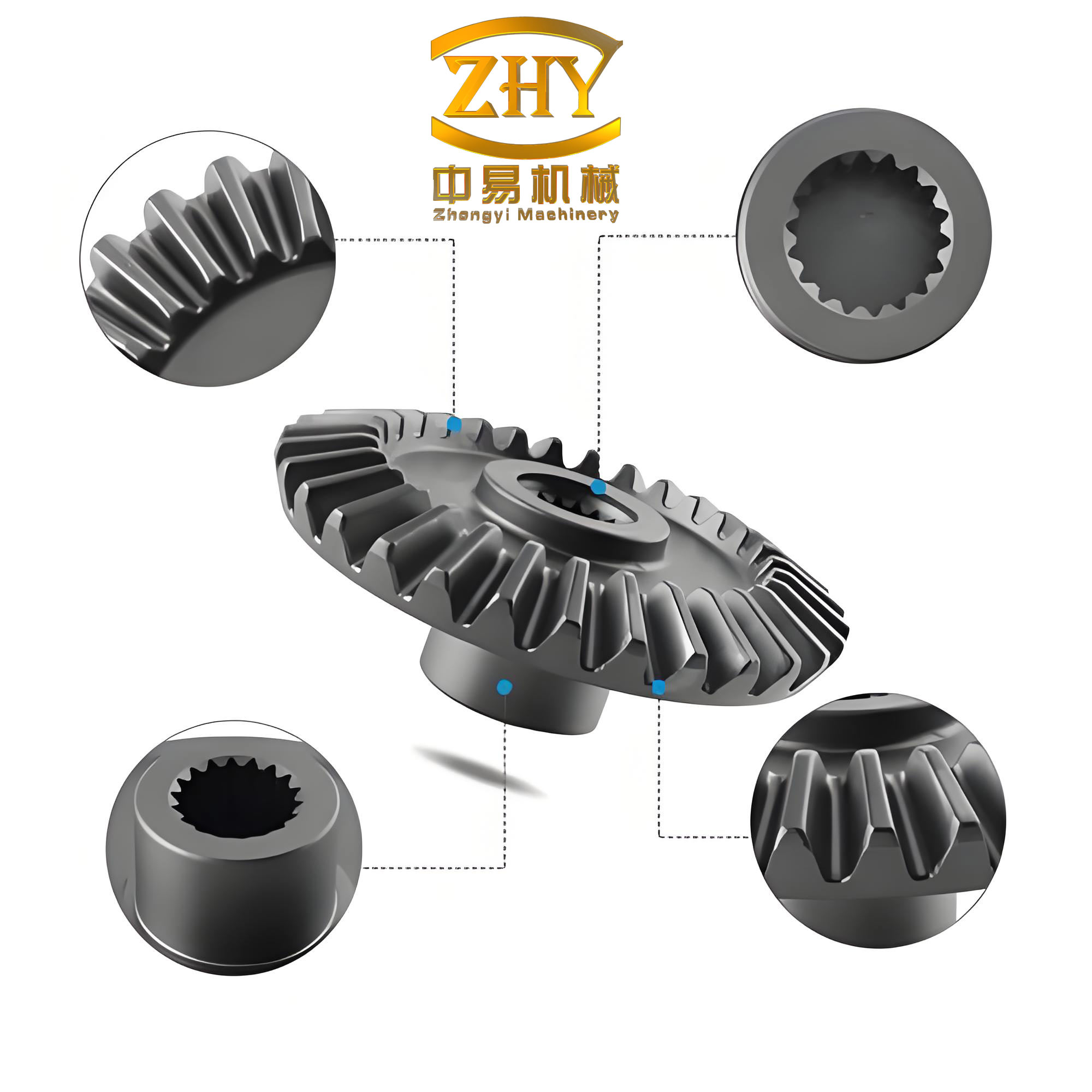
Next, we perform tooth contact analysis (TCA) to determine the instantaneous contact points and paths during meshing. The TCA is based on the principles of gear meshing, which require that at the contact point, the position vectors coincide, the normal vectors are collinear, and the relative velocity vector is perpendicular to the normal vector. We define coordinate systems for the pinion (small gear) and gear (large gear), denoted as $S_p$ and $S_g$, respectively. The transformation between these systems accounts for the shaft angle $\sigma$. For a given point on the gear tooth surface with parameters $u_g$ and $v_g$, we solve for the corresponding pinion parameters $u_p$ and $v_p$ that satisfy the meshing conditions. The collinearity of normal vectors after rotations $\mu_p$ and $\mu_g$ (for pinion and gear) is expressed as:
$$ n_{[g]}^{(g)} \cos \mu_g + k_{[g]}^{(g)} (k_{[g]}^{(g)} \cdot n_{[g]}^{(g)}) (1 – \cos \mu_g) + (k_{[g]}^{(g)} \times n_{[g]}^{(g)}) \sin \mu_g = – \left[ n_{[g]}^{(p)} \cos \mu_p + k_{[g]}^{(p)} (k_{[g]}^{(p)} \cdot n_{[g]}^{(p)}) (1 – \cos \mu_p) + (k_{[g]}^{(p)} \times n_{[g]}^{(p)}) \sin \mu_p \right], $$
where $k$ denotes the unit vectors along the axes. The relative velocity condition is given by:
$$ (z_g k_{[g]}^{(g)} \times R_{[g]}^{(g)}) \cdot n_{[g]}^{(g)} + (z_p k_{[g]}^{(p)} \times R_{[g]}^{(p)}) \cdot n_{[g]}^{(p)} = 0, $$
with $z_p$ and $z_g$ being the number of teeth. The position vector equality leads to a difference vector $\Delta R_{[g]}^{(gp)} = R_{[g]}^{(g)} – R_{[g]}^{(p)}$, which is decomposed into adjustments for misalignment: $V$ (offset), $H$ (pinion mounting distance), and $J$ (gear mounting distance). By iteratively solving these equations, we obtain the contact path over the meshing cycle. For instance, starting from a initial contact point, we vary $v_g$ and compute the corresponding parameters to trace the entire path, ensuring the installation adjustments remain within tolerances (e.g., $|J| < 0.001$). This TCA method effectively predicts the contact pattern for straight bevel gears under no-load conditions.
Under load, the contact behavior changes due to elastic deformations, necessitating loaded tooth contact analysis (LTCA). We employ a Hertzian contact model modified for gear teeth to compute the contact ellipse dimensions, maximum stress, and stress distribution. The principal curvatures at the contact point are derived from the surface geometry. For a surface defined by $R(u, v)$, the first and second fundamental forms are used to compute the normal curvature $k$ in a direction given by $du/dv$:
$$ k = \frac{L du^2 + 2M du dv + N dv^2}{E du^2 + 2F du dv + G dv^2}, $$
where $E, F, G$ are the first fundamental quantities, and $L, M, N$ are the second fundamental quantities, calculated as:
$$ E = R_u \cdot R_u, \quad F = R_u \cdot R_v, \quad G = R_v \cdot R_v, $$
$$ L = \frac{1}{\sqrt{EG – F^2}} |R_u \, R_v \, R_{uu}|^T, \quad M = \frac{1}{\sqrt{EG – F^2}} |R_u \, R_v \, R_{uv}|^T, \quad N = \frac{1}{\sqrt{EG – F^2}} |R_u \, R_v \, R_{vv}|^T. $$
The principal curvatures $k_1$ and $k_2$ are the eigenvalues of the matrix derived from these quantities, and the principal directions are obtained by solving:
$$ \begin{vmatrix} kE – L & kF – M \\ kF – M & kG – N \end{vmatrix} = 0. $$
For two contacting surfaces, the effective radii and curvatures are combined to find the contact ellipse semi-axes $a$ and $b$ using Hertz theory:
$$ \frac{k_{p1} + k_{g1}}{k_{p2} + k_{g2}} = \frac{(a/b)^2 E(e) – K(e)}{K(e) – E(e)}, \quad a b = \left( \frac{3 F R_e}{4 \eta} \right)^{2/3} [F(e)]^2, $$
where $F$ is the contact force, $R_e$ is the effective radius, $\eta$ is the material constant, $K(e)$ and $E(e)$ are complete elliptic integrals of the first and second kind, and $e = \sqrt{1 – (b/a)^2}$ is the eccentricity. The function $F(e)$ is defined as:
$$ F(e) = \left( \frac{4}{\pi e^2} \right)^{1/3} \left( \frac{b}{a} \right)^{1/2} \left[ \left( \frac{a}{b} \right)^2 (E(e) – K(e)) (K(e) – E(e)) \right]^{1/6}. $$
The maximum contact stress $p_{\text{max}}$ is then:
$$ p_{\text{max}} = \frac{3F}{2\pi a b}, $$
and the stress distribution along the axes follows elliptical decay: $p(x) = p_{\text{max}} \sqrt{1 – (x/a)^2}$ and $p(y) = p_{\text{max}} \sqrt{1 – (y/b)^2}$.
To account for load sharing in multi-tooth contact, we model the gear teeth as a series of sliced beams, each represented as a spring. The total tooth stiffness $K_t$ is the sum of bending, shear, and axial compression stiffness components. For a slice of width $db$, the stiffness contributions are computed using energy methods. The bending stiffness $K_b$, shear stiffness $K_s$, and axial stiffness $K_a$ for a tooth are integrated over the tooth height:
$$ \frac{1}{K_b} = \int_0^{x_\alpha} \frac{3[(x_\alpha – x) \cos \alpha – y_\alpha \sin \alpha]^2}{2E y^3 db} dx, $$
$$ \frac{1}{K_s} = \int_0^{x_\alpha} \frac{1.2 \cos^2 \alpha}{2G y db} dx, $$
$$ \frac{1}{K_a} = \int_0^{x_\alpha} \frac{\sin^2 \alpha}{2E y db} dx, $$
where $x_\alpha$ is the distance to the load application point, $\alpha$ is the pressure angle, $E$ is Young’s modulus, and $G$ is the shear modulus. The total tooth stiffness is then:
$$ \frac{1}{K_t} = \frac{1}{K_b} + \frac{1}{K_s} + \frac{1}{K_a}. $$
The Hertzian contact stiffness $K_h$ is approximated as:
$$ K_h = \frac{E_e^{0.9} (2a)^{0.8} F^{0.1}}{1.275}, $$
with $E_e = 2E_1 E_2 / (E_1 + E_2)$. For a gear pair, the overall stiffness $K_{(pg)}$ is a series combination:
$$ K_{(pg)} = \frac{1}{\frac{1}{K_t^{(p)}} + \frac{1}{K_h} + \frac{1}{K_t^{(g)}}}. $$
The deformation under load $F$ is $\delta = F / K_{(pg)}$. In double-tooth contact, the load distribution between two pairs is determined by solving the equilibrium and compatibility equations. If $F_1$ and $F_2$ are the loads on the first and second tooth pairs, and $E_{12}$ is the backlash, then:
$$ F = F_1 + F_2, \quad \delta_1 = \delta_2 + E_{12}. $$
Iterative methods are used to find $F_1$ and $F_2$, and the contact features for each pair are computed accordingly.
We validate our method against finite element analysis (FEA) for a straight bevel gear pair with parameters as listed in Table 1. The gear specifications include module, number of teeth, face width, pressure angle, and material properties. Tooth modifications are applied with lead crowning of 0.02 mm and profile crowning of 0.01 mm. The FEA model is built using a quasi-static approach, and contact stresses are extracted for comparison.
| Parameter | Pinion | Gear |
|---|---|---|
| Module (mm) | 3 | 3 |
| Number of Teeth | 25 | 30 |
| Face Width (mm) | 20 | 20 |
| Pressure Angle (°) | 20 | 20 |
| Young’s Modulus (GPa) | 210 | 210 |
| Poisson’s Ratio | 0.3 | 0.3 |
| Lead Modification (mm) | 0.02 | 0.02 |
| Profile Modification (mm) | 0.01 | 0.01 |
The TCA results show that the contact path obtained from our method closely matches the FEA results, with identical instantaneous contact points and meshing paths. For example, at a torque of 100 Nm, the contact points and corresponding parameters are computed, and the contact ellipse dimensions are compared in Table 2. The errors in contact force and maximum stress are within 1% and 2%, respectively, demonstrating the accuracy of our approach.
| Pinion Contact Point (x, y, z) | Gear Contact Point (x, y, z) | Analytical a (mm) | Analytical b (mm) | Analytical F (N) | Analytical p_max (MPa) | FEA a (mm) | FEA b (mm) | FEA F (N) | FEA p_max (MPa) |
|---|---|---|---|---|---|---|---|---|---|
| (28.060, -1.067, 21.224) | (28.365, -0.545, 20.836) | 2.128 | 0.289 | 3641 | 2830 | 2.169 | 0.311 | 3668 | 2788 |
| (28.634, -0.462, 20.372) | (28.698, -0.338, 20.280) | 2.130 | 0.290 | 3662 | 2833 | 2.170 | 0.314 | 3682 | 2808 |
| (28.883, -0.269, 20.086) | (28.869, -0.230, 20.040) | 2.132 | 0.289 | 3671 | 2848 | 2.175 | 0.317 | 3693 | 2817 |
| (29.533, 0.264, 18.689) | (29.553, 0.430, 18.713) | 2.165 | 0.277 | 3768 | 2997 | 2.210 | 0.300 | 3795 | 2943 |
Similarly, at 150 Nm torque, the results in Table 3 show consistent agreement, with contact force errors below 1% and stress errors under 2%. The stress distribution clouds from both methods align well, confirming the reliability of our LTCA method for straight bevel gears.
| Pinion Contact Point (x, y, z) | Gear Contact Point (x, y, z) | Analytical a (mm) | Analytical b (mm) | Analytical F (N) | Analytical p_max (MPa) | FEA a (mm) | FEA b (mm) | FEA F (N) | FEA p_max (MPa) |
|---|---|---|---|---|---|---|---|---|---|
| (28.060, -1.067, 21.224) | (28.365, -0.545, 20.836) | 2.436 | 0.330 | 5462 | 3240 | 2.492 | 0.354 | 5535 | 3208 |
| (28.634, -0.462, 20.372) | (28.698, -0.338, 20.280) | 2.438 | 0.332 | 5494 | 3243 | 2.498 | 0.355 | 5549 | 3222 |
| (28.883, -0.269, 20.086) | (28.869, -0.230, 20.040) | 2.441 | 0.330 | 5507 | 3260 | 2.501 | 0.354 | 5567 | 3241 |
| (29.533, 0.264, 18.689) | (29.553, 0.430, 18.713) | 2.478 | 0.317 | 5653 | 3431 | 2.561 | 0.332 | 5692 | 3405 |
In conclusion, our proposed method for loading contact analysis of modified straight bevel gears provides a robust and accurate framework for predicting contact characteristics under load. By combining spherical involute geometry, B-spline surface reconstruction, TCA, and LTCA with Hertzian theory, we efficiently compute contact paths, ellipse dimensions, and stress distributions. The validation against FEA confirms the method’s precision, with errors in contact forces and stresses within acceptable limits. This approach is particularly beneficial for the design and optimization of straight bevel gears in high-power applications, as it reduces computational costs while maintaining accuracy. Future work will extend this method to dynamic analysis and system-level simulations for comprehensive gear design.