
In the field of mechanical transmission systems, helical gears are widely recognized for their reliability, efficiency, and compact structure. They find extensive applications in aerospace, marine, and automotive industries, where high-performance demands such as reduced noise, enhanced comfort, and operational stability are paramount. However, vibration and noise remain critical challenges in helical gear systems, primarily driven by internal excitations like time-varying mesh stiffness and transmission error. My research focuses on addressing these issues by proposing a novel design method aimed at minimizing mesh stiffness fluctuations in helical gears, thereby improving vibration characteristics. This approach is grounded in the fundamental principle that reducing stiffness variations can lead to smoother operation and lower dynamic responses.
The core idea stems from the observation that the total contact line length during meshing of helical gears fluctuates, causing periodic changes in mesh stiffness. I derive conditions under which this fluctuation is minimized, leading to a low-stiffness-excitation design. By optimizing key parameters such as helix angle and tooth width, I aim to achieve near-constant mesh stiffness over a meshing cycle. This article presents the theoretical framework, analytical modeling, validation through finite element analysis, and dynamic system analysis to demonstrate the effectiveness of the method. The findings provide a theoretical foundation for vibration reduction in gear systems, offering practical insights for designers and engineers.
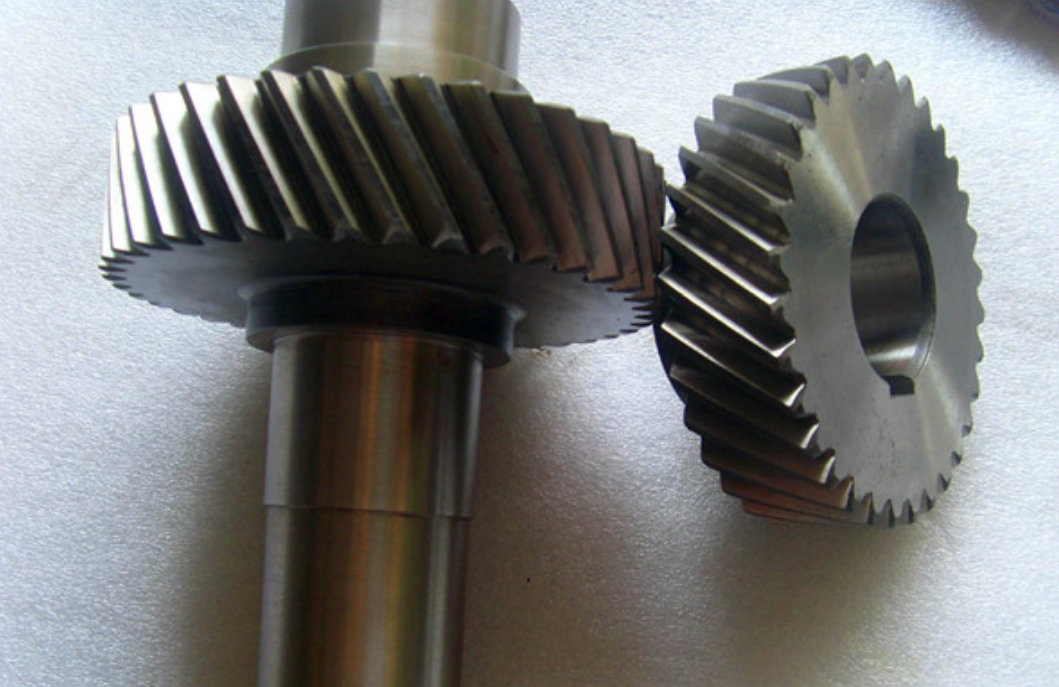
Helical gears are characterized by their angled teeth, which engage gradually compared to spur gears, resulting in smoother transmission and higher load capacity. However, this complexity introduces variations in contact line length during meshing, directly influencing time-varying mesh stiffness. The mesh stiffness of helical gears is a critical internal excitation source that can induce vibrations and noise if not properly controlled. In previous studies, methods like tooth profile modification and dampers have been employed to mitigate vibrations, but limited attention has been paid to directly minimizing stiffness fluctuations through parameter design. My work addresses this gap by developing a design methodology that reduces stiffness波动, thereby enhancing system performance.
The design method is based on minimizing the variation in total contact line length during meshing. For a helical gear pair, the contact line length changes as the gears rotate, leading to stiffness fluctuations. I start by defining the parameters involved. Let the helical gear pair have a normal module \( m_n \), helix angle \( \beta \), tooth width \( B \), normal pressure angle \( \alpha_n \), and numbers of teeth \( z_p \) and \( z_g \) for the pinion and gear, respectively. The transverse base pitch \( p_{bt} \) is given by \( p_{bt} = \pi m_n \cos \alpha_t \), where \( \alpha_t \) is the transverse pressure angle. The total contact ratio \( \varepsilon_h \) consists of the transverse contact ratio \( \varepsilon_\alpha \) and the overlap ratio \( \varepsilon_\beta \), expressed as:
$$ \varepsilon_h = \varepsilon_\alpha + \varepsilon_\beta $$
where
$$ \varepsilon_\alpha = \frac{z_p (\tan \alpha_{ap} – \tan \alpha_t) + z_g (\tan \alpha_{ag} – \tan \alpha_t)}{2\pi} $$
and
$$ \varepsilon_\beta = \frac{B \sin \beta}{\pi m_n} $$
Here, \( \alpha_{ap} \) and \( \alpha_{ag} \) are the tip circle pressure angles for the pinion and gear, respectively. The contact line length variation is analyzed by dividing the meshing region into areas where the contact lines increase, remain constant, or decrease. For a helical gear pair, the total contact line length \( L_{total} \) as a function of meshing position can be derived. I consider two types based on the comparison between \( \varepsilon_\alpha \) and \( \varepsilon_\beta \): Type 1 where \( \varepsilon_\alpha > \varepsilon_\beta \), and Type 2 where \( \varepsilon_\alpha < \varepsilon_\beta \). The expressions for contact line length are:
For Type 1:
$$ W_1 =
\begin{cases}
\frac{u}{\sin \beta_b}, & u < L_\beta \\
\frac{B}{\cos \beta_b}, & L_\beta \leq u \leq L_\alpha \\
\frac{B}{\cos \beta_b} – \frac{u – L_\alpha}{\sin \beta_b}, & L_\alpha < u \leq L_\alpha + L_\beta
\end{cases} $$
For Type 2:
$$ W_2 =
\begin{cases}
\frac{u}{\sin \beta_b}, & u < L_\alpha \\
\frac{L_\alpha}{\sin \beta_b}, & L_\alpha \leq u \leq L_\beta \\
\frac{B}{\cos \beta_b} – \frac{u – L_\alpha}{\sin \beta_b}, & L_\beta < u \leq L_\alpha + L_\beta
\end{cases} $$
where \( u \) is the distance along the line of action, \( \beta_b \) is the base helix angle, \( L_\alpha = \varepsilon_\alpha p_{bt} \), and \( L_\beta = \varepsilon_\beta p_{bt} \). The fluctuation in total contact line length leads to mesh stiffness variations. To minimize this, I derive the condition where the contact line length remains nearly constant. This occurs when either the transverse contact ratio \( \varepsilon_\alpha \) or the overlap ratio \( \varepsilon_\beta \) is an integer, i.e.,
$$ \varepsilon_\alpha = N^+ \quad \text{or} \quad \varepsilon_\beta = N^+ $$
where \( N^+ \) represents a positive integer. This condition ensures that the number of contact lines in increasing and decreasing regions balances, reducing overall fluctuation. For helical gears, this can be achieved by optimizing parameters like helix angle \( \beta \) or tooth width \( B \). Specifically, from \( \varepsilon_\beta = B \sin \beta / (\pi m_n) \), setting \( \varepsilon_\beta = N^+ \) gives:
$$ B = \frac{\pi m_n N^+}{\sin \beta} $$
This relation guides the design for low stiffness波动. In my study, I propose two optimization schemes: Scheme 1 optimizes the helix angle while keeping load capacity constant, and Scheme 2 optimizes the tooth width while maintaining center distance. These schemes are applied to example helical gear pairs to evaluate their effectiveness.
To compute the time-varying mesh stiffness of helical gears, I develop an analytical model combining the slice method and offset method. The helical gear tooth is divided into slices along the face width, and each slice is treated as a spur gear with modified geometry. The stiffness contributions from bending, shear, axial compression, and Hertzian contact are aggregated. For a single tooth pair, the mesh stiffness \( k_t^i \) for the \( i \)-th slice is given by:
$$ \frac{1}{k_t^i} = \int_{\phi_{l \min}}^{\phi_{l \max}} \left( \frac{1}{dk_a} + \frac{1}{dk_b} + \frac{1}{dk_s} + \frac{1}{dk_h} \right) d\phi_1 $$
where \( dk_a \), \( dk_b \), \( dk_s \), and \( dk_h \) are the stiffness components for axial, bending, shear, and Hertzian contact, respectively. Detailed expressions are based on energy methods. For instance, the bending stiffness component is:
$$ \frac{1}{dk_b} = \int \frac{[\cos \phi_1 (y_{\phi_1} – y) – x_{\phi_1} \sin \phi_1]^2 \cos^2 \beta}{EI_y} \frac{dy}{d\gamma} d\gamma $$
The total mesh stiffness \( K(t) \) for the helical gear pair over a meshing cycle is then:
$$ K(t) = \frac{1}{\sum_{i=1}^{\lceil \varepsilon_h \rceil} \frac{1}{k_t^i} + \frac{1}{k_f}} $$
where \( k_f \) represents the fillet foundation stiffness. The loaded static transmission error (LSTE) \( e_{LSTE} \) is calculated as:
$$ e_{LSTE} = \frac{F}{K(t)} $$
with \( F \) being the meshing force. This model allows for analyzing stiffness fluctuations and evaluating the impact of parameter optimization.
I validate the proposed design method and analytical model using finite element analysis (FEA). Three helical gear pairs are considered: Gear Pair 1 (baseline), Gear Pair 2 (optimized helix angle), and Gear Pair 3 (optimized tooth width). Their parameters are summarized in the table below.
| Parameter | Gear Pair 1 | Gear Pair 2 | Gear Pair 3 |
|---|---|---|---|
| Number of teeth \( z_p / z_g \) | 29 / 49 | 29 / 49 | 29 / 49 |
| Normal module \( m_n \) (mm) | 1.75 | 1.75 | 1.75 |
| Normal pressure angle \( \alpha_n \) (°) | 25 | 25 | 25 |
| Helix angle \( \beta \) (°) | 10 | 15.95 | 10 |
| Tooth width \( B \) (mm) | 20 | 20 | 31.66 |
| Transverse contact ratio \( \varepsilon_\alpha \) | 1.470 | 1.422 | 1.470 |
| Overlap ratio \( \varepsilon_\beta \) | 0.632 | 1.000 | 1.000 |
| Total contact ratio \( \varepsilon_h \) | 2.102 | 2.422 | 2.470 |
The FEA model simulates meshing under a torque load of 200 Nm, and mesh stiffness is extracted from reaction forces. Comparison with analytical results shows good agreement, with a maximum error of 4.7%. The stiffness fluctuation coefficient \( \varepsilon_k \) is defined as:
$$ \varepsilon_k = \frac{K_{\max} – K_{\min}}{K_{\min}} \times 100\% $$
For Gear Pair 1, \( \varepsilon_k = 18.97\% \); for Gear Pair 2, \( \varepsilon_k = 2.02\% \); and for Gear Pair 3, \( \varepsilon_k = 2.96\% \). This confirms that optimization significantly reduces stiffness波动. Additionally, the LSTE analysis reveals that peak-to-peak values drop by 95.6% for Gear Pair 2 and 96.7% for Gear Pair 3, indicating smoother transmission.
To assess the impact on system dynamics, I establish an 8-degree-of-freedom (DOF) dynamic model for the helical gear system. The model includes displacements in three translational directions and rotational motion for both gears. The equations of motion are derived using Newton’s second law. The displacement vector is:
$$ \mathbf{q} = [X_p, Y_p, Z_p, \theta_p, X_g, Y_g, Z_g, \theta_g]^T $$
The dynamic transmission error (DTE) along the line of action is:
$$ \delta_m = (X_p – X_g) \sin \alpha_n \cos \beta + (Y_p – Y_g) \cos \alpha_n \cos \beta + (r_{bp} \theta_p + r_{bg} \theta_g) \cos \beta + (Z_g – Z_p) \sin \beta – e(t) $$
where \( e(t) \) is the unloaded static transmission error, and \( r_{bp} \), \( r_{bg} \) are base radii. The dynamic meshing force is:
$$ F_m = c_m(t) \dot{\delta}_m + k_m(t) f(\delta_m) $$
with \( f(\delta_m) \) accounting for backlash nonlinearity. The equations of motion for the pinion and gear are:
$$ \begin{aligned}
I_p \ddot{\theta}_p + F_m r_{bp} \cos \beta &= T_{in} \\
m_p \ddot{X}_p + c_{xp} \dot{X}_p + k_{xp} X_p + F_m \sin \alpha_n \cos \beta &= 0 \\
m_p \ddot{Y}_p + c_{yp} \dot{Y}_p + k_{yp} Y_p + F_m \cos \alpha_n \cos \beta &= 0 \\
m_p \ddot{Z}_p + c_{zp} \dot{Z}_p + k_{zp} Z_p – F_m \sin \beta &= 0 \\
I_g \ddot{\theta}_g + F_m r_{bg} \cos \beta &= T_{out} \\
m_g \ddot{X}_g + c_{xg} \dot{X}_g + k_{xg} X_g – F_m \sin \alpha_n \cos \beta &= 0 \\
m_g \ddot{Y}_g + c_{yg} \dot{Y}_g + k_{yg} Y_g – F_m \cos \alpha_n \cos \beta &= 0 \\
m_g \ddot{Z}_g + c_{zg} \dot{Z}_g + k_{zg} Z_g + F_m \sin \beta &= 0
\end{aligned} $$
Parameters such as bearing stiffness and damping are set based on typical values. I solve these equations numerically using the Runge-Kutta method over a range of input speeds from 500 to 50,000 rpm. The vibration response is evaluated using root mean square (RMS) values for displacement and velocity. For displacement, the RMS is:
$$ R_{\text{RMS}} = \sqrt{ \frac{1}{D_n} \sum_{j=1}^{D_n} f^2 } $$
where \( f \) represents \( \delta_m \), \( X \), \( Y \), or \( Z \) displacements. For velocity, the vibration intensity is:
$$ f_v = \sqrt{ \frac{1}{D_n} \sum_{j=1}^{D_n} \dot{f}^2 } $$
Results show that optimizing tooth width (Gear Pair 3) reduces DTE RMS by about 13% across most speeds, while optimizing helix angle (Gear Pair 2) has a minor effect on DTE but reduces radial vibrations by approximately 2%. However, axial vibrations increase by 59% for Gear Pair 2 due to the larger helix angle enhancing axial forces. This highlights a trade-off: reducing stiffness波动 may amplify axial vibrations if the helix angle is increased. In contrast, optimizing tooth width maintains or reduces vibrations in all directions.
To further explore design strategies, I analyze two optimization approaches: forward optimization (increasing helix angle to achieve integer \( \varepsilon_\beta \)) and reverse optimization (decreasing helix angle to achieve integer \( \varepsilon_\beta \)). A fourth helical gear pair, Gear Pair 4, with a helix angle of 21.84° and \( \varepsilon_\beta = 1.353 \), is considered. The contact line fluctuation coefficient \( \varepsilon_l \) is defined as:
$$ \varepsilon_l = \frac{l_{\max} – l_{\min}}{B} $$
Plotting \( \varepsilon_l \) against helix angle shows a V-shaped curve, with minima near integer \( \varepsilon_\beta \) values. Reverse optimization from Gear Pair 4 to Gear Pair 2 (reducing helix angle) reduces axial vibration RMS by 26.7% and velocity by 14.3%, while maintaining low stiffness波动. This suggests that reverse optimization can mitigate axial vibration issues associated with forward optimization.
The dynamic responses are summarized in the table below, comparing RMS values for DTE and directional vibrations before and after optimization.
| Response Metric | Gear Pair 1 (Baseline) | Gear Pair 2 (Opt. Helix Angle) | Gear Pair 3 (Opt. Tooth Width) | Gear Pair 4 (High Helix Angle) |
|---|---|---|---|---|
| DTE RMS Reduction | Reference | ~0% | ~13% | N/A |
| X-direction RMS Change | Reference | ~2% decrease | Variable decrease | N/A |
| Y-direction RMS Change | Reference | ~2% decrease | Similar to X | N/A |
| Z-direction RMS Change | Reference | 59% increase | ~0% change | Reference for reverse opt. |
| Stiffness Fluctuation \( \varepsilon_k \) | 18.97% | 2.02% | 2.96% | 7.01% |
These results demonstrate that parameter optimization for low stiffness波动 effectively improves vibration performance, but careful selection is needed to balance radial and axial responses. For helical gears, achieving integer \( \varepsilon_\beta \) through tooth width adjustment or reverse helix angle optimization offers a robust solution.
In conclusion, my research presents a design method for reducing mesh stiffness fluctuations in helical gears by optimizing parameters such as helix angle and tooth width. The key condition is to set either the transverse or overlap contact ratio to an integer, which minimizes contact line length variations. Analytical and finite element validations confirm that this approach significantly lowers stiffness波动 and improves loaded static transmission error. Dynamic analysis using an 8-DOF model shows that optimization can reduce vibration energy, as measured by RMS values, though axial vibrations may increase with larger helix angles. Reverse optimization is proposed as an alternative to mitigate this issue. This work provides a theoretical foundation for vibration reduction in helical gear systems, emphasizing the importance of stiffness波动 control in design. Future studies could extend this method to other gear types or incorporate additional factors like manufacturing errors and thermal effects.
The implications for practical applications are substantial. In industries where helical gears are prevalent, such as automotive transmissions or aerospace propulsion, adopting low-stiffness-fluctuation designs can lead to quieter, more reliable systems. By integrating the derived conditions into gear design software, engineers can easily optimize parameters early in the development process. Moreover, this method complements existing techniques like tooth profiling, offering a holistic approach to vibration management. As demand for high-performance gear systems grows, such innovations will play a crucial role in advancing mechanical transmission technology.
Throughout this study, the focus on helical gears has underscored their unique characteristics and challenges. The angled teeth of helical gears provide advantages in load distribution and smoothness, but also introduce complexities in stiffness behavior. By addressing these through systematic design, I aim to contribute to the broader goal of enhancing gear system efficiency and longevity. The formulas and tables presented here serve as practical tools for designers, while the dynamic insights highlight the interconnected nature of geometry and vibration in helical gears.