
Straight bevel gears are essential components in various mechanical systems, particularly in aerospace and automotive applications, due to their ability to transmit motion between intersecting shafts. However, traditional straight bevel gears exhibit line contact under ideal conditions, which makes them highly sensitive to installation errors such as axial misalignments and shaft angle deviations. This sensitivity can lead to undesirable contact patterns, edge loading, and reduced operational life. In this study, we address this issue by proposing a modified tooth surface design for straight bevel gears that incorporates crowning through profile and lead modifications. Our approach aims to transform the line contact into point contact, thereby reducing the installation error sensitivity and enhancing the stability of contact patterns under real-world conditions.
The design process begins with the mathematical modeling of the tooth surface for straight bevel gears. In conventional manufacturing, the tooth surface is generated using a straight-edged cutter, resulting in a line contact geometry. We modify this by introducing a parabolic trajectory for the cutter motion to achieve lead crowning and adjust the instantaneous roll ratio for profile crowning. This dual modification strategy ensures a drum-shaped tooth surface that promotes point contact between the mating gears. The modified tooth surface equations are derived based on coordinate transformations and meshing conditions, allowing for precise control over the tooth geometry. For instance, the position vector and normal vector of the generating surface in the cutter coordinate system are expressed as follows for lead modification:
$$ \mathbf{r}_c(l, d) = [l, -a l^2, d, 1]^T $$
$$ \mathbf{n}_c(l, d) = \frac{[2a l, 1, 0]^T}{\sqrt{4a^2 l^2 + 1}} $$
Here, $a$ represents the lead modification coefficient, which determines the extent of crowning along the tooth length. Similarly, the roll ratio for profile modification is given by:
$$ I_f = \frac{\cos \theta}{\sin \delta} + 2b (\phi_g + \phi_0) $$
where $b$ is the profile modification coefficient, $\theta$ is the root angle, $\delta$ is the pitch angle, $\phi_g$ is the cradle rotation angle, and $\phi_0$ is the initial cradle angle. These modifications collectively enable the transition from line to point contact, which is crucial for mitigating installation error effects in straight bevel gears.
To further optimize the tooth surface for low installation error sensitivity, we develop an optimization model that focuses on the differential surface geometry between the mating gears. The differential surface, which represents the relative curvature between the pinion and gear tooth surfaces, plays a key role in determining the contact behavior. We define the Gaussian curvature and principal curvatures of the differential surface as critical parameters. The Gaussian curvature $K_{12}$ at a contact point is calculated as:
$$ K_{12} = k_{12n\alpha} k_{12n\beta} – (\tau_{12g\alpha})^2 $$
where $k_{12n\alpha}$ and $k_{12n\beta}$ are the relative normal curvatures along orthogonal directions $\alpha$ and $\beta$ on the tangent plane, and $\tau_{12g\alpha}$ is the relative geodesic torsion. The principal curvatures $K_1$ and $K_2$, which correspond to the major and minor axes of the instantaneous contact ellipse, are derived from:
$$ K_1 = k_{12n\alpha} \cos^2 \phi_1 + k_{12n\beta} \sin^2 \phi_1 + \tau_{12g\alpha} \sin 2\phi_1 $$
$$ K_2 = k_{12n\alpha} \sin^2 \phi_1 + k_{12n\beta} \cos^2 \phi_1 – \tau_{12g\alpha} \sin 2\phi_1 $$
Here, $\phi_1$ is the angle between the principal direction and the $\alpha$-direction, given by $\cot 2\phi_1 = \frac{1}{2\tau_{12g\alpha}} (k_{12n\alpha} – k_{12n\beta})$. The length of the contact ellipse semi-axis is approximated using the Taylor expansion as $\Delta l \approx \sqrt{\frac{2 \Delta \delta}{K_1}}$, where $\Delta \delta$ is set to 0.00635 mm based on experimental data.
Our optimization objective is to minimize the fluctuation of the Gaussian curvature along the contact path while increasing its value at a reference point to enhance stability. The objective function is formulated as:
$$ f(a, b) = \max \sum_{i=1}^n \left| 1 – \frac{k_{12}^i – k_{12}^0}{k_{12}^0} \right| k_{12}^0 $$
where $k_{12}^0$ is the Gaussian curvature at the reference point, and $k_{12}^i$ represents the Gaussian curvature at each meshing point from start to end of engagement. The optimization variables are the lead modification coefficient $a$ and profile modification coefficient $b$ for the pinion, while the gear tooth surface remains unmodified. Constraints are imposed to ensure practical feasibility:
$$ g(1) = a > 0 $$
$$ g(2) = b > 0 $$
$$ g(3) = \Delta l – \frac{B}{3} \geq 0 $$
These constraints ensure positive modification coefficients and that the instantaneous contact ellipse length is at least one-third of the face width $B$ to prevent excessive contact stress. The optimization process involves iterative tooth contact analysis (TCA) to evaluate the contact patterns under various installation errors, such as axial misalignment ($H$), axial separation ($V$), and shaft angle error ($\beta$).
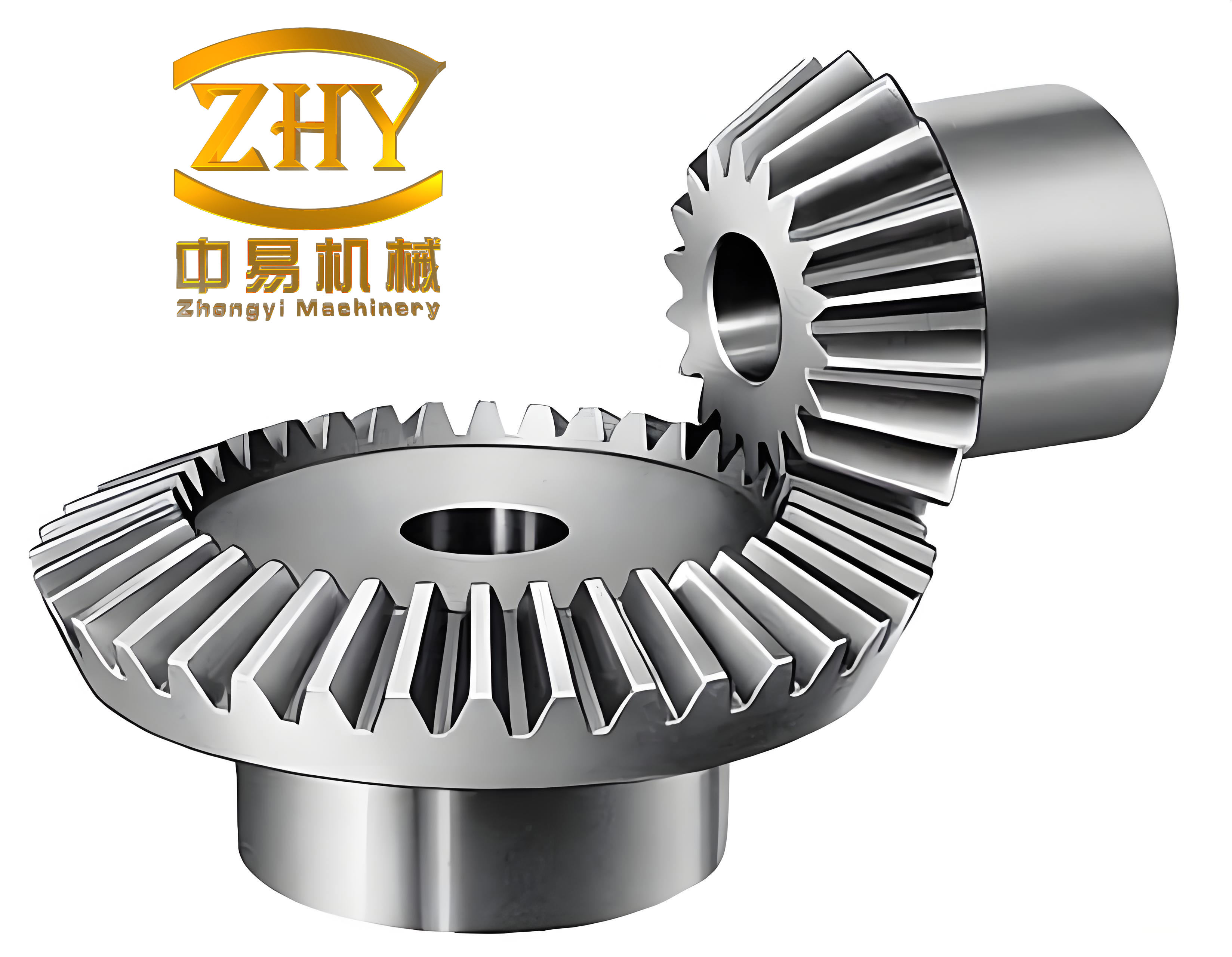
To validate our design, we conduct a case study using a straight bevel gear pair with parameters summarized in the table below. The pinion has 10 teeth, and the gear has 16 teeth, with a normal module of 7.65 mm and a face width of 20.4 mm. Through optimization, we obtain optimal modification coefficients of $a = 0.0046$ for lead and $b = 0.003$ for profile.
| Parameter | Pinion | Gear |
|---|---|---|
| Number of teeth, $Z$ | 10 | 16 |
| Module, $m$ (mm) | 7.65 | 7.65 |
| Pressure angle, $\alpha$ (°) | 22.5 | 22.5 |
| Shaft angle, $\Gamma$ (°) | 90 | 90 |
| Addendum, $h_a$ (mm) | 11.115 | 4.185 |
| Dedendum, $h_f$ (mm) | 4.685 | 11.615 |
| Face width, $B$ (mm) | 20.4 | 20.4 |
| Pitch angle, $\delta$ (°) | 32 | 58 |
| Tip angle, $\delta_a$ (°) | 39.332 | 62.62 |
| Root angle, $\delta_f$ (°) | 27.38 | 50.668 |
We perform tooth contact analysis (TCA) and loaded tooth contact analysis (LTCA) under a torque of 100 N·m to evaluate the contact patterns. The results show that the unmodified straight bevel gears exhibit line contact, which is highly sensitive to errors. In contrast, the optimized modified tooth surface displays a point contact pattern with a contact ellipse width approximately one-third of the face width. The contact path remains stable and perpendicular to the root cone under ideal conditions. When installation errors are introduced, such as axial misalignment ($H = \pm 1$ mm), axial separation ($V = \pm 1$ mm), or shaft angle error ($\beta = \pm 2°$), the contact pattern shifts slightly towards the toe or heel but maintains its shape and direction without edge contact or severe distortion. This demonstrates the low installation error sensitivity of the designed straight bevel gears.
For experimental verification, we manufacture the gear pair based on the digital tooth surface model derived from our optimization. The pinion and gear are machined on a four-axis CNC milling machine using a ball-end mill with a diameter of 4 mm. The tooth surfaces are measured on a gear inspection center, revealing a maximum deviation of 5 μm, with most areas having negligible errors. Rolling tests are conducted on a gear rolling tester to assess the actual contact patterns under various installation errors. The results confirm that the contact pattern remains stable even with significant errors, such as total axial misalignment and separation accounting for 30% of the normal module. This tolerance level is substantially higher than that of spiral bevel gears, which typically allow only 10% of the normal module, highlighting the effectiveness of our design for straight bevel gears.
In conclusion, our study presents a comprehensive approach to designing straight bevel gears with low installation error sensitivity. By incorporating lead and profile modifications through controlled cutter motion and roll ratio adjustments, we achieve a drum-shaped tooth surface that facilitates point contact. The optimization of modification coefficients based on differential surface curvature ensures minimal Gaussian curvature fluctuation and adequate contact ellipse dimensions. Experimental results validate the theoretical predictions, showing stable contact patterns under substantial installation errors. This design methodology not only enhances the performance and reliability of straight bevel gears but also provides a foundation for advanced manufacturing techniques, such precision forging, enabling broader applications in high-precision industries.
The success of this approach underscores the importance of geometric optimization in gear design. Future work could explore the integration of dynamic load conditions and thermal effects to further improve the robustness of straight bevel gears. Additionally, the optimization model can be extended to other types of bevel gears, such as spiral or hypoid gears, to achieve similar benefits. Overall, the low installation error sensitivity design for straight bevel gears represents a significant advancement in gear technology, offering improved stability and longevity in demanding operational environments.