
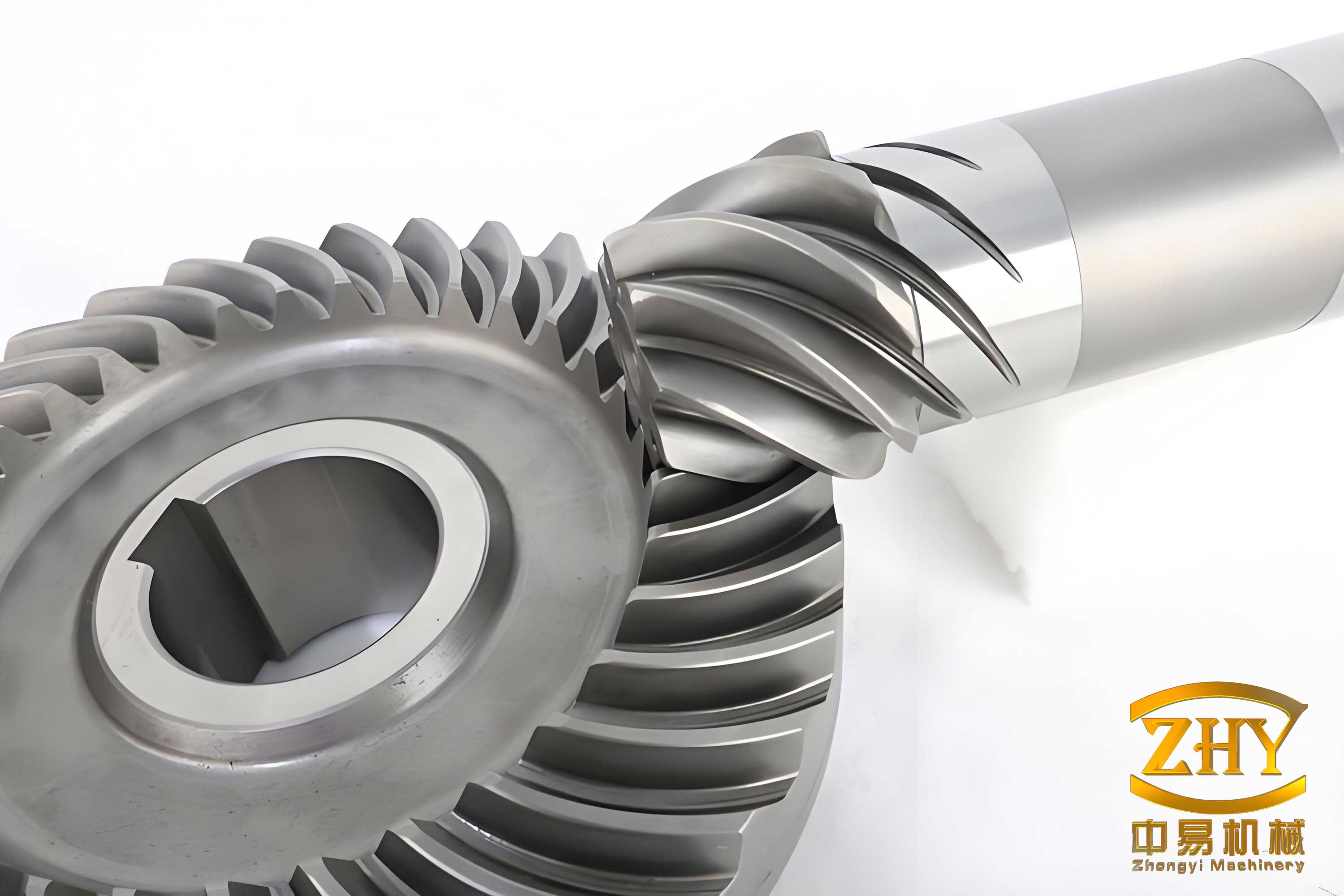
In the field of mechanical transmission, spiral bevel gears are critical components used in automotive, aerospace, and industrial machinery due to their ability to transmit motion between intersecting shafts with high efficiency and load capacity. The complex tooth surface geometry of spiral bevel gears poses significant challenges in manufacturing and inspection, as achieving precise tooth contact patterns and minimizing transmission errors are essential for optimal performance. Traditional methods for quality control, such as contact pattern inspection, rely heavily on operator experience and lack quantitative analysis capabilities. Specialized gear measuring centers are expensive and not versatile for other components. Therefore, developing a technique using general-purpose coordinate measuring machines (CMMs) for spiral bevel gear inspection and machine-settings correction offers substantial theoretical and practical value. This article presents a comprehensive study on a machine-settings correction methodology for spiral bevel gears based on CMM measurements, focusing on establishing theoretical tooth surface models, planning measurement grids, calculating deviations, and optimizing adjustment parameters through advanced mathematical methods.
The core of this approach lies in integrating gear meshing theory with precision metrology. I begin by deriving the mathematical representation of the ideal tooth surface for spiral bevel gears, specifically those generated using the Gleason HGM method on a No. 116 spiral bevel gear generator. The tooth surface is a product of the relative motion between the cutting tool and the gear blank, governed by machine-tool settings. By establishing coordinate systems on the machine—including the tool, cradle, and workpiece systems—the tooth surface equation can be expressed as a function of tool parameters and machine kinematics. For a spiral bevel gear, the surface is generated through a series of transformations, and the meshing condition ensures that the tool envelope forms the desired gear tooth. The position vector of a point on the tooth surface in the workpiece coordinate system is given by:
$$ \mathbf{R}(u, \theta, t) = \mathbf{M}_{pt} \cdot \mathbf{r}(u, \theta, t) $$
where \( u \) represents the tool blade distance parameter, \( \theta \) is the tool rotation angle, \( t \) is the time parameter related to the cradle rotation, \( \mathbf{r}(u, \theta, t) \) is the tool surface equation in the tool coordinate system, and \( \mathbf{M}_{pt} \) is the homogeneous transformation matrix from the tool to the workpiece coordinate system. The meshing equation, which defines the contact between the tool and the workpiece, is expressed as:
$$ \mathbf{n} \cdot \mathbf{v} = 0 $$
Here, \( \mathbf{n} \) is the normal vector to the tool surface in the fixed coordinate system, and \( \mathbf{v} \) is the relative velocity between the tool and the workpiece. Solving these equations allows for the parametric representation of the tooth surface as \( \mathbf{R}(\theta, t) = \mathbf{g}(\theta, t) \). Due to the complexity of the explicit form, the surface is discretized into points for practical computation and measurement planning. This discretization facilitates the generation of a measurement grid that covers the entire tooth surface uniformly.
To ensure comprehensive measurement coverage, I divide the tooth surface into a grid of points based on its projection onto a plane. The spiral bevel gear tooth is bounded by the root cone, face cone, tip cone, and back cone. By rotating the tooth surface onto an axial cross-section, a planar mapping is created where straight boundaries correspond to intersections with these cones. The grid is defined with points along the tooth length and profile directions. According to industry standards, such as AGMA guidelines, the measurement area typically excludes edges to avoid inaccuracies; for instance, the grid boundaries are contracted by 10% along the tooth length and by 7% and 26% along the tooth profile from the tip and root, respectively. A common grid consists of 9 points along the length and 5 points along the profile, totaling 45 measurement points. The coordinates of each grid point can be calculated by solving equations that relate the tooth surface parameters to geometric dimensions like cone distance and angles. For the \( i \)-th row and \( j \)-th column point, the following system holds:
$$ \begin{cases}
R^x_{ij}(u, \theta, t) + (i-3) \frac{l_{ij}}{\sin \delta} = \left[ L + (i-3) \frac{l_{ij}}{\tan \delta} + (j-5) \cdot l \right] \cos \delta \\
\mathbf{n}(u, \theta, t) \cdot \mathbf{v}(u, \theta, t) = 0 \\
\left( R^y_{ij}(u, \theta, t) \right)^2 + \left( R^z_{ij}(u, \theta, t) \right)^2 = \left[ L + (i-3) \frac{l_{ij}}{\tan \delta} + (j-5) \cdot l \right] \sin \delta
\end{cases} $$
where \( \delta \) is the pitch cone angle, \( L \) is the pitch cone distance, \( l \) is the distance along the profile, and \( l_{ij} \) is the distance along the length. Solving this yields the parameters \( u, \theta, t \) for each grid point, which are then substituted into the tooth surface equation to obtain theoretical coordinates. This grid serves as the reference for CMM measurement, enabling quantitative assessment of tooth surface deviations.
The measurement process on a CMM involves precise alignment of the spiral bevel gear within the machine coordinate system. The gear is positioned using datums such as the mounting face and a reference bore to establish a coordinate system that matches the theoretical framework. The origin is typically set at the gear axis intersection point, achieved by translating from the mounting face by the installation distance. To align the actual tooth surface with the theoretical model, a reference point—often the pitch point—is used. By probing near the tooth center and iteratively adjusting the gear rotation, the surface is oriented so that the probe approaches along the normal direction at grid points. This minimizes alignment errors and ensures that deviations are measured perpendicular to the ideal surface. For spiral bevel gears, multiple stylus tips may be required to avoid collisions due to the curved tooth flank; for example, a set of horizontal styli (e.g., 8 or 12) can be employed. The measurement workflow includes: initial setup and calibration, alignment using datums, rotational positioning via reference point probing, and sequential probing of all grid points according to the planned coordinates. The CMM records the actual coordinates of each point, which are then compared to theoretical values to compute normal deviations. The deviation at each point is calculated as the dot product between the vector from theoretical to actual point and the unit normal vector of the theoretical surface:
$$ \Delta_i = (\mathbf{R}_{\text{actual}, i} – \mathbf{R}_{\text{theoretical}, i}) \cdot \mathbf{n}_i $$
These deviations form an error surface that visually represents tooth inaccuracies. The measurement results can be output as a topological map, where color contours indicate deviation magnitude, aiding in identifying error patterns such as lead crowning or profile mismatches. This quantitative data is crucial for subsequent machine-settings correction.
To correct the tooth surface errors, I relate the deviations to the machine-tool settings used in manufacturing. The theoretical tooth surface is a function of multiple adjustment parameters, such as radial distance, sliding base setting, machine center to back, and ratio of roll. For a spiral bevel gear, common parameters include radial setting (\( S_d \), vertical setting (\( E_m \), work offset (\( X_1 \), blank offset (\( X_b \), and ratio of roll (\( R_r \)), among others. A change in any parameter alters the tool path and thus the generated tooth surface. By linearizing around the nominal settings, the deviation at a point can be expressed as a sum of contributions from each parameter change. Let \( \zeta_j \) represent the \( j \)-th machine-setting parameter, with \( j = 1, 2, \dots, q \), where \( q \) is the number of adjustable parameters. The normal error \( \Delta R_i \) at the \( i \)-th grid point is approximated as:
$$ \Delta R_i = \sum_{j=1}^{q} \lambda_{ij} \Delta \zeta_j $$
Here, \( \Delta \zeta_j \) is the incremental change in parameter \( \zeta_j \), and \( \lambda_{ij} \) is the sensitivity coefficient, which quantifies how the error at point \( i \) changes with respect to parameter \( \zeta_j \). The sensitivity coefficient is computed as the partial derivative of the tooth surface position with respect to the parameter, projected onto the normal direction:
$$ \lambda_{ij} = \frac{\partial \mathbf{R}_i}{\partial \zeta_j} \cdot \mathbf{n}_i $$
By evaluating these coefficients for all grid points and parameters, a sensitivity matrix \( \mathbf{\Lambda} \) is constructed, where each element \( \lambda_{ij} \) corresponds to the influence of parameter \( j \) on point \( i \). For \( m \) measurement points (e.g., 45), the relationship between errors and parameter changes is written in matrix form:
$$ \begin{bmatrix} \Delta R_1 \\ \Delta R_2 \\ \vdots \\ \Delta R_m \end{bmatrix} = \begin{bmatrix}
\lambda_{11} & \lambda_{12} & \dots & \lambda_{1q} \\
\lambda_{21} & \lambda_{22} & \dots & \lambda_{2q} \\
\vdots & \vdots & \ddots & \vdots \\
\lambda_{m1} & \lambda_{m2} & \dots & \lambda_{mq}
\end{bmatrix} \begin{bmatrix} \Delta \zeta_1 \\ \Delta \zeta_2 \\ \vdots \\ \Delta \zeta_q \end{bmatrix} $$
Since the number of points \( m \) exceeds the number of parameters \( q \), this is an overdetermined system. To find the optimal parameter adjustments that minimize the deviations, I employ the Sequential Quadratic Programming (SQP) method, a robust optimization technique for constrained nonlinear problems. The objective is to minimize the maximum absolute error across all points, subject to bounds on parameter changes to ensure practical feasibility. The optimization problem is formulated as:
$$ \min_{\Delta \zeta_j} f(\Delta \zeta_j) = \max_i \left| \sum_{j=1}^{q} \lambda_{ij} \Delta \zeta_j – \Delta R_i \right| $$
subject to constraints: \( \Delta \zeta_j^{\text{min}} \leq \Delta \zeta_j \leq \Delta \zeta_j^{\text{max}} \), with initial guesses \( \Delta \zeta_j^{(0)} = 0 \). The SQP method iteratively solves quadratic subproblems, converging to a solution that balances error reduction across the tooth surface. This approach effectively corrects systematic errors in spiral bevel gear manufacturing by adjusting machine settings based on measured data.
To validate this methodology, I conducted an experiment using a spiral bevel gear pair with specified geometric parameters. The gear data is summarized in the following tables, which include key dimensions for both the pinion and gear. The spiral bevel gear was manufactured using a Gleason No. 116 generator, and the initial machine settings are documented for concave and convex surfaces separately.
| Component | Number of Teeth | Pitch Diameter (mm) | Outer Diameter (mm) | Pitch Cone Angle (°) | Face Cone Angle (°) | Root Cone Angle (°) | Distance from Pitch Apex to Crossing Point (mm) |
|---|---|---|---|---|---|---|---|
| Gear | 39 | 434.131 | 435.36 | 75.5167 | 76.067 | 72.35 | 3.65 |
| Pinion | 8 | 133.65 | 215.19 | 14.4 | 17.3667 | 13.7 | -8.06 |
| Surface Type | Horizontal Work Offset (mm) | Blank Offset (mm) | Vertical Setting (mm) | Radial Setting (mm) | Angular Setting (°) | Ratio of Roll | Blank Tilt Angle (°) |
|---|---|---|---|---|---|---|---|
| Concave | -6.5945 | -2.3057 | 32.1575 | 156.3347 | 62.706 | 4.8331 | 13.706 |
| Convex | 4.4274 | -4.9157 | 32.1686 | 162.3157 | 60.001 | 4.9569 | 13.73 |
The measurement was performed on a HEXAGON GLOBAL STATUS 575 CMM, a high-precision machine capable of micron-level accuracy. After aligning the spiral bevel gear as described, I probed the 45 grid points on both concave and convex surfaces of the pinion. The deviations were computed in the normal direction, and the results showed significant errors. For the concave surface, the maximum positive deviation was 0.597 mm and the maximum negative deviation was -0.1356 mm, with a trend of increasing error from the toe to the heel, peaking at the heel root area. For the convex surface, the maximum positive deviation was 0.395 mm and the maximum negative deviation was -0.0589 mm, showing a decreasing error from toe to heel, with the largest error at the toe tip. These patterns indicate systematic manufacturing inaccuracies that can be attributed to machine-setting misalignments.
Using the sensitivity matrix derived from the tooth surface model, I applied the SQP optimization to calculate the required adjustments in machine settings. The sensitivity coefficients were computed by perturbing each parameter slightly and evaluating the change in tooth surface points. For the spiral bevel gear, the parameters considered for correction included blank tilt angle, horizontal work offset, vertical setting, blank offset, angular setting, radial setting, and ratio of roll. The optimization aimed to minimize the peak normal error across the grid. The resulting parameter changes are listed below:
| Parameter | Blank Tilt Angle (°) | Horizontal Work Offset (mm) | Vertical Setting (mm) | Blank Offset (mm) | Angular Setting (°) | Radial Setting (mm) | Ratio of Roll |
|---|---|---|---|---|---|---|---|
| Concave Correction | -0.98 | 2.0 | -1.2628 | 1.3581 | -0.9 | -1.7529 | -0.0508 |
| Convex Correction | 0.98 | 2.0 | 0.2268 | -2.0 | -0.9 | 0.5979 | 0.0762 |
After applying these corrections to the machine settings, a new tooth surface would be generated. To verify the effectiveness, I simulated the corrected tooth surface by updating the theoretical model with the adjusted parameters and recalculating the deviations. The error surface showed a significant reduction in maximum deviations, with values dropping to within acceptable tolerances (e.g., below 0.05 mm for most points). The topological map of the corrected surface appeared flatter, indicating improved conformity to the ideal geometry. This demonstrates that the machine-settings correction method successfully compensates for manufacturing errors in spiral bevel gears.
The integration of CMM measurement with mathematical optimization offers a robust framework for quality control in spiral bevel gear production. Unlike traditional trial-and-error approaches, this technique provides a quantitative basis for adjustments, reducing reliance on operator skill and shortening setup times. The sensitivity analysis reveals how each machine parameter influences tooth geometry, aiding in diagnostic assessments. For instance, errors in radial setting often affect tooth thickness, while ratio of roll deviations impact lead curvature. By correlating error patterns with parameter changes, manufacturers can identify root causes of defects and implement targeted corrections. Furthermore, the use of a general-purpose CMM makes this method accessible to small and medium-sized enterprises that may not afford dedicated gear measuring equipment.
In practice, the implementation requires careful consideration of several factors. The accuracy of the CMM measurement is paramount; thus, proper calibration and environmental control (e.g., temperature stability) are essential. The stylus selection must account for the spiral bevel gear’s curvature to avoid probe lobing errors. Additionally, the theoretical tooth surface model should accurately reflect the actual manufacturing process, including tool wear and machine deflections. Advanced modeling techniques, such as incorporating elastic deformations or thermal effects, could enhance prediction accuracy. The optimization process, while effective, may require multiple iterations if nonlinearities are significant, but SQP generally converges efficiently for this application.
The broader implications of this research extend to the digital manufacturing paradigm. By combining metrology data with computational models, a closed-loop correction system can be established for spiral bevel gears. Real-time feedback from CMM measurements could drive adaptive machining processes, where machine settings are dynamically adjusted during production. This aligns with Industry 4.0 trends, enabling smart manufacturing of high-precision gears. Moreover, the methodology is adaptable to other gear types, such as hypoid gears or face gears, with modifications to the tooth surface equations. The core principles—grid-based measurement, sensitivity analysis, and optimization—remain applicable across various gear geometries.
To further illustrate the mathematical foundation, let’s delve into the derivation of sensitivity coefficients. For a spiral bevel gear generated by a face-milling process, the tooth surface coordinates depend on machine settings through kinematic chains. Consider the radial setting \( S_d \), which controls the distance from the cutter center to the machine center. The partial derivative \( \partial \mathbf{R} / \partial S_d \) can be computed using the Jacobian of the transformation matrices. Given the transformation from tool to workpiece:
$$ \mathbf{R} = \mathbf{T}_{\text{work}} \cdot \mathbf{T}_{\text{cradle}} \cdot \mathbf{T}_{\text{tool}} \cdot \mathbf{r} $$
where each \( \mathbf{T} \) is a homogeneous matrix involving rotations and translations. The sensitivity coefficient for \( S_d \) at point \( i \) is:
$$ \lambda_{i, S_d} = \left( \frac{\partial \mathbf{T}_{\text{work}}}{\partial S_d} \cdot \mathbf{T}_{\text{cradle}} \cdot \mathbf{T}_{\text{tool}} \cdot \mathbf{r}_i \right) \cdot \mathbf{n}_i $$
Similar expressions hold for other parameters. In practice, these derivatives are evaluated numerically by finite differences during the grid computation. This forms the basis for the sensitivity matrix used in correction.
Another aspect is the error evaluation metric. While maximum absolute error is used in the objective function, other norms like root mean square (RMS) error could be employed. The choice depends on the gear application; for example, transmission error minimization might prioritize smoothness over peak deviation. The optimization can be tailored accordingly by modifying the objective to:
$$ \min_{\Delta \zeta_j} f(\Delta \zeta_j) = \sqrt{ \frac{1}{m} \sum_{i=1}^{m} \left( \sum_{j=1}^{q} \lambda_{ij} \Delta \zeta_j – \Delta R_i \right)^2 } $$
This RMS formulation tends to distribute errors more evenly across the spiral bevel gear tooth surface. Constraints on parameter changes ensure that adjustments are within machine limits, preventing unrealistic settings that could cause collisions or degrade surface finish.
In conclusion, the machine-settings correction method for spiral bevel gears based on CMM measurements represents a significant advancement in gear metrology and manufacturing. By establishing a theoretical tooth surface model, planning systematic measurement grids, and applying optimization techniques like SQP, it is possible to quantitatively assess and correct tooth surface deviations. The experiment on a GLOBAL STATUS 575 CMM validated the approach, showing substantial error reduction after parameter adjustments. This methodology enhances the precision of spiral bevel gears, which are vital for high-performance transmission systems. Future work could explore real-time integration with machining centers, expanded parameter sets including tool geometry, and application to large-scale production environments. Ultimately, the fusion of measurement data and computational optimization paves the way for more reliable and efficient manufacturing of complex gear components.