
In our manufacturing facility, we faced the challenge of producing large straight bevel gears, specifically miter gears, without access to dedicated gear-cutting equipment. Since the inception of this project, we have successfully machined five large miter gear rings of varying specifications using a conventional shaper machine. The largest of these miter gears had an outer diameter of 2000 mm and a module of 20 mm. These miter gears were not required to meet extremely high precision standards, and utilizing large, specialized gear cutting machinery would have been prohibitively expensive. Therefore, we sought an economical alternative that could still satisfy the technical requirements outlined in the drawings. We recalled prior experiences from other workshops—the method of machining miter gears on a shaper, which is both straightforward and cost-effective. After machining, our measurements showed that the maximum error in the chordal tooth thickness at the large end of the miter gear teeth and the cumulative pitch error did not exceed 0.3 mm. The chordal tooth thickness at the small end had a maximum error of no more than 0.5 mm, and the surface roughness of the tooth flanks ranged between Ra 6.3 μm and Ra 12.5 μm. Upon installation and operation, these miter gears performed satisfactorily. The following details our comprehensive methodology, incorporating formulas and tables to summarize key aspects of machining large miter gears.
The core of our approach involves adapting a standard shaper to handle the complex geometry of a miter gear. A miter gear, being a type of bevel gear with a shaft angle of 90 degrees, requires precise conical tooth forms. The lack of dedicated machinery necessitated a customized setup involving fixtures, tooling, and careful procedural steps. Below, we elaborate on each phase, emphasizing calculations and practical considerations for machining large miter gears.
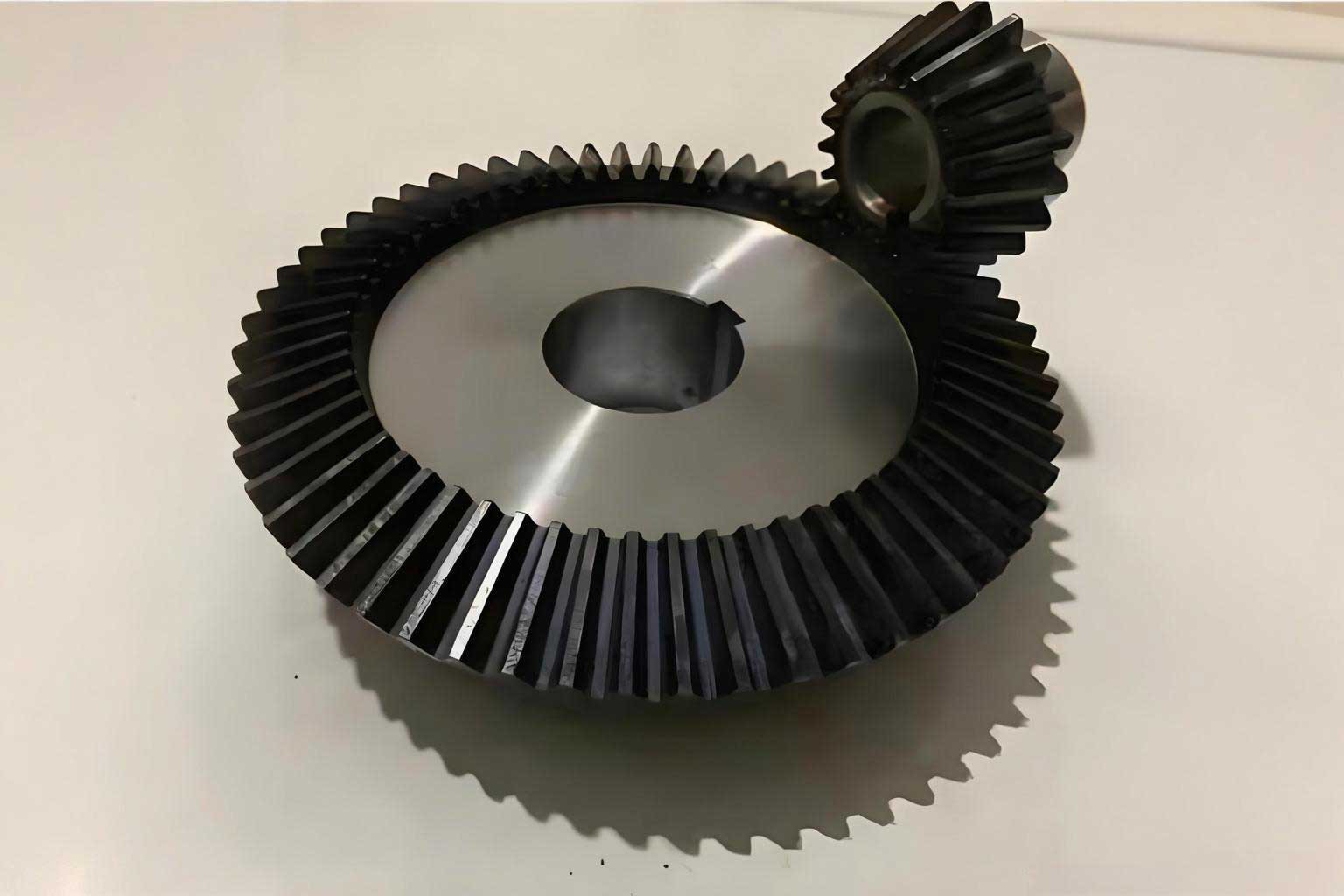
To begin, we must understand the fundamental geometry of a miter gear. The key parameters include the module \( m \), number of teeth \( Z \), pitch diameter \( d \), pitch cone angle \( \delta \), and face width \( b \). For a miter gear with a 90-degree shaft angle, the pitch cone angle for both gears is 45 degrees if the number of teeth is equal. However, in our case, the gear rings had varying sizes. The basic relationship for a bevel gear’s pitch diameter is given by:
$$ d = m \cdot Z $$
For a miter gear with shaft angle \(\Sigma = 90^\circ\), and assuming equal teeth numbers, the pitch cone angle \(\delta\) is:
$$ \delta = \arctan\left(\frac{Z_1}{Z_2}\right) $$
but since \(Z_1 = Z_2\) for a standard miter gear, \(\delta = 45^\circ\). The outer diameter \(d_a\) of the miter gear is calculated as:
$$ d_a = d + 2 \cdot h_a \cdot \cos \delta $$
where \(h_a\) is the addendum. For standard full-depth teeth, \(h_a = m\). The root angle \(\delta_f\) is crucial for designing the fixture, as it determines the tilt required during setup. The root angle is given by:
$$ \delta_f = \delta – \theta_f $$
where \(\theta_f\) is the dedendum angle, calculated as \(\theta_f = \arctan(h_f / R)\), with \(h_f\) being the dedendum and \(R\) the pitch cone distance. For large miter gears, these angles must be precisely accounted for in the fixture design.
Our first step was the preparation of fixtures, tools, and accessories. We designed a dedicated gear ring fixture based on the root angle of the miter gear. The shaper’s worktable was removed, and the fixture base was securely fastened to the shaper’s ram slide. A vertical plate was also fixed above the slide, and two rear support rollers were installed, which served both as supports and as rotational aids. The miter gear ring was positioned on these two support rollers and the vertical plate, forming an inclined plane corresponding to the root angle. All auxiliary components were welded onto the fixture base to create a rigid, integrated unit. The following table summarizes the key components of our setup for machining large miter gears:
| Component | Quantity | Function |
|---|---|---|
| Gear Ring Fixture Base | 1 | Primary mounting structure attached to shaper slide |
| Vertical Plate | 1 | Provides front support point for the miter gear ring |
| Rear Support Rollers | 2 | Support and allow rotation of the miter gear ring |
| Gear Ring Clamping Plates | 3 | Secure the miter gear ring in position (rear, front, and large) |
| Sliding Bronze Pad | 1 | Reduces friction during adjustment |
| Adjusting Blocks | As needed | Used for leveling the miter gear ring based on tooth depth difference |
For tooling, we manufactured three types of templates and four types of shaping tools. The templates included: a large-end tooth profile template (for laying out the tooth shape), a tooth space template (for inspecting the slot), and a two-tooth spanning template (for checking individual tooth profile and cumulative error). The shaping tools comprised: a right-side tooth profile forming tool, a left-side tooth profile forming tool, a slotting tool for roughing, and a root fillet tool. Each tool was ground to the exact tooth profile of the miter gear, considering the conical geometry. The material of the tools was high-speed steel (HSS) to withstand the intermittent cutting forces involved in shaping large miter gears.
Next, we proceeded with marking the gear ring. To prevent cumulative pitch errors, we first divided the miter gear ring into several equal segments, each containing the same number of teeth. This ensured that the central distance between each tooth was uniform. We marked the centerlines for each tooth’s top land and tooth space, radiating from the center of the miter gear ring. The centerlines on the tooth tops were used for inspecting the tooth profile and for laying out the large-end tooth form, while those in the tooth spaces were used for alignment during machining. Using the large-end tooth profile template, we carefully traced the tooth shape onto the miter gear ring, ensuring the template’s crosshair aligned precisely with the tooth top centerline. This step is critical for achieving accurate tooth forms on the miter gear.
The installation and adjustment phase is vital for machining large miter gears correctly. The gear ring was hoisted and placed onto the fixture base. The center of the miter gear ring was aligned to lie in the central plane of the shaper’s ram. The bottom of the tooth spaces was adjusted to a horizontal position. This adjustment required calculating the difference in total tooth height between the large end and the small end of the miter gear teeth. The total tooth height \(h\) for a bevel gear is \(h = h_a + h_f\), where typically \(h_a = m\) and \(h_f = 1.25m\) for full-depth teeth. The difference in tooth height \(\Delta h\) between the large and small ends over the face width \(b\) is given by:
$$ \Delta h = b \cdot \tan \delta_f $$
We used adjusting blocks of thickness equal to \(\Delta h\) to level the tooth space bottom. A dial indicator or a scribe mounted on the shaper’s tool head was then used to align the gear ring by following the tooth space centerlines while the machine was run slowly. Once aligned, all clamping components were tightened securely. The following table outlines the key adjustment parameters for a typical large miter gear we machined:
| Parameter | Symbol | Value | Remarks |
|---|---|---|---|
| Module | \(m\) | 20 mm | Defines tooth size for the miter gear |
| Number of Teeth | \(Z\) | 100 | For the largest miter gear ring |
| Face Width | \(b\) | 200 mm | Width of the miter gear ring |
| Pitch Cone Angle | \(\delta\) | 45° | Standard for a miter gear with equal teeth |
| Root Angle | \(\delta_f\) | 43.5° | Approximated based on dedendum angle |
| Tooth Height Difference (\(\Delta h\)) | ~3.5 mm | Calculated for leveling adjustment |
The actual shaping of the miter gear teeth commenced with roughing using the slotting tool. Starting from the center of the tooth space, we gradually increased the depth and width of the cut by coordinating the feed handle and the slide handle. The depth of cut per pass was kept minimal, typically 0.5 mm to 1 mm, to avoid excessive tool pressure. The roughing continued until about 1 mm to 2 mm of material remained on each side of the tooth space. At this point, we switched to the forming tools. The right-side and left-side forming tools were employed to gradually shape the tooth flanks from top to bottom, in a series of light finishing cuts. Each cut was carefully aligned using the marked centerlines and checked frequently with measuring instruments.
To ensure precision in each tooth of the miter gear, we regularly used a gear tooth vernier caliper and the templates for inspection. The chordal tooth thickness \(s_c\) at a given point on the miter gear tooth can be calculated using the formula:
$$ s_c = m \cdot Z \cdot \sin\left(\frac{90^\circ}{Z}\right) $$
but this is for spur gears; for bevel gears like a miter gear, the chordal tooth thickness varies along the face width. At the large end, the chordal tooth thickness \(s_{cL}\) is approximately:
$$ s_{cL} \approx s_L – \frac{s_L^3}{6 \cdot (R)^2} $$
where \(s_L\) is the arc tooth thickness at the large end, given by \(s_L = \frac{\pi m}{2}\) for standard teeth, and \(R\) is the pitch cone distance \(R = \frac{d}{2 \sin \delta}\). For our miter gear with \(m=20\) mm, \(Z=100\), and \(\delta=45^\circ\), we have \(d = 20 \times 100 = 2000\) mm, so \(R = \frac{2000}{2 \sin 45^\circ} \approx 1414.21\) mm. Then \(s_L = \frac{\pi \times 20}{2} = 31.4159\) mm, and the chordal thickness correction is negligible for large \(R\), so \(s_{cL} \approx 31.4\) mm. We measured this with calipers to ensure it was within tolerance.
After completing each tooth, we performed a realignment by checking the next tooth space centerline and reclamping the gear ring. This step-by-step approach minimized cumulative errors across the miter gear. The shaping process for a single tooth on such a large miter gear could take several hours, depending on the material (typically cast steel or forged steel) and the available machine power. Cutting speeds and feed rates were conservative to maintain tool life and accuracy. The cutting speed \(V\) in shaping is given by:
$$ V = \frac{N \cdot L \cdot (1+R)}{1000} \text{ m/min} $$
where \(N\) is the number of strokes per minute, \(L\) is the stroke length, and \(R\) is the return ratio (often 0.6 to 0.7 for shapers). For our application, we used a stroke length slightly larger than the face width of the miter gear, and a slow stroke rate to ensure smooth cutting.
Quality control was integral throughout the machining of the miter gear. We employed the two-tooth spanning template to check the profile of each tooth and to assess cumulative pitch error. The cumulative pitch error \(F_p\) over a sector of the miter gear is the difference between the actual and theoretical positions of teeth. We measured this by comparing the spanned distance across several teeth with the template. Additionally, we checked the surface roughness using a profilometer, ensuring it met the required Ra values. The success of machining large miter gears on a shaper hinges on meticulous attention to detail at every stage.
To further illustrate the process, let’s consider the forces involved. The cutting force \(F_c\) in shaping can be estimated using the formula:
$$ F_c = k_s \cdot a_p \cdot f $$
where \(k_s\) is the specific cutting force (in N/mm²), \(a_p\) is the depth of cut (in mm), and \(f\) is the feed per stroke (in mm/stroke). For steel, \(k_s\) ranges from 1500 to 2500 N/mm². In our roughing passes with \(a_p = 1\) mm and \(f = 0.5\) mm/stroke, \(F_c\) could be around 1250 N. This force must be absorbed by the fixture and the machine structure, hence the need for a rigid setup when machining large miter gears.
Another critical aspect is the thermal expansion of the miter gear ring during machining. Large workpieces can heat up due to cutting, leading to dimensional changes. We allowed for cooling intervals and took measurements at stable temperatures. The coefficient of thermal expansion \(\alpha\) for steel is approximately \(12 \times 10^{-6} /^\circ C\). For a 2000 mm diameter miter gear, a temperature rise of \(10^\circ C\) would cause a diameter change \(\Delta d = d \cdot \alpha \cdot \Delta T = 2000 \times 12 \times 10^{-6} \times 10 = 0.24\) mm, which is significant for precision. Therefore, we monitored temperature and compensated accordingly.
In summary, the method of machining large miter gears on a shaper is a viable and economical solution when dedicated gear cutters are unavailable. The key lies in a well-designed fixture that accommodates the conical geometry of the miter gear, precise marking and alignment, and careful step-by-step shaping with frequent inspections. The formulas and tables provided here encapsulate the technical considerations essential for success. This approach has enabled us to produce large miter gears that meet functional requirements at a fraction of the cost of specialized machining. The experience gained from these projects underscores the versatility of conventional machine tools when applied with ingenuity and thorough planning. For future endeavors involving large miter gears, we recommend further optimization of tool paths and the use of CNC shapers if available, but the fundamental principles remain unchanged. The miter gear, as a critical component in right-angle power transmission, demands accuracy in its tooth form to ensure smooth operation and longevity. Our method demonstrates that even with limited resources, it is possible to achieve satisfactory results for large miter gears through diligent engineering and craftsmanship.