
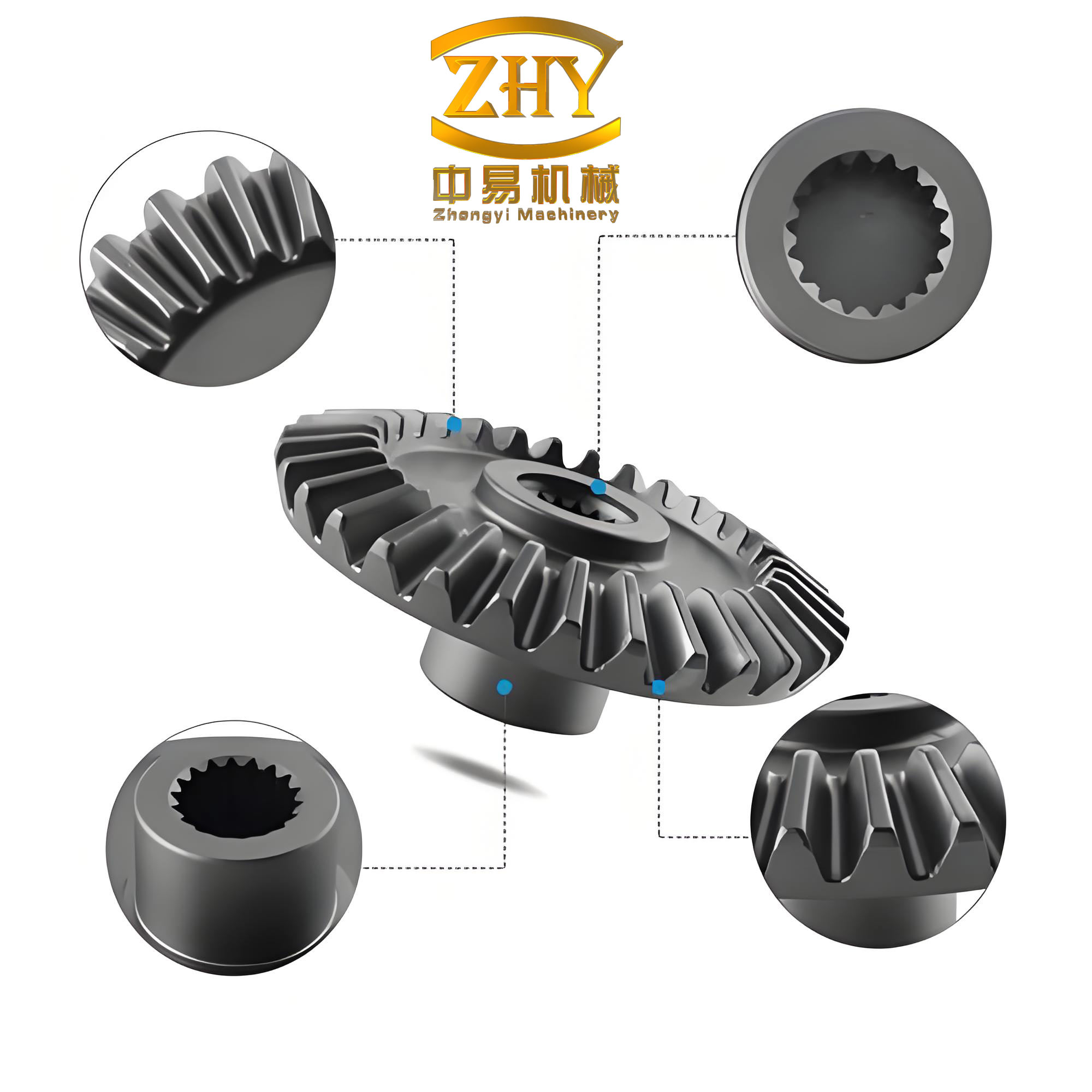
In my experience working with mechanical transmission systems, I encountered a critical situation where a large prime number straight bevel gear in a龙门刨床刀架传动系统 failed and became unusable. Given the workshop’s equipment constraints, I decided to implement an alternative machining approach: utilizing differential indexing on a vertical milling machine to process this straight bevel gear. This method offers distinct advantages, including achieving precise equal division for large prime number straight bevel gears and compatibility with standard vertical milling machines, making it accessible for various workshop environments.
The damaged straight bevel gear had specific parameters that required accurate measurement and calculation to replicate. Through meticulous inspection, I derived the key dimensions necessary for redrawing the component. Ensuring the gear’s integrity involved adhering to several machining criteria: accurate tooth profile at the large end, controlled radial runout error within tolerance limits, permissible pitch deviation, acceptable thickness variations at both ends, defined tooth direction error, and achieving the required surface roughness. These factors are crucial for the reliable performance of straight bevel gears in high-precision applications.
| Parameter | Value |
|---|---|
| Number of Teeth (Z) | 73 |
| Module at Large End (m) / mm | 3 |
| Pitch Diameter (d1) / mm | 218 |
| Addendum Diameter (da1) / mm | 220.5 |
| Addendum Height (ha) / mm | 3 |
| Dedendum Height (hf) / mm | 3.6 |
| Total Tooth Height (h) / mm | 6.6 |
| Pitch Cone Angle (δ1) / degrees | 73.4 |
| Face Width (b) / mm | 50 |
| Cone Distance (R1) / mm | 113.5 |
The machining process for this straight bevel gear necessitated a specialized approach due to the prime number of teeth (73). In standard indexing, the formula $$ n = \frac{40}{Z} $$ is used, where ( n ) is the number of turns of the indexing handle and ( Z ) is the number of teeth. However, for ( Z = 73 ), a prime number, simple division is impossible, and the indexing plate lacks a suitable hole circle. Thus, I employed differential indexing, which integrates a gear train between the indexing head’s spindle and side shaft, allowing for precise angular divisions.
Differential indexing operates on the principle that the actual rotation of the indexing handle is the sum of its relative rotation to the indexing plate and the plate’s own rotation. The setup involves mounting gears on the indexing head’s spindle and side shaft, with the indexing plate’s locking screw loosened. The gear ratio for differential indexing is calculated as: $$ \frac{Z_1 \cdot Z_3}{Z_2 \cdot Z_4} = \frac{40 (Z_0 – Z)}{Z_0} $$ where ( Z_0 ) is a chosen number close to the actual teeth count ( Z ), and ( Z_1, Z_2, Z_3, Z_4 ) are the gear teeth numbers. For ( Z = 73 ), I selected ( Z_0 = 70 ), leading to: $$ n_0 = \frac{40}{Z_0} = \frac{40}{70} = \frac{28}{49} $$ meaning the handle rotates 28 holes on a 49-hole circle per division. The gear ratio is: $$ \frac{Z_1 \cdot Z_3}{Z_2 \cdot Z_4} = \frac{40 (70 – 73)}{70} = -\frac{60}{35} $$ indicating opposite rotation directions, achieved using an intermediate gear.
To facilitate this on a vertical milling machine, I mounted the indexing head at an angle equal to the cutting angle of the straight bevel gear, which is the pitch cone angle ( δ = 73.4^\circ ). This orientation allows unrestricted gear train operation while maintaining indexing accuracy. I used a short arbor to mount a disk-type straight bevel gear cutter, selected based on the virtual number of teeth ( Z_v ), calculated as: $$ Z_v = \frac{Z}{\cos \delta} = \frac{73}{\cos 73.4^\circ} \approx 103 $$ For a module ( m = 3 ) mm, a No. 7 cutter was appropriate, as it corresponds to the tooth profile for this virtual count.
The machining sequence began with analyzing the gear drawing and setting up the indexing head. I verified the head’s alignment with the longitudinal feed direction at ( 73.4^\circ ), then performed differential indexing calculations and installed the gear train. Centering the workpiece involved scribing reference lines on the conical surface; using a height gauge, I marked lines on opposite sides and aligned the cutter’s symmetry to the midpoint. This ensured accurate tooth spacing for the straight bevel gear.
For milling the tooth slots, I started with the central portion, using the large end as a reference. The milling depth was set to the total tooth height: $$ h = 2.2m = 2.2 \times 3 = 6.6 \, \text{mm} $$ I sequentially milled all central slots to this depth. However, due to the taper of the straight bevel gear, the cutter—designed for the small end—left excess material at the large end. To address this, I milled the tooth sides by adjusting the vertical table. The displacement ( S ) for side milling is given by: $$ S = \frac{m \cdot b}{2R} = \frac{3 \times 50}{2 \times 113.5} \approx 0.48 \, \text{mm} $$ For the upper side, I raised the table by ( S ), rotated the workpiece to engage the cutter with the small end, and milled the large end’s excess. For the lower side, I lowered the table by ( 2S = 0.96 \, \text{mm} ) and repeated the process in the opposite direction. This two-step approach ensured uniform tooth thickness across the straight bevel gear.
| Component | Value |
|---|---|
| Selected Z0 | 70 |
| Handle Turns (n0) | 28/49 |
| Gear Ratio (Z1·Z3)/(Z2·Z4) | -60/35 |
| Active Gears | Z1=60, Z3=35 |
| Intermediate Gears | 2 (for direction reversal) |
Post-machining, I conducted thorough inspections to verify the straight bevel gear’s quality. Tooth thickness was measured using a gear tooth caliper at the large end, with the chordal tooth thickness and chordal addendum calculated as: $$ S = m \cdot Z_v \cdot \sin\left(\frac{90^\circ}{Z_v}\right) $$ $$ h = m \left[1 + \frac{Z_v}{2} \left(1 – \cos\left(\frac{90^\circ}{Z_v}\right)\right)\right] $$ For the small end, I used the small end module in similar formulas to check consistency. Tooth direction error was assessed by inserting precision pins into opposite tooth slots; alignment of the pin tips indicated correct tooth orientation. Surface roughness was evaluated using a profilometer to ensure it met specifications.
Throughout this process, I emphasized the importance of precision in machining straight bevel gears, particularly for large prime numbers where conventional methods fall short. The differential indexing method proved effective, enabling accurate division without specialized equipment. The final straight bevel gear exhibited all required dimensional and surface characteristics, demonstrating the viability of this approach for extending machining capabilities and reducing costs in workshop settings.
In summary, the successful fabrication of this straight bevel gear highlights the adaptability of differential indexing on vertical milling machines. By integrating mathematical calculations with practical machining techniques, I achieved a cost-effective solution that maintains high precision. This method not only addresses the challenges of large prime number straight bevel gears but also offers a reproducible framework for similar applications, underscoring the value of innovative approaches in mechanical engineering.