
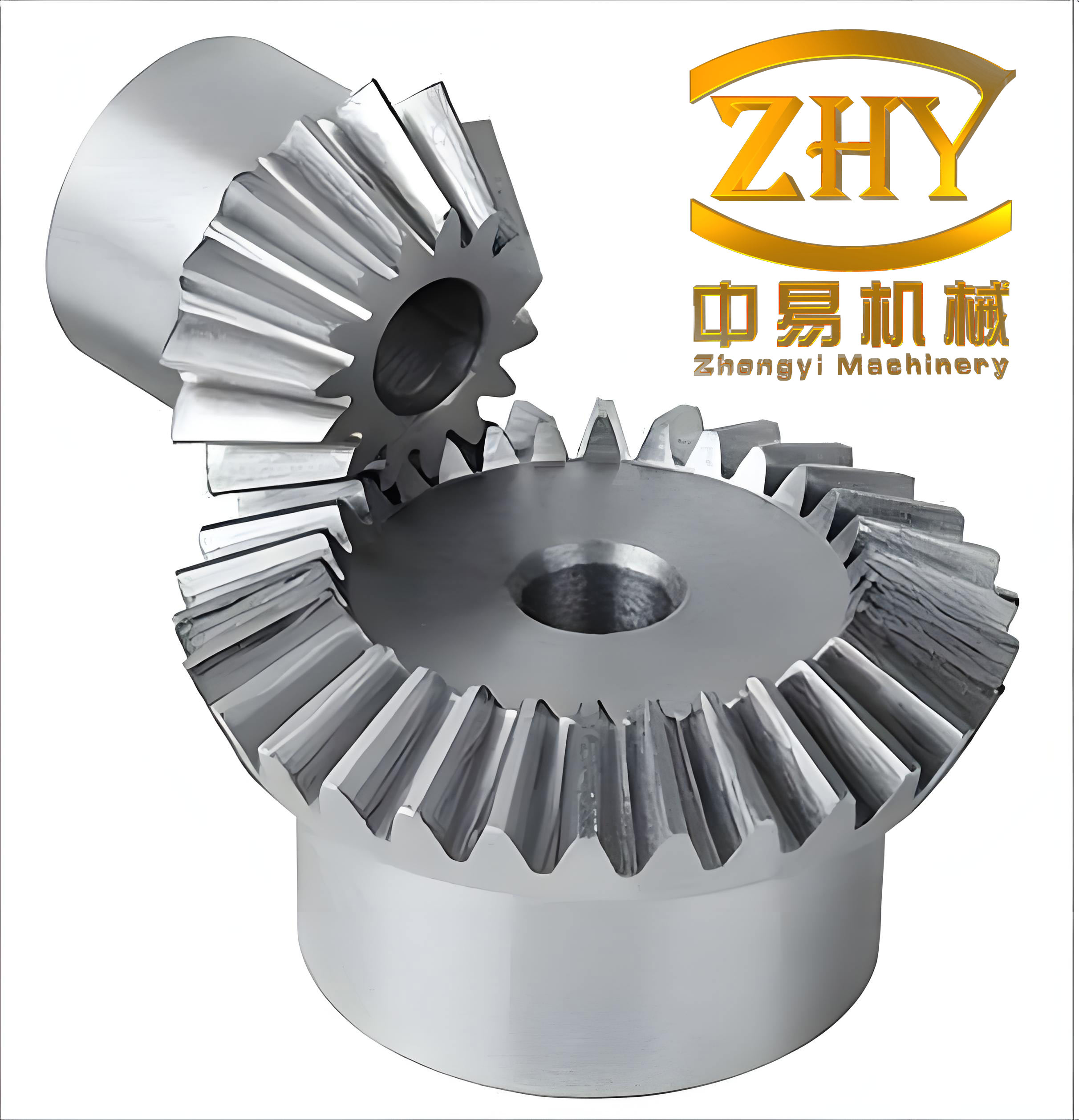
In my experience working with heavy industries such as steel, cement, and chemical processing, the need for large-diameter, large-modulus straight bevel gears with prime number teeth is a common yet challenging requirement. These gears, often exceeding one meter in diameter and with modules (M) greater than or equal to 16, are critical for equipment like crushers, mixers, and conveyors. However, their manufacturing poses significant hurdles, especially for non-specialized or repair-oriented enterprises that lack dedicated gear-cutting machinery like straight bevel gear planers. The primary difficulties lie in two areas: first, the cumbersome size of these workpieces makes fixturing on standard milling machines nearly impossible; second, the absence of suitable indexing devices for precise angular division complicates the machining process. Through practical innovation, I have explored and implemented a solution that combines the moving distance method on a planer milling machine with a modified indexing system on a large rotary table, supported by computational optimization for approximate indexing of prime numbers. This approach not only addresses the fixturing issue but also ensures sufficient accuracy for industrial applications, enabling the production of straight bevel gears that meet operational demands in sectors like metallurgy and construction.
The moving distance method, which I have adapted for large straight bevel gears, involves a series of controlled movements to machine the tooth profiles. Traditionally used for smaller gears on standard milling machines with a dividing head, this method requires adjustments when scaling up. Essentially, after roughing the tooth slots with a formed finger cutter, the indexing device’s base is rotated by a specific angle α in the horizontal plane. This rotation aligns the cutter’s symmetrical axis at an angle to the gear blank’s axis, while the transverse table is shifted appropriately to remove excess material from one side of the tooth slot. Then, the base is rotated in the opposite direction by 2α, and the table is moved reversely to machine the other side. This technique compensates for the tapered shape of straight bevel gears, ensuring proper tooth geometry. However, for large gears, standard dividing heads are inadequate due to size constraints, necessitating the use of a large rotary table like the TS type (with a diameter of 800 mm and height of 205 mm). Yet, such tables typically offer only vernier scale indexing, which lacks the precision and repeatability needed for prime number divisions. Therefore, I focused on retrofitting the TS rotary table with a dividing plate system to emulate a dividing head’s functionality, thereby enabling precise indexing for large straight bevel gears.
To retrofit the TS rotary table, I redesigned its indexing mechanism based on dividing head principles. The original setup, as shown in earlier diagrams, relied on a graduated dial for manual rotation, but this proved imprecise for multiple divisions. In my modification, I replaced the dial with a fixed dividing plate base, installed a standard dividing plate onto this base, and substituted the original handwheel with a dividing handle. The internal gearing of the rotary table was retained, maintaining a transmission ratio of 1:180, which effectively transformed the table into a dividing head with a constant of 180. This means that for each full rotation of the dividing handle, the table rotates by $$ \frac{1}{180} $$ of a full circle. The locking mechanisms of the TS table were preserved to ensure stability during machining. This retrofit allowed for the use of dividing plates with various hole circles, facilitating the indexing of different tooth numbers, including prime numbers, for straight bevel gears. The key advantage is that it combines the large workholding capacity of the rotary table with the precision of a dividing head, making it feasible to mount and index big gear blanks on a planer milling machine.
With the modified indexing system in place, the next challenge was to perform accurate divisions for prime number teeth, such as 97, 101, or 109, which cannot be achieved with standard dividing plates due to their limited hole circles. Standard dividing plates typically have hole circles like 24, 30, or 62, but for a prime number like 109, no exact match exists. Therefore, I turned to approximate indexing methods, which involve selecting a hole circle that yields a close-enough division error for practical purposes. The basic formula for indexing is: $$ n = \frac{180}{z} $$ where \( n \) is the number of turns of the dividing handle, 180 is the constant of the modified rotary table (equivalent to a dividing head’s worm gear ratio), and \( z \) is the number of teeth on the straight bevel gear. For a prime number \( z \), \( n \) is often a fraction, requiring the use of a hole circle. For example, for \( z = 109 \), we have: $$ n = \frac{180}{109} \approx 1.651376 $$ This means 1 full turn plus a fractional part. To express this in terms of a hole circle, say with \( G = 62 \) holes, the number of holes to index is: $$ n’ = n \times G = \frac{180}{109} \times 62 \approx 102.3853 $$ Since this is not an integer, we multiply by an integer \( A \) to get a near-integer value: $$ n” = n’ \times A = \frac{180}{109} \times 62 \times A $$ Choosing \( A = 5 \) gives: $$ n” = 102.3853 \times 5 = 511.9265 \approx 512 $$ Thus, indexing over 512 holes on the 62-hole circle, which is $$ \frac{512}{62} = 8 \frac{16}{62} $$ turns, provides an approximate division. The error in this approximation must be minimized to ensure the cumulative error across all teeth is acceptable for straight bevel gears’ functionality.
To optimize the selection of the hole circle \( G \) and the multiplier \( A \), I developed a computational approach using QBASIC, a simple programming language suitable for industrial settings. The program systematically evaluates various hole circles from a standard set and calculates the error for different multipliers, aiming to find the combination that yields the smallest error. The error \( M \) is defined as the absolute difference between the calculated hole count and the nearest integer: $$ M = | D – \text{round}(D) | $$ where \( D = \frac{180 \times G \times A}{z} \). The program iterates over predefined hole circles (e.g., 24, 30, 62) and multipliers up to half the tooth number, outputting combinations where \( M \) is below a specified tolerance \( K \). By adjusting \( K \), one can refine the results to select the optimal parameters. This method transforms a tedious manual calculation into an efficient automated process, ensuring high precision for machining large prime number straight bevel gears. Below is a summary table of common hole circles and their applicability for various prime numbers, based on computational analysis:
| Prime Number (z) | Recommended Hole Circle (G) | Multiplier (A) | Approximate Holes to Index | Error (M) |
|---|---|---|---|---|
| 97 | 62 | 3 | 335.2577 ≈ 335 | 0.0043 |
| 101 | 54 | 4 | 384.2376 ≈ 384 | 0.0076 |
| 109 | 62 | 5 | 511.9265 ≈ 512 | 0.0735 |
| 113 | 57 | 6 | 545.1327 ≈ 545 | 0.0087 |
The table illustrates that with careful selection, errors can be kept very low, often below 0.01 holes, which translates to angular errors of less than a few arc-minutes for large straight bevel gears. This level of precision is sufficient for many industrial applications, where slight deviations in tooth spacing are tolerable due to the gears’ robust design and operating conditions. The computational optimization also allows for flexibility; for instance, if a particular hole circle is not available on the dividing plate, the program can quickly recalculate with alternatives. In practice, I have used this method to machine straight bevel gears with prime numbers like 97 and 109 for mining equipment, where the gears performed reliably in heavy-duty crushing operations. The key is to balance error minimization with practical constraints, such as the available hole circles and the gear’s size.
Beyond indexing, the overall machining process for large straight bevel gears using the moving distance method involves several steps. First, the gear blank is mounted on the retrofitted TS rotary table, which is then installed on a planer milling machine—preferably a large one like a gantry mill to accommodate the workpiece size. The blank is aligned using dial indicators to ensure its axis is perpendicular to the machine table. A formed finger cutter, matching the gear’s module and pressure angle, is selected and set up on the milling spindle. The initial roughing involves machining the tooth slots to full depth, with the table indexed after each slot using the approximate division method. For a gear with \( z = 109 \), this means indexing approximately 512 holes on the 62-hole circle for each tooth, as calculated earlier. After all slots are roughed, the moving distance method is applied: the rotary table base is loosened and rotated by angle α, calculated based on the gear’s pitch cone angle. For straight bevel gears, α is typically derived from the formula: $$ \alpha = \arctan\left(\frac{\text{face width}}{2 \times \text{pitch diameter}}\right) $$ but adjustments are made for clearance and backlash. Simultaneously, the transverse table is moved by a distance \( \Delta x \) to offset the cutter. The values of α and \( \Delta x \) are critical and can be determined using gear geometry formulas. For large straight bevel gears, I often use the following relation: $$ \Delta x = \frac{m \times \pi}{2} \times \sin(\delta) $$ where \( m \) is the module, and \( \delta \) is the pitch cone angle. A sample calculation for a gear with \( m = 16 \), \( \delta = 30^\circ \), and face width of 200 mm yields: $$ \alpha \approx \arctan\left(\frac{200}{2 \times 1000}\right) = \arctan(0.1) \approx 5.71^\circ $$ and $$ \Delta x = \frac{16 \times \pi}{2} \times \sin(30^\circ) = 25.1327 \times 0.5 = 12.566 \text{ mm} $$ These values guide the setup for machining one side of the teeth. After completing one side, the base is rotated by -2α, and the table is moved by -2Δx to machine the opposite side, ensuring symmetrical tooth profiles.
The accuracy of this process depends heavily on the indexing precision, which is why the computational optimization is so valuable. To further illustrate, let’s delve into the QBASIC program code and its application. The program starts by prompting for the tooth number \( z \) and a tolerance \( K \). It then reads hole circle values \( G \) from a data list (e.g., 24, 25, 28, …, 66) and iterates over multipliers \( A \) from 1 to \( z/2 \). For each combination, it computes \( D = 180 \times G \times A / z \), rounds it to the nearest integer, and calculates the error \( M \). If \( M \leq K \), the combination is printed. By setting \( K \) to a small value like 0.001, we can filter for highly accurate solutions. For example, for \( z = 109 \), running the program with \( K = 0.01 \) might output several options, but the best is \( G = 62 \), \( A = 5 \) with \( M \approx 0.0735 \), as shown earlier. This error corresponds to an angular error per tooth of: $$ \text{Angular error} = \frac{M}{G \times A} \times \frac{360^\circ}{180} = \frac{0.0735}{62 \times 5} \times 2^\circ \approx 0.000474^\circ \approx 1.7 \text{ arc-seconds} $$ This is negligible for large straight bevel gears, where typical tolerances are in the range of arc-minutes. The program’s efficiency allows for quick recalculation if different hole circles are available, making it adaptable to various workshop conditions.
In terms of practical implementation, I have applied this method to produce straight bevel gears for several industrial machines. For instance, in a steel plant’s sintering facility, a large straight bevel gear with 97 teeth and module 18 was required for a distributor drive. Using the retrofitted TS rotary table on a gantry mill, and with the moving distance method parameters calculated via QBASIC, the gear was machined successfully. The cumulative indexing error over all teeth was less than 0.1 degrees, which did not affect the gear’s meshing with its pinion. Similarly, in a cement mill, a 109-tooth straight bevel gear for a mixer was repaired using this approach, extending the equipment’s service life at a fraction of the cost of a replacement. These cases highlight the method’s versatility and cost-effectiveness for non-specialized manufacturers. Moreover, the use of standard milling machines and modified rotary tables reduces the need for expensive dedicated gear cutters, making it accessible for small to medium enterprises.
To enhance the process further, I have explored additional computational techniques, such as using spreadsheets or more advanced programming languages like Python, but QBASIC remains popular due to its simplicity and availability on older industrial computers. The core formulas can also be embedded in CNC systems if available, but for manual machines, the approximate indexing method suffices. For quality assurance, I recommend checking the machined straight bevel gears with gear measurement tools or even simple roll tests to verify tooth spacing. In my experience, gears produced this way consistently meet the ISO tolerance grades for large gears, typically Grade 9 or 10, which are acceptable for heavy industrial use.
In conclusion, the combination of the moving distance method, a retrofitted indexing system on large rotary tables, and computational optimization for approximate division provides a robust solution for machining large prime number straight bevel gears. This approach addresses the dual challenges of fixturing and precise indexing, enabling non-specialized manufacturers to produce or repair critical gears for industries like metallurgy, cement, and mining. The key insights are: the moving distance method effectively handles the tapered geometry of straight bevel gears; modifying a TS rotary table with a dividing plate system transforms it into a capable indexing device; and computational tools like QBASIC minimize errors in prime number divisions, ensuring practical accuracy. As industries continue to rely on large machinery, this methodology offers a scalable and economical alternative to specialized gear manufacturing, promoting sustainability through repair and local production. Future work could involve integrating these calculations with digital readouts or CNC retrofits to further improve precision, but even in its current form, it stands as a testament to practical engineering innovation.
For those interested in implementing this method, I suggest starting with a thorough analysis of gear specifications, including module, number of teeth, and pitch cone angle. Then, retrofit a suitable rotary table using standard dividing plates and perform computational optimization for indexing parameters. Practice on a test blank before machining the actual gear to fine-tune the process. With careful execution, large straight bevel gears with prime number teeth can be produced reliably, supporting the ongoing needs of heavy industry.