
In my years of experience as a mechanical engineer specializing in gear design and manufacturing, I have often encountered the need for precise angle transmission systems, particularly those involving miter gears. Miter gears, a subset of bevel gears where the shafts intersect at a 90-degree angle and the gears are of equal size, are fundamental components in various machinery, from automotive differentials to industrial equipment. This article delves into the intricate process of machining straight-tooth miter gears using a universal milling machine, a method that balances accessibility with precision. I will share detailed insights, formulas, and tables to guide practitioners through the design, setup, and cutting processes, emphasizing the unique considerations for miter gears throughout.
The appeal of miter gears lies in their ability to change the direction of rotational motion efficiently while maintaining a 1:1 speed ratio. In many applications, such as right-angle drives in conveyors or indexing mechanisms, miter gears provide a compact and reliable solution. However, machining these gears, especially on conventional equipment like a universal milling machine, requires a deep understanding of their geometry and careful execution. I recall numerous projects where I had to produce custom miter gears for prototyping or small-batch production, often resorting to milling due to its flexibility. The process involves generating the tapered tooth profiles through a series of calculated movements and cutter adjustments, which I will elaborate on with mathematical rigor.
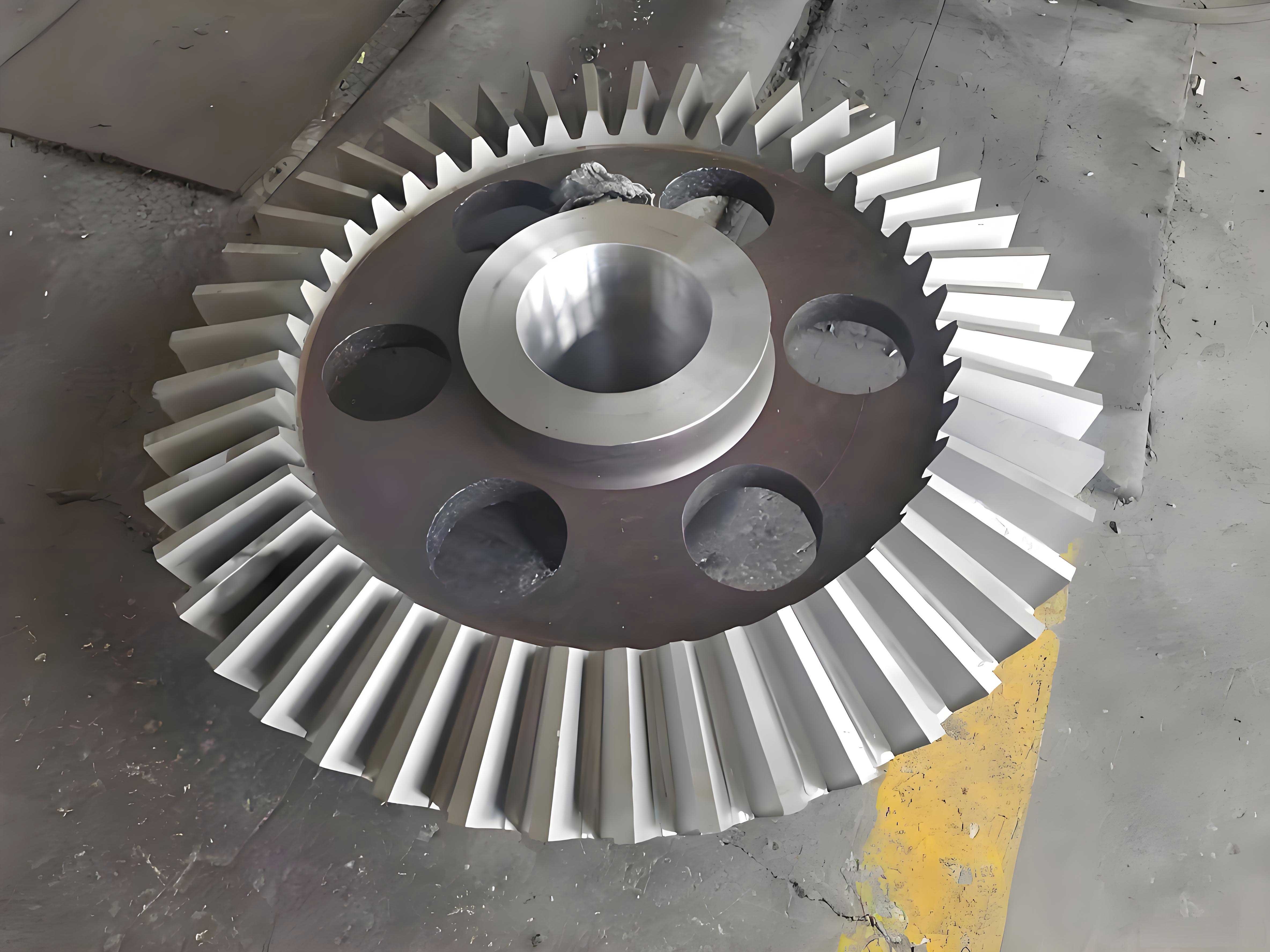
Before delving into machining, it is crucial to grasp the geometric parameters that define miter gears. Unlike spur gears, miter gears have teeth that are tapered along the face width, converging at the apex of the pitch cone. The key dimensions include the pitch diameter, cone angle, face width, and tooth proportions. For miter gears, since the shaft angle is 90 degrees and the gear ratio is 1:1, the pitch cone angle for each gear is 45 degrees. This simplifies some calculations but introduces challenges in tooth alignment and strength. The fundamental relationship for bevel gears, including miter gears, is given by the pitch cone angle $\gamma$: for miter gears, $\gamma = 45^\circ$. The pitch diameter $d$ relates to the module $m$ and number of teeth $N$ as in spur gears: $d = mN$. However, due to the conical shape, the module varies along the tooth; typically, the module at the large end is considered standard.
To design miter gears, one must account for the virtual or formative number of teeth, which affects tooth strength and contact. The formative number of teeth $N_f$ for a bevel gear is calculated as $N_f = \frac{N}{\cos \gamma}$. For miter gears with $\gamma = 45^\circ$, this becomes $N_f = \frac{N}{\cos 45^\circ} = \sqrt{2} N \approx 1.414N$. This implies that the teeth behave similarly to those in a spur gear with more teeth, influencing the selection of cutters and load calculations. I often use this concept to determine the appropriate cutter number from standard gear cutter sets, which are designed for spur gears but can be adapted for miter gears through careful indexing.
The tooth profile for straight-tooth miter gears is typically an involute form, but it is projected onto a conical surface. The pressure angle $\alpha$, commonly 20° or 14.5°, defines the tooth shape. The addendum $a$ and dedendum $b$ are usually based on the module: $a = 1.0m$ and $b = 1.25m$ for full-depth teeth, though these may be adjusted for clearance. For miter gears, the tooth dimensions taper, so calculations must be performed at specific sections, such as the large end or mid-face. Below is a table summarizing key geometric parameters for a standard miter gear set:
| Parameter | Symbol | Formula for Miter Gears | Example Value (N=20, m=3 mm) |
|---|---|---|---|
| Number of Teeth | N | Given | 20 |
| Module (large end) | m | Given | 3 mm |
| Pitch Cone Angle | γ | 45° | 45° |
| Pitch Diameter | d | d = mN | 60 mm |
| Cone Distance | R | R = d / (2 sin γ) | 42.43 mm |
| Face Width | F | Typically F ≤ R/3 | 14 mm |
| Addendum (large end) | a | a = 1.0m | 3 mm |
| Dedendum (large end) | b | b = 1.25m | 3.75 mm |
| Formative Teeth | N_f | N_f = N / cos γ | 28.28 |
Machining miter gears on a universal milling machine involves using a rotary table to index the gear blank and a formed milling cutter, such as a gear hob or a disc-type form cutter, to cut the teeth. The setup requires precise alignment of the gear blank relative to the cutter and the rotary axis. I typically begin by mounting the gear blank on a mandrel attached to the rotary table, ensuring that the axis of the blank is inclined at the pitch cone angle relative to the table surface. For miter gears, this angle is 45°, so the blank is tilted accordingly. The cutter, usually a standard involute gear cutter selected based on the formative number of teeth, is mounted on the milling machine arbor. The cutting process involves indexing after each tooth cut, similar to milling spur gears, but with additional adjustments for the taper.
The indexing calculation is critical for accuracy. For a gear with N teeth, the indexing angle per tooth is $\theta = \frac{360^\circ}{N}$. On a universal milling machine with a rotary table, this is achieved through a dividing head or direct dial settings. For example, for N=20, $\theta = 18^\circ$ per tooth. However, due to the conical shape, the cutter must be fed radially and vertically to generate the tapered tooth space. This requires setting the cutter depth differently at the large and small ends of the tooth. The depth of cut $t$ varies along the face width; at the large end, $t = a + b = 2.25m$, and at the small end, it is reduced proportionally based on the cone distance. I often use the following formula to calculate the depth at any point along the face: $$t(x) = (a + b) \frac{R – x}{R}$$ where $x$ is the distance from the large end along the cone axis, and $R$ is the cone distance.
To achieve the taper, the milling machine table may be swiveled, or the cutter path may be controlled through compound feeds. One common method is to offset the cutter centerline relative to the gear axis, then feed the cutter along an angled path. The offset distance $O$ can be calculated as $O = \frac{F}{2} \tan \gamma$, where $F$ is the face width. For miter gears with $\gamma = 45^\circ$, this simplifies to $O = \frac{F}{2}$, since $\tan 45^\circ = 1$. This offset ensures that the cutter generates the correct tooth taper. Below is a table outlining the machining steps and parameters for cutting miter gears on a universal milling machine:
| Step | Action | Key Parameters | Formula/Setting |
|---|---|---|---|
| 1. Blank Preparation | Mount gear blank on mandrel | Pitch cone angle γ | Tilt blank to γ = 45° |
| 2. Cutter Selection | Choose involute gear cutter | Formative teeth N_f | Use cutter # for N_f ≈ 28.28 |
| 3. Initial Setup | Align cutter to blank center | Offset O | O = F/2 (for γ=45°) |
| 4. Depth Setting | Set cutter depth at large end | Total depth t_large | t_large = 2.25m |
| 5. Indexing | Rotate blank for each tooth | Index angle θ | θ = 360°/N |
| 6. Cutting Feed | Feed cutter along taper path | Feed rate, path angle | Use compound slide at γ |
| 7. Finishing | Light passes for accuracy | Tolerance | Adjust based on measurement |
The mathematics behind miter gear machining extends to checking tooth thickness and backlash. The chordal tooth thickness $s$ at the large end is given by $s = mN \sin\left(\frac{90^\circ}{N}\right)$ for approximate measurement, but for precision, the arc tooth thickness should be calculated based on the pressure angle. For a standard tooth, the arc thickness at the pitch circle is $s_p = \frac{\pi m}{2}$. However, due to taper, this varies. I often use the following formula to compute the chordal thickness at the large end for inspection: $$s_c = d \sin\left(\frac{90^\circ}{N} + \text{inv}(\alpha)\right)$$ where $\text{inv}(\alpha) = \tan \alpha – \alpha$ (in radians) is the involute function. For miter gears, this must be adjusted for the cone angle, but in practice, for small angles, the error is minimal if the formative number is used.
Another critical aspect is the calculation of the cutter path or the generation of the tooth flank. On a universal milling machine, we approximate the true involute profile by using a formed cutter, but for higher accuracy, a generating method like planing or using a special bevel gear generator is preferred. However, for many applications, milling suffices. The cutter’s shape corresponds to the tooth space of a spur gear with $N_f$ teeth, and by feeding along the taper, we produce the conical tooth. The relationship between the cutter’s profile and the desired miter gear tooth can be expressed through coordinate transformations. For a point on the cutter edge at radius $r_c$, the corresponding point on the gear tooth at a distance $x$ from the apex is given by parametric equations. In my work, I use these to simulate the tooth geometry before cutting:
Let the coordinate system have the gear axis along z, and the tooth profile in the x-y plane. For a straight tooth miter gear, the tooth flank is a plane that passes through the apex. The equation of this plane can be derived from the pitch cone parameters. If the pressure angle is $\alpha$, the tooth plane is inclined at an angle $\beta$ relative to the pitch cone generator, where $\beta = \alpha$ in the transverse plane. For miter gears, the transverse plane is normal to the pitch cone, so the calculations involve spherical trigonometry. However, for machining purposes, we simplify by using the formative gear concept.
I have found that using tables to record settings and measurements enhances repeatability. Below is a sample table for a miter gear cutting operation with N=24, m=4 mm, and pressure angle α=20°:
| Parameter | Value | Calculation Notes |
|---|---|---|
| Module m | 4 mm | Given |
| Teeth N | 24 | Given |
| Pitch Diameter d | 96 mm | d = mN = 4*24 |
| Cone Distance R | 67.88 mm | R = d/(2 sin 45°) = 96/(2*0.7071) |
| Face Width F | 22 mm | Selected as R/3 ≈ 22.63 mm |
| Formative Teeth N_f | 33.94 | N_f = N/cos 45° = 24/0.7071 |
| Cutter Number | #4 (for 35 teeth) | Based on N_f ≈ 34 |
| Offset O | 11 mm | O = F/2 = 22/2 |
| Depth at Large End | 9 mm | t_large = 2.25m = 2.25*4 |
| Index Angle θ | 15° | θ = 360°/24 = 15° |
| Chordal Thickness s_c | 6.28 mm | s_c ≈ d sin(90°/N + inv(20°)) |
During actual machining, I set up the milling machine with the rotary table tilted to 45° using a sine bar or angle gauge. The gear blank is mounted concentrically, and the cutter is positioned at the offset distance from the center. I then perform a trial cut on a scrap piece to verify the tooth profile, measuring the chordal thickness with gear tooth calipers. Adjustments to the cutter depth or offset may be needed based on the measurement. For miter gears, it is essential to ensure that both gears in the pair are cut identically to mesh properly with minimal backlash. I often cut them as a matched set on the same setup to maintain consistency.
The challenges in machining miter gears include achieving the correct taper without undercutting at the small end and maintaining tooth strength. Undercutting occurs if the tooth thickness becomes too narrow, which can happen if the face width is too large relative to the cone distance. To avoid this, I limit the face width to about one-third of the cone distance, as noted in the table. Additionally, the cutter must be sharp and free of runout to produce smooth tooth flanks. Vibration can be an issue, so I use low feed rates and secure clamping. For hardened materials, subsequent grinding may be necessary, but for many applications, such as in low-speed mechanisms, milled miter gears are sufficient.
In terms of applications, miter gears are ubiquitous in right-angle drives. I have used them in custom machinery for packaging equipment, where space constraints required a compact 90° transmission. The ability to machine them on a universal milling machine makes them accessible for small workshops or repair jobs. However, for high-precision or high-load applications, such as in aerospace or automotive differentials, dedicated bevel gear generators are preferred. Nonetheless, the milling approach provides a valuable skill set for engineers and machinists.
To further illustrate the calculations, consider the dynamic forces on miter gears. The tangential force $F_t$ at the pitch circle is given by $F_t = \frac{2T}{d}$, where $T$ is the torque. For miter gears, since the shafts are perpendicular, the axial force $F_a$ and radial force $F_r$ depend on the pressure angle and cone angle. For a gear with pressure angle $\alpha$ and pitch cone angle $\gamma$, the forces are: $$F_a = F_t \tan \alpha \sin \gamma$$ $$F_r = F_t \tan \alpha \cos \gamma$$ For miter gears with $\gamma = 45^\circ$, these simplify to $F_a = F_r = F_t \tan \alpha / \sqrt{2}$. This symmetry is a unique feature of miter gears and must be considered in bearing selection and housing design.
I often incorporate these force calculations into a comprehensive design table for miter gear sets, ensuring that the gears and supports are adequately sized. Below is a table for force analysis based on a given torque:
| Force Component | Symbol | Formula for Miter Gears (γ=45°) | Example (T=100 Nm, d=0.1 m, α=20°) |
|---|---|---|---|
| Tangential Force | F_t | F_t = 2T/d | 2000 N |
| Axial Force | F_a | F_a = F_t tan α / √2 | 520.3 N |
| Radial Force | F_r | F_r = F_t tan α / √2 | 520.3 N |
| Resultant Force | F_res | F_res = √(F_t^2 + F_a^2 + F_r^2) | 2121.3 N |
In addition to machining, I emphasize the importance of heat treatment and finishing for miter gears. After cutting, gears may be carburized or induction hardened to improve wear resistance. However, distortion during heat treatment can affect the precise tooth geometry, so I recommend stress relieving before final finishing. For critical applications, lapping the gear pair together can reduce noise and improve efficiency. The lapping process involves running the miter gears with an abrasive compound to wear in the teeth for better contact pattern.
From a design perspective, the selection of materials for miter gears depends on the application. For light-duty uses, plastics or aluminum may suffice, while for heavy loads, alloy steels such as 4140 or 8620 are common. I have often used 1045 steel for prototype miter gears due to its machinability and moderate strength. The material properties influence the module selection; for higher loads, a larger module is chosen to increase tooth strength. The bending stress $\sigma_b$ in a gear tooth can be estimated using the Lewis formula: $$\sigma_b = \frac{F_t}{b m Y}$$ where $b$ is the face width, $m$ is the module, and $Y$ is the Lewis form factor based on the formative number of teeth. For miter gears, using $N_f$ in determining $Y$ from standard tables is advisable.
To ensure durability, I also check the surface contact stress using the Hertzian formula: $$\sigma_c = \sqrt{\frac{F_t E}{b d \sin \alpha}}$$ where $E$ is the equivalent modulus of elasticity for the gear pair. For steel gears, $E \approx 210$ GPa. This stress should be below the material’s allowable limit to prevent pitting. For miter gears, the contact pattern is along a line, so proper alignment during assembly is crucial to avoid edge loading.
In my practice, I have developed a step-by-step checklist for machining miter gears on a universal milling machine, which I share with trainees:
- Design the gear: Determine N, m, α, and material based on load requirements.
- Prepare the blank: Turn to the pitch cone angle, leaving allowance for finishing.
- Set up the milling machine: Mount rotary table, tilt to 45°, align blank.
- Select and mount cutter: Choose based on N_f, ensure runout is minimal.
- Calculate offsets and depths: Use formulas for O and t.
- Perform trial cut: Measure tooth thickness and adjust as needed.
- Cut all teeth: Index precisely, maintain consistent feed.
- Deburr and inspect: Check dimensions, tooth form, and surface finish.
- Heat treat if required: Control distortion.
- Assemble and test: Run with mating gear, check backlash and noise.
This process, while time-consuming, yields functional miter gears for various applications. I recall a project where I machined a set of stainless steel miter gears for a marine steering mechanism, using the above steps. The gears performed reliably despite exposure to saltwater, demonstrating the versatility of milled gears.
In conclusion, machining miter gears on a universal milling machine is a valuable skill that combines theoretical knowledge with practical craftsmanship. The key lies in understanding the unique geometry of miter gears, from the 45° pitch cone angle to the formative tooth count, and applying precise calculations for setup and cutting. Through formulas, tables, and careful execution, high-quality miter gears can be produced for prototypes, repairs, or small-scale production. I encourage engineers and machinists to master this technique, as it opens doors to custom gear solutions without the need for specialized equipment. Whether for industrial machinery or hobbyist projects, miter gears remain indispensable components, and their manufacture via milling is both an art and a science.
As I reflect on my experiences, I am continually amazed by the elegance of miter gears in transmitting motion at right angles. The interplay of forces, the precision of tooth engagement, and the satisfaction of a well-machined pair underscore the importance of attention to detail. By sharing these insights, I hope to foster a deeper appreciation for gear manufacturing and inspire others to explore the world of miter gears further.