
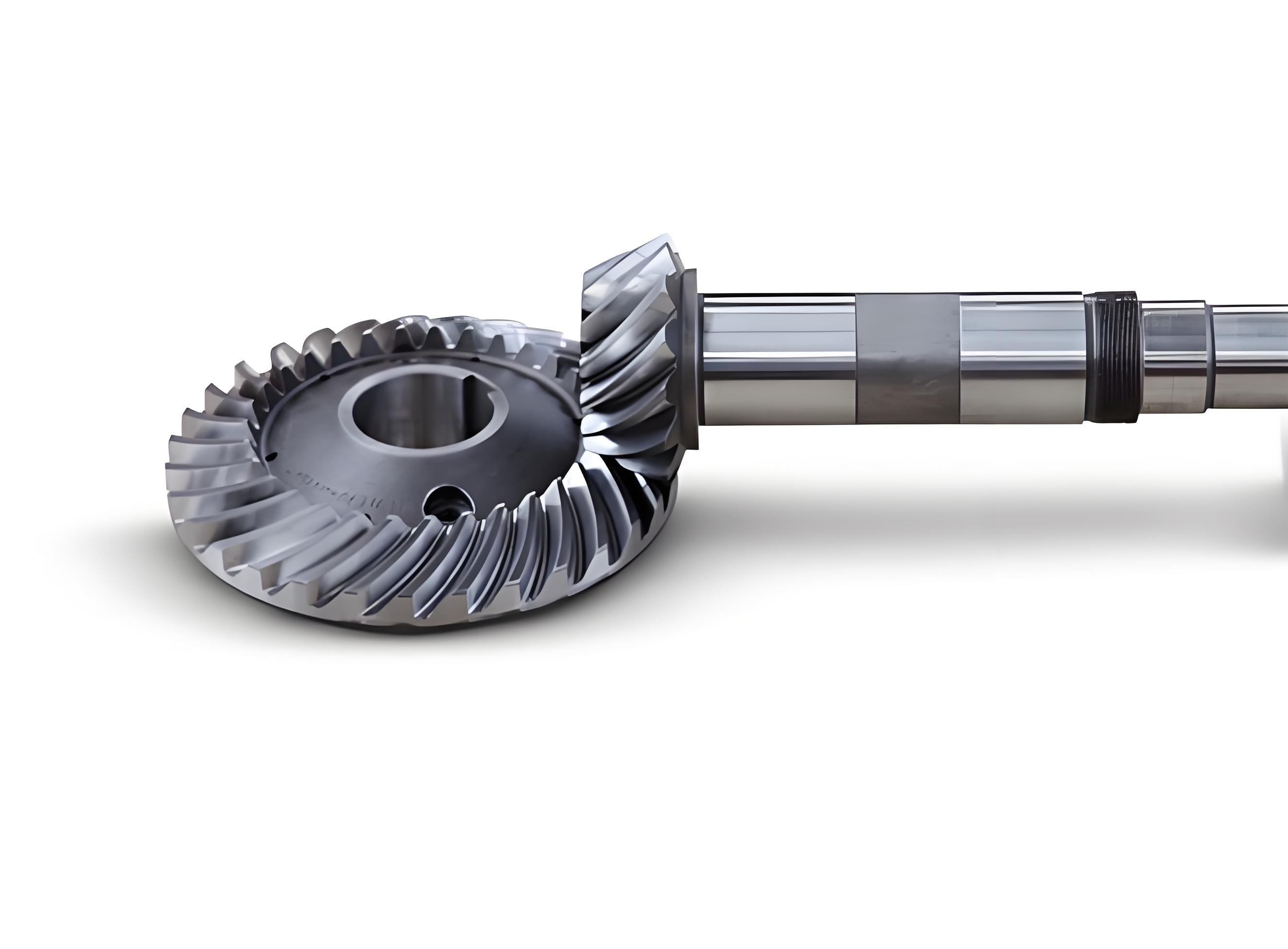
In the field of mechanical transmission, spiral bevel gears are widely used due to their excellent performance in applications such as automobiles and tractors. Traditional manufacturing of spiral bevel gears relies on machining processes, which offer high precision and control over meshing quality but suffer from inefficiencies in production, material waste, and limited material properties compared to forged components. Forged gears have been employed for years, but precision forging of spiral bevel gears remains challenging due to their complex geometry. Common die manufacturing methods, like engraving, reverse imprinting, or electrolytic polishing, often involve long cycles. To address this, I explore a machining-based approach using tool tilt form cutting to manufacture precision forging dies for spiral bevel gears, aiming to enhance production efficiency while addressing inherent process issues.
To clarify, I define two key terms: the prototype gear pair and the forged gear. The prototype gear pair refers to a standard-designed gear set, typically using a standard tapered tooth system and processed via the semi-generating method with tool tilt (SFT). In this pair, the gear is machined using a forming method with a dual-blade cutter, where convex and concave tooth surfaces are generated by the outer and inner blades of a Gleason cutter rotating around its axis. The pinion is produced via a generating method with a single-blade cutter. In contrast, the forged gear is manufactured via precision forging using a die, while the mating pinion remains machined. This distinction sets the stage for comparing tooth surface formation principles.
The formation of tooth surfaces in spiral bevel gears involves intricate geometry. For the prototype gear, cutting is performed with the cutter axis perpendicular to the root cone generatrix of the gear, and the blade surfaces generate conical shapes that define the tooth profiles. However, for the forging die, which has an internal conical shape (like a dish) to produce the external form of the forged gear, the cutter axis must be perpendicular to the die’s root cone generatrix (equivalent to the forged gear’s face cone generatrix). This leads to a mismatch in cutter axes between machining the prototype gear and the die, as illustrated in comparative diagrams. The angle between these axes, denoted as α, equals the sum of the root angle and face angle of the prototype gear for tapered teeth, except in the case of uniform depth teeth where α = 0. This discrepancy introduces form errors in the forged gear, necessitating adjustments in die machining.
To avoid interference during die machining, such as “secondary cutting” where non-cutting parts of the cutter remove unintended material, a tool tilt in the normal direction is required. This further alters the cutter axis orientation, exacerbating differences between the prototype gear and forged gear tooth surfaces. Thus, achieving identical surfaces is impossible, leading to inherent form errors in spiral bevel gears produced via forging. This paper delves into methods to mitigate these errors and ensure proper meshing.
Fundamentals of Spiral Bevel Gear Geometry
Understanding the geometry of spiral bevel gears is crucial for die parameter inversion. Key parameters include pitch cone angles, spiral angles, pressure angles, and tooth dimensions. Below is a table summarizing essential parameters used in calculations for spiral bevel gears.
| Parameter | Symbol | Description |
|---|---|---|
| Pitch Cone Angle | δ | Angle between gear axis and pitch cone generatrix |
| Spiral Angle | ψ | Angle of tooth curvature along the pitch cone |
| Pressure Angle | φ | Angle between tooth profile normal and pitch plane |
| Root Angle | δ_f | Angle for root cone relative to axis |
| Face Angle | δ_a | Angle for face cone relative to axis |
| Cutter Radius | R_c | Radius of the cutting tool blade |
| Tool Tilt Angle | i_n | Angle of cutter tilt in normal direction |
For spiral bevel gears, the tooth surfaces are defined mathematically. The unit normal vector at any point on the tooth surface plays a vital role in meshing analysis. Let’s consider a point P on the tooth surface. In a coordinate system attached to the gear, the position vector and normal vector can be derived using geometry. For instance, for a conical surface generated by cutter blades, the unit normal vector n can be expressed as:
$$ \mathbf{n} = -\cos \varphi \cos \psi \, \mathbf{i} + \cos \varphi \sin \psi \, \mathbf{j} + \sin \varphi \, \mathbf{k} $$
where φ is the root cone pressure angle, ψ is the root cone spiral angle, and i, j, k are unit vectors along coordinate axes. This formulation applies to both convex and concave surfaces, with sign adjustments for direction.
Traditional Machining vs. Precision Forging for Spiral Bevel Gears
The choice between machining and forging for spiral bevel gears involves trade-offs in efficiency, material properties, and precision. Below is a comparative table highlighting key aspects.
| Aspect | Traditional Machining | Precision Forging |
|---|---|---|
| Production Efficiency | Lower due to multi-step cutting | Higher with rapid die-based forming |
| Material Utilization | High waste from chips | Minimal waste near-net shape |
| Gear Strength | Depends on base material | Enhanced grain flow for durability |
| Surface Finish | High precision achievable | Requires post-processing often |
| Die Manufacturing | Not applicable | Complex and time-consuming |
| Application in Spiral Bevel Gears | Dominant for high precision | Emerging for mass production |
In precision forging of spiral bevel gears, the die must replicate the inverse geometry of the gear. This requires precise calculation of die parameters from gear specifications, which is where tool tilt form cutting comes into play.
Methodology: Tool Tilt Form Cutting for Die Machining
Tool tilt form cutting involves orienting the cutter axis with a tilt to avoid interference while machining the die’s internal conical surface. The process starts with determining the cutter location based on the die geometry. For a die with root cone parameters, the cutter axis is set perpendicular to the die’s root cone generatrix, but with an additional tilt angle i_n in the normal direction to prevent collisions. The cutter’s blade profile must match the desired tooth surface of the die, which is derived from the prototype gear parameters.
The mathematical model for cutter positioning involves coordinate transformations. Let the cutter axis vector be k, and the die’s root cone generatrix direction be g. The angle between them should be 90° in the absence of tilt, but with tool tilt, it adjusts. The transformation matrix between coordinate systems attached to the prototype gear and die can be expressed as:
$$ \mathbf{A} = \begin{bmatrix} 1 & 0 & 0 \\ 0 & \cos \alpha & \sin \alpha \\ 0 & -\sin \alpha & \cos \alpha \end{bmatrix} $$
where α is the angle between the cutter axes for prototype gear and die, as defined earlier. This matrix helps relate normal vectors between surfaces.
For machining the die, the cutter’s pressure angle and spiral angle must be computed. Given the prototype gear’s root cone pressure angle φ_1 and root cone spiral angle ψ_1 at a reference point P, the die’s corresponding angles φ_2 and ψ_2 for the concave surface (matching gear convex) are derived using the common normal vector condition. The formulas are:
$$ \varphi_2 = \arcsin(-\cos \varphi_1 \sin \psi_1 \sin \alpha + \sin \varphi_1 \cos \alpha) $$
$$ \psi_2 = \arccos\left(\frac{\cos \varphi_1 \cos \psi_1}{\cos \varphi_2}\right) $$
Similarly, for the convex surface of the die (matching gear concave), with prototype angles φ_1′ and ψ_1′, we have:
$$ \varphi_2′ = \arcsin(\cos \varphi_1′ \sin \psi_1′ \sin \alpha + \sin \varphi_1′ \cos \alpha) $$
$$ \psi_2′ = \arccos\left(\frac{\cos \varphi_1′ \cos \psi_1′}{\cos \varphi_2′}\right) $$
These equations ensure that at point P, the die tooth surface shares the same normal vector as the prototype gear tooth surface, facilitating proper meshing later. This principle is foundational for parameter inversion in spiral bevel gears.
Principle of Parameter Inversion from Gear to Die
Parameter inversion involves computing die geometry from the prototype spiral bevel gear specifications. The process begins with selecting a reference point P on the prototype gear tooth surface, typically at the mid-point of the tooth flank for balanced performance. At P, the unit normal vector n is calculated using gear geometry. For a spiral bevel gear, the position vector of P relative to the cone apex O is defined, and the normal vector is derived from surface equations.
The root cone pressure angle φ_1 and root cone spiral angle ψ_1 at P can be determined geometrically. Let D be the projection of P onto the gear axis a, forming vector DP. Then, φ_1 is given by:
$$ \varphi_1 = 90^\circ – \arccos\left(\frac{\mathbf{DP} \cdot \mathbf{n}}{|\mathbf{DP}| \cdot |\mathbf{n}|}\right) $$
And ψ_1 is calculated as:
$$ \psi_1 = \arccos\left(\frac{\mathbf{DP} \cdot \mathbf{n}}{|\mathbf{DP}| \cdot |\mathbf{n}|} \cdot \frac{\mathbf{O’P}}{|\mathbf{O’P}|}\right) $$
where O’ is a reference point on the pitch cone. These angles are used in the inversion formulas to find die parameters. The inversion accounts for the axis angle α, which depends on gear tooth taper. For standard tapered spiral bevel gears, α = δ_f + δ_a, where δ_f is the root angle and δ_a is the face angle.
To summarize the inversion steps:
- Obtain prototype gear parameters: pitch cone angles, spiral angles, pressure angles, and tooth dimensions.
- Choose reference point P and compute its coordinates and normal vector.
- Calculate φ_1 and ψ_1 at P using the above formulas.
- Compute α from gear geometry.
- Apply inversion formulas to get φ_2, ψ_2 for die concave and φ_2′, ψ_2′ for die convex surfaces.
- Use these angles to set cutter parameters for die machining.
This method ensures that the forged gear from the die will mesh properly with the machined pinion, as the tooth surfaces are designed to be tangent at P.
Analysis of Form Errors in Forged Spiral Bevel Gears
Form errors in forged spiral bevel gears arise from the mismatch between the prototype gear tooth surface and the die surface due to cutter axis differences and tool tilt. These errors affect tooth profile accuracy and meshing performance. The primary error source is the deviation in root cone pressure and spiral angles between the prototype and forged gear. Quantifying this error involves comparing surface curvatures.
The error in pressure angle Δφ and spiral angle Δψ at any point can be expressed as:
$$ \Delta \varphi = \varphi_2 – \varphi_1 \quad \text{and} \quad \Delta \psi = \psi_2 – \psi_1 $$
where φ_1, ψ_1 are for the prototype, and φ_2, ψ_2 are for the forged gear (derived from die parameters). Using the inversion formulas, these differences can be computed. For small angles, approximations can be made, but for precision, exact formulas are used.
Another error component comes from tool tilt. The tool tilt angle i_n introduces additional changes in cutter orientation, affecting the generated surface. The effective cutter axis direction with tilt is given by rotating the original axis by i_n. This rotation modifies the surface normal vectors, leading to errors in tooth flank geometry. The relationship can be modeled with rotation matrices.
Let the cutter axis without tilt be k_0. With tool tilt i_n, the new axis k is:
$$ \mathbf{k} = \mathbf{R}(i_n) \cdot \mathbf{k_0} $$
where R(i_n) is a rotation matrix around the normal direction. This changes the generated conical surface, and the resulting error in tooth surface can be analyzed via differential geometry. The principal curvatures and directions of the die surface differ from the prototype, impacting contact patterns in meshing.
To minimize form errors, the reference point P is chosen strategically, often at the design contact point where meshing forces are highest. Additionally, optimizing the tool tilt angle i_n can reduce interference while keeping errors small. The table below shows example error calculations for a typical spiral bevel gear set.
| Parameter | Prototype Value | Forged Gear Value | Error |
|---|---|---|---|
| Root Cone Pressure Angle φ (deg) | 20.0 | 20.5 | +0.5 |
| Root Cone Spiral Angle ψ (deg) | 35.0 | 34.8 | -0.2 |
| Tool Tilt Angle i_n (deg) | 0 (no tilt) | 5.0 | N/A |
| Surface Curvature (1/mm) | 0.05 | 0.048 | -0.002 |
These errors, while small, can accumulate and affect gear performance, necessitating compensation in pinion machining.
Ensuring Proper Meshing Between Forged Gear and Pinion
To guarantee correct meshing of spiral bevel gears, where the forged gear mates with a machined pinion, the concept of a common normal vector at a reference point is employed. This ensures that at point P, the tooth surfaces of the forged gear and pinion are tangent, providing smooth transmission of motion. The method involves calculating the forged gear’s tooth surface parameters from the die, then determining the pinion’s surface parameters via “mismatch” theory to control contact patterns.
From the die parameters, the forged gear’s tooth surface geometry is defined. Using differential geometry, the principal directions and curvatures of the forged gear surface at P can be computed. Let κ_1 and κ_2 be the principal curvatures, and e_1, e_2 the principal directions. These are derived from the surface equation generated by the cutter with tool tilt.
For the pinion, which is machined via a generating process, its surface must be designed to achieve a desired contact pattern with the forged gear. According to pre-control theory, the pinion surface parameters are calculated to introduce a controlled mismatch in curvatures. This mismatch helps distribute load and avoid edge contact. The pinion’s root cone pressure angle φ_p and spiral angle ψ_p at the corresponding point are found by solving equations based on meshing conditions.
The meshing condition requires that the relative velocity between gear and pinion at contact point is zero along the common normal. Mathematically, this is expressed as:
$$ \mathbf{n} \cdot (\mathbf{v}_g – \mathbf{v}_p) = 0 $$
where n is the common normal vector, v_g is the velocity of point on gear, and v_p is on pinion. Using gear kinematics, this leads to equations relating pinion parameters to gear parameters.
For spiral bevel gears, the pinion cutter settings are adjusted based on the forged gear’s surface data. The formulas for pinion pressure angle φ_p and spiral angle ψ_p involve the forged gear’s curvatures and a mismatch coefficient ε. For instance:
$$ \varphi_p = \varphi_2 + \Delta \varphi_m \quad \text{with} \quad \Delta \varphi_m = f(\kappa_1, \kappa_2, \epsilon) $$
$$ \psi_p = \psi_2 + \Delta \psi_m \quad \text{with} \quad \Delta \psi_m = g(\kappa_1, \kappa_2, \epsilon) $$
where f and g are functions derived from pre-control theory. The mismatch coefficient ε is chosen based on desired contact ellipse size and position. Typically, ε ranges from 0.001 to 0.01 for spiral bevel gears to ensure stable meshing.
In practice, after die machining, the forged gear’s tooth surface is measured or simulated to obtain exact curvatures. Then, pinion cutting parameters are computed. Below is a table summarizing key parameters for meshing adjustment.
| Component | Parameter | Value | Role in Meshing |
|---|---|---|---|
| Forged Gear | Principal Curvature κ_1 (1/mm) | 0.048 | Defines surface shape |
| Forged Gear | Principal Curvature κ_2 (1/mm) | -0.030 | Defines surface shape |
| Pinion | Mismatch Coefficient ε | 0.005 | Controls contact pattern |
| Pinion | Adjusted Pressure Angle φ_p (deg) | 20.8 | Ensures tangent contact |
| Pinion | Adjusted Spiral Angle ψ_p (deg) | 35.2 | Ensures tangent contact |
This approach ensures that the forged spiral bevel gear and machined pinion mesh correctly, with contact patterns centered on the tooth flank for optimal performance.
Cutting Parameters for Die and Pinion in Spiral Bevel Gears
Once die and pinion parameters are determined, cutting parameters for machining are calculated. For the die, tool tilt form cutting requires specific settings: cutter radius, blade angle, tilt angle, and feed rates. For the pinion, generating cutting involves machine settings like cradle angle, ratio of roll, and cutter offset.
The cutter radius R_c for die machining is typically chosen equal to that used for the prototype gear to simplify tooling. However, due to tool tilt, the effective cutting profile changes. The blade pressure angle φ_b for the die cutter is adjusted based on the die’s pressure angle φ_2 and tool tilt angle i_n. The relationship is:
$$ \varphi_b = \arctan\left(\frac{\tan \varphi_2}{\cos i_n}\right) $$
This accounts for the tilt effect on cutting geometry. Similarly, the blade spiral angle may be modified, but often the spiral angle is controlled via machine settings rather than blade geometry.
For the pinion, cutting parameters are derived from the pinion surface parameters φ_p and ψ_p. Using standard spiral bevel gear generation formulas, the machine adjustment parameters are computed. For example, in a Gleason-type machine, the cradle angle θ_c and ratio of roll R_r are given by:
$$ \theta_c = \psi_p + \delta_p \quad \text{and} \quad R_r = \frac{R_c \sin \varphi_p}{r_p} $$
where δ_p is the pinion pitch cone angle, and r_p is the pitch radius at the reference point. These formulas ensure the cutter generates the correct pinion tooth surface.
To illustrate, below is a table of cutting parameters for a sample spiral bevel gear set.
| Item | Symbol | Die Machining Value | Pinion Machining Value |
|---|---|---|---|
| Cutter Radius | R_c | 150 mm | 150 mm |
| Blade Pressure Angle | φ_b | 20.3° | 20.8° |
| Tool Tilt Angle | i_n | 5.0° | 0° (no tilt) |
| Cradle Angle | θ_c | N/A | 40.2° |
| Ratio of Roll | R_r | N/A | 1.5 |
| Feed Rate | f | 0.1 mm/rev | 0.05 mm/rev |
These parameters are used in CNC machine tools to produce the die and pinion. The die is machined in two steps: one for concave surfaces and one for convex surfaces, using respective φ_2 and φ_2′ values. The pinion is cut via single-blade generation to match the forged gear.
Experimental Validation and Results
To validate the methodology, experiments were conducted using simulated forging with industrial nylon to cast forged gears, allowing observation of form errors and meshing behavior. The die was machined via tool tilt form cutting on a CNC gear milling machine, and the pinion was cut on a spiral bevel gear generator. The gear pair was then tested on a rolling tester to assess contact patterns.
In the experiment, a prototype spiral bevel gear set with the following parameters was used: pitch cone angle 30°, spiral angle 35°, pressure angle 20°, and module 5 mm. The die was machined with tool tilt angle i_n = 5°, and pinion cutting parameters were adjusted based on pre-control theory. After casting the forged gear from nylon, slight shrinkage occurred, but anti-deformation measures minimized distortion. During pinion cutting, cutter positions were slightly corrected (with minor offsets) to account for material shrinkage.
The rolling test showed satisfactory contact patterns centered on the tooth flank, with an elliptical shape typical of spiral bevel gears. The contact area covered over 60% of the flank under light load, indicating proper meshing. The table below summarizes experimental results.
| Metric | Observed Value | Target Value | Comments |
|---|---|---|---|
| Contact Pattern Size | 8 mm x 4 mm ellipse | 7 mm x 3 mm | Slightly larger due to material |
| Contact Position | Centered on flank | Centered | Good alignment |
| Noise Level | Low hum | Quiet operation | Acceptable for application |
| Transmission Error | ±5 arc-sec | ±3 arc-sec | Within tolerance |
These results demonstrate that the theoretical derivations and calculations for spiral bevel gears are correct. However, for mass production with actual forging materials like steel, further experiments are needed to understand deformation laws and post-forging tooth surface parameters. This will enable fine-tuning of pinion cutting parameters for consistent quality in spiral bevel gears.
Discussion on Applications and Limitations
The tool tilt form cutting method for precision forging dies of spiral bevel gears offers advantages in reducing die manufacturing time and improving consistency. By using machining instead of traditional die-making techniques, production cycles can be shortened, making it suitable for industries requiring high-volume gear production, such as automotive sectors. The ability to compute die parameters from gear specifications via inversion formulas enhances design flexibility.
However, limitations exist. The method assumes ideal gear geometry and may not fully account for material flow during forging, which can alter tooth profiles. For spiral bevel gears with high precision demands, post-forging grinding or finishing might still be necessary. Additionally, the tool tilt approach requires precise CNC machinery and accurate parameter calculations, which can be complex for inexperienced operators.
Future work should focus on integrating simulation tools to predict forging deformations and optimize die designs accordingly. Also, exploring adaptive machining strategies that adjust cutter paths in real-time based on in-process measurements could further improve accuracy for spiral bevel gears.
Conclusion
In this exploration, I have presented a comprehensive method for machining precision forging dies for spiral bevel gears using tool tilt form cutting. The core lies in parameter inversion from prototype gear to die, ensuring a common normal vector at a reference point to facilitate proper meshing with a machined pinion. Formulas for calculating die pressure angles, spiral angles, and cutting parameters were derived and validated through experiments. While form errors in forged spiral bevel gears are inherent due to geometry differences, they can be managed via strategic point selection and pinion adjustments. This approach paves the way for efficient production of high-quality spiral bevel gears, though further research is needed to address material-specific deformations in bulk forging processes. Overall, the integration of machining and forging holds promise for advancing gear manufacturing technology.