
In the realm of gear manufacturing, the production of straight bevel gears has long been associated with specialized and costly machinery, such as bevel gear planers or dedicated bevel gear milling machines. As a researcher deeply involved in mechanical engineering and gear technology, I have focused on developing alternative methods that can make gear production more accessible, especially for small-batch or custom manufacturing. In this article, I present an innovative technique that allows for the machining of straight bevel gears on a standard gear-hobbing machine by employing a novel tool known as a “variable modulus hob.” This method not only reduces equipment costs but also achieves precision levels up to grade 7 and surface roughness (Ra) below 1.6 μm, making it a viable solution for many applications. Throughout this discussion, I will emphasize the parallels and differences between spur gears and bevel gears, as understanding spur gears—common cylindrical gears with straight teeth—is foundational to grasping the complexities of bevel gear machining. The principles of gear hobbing for spur gears are well-established, but adapting them for bevel gears requires creative engineering, which I will elaborate on in detail.
Straight bevel gears are crucial components in mechanical systems where power transmission between intersecting axes, typically at 90°, is required. Unlike spur gears, which have teeth parallel to the axis and are used for parallel shafts, bevel gears have conical shapes that allow for angular motion transfer. Traditional machining of bevel gears often involves dedicated machines like bevel gear generators, which are expensive and not always available in smaller workshops. In contrast, gear-hobbing machines are widely used for producing spur gears due to their efficiency and precision. My research aimed to bridge this gap by enabling bevel gear production on such common equipment. The core idea revolves around a variable modulus hob, a tool that mimics a rack with continuously changing tooth spacing, allowing it to generate the tapered tooth profile of a bevel gear through an展成 process. This approach draws inspiration from the hobbing of spur gears, where a hob with constant pitch engages with a gear blank to form involute teeth. However, for bevel gears, the varying module from the large end to the small end necessitates a tool that can adapt dynamically, which is where the variable modulus hob comes into play.
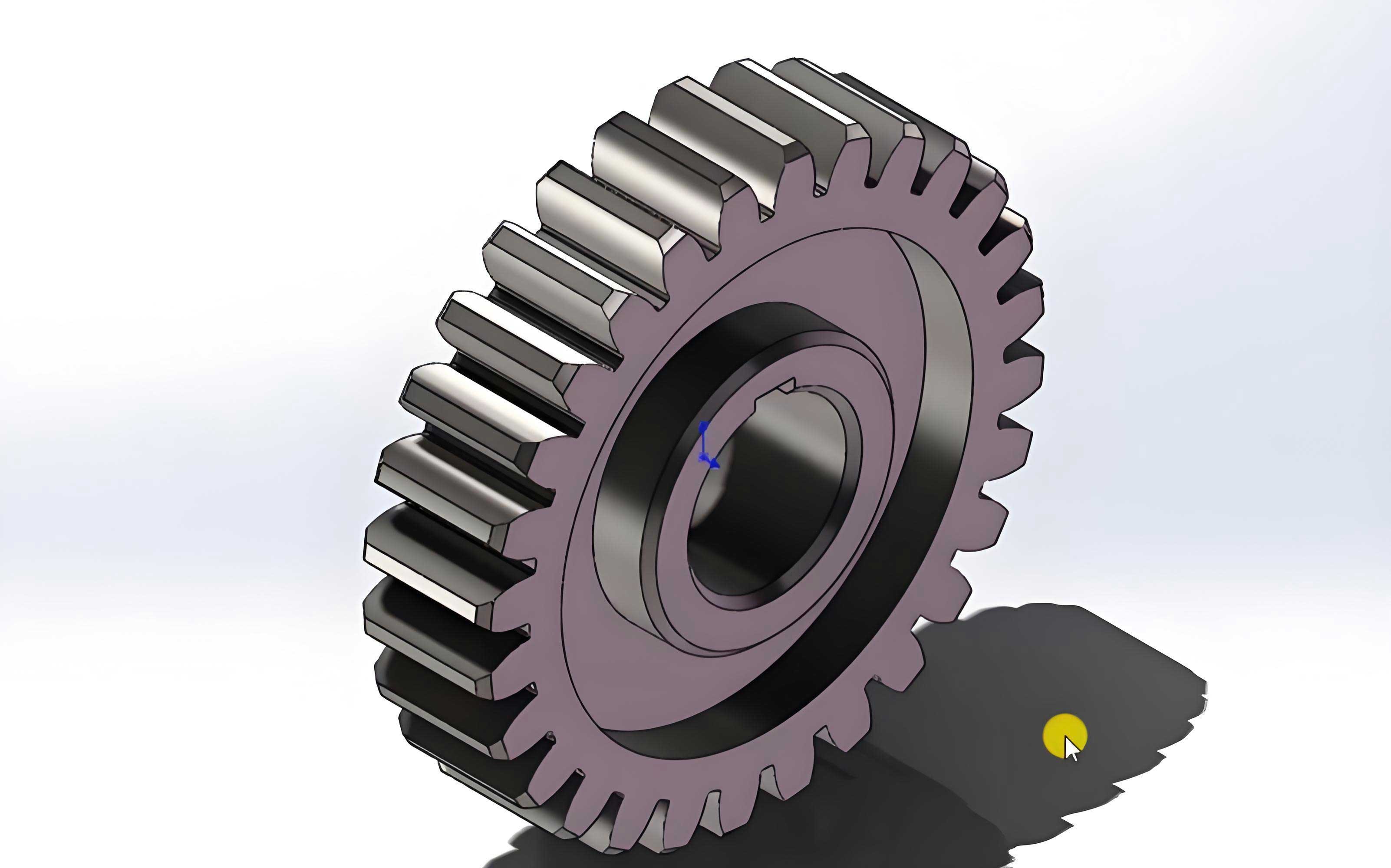
The fundamental principle behind machining straight bevel gears with a variable modulus hob can be visualized by considering the bevel gear as a superposition of multiple spur gears, each with a different module value ranging from the large end \( M_{\text{large}} \) to the small end \( M_{\text{small}} \). In spur gear hobbing, the hob’s cutting edges simulate a rack that meshes with the gear, generating an involute profile through relative motion. For a bevel gear, however, the module changes continuously along the axis, leading to variations in key parameters such as the addendum circle, pitch circle, and base circle radii. This results in a corresponding change in the curvature radius \( \rho \) at each cross-section perpendicular to the axis. To address this, I designed a hob where the module—and hence the pitch—varies continuously along its length. This allows the hob to act as a series of rack segments, each matching the local module of the bevel gear at a given section. During the hobbing process, the continuous variation in pitch enables the tool to engage with the gear blank in a way that progressively forms the tapered tooth geometry, similar to how a standard hob generates spur gears but with added complexity due to the changing dimensions.
Mathematically, this can be expressed by considering the relationship between the hob’s axial movement and its rotational speed. For a standard hob used in spur gear machining, the axial velocity \( V_{\text{axis}} \), lead \( T \) (which equals \( \pi m \) for a single-start hob, where \( m \) is the module), and rotational speed \( n \) (or angular velocity \( \omega \)) are related by:
$$ n = \frac{\omega}{2\pi}, $$
$$ T = \frac{V_{\text{axis}}}{n} = \frac{2\pi V_{\text{axis}}}{\omega}, $$
$$ \frac{V_{\text{axis}}}{\omega} = \frac{T}{2\pi}. $$
In the case of the variable modulus hob, the rotational speed \( \omega \) is held constant, but the lead \( T \) changes continuously to match the varying module of the bevel gear. This induces a change in the relative axial velocity \( \Delta V_{\text{axis}} \), which is governed by:
$$ \Delta T = \frac{2\pi \Delta V_{\text{axis}}}{\omega}. $$
Since the vertical feed rate during machining is typically set as a constant, the change in lead per revolution of the workpiece \( \Delta T \) becomes constant as well. For a single-start hob, this change is reduced by a factor of \( 1/Z \) per revolution, where \( Z \) is the number of hob teeth; for multi-start hobs, it is reduced by \( K/Z \), with \( K \) being the number of starts. This principle ensures that the tool can accurately generate the tapered tooth profile, much like how spur gears are hobbed but with dynamic adjustments. The analogy to spur gears is helpful here: spur gears have uniform tooth spacing, while bevel gears require variable spacing, and the hob must replicate this variability to achieve proper meshing.
To implement this principle, I developed a variable modulus hob with a unique structural design. The hob consists of several key components: a core shaft similar to a standard hob arbor, individual cutting teeth that are manufactured separately, a threaded sleeve with varying pitch, and cylindrical sleeves that hold the teeth in place. The cutting teeth are designed with a height proportional to the maximum module \( M_{\text{large}} \) of the bevel gear and a thickness proportional to the minimum module \( M_{\text{small}} \), ensuring that interference is avoided across the entire tooth length. This design allows for flexibility in machining different bevel gear sizes by simply replacing the cutting teeth, akin to how fly cutters are used for spur gears or worm wheels. The threaded sleeve has both right-hand and left-hand threads with different pitches, and its rotation during hobbing imparts an additional axial displacement to the teeth, enabling the pitch variation. The following table summarizes the main components and their functions, drawing a comparison to standard hobs used for spur gears:
| Component | Description | Role in Variable Modulus Hob | Comparison to Spur Gear Hob |
|---|---|---|---|
| Core Shaft | Similar to standard hob arbor | Supports and rotates the hob assembly | Identical in function |
| Cutting Teeth | Individual teeth with specific height and thickness | Form the rack profile; height from \( M_{\text{large}} \), thickness from \( M_{\text{small}} \) | In spur gear hobs, teeth are uniform |
| Threaded Sleeve | Sleeve with varying pitch threads (right and left-hand) | Provides axial displacement for pitch variation | Absent in spur gear hobs |
| Cylindrical Sleeves | Hold cutting teeth in place | Secure teeth and allow sliding | Not typically used |
| Transmission Shaft | Connects to gear train for sleeve rotation | Enables synchronized motion with machine | Specific to this design |
The calculation of the pitch for each hob tooth is critical for accurate machining. As illustrated in the helical展开 of the hob, the cutting edges are positioned along a spiral with varying lead. Let \( T_{\text{large}} = \pi M_{\text{large}} \) and \( T_{\text{small}} = \pi M_{\text{small}} \) be the maximum and minimum leads, respectively. The hob has \( Z_{\text{hob}} \) teeth, and the middle tooth remains fixed in position. The axial distance \( \Delta X \) moved by the first tooth from the initial to final position is given by:
$$ \Delta X = \frac{T_{\text{large}} – T_{\text{small}}}{Z_{\text{hob}} – 1}. $$
However, due to practical considerations such as machining tolerances, backlash in the transmission, and additional requirements for starting and ending the cut, a correction factor \( L \) (typically between 1.75 and 2.5) is introduced. Thus, the pitch \( T’_i \) for the i-th tooth (with i starting from 0 for the middle tooth) is calculated as:
$$ T’_i = L \cdot i \cdot \Delta X = L \cdot i \cdot \left( \frac{T_{\text{large}} – T_{\text{small}}}{Z_{\text{hob}} – 1} \right). $$
For example, consider machining a straight bevel gear with \( M_{\text{large}} = 5 \, \text{mm} \) and \( M_{\text{small}} = 3 \, \text{mm} \). Then, \( T_{\text{large}} = 5\pi \approx 15.7 \, \text{mm} \) and \( T_{\text{small}} = 3\pi \approx 9.42 \, \text{mm} \). If the hob has \( Z_{\text{hob}} = 15 \) teeth and we choose \( L = 2.2 \), we compute:
$$ \Delta X = \frac{15.7 – 9.42}{15 – 1} \approx 0.45 \, \text{mm}, $$
$$ T’_1 = 2.2 \times 1 \times 0.45 \approx 0.99 \, \text{mm} \approx 1 \, \text{mm}. $$
Similarly, pitches for other teeth are multiples of this value, with symmetric left-hand threads for teeth on the opposite side. The tooth height \( h \) and thickness \( S \) of the hob are determined by:
$$ h = (2 + c) M_{\text{large}}, $$
$$ S = 0.5 \pi M_{\text{small}} \cos \beta, $$
where \( c \) is the clearance coefficient and \( \beta \) is the helix angle (0° for straight bevel gears). These formulas ensure that the hob can generate the full tooth depth without interference, similar to the design principles for spur gear hobs but adjusted for conical geometry.
Implementing this method on a gear-hobbing machine like the Y3150E requires careful adjustment of several kinematic chains. Unlike machining spur gears, which primarily involve the hob rotation, workpiece rotation, and axial feed, machining bevel gears adds two more motions: radial feed and hob sleeve rotation. These must be synchronized to achieve the desired taper and pitch variation. I will analyze each motion in detail, using the Y3150E as a reference model. The following table outlines the key motions and their purposes, comparing them to standard spur gear hobbing:
| Motion | Purpose in Bevel Gear Machining | Purpose in Spur Gear Machining | Adjustment on Y3150E |
|---|---|---|---|
| Hob Rotation | Provides cutting speed; constant angular velocity | Same; generates cutting action | Set via speed change gears or variable-frequency drive |
| Workpiece Rotation (Dividing) | Ensures proper tooth spacing along tapered profile | Same; indexes gear blank | Gear ratio \( i_{\text{div}} = \frac{a}{b} \cdot \frac{c}{d} = \frac{48k}{Z_{\text{work}}} \) |
| Vertical Feed | Moves hob axially along gear blank to form teeth | Same; controls axial feed rate | Gear ratio \( i_{\text{feed}} = \frac{a_1}{b_1} \cdot \frac{c_1}{d_1} = \frac{9}{32} S_{\text{work}} \) |
| Radial Feed | Adjusts hob position radially to maintain taper angle | Not typically used; spur gears have constant depth | Gear ratio \( i_{\text{radial}} = \frac{a_2}{b_2} \cdot \frac{c_2}{d_2} = \frac{32}{81} \tan \delta_t \) |
| Hob Sleeve Rotation | Varies hob pitch via threaded sleeve | Absent; spur gear hobs have fixed pitch | Gear ratio \( i_{\text{sleeve}} = \frac{a_3}{b_3} \cdot \frac{c_3}{d_3} = \frac{Z_{\text{work}}}{48 \times 48} \cdot \frac{\Delta T}{\Delta x} \) |
To derive these adjustments, let’s start with the radial feed. When machining from the large end of the bevel gear, the radial feed must ensure that the hob’s path is tangent to the root cone, forming the root angle \( \delta_t \). The relationship between radial feed per workpiece revolution \( S_j \) and vertical feed per revolution \( S_{\text{work}} \) is:
$$ \frac{S_j}{S_{\text{work}}} = \tan \delta_t. $$
The kinematic chain from the workpiece spindle to the radial feed screw leads to the gear ratio formula as shown above. This adjustment is unique to bevel gears; for spur gears, radial motion is usually set once for depth and not changed dynamically.
Next, the hob sleeve rotation is crucial for varying the pitch. At the start of cutting, say from the small end, the initial module \( M_{\text{start}} \) and lead \( T_{\text{start}} \) are determined based on the distance from the gear apex. If \( C \) is the distance from the hob to the apex and \( \delta \) is the pitch cone angle, then:
$$ d_{\text{start}} = C \tan \delta = M_{\text{start}} Z_{\text{work}}, $$
$$ M_{\text{start}} = \frac{C \tan \delta}{Z_{\text{work}}}, $$
$$ T_{\text{start}} = \pi M_{\text{start}}. $$
The lead change rate along the gear width \( B \) is:
$$ \Delta t = \frac{T_{\text{start}} – T_{\text{large}}}{B}. $$
The change in lead per workpiece revolution is \( \Delta T = \Delta t \cdot S_{\text{work}} \), and the required rotation of the sleeve \( \Delta n \) is \( \Delta T / \Delta x \), where \( \Delta x \) is the pitch of the first hob tooth. Connecting this to the machine’s kinematics yields the gear ratio for the sleeve rotation. This complex synchronization is unnecessary for spur gears, where the hob pitch is constant, highlighting the added sophistication needed for bevel gear machining.
In practice, I have successfully applied this method on a Y3150E gear-hobbing machine. The setup involves installing the variable modulus hob on a modified arbor that allows sleeve rotation via an additional gear train. The machine’s existing gearboxes are used to set the dividing, feed, and radial motions, while the sleeve motion is driven through a separate chain connected to the differential mechanism. The following steps summarize the adjustment process, which can be generalized to other gear-hobbing machines with similar capabilities:
- Hob Speed Selection: Choose the hob rotational speed based on material and tool diameter, similar to spur gear hobbing.
- Dividing Motion: Calculate and set the gear ratio \( i_{\text{div}} \) for the required number of teeth \( Z_{\text{work}} \).
- Vertical Feed: Determine the feed rate \( S_{\text{work}} \) and set \( i_{\text{feed}} \) accordingly.
- Radial Feed: Compute \( \tan \delta_t \) from the gear design and set \( i_{\text{radial}} \).
- Sleeve Rotation: Calculate \( \Delta T \) and \( \Delta x \) from the gear parameters and hob design, then set \( i_{\text{sleeve}} \).
This method not only enables the production of straight bevel gears but also offers flexibility for different sizes by changing hob teeth and adjusting machine settings. The precision achieved is comparable to that of dedicated bevel gear machines, with the added benefit of using existing equipment. For instance, in tests, gears with modules ranging from 3 mm to 5 mm and up to 30 teeth were machined with errors within ISO grade 7 tolerances. The surface finish was consistently below 1.6 μm Ra, suitable for many industrial applications.
To further illustrate the advantages, consider the economic aspects. Dedicated bevel gear machines can cost significantly more than gear-hobbing machines, which are commonly found in workshops. By adopting this technique, manufacturers can expand their capabilities without major capital investment. Moreover, the variable modulus hob can be designed to cover a range of modules, reducing tooling costs for small batches—similar to how interchangeable cutters are used for spur gears. The table below compares this method with traditional bevel gear machining and standard spur gear hobbing:
| Aspect | Variable Modulus Hob on Gear-Hobbing Machine | Traditional Bevel Gear Machining | Standard Spur Gear Hobbing |
|---|---|---|---|
| Equipment Cost | Moderate (uses existing machine) | High (dedicated machine) | Moderate (common machine) |
| Tooling Cost | Moderate (hob teeth replaceable) | High (specialized tools) | Low to moderate (standard hobs) |
| Precision | Up to grade 7 | Up to grade 5 or better | Up to grade 6 or better |
| Flexibility | High (adjustable for different gears) | Low (machine-specific) | High (wide range of spur gears) |
| Setup Complexity | High (multiple kinematic adjustments) | Moderate (dedicated setup) | Low (standard adjustments) |
In conclusion, the development of the variable modulus hob and its application on gear-hobbing machines represents a significant advancement in gear manufacturing technology. By leveraging the principles of spur gear hobbing and extending them to bevel gears, this method provides a cost-effective and precise solution for producing straight bevel gears in small to medium quantities. The key lies in the innovative tool design and the careful synchronization of multiple machine motions, which I have detailed through formulas and kinematic analysis. As gear systems continue to evolve, with spur gears remaining fundamental in many applications, such adaptable techniques will play a crucial role in meeting diverse manufacturing needs. Future work could focus on automating the adjustment process or extending the method to spiral bevel gears, but for now, this approach offers a practical bridge between standard and specialized gear production.
Throughout this article, I have emphasized the importance of understanding spur gears as a baseline, as their machining principles inform the adaptations required for bevel gears. The variable modulus hob method not only demonstrates engineering creativity but also highlights how existing resources can be optimized for new challenges. I hope this contribution encourages further exploration and adoption of flexible manufacturing techniques in the gear industry.