
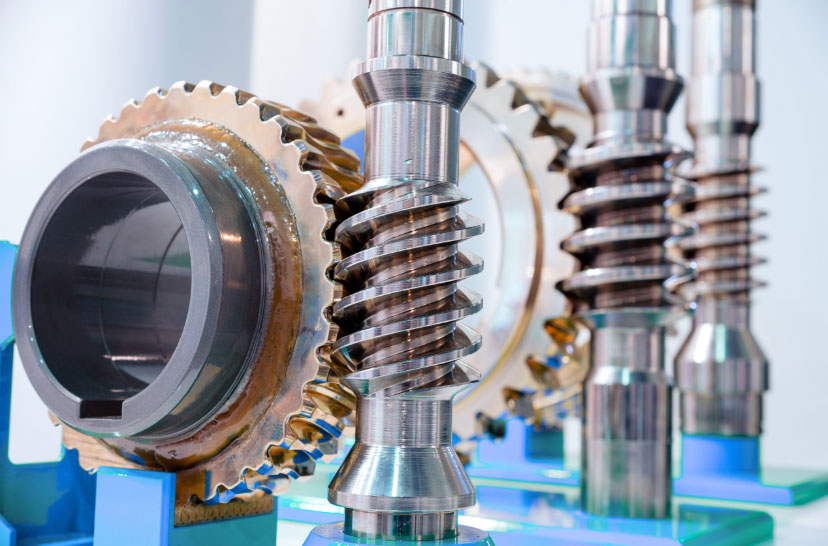
In my extensive experience with mechanical systems in offshore oil and gas production, the reliable operation of pipeline valves is paramount for safety and continuous production. Among these, butterfly valves actuated by worm gear reducers are ubiquitous due to their compact design, significant mechanical advantage, and inherent self-locking capability. The fundamental principle involves a worm (the driving component) engaging with a worm wheel, which is directly connected to the valve stem. This arrangement allows a relatively small input torque applied to the handwheel to be transformed into a large output torque capable of rotating the valve disc through a 90-degree arc. The core kinematic relationship for a single-start worm gear is given by the transmission ratio $i$:
$$ i = \frac{N_2}{N_1} = \frac{Z_2}{Z_1} $$
Where $N_1$ and $Z_1$ are the rotational speed and number of threads (starts) on the worm, and $N_2$ and $Z_2$ are the rotational speed and number of teeth on the worm wheel. For a single-start worm ($Z_1 = 1$), the ratio simplifies to $i = Z_2$, meaning the worm wheel rotates once for every $Z_2$ revolutions of the worm, providing a substantial speed reduction and torque multiplication.
However, the very environment that necessitates their use—the offshore atmosphere—is also the primary adversary of these robust mechanisms. The persistent high humidity, salt-laden air, and wide temperature fluctuations create a perfect storm for corrosion and subsequent operational failure, most commonly manifested as severe difficulty in opening or closing the valve. This paper, drawn from firsthand field experience, delves into a detailed analysis of the root causes, presents a proven step-by-step remediation procedure, and proposes design and maintenance philosophies to enhance the longevity and reliability of worm gear actuated butterfly valves.
Analysis of Operational Failure: The Root Causes
The immediate symptom is excessive friction when turning the handwheel. The superficial cause is often visible corrosion on exposed steel parts like the handwheel stem. However, the fundamental and most debilitating failure occurs at a critical, yet poorly accessible, interface within the worm gear housing. The design typically involves the扇形 gear (sector gear or worm wheel) having a central hub that rotates within a closely fitted bore in the aluminum or iron gear housing. The clearance at this interface, $C_{design}$, is minimal to ensure proper alignment and load distribution.
$$ C_{design} = D_{bore} – D_{hub} $$
Under ideal, lubricated conditions, this interface operates with minimal friction. The offshore environment, however, breaches the housing’s seals over time. Moisture and contaminants ingress, reacting with the metallic surfaces. The corrosion products, primarily iron oxides from steel hubs and possibly aluminum oxides from housings, have a larger specific volume than the parent metal. This expansion effectively fills the designed clearance, $C_{design}$, transforming it into an interference fit. The friction force $F_f$ at this junction, which must be overcome to rotate the valve, skyrockets according to:
$$ F_f = \mu \cdot F_n $$
Where $\mu$ is the coefficient of friction (dramatically increased by abrasion from corrosion particles) and $F_n$ is the normal force, which becomes extremely high due to the expansion-induced press-fit. This seized hub-to-bore interface becomes the dominant resisting torque, often far exceeding the torque required to actually rotate the valve disc, even if the disc itself is slightly stuck. The self-locking property of the worm gear, while a safety feature, prevents back-driving, meaning any seizure feels absolute to the operator. The predominant failure modes for offshore worm gears in this context are summarized below:
| Failure Mode | Location | Primary Cause (Offshore) | Effect on Operation |
|---|---|---|---|
| Abrasive Wear & Seizure | Worm Wheel Hub / Housing Bore | Corrosion product accumulation, lack of lubrication. | Extreme friction, inability to turn handwheel. |
| Pitting & Micropitting | Worm and Wheel Tooth Flanks | Moisture-induced lubricant breakdown, high cyclic stress. | Increased backlash, vibration, eventual tooth fracture. |
| Generalized Corrosion | All Ferrous Components (Hardware, Shafts) | Saltwater and humid atmosphere. | Weakening of parts, increased friction on threads and stems. |
| Lubricant Washout/Degradation | Gear Teeth and Bearings | Water ingress, oxidation, thermal breakdown. | Loss of protective film leading directly to wear, corrosion, and seizure. |
A Proven Field Remediation Procedure for Seized Worm Gear Actuators
When preventative maintenance fails and a valve becomes inoperable, a structured repair procedure is required. The following method has been successfully applied to restore function without requiring total valve replacement, which is often logistically challenging and costly offshore.
Step 1: Disassembly Preparation. Isolate and depressurize the valve line. Remove the position indicator plate and the top cover or gland plate of the worm gear housing. This exposes the worm shaft and sometimes the top of the worm wheel.
Step 2: Housing Removal. Unbolt the worm gear housing from the valve body’s mounting pad. Carefully insert a blunt chisel or pry tool into the gap to break the seal created by gaskets and corrosion. Utilize a puller (e.g., a jaw puller) anchored on the housing body to apply even, axial force, separating the housing from the valve stem. The worm wheel will remain engaged with the stem or may come out with the housing, depending on the design.
Step 3: Worm Wheel Extraction. If the worm wheel hub is seized in the housing bore, extraction is the critical step. Use a brass or copper drift slightly smaller than the hub’s outer diameter. Place it squarely against the hub’s face near the central axis. Apply sharp, controlled taps with a hammer to drive the wheel out of the bore. The use of a soft metal drift prevents damage to the machined surfaces of the hub.
Step 4: Surface Rehabilitation and Clearance Restoration. This is the core remedial action. Thoroughly clean all components. Inspect the worm wheel hub and the housing bore. Using a flat file or fine emery cloth, remove all corrosion products from both surfaces. The objective is not just to clean, but to intentionally increase the radial clearance $C_{new}$ to a value greater than the original $C_{design}$ to compensate for future corrosion and to facilitate lubrication.
$$ C_{new} = (D_{bore} + \Delta D_{bore}) – (D_{hub} – \Delta D_{hub}) > C_{design} $$
Where $\Delta D_{bore}$ is a small, controlled increase in bore diameter from filing and $\Delta D_{hub}$ is a small decrease in hub diameter. The goal is a clean, smooth finish with a clearance of 0.1mm to 0.2mm. Simultaneously, clean the worm and wheel teeth, checking for pitting or wear. A simplified wear depth calculation can be informed by measuring backlash before and after.
Step 5: Lubrication and Reassembly. Apply a high-performance, water-resistant, extreme-pressure (EP) grease to the cleaned hub and bore interface liberally. Also pack the gear teeth with the same grease. The choice of lubricant is critical for offshore worm gears. Slide the worm wheel back into the housing; it should rotate freely by hand. Re-mount the housing onto the valve stem, ensuring proper engagement of the wheel with the stem key or flats. Tighten the housing bolts in a star pattern to the manufacturer’s specified torque.
Step 6: Final Adjustment and Testing. Replace the top cover/gland and the indicator plate. Operate the handwheel through several full open-to-close cycles. The motion should be smooth and require consistent, moderate effort. The output torque $T_{out}$ available at the valve stem can be estimated from the input torque $T_{in}$ and the gear efficiency $\eta$:
$$ T_{out} = T_{in} \cdot i \cdot \eta $$
While $\eta$ is often low (0.7-0.9 for a well-lubricated worm gear), the high ratio $i$ ensures sufficient output. A successful repair results in $T_{in}$ being low and consistent, confirming the friction at the hub has been eliminated.
Design and Manufacturing Enhancements for Offshore Durability
The field repair addresses a symptom of a design limitation. The hub-bore interface is a critical wear point that is notoriously difficult to lubricate in service because it is shrouded by the gear housing and the wheel itself. A proactive engineering solution involves modifying the housing design to include dedicated lubrication channels. A radial lubrication port could be drilled into the housing wall intersecting the bore, fitted with a grease nipple (zerk fitting). This allows for the periodic injection of fresh grease, which displaces old grease, contaminants, and moisture, creating a positive pressure barrier. The effectiveness of such a system can be modeled by considering grease flow under pressure $P$ through the clearance $C_{new}$, governed by a simplified form of the Reynolds equation for a short bearing. More importantly, it changes the maintenance from a corrective, invasive overhaul to a simple preventative task.
Beyond this specific modification, several other design considerations are paramount for offshore worm gear actuators. Material selection is key: housing should be marine-grade aluminum with hard anodizing or corrosion-resistant bronze; the worm wheel should be made from phosphor bronze or similar; and all fasteners should be at least A4 (316) stainless steel. Sealing must be enhanced with multiple lip seals or labyrinth seals on rotating shafts. Furthermore, the classic failure modes of worm gears must be addressed through rigorous design calculations:
- Contact Stress (Pitting Resistance): The Hertzian contact stress on the tooth flanks must be below the allowable stress for the material pair. For a worm gear, this is calculated based on the geometry of the meshing teeth.
- Bending Strength: The tooth root stress of the worm wheel must be checked to prevent fatigue fracture.
- Thermal Capacity (Anti-Scuffing): The high sliding velocities in worm gears generate significant heat. The power rating is often limited by the heat dissipation capacity. The heat generation $H_{gen}$ must be less than the heat dissipation $H_{diss}$:
$$ H_{gen} = P_{in} (1 – \eta) $$
$$ H_{diss} = k A \Delta T $$
Where $P_{in}$ is input power, $\eta$ is efficiency, $k$ is overall heat transfer coefficient, $A$ is housing surface area, and $\Delta T$ is temperature difference to ambient. For offshore units, finned housings or even cooling jackets may be necessary for high-duty cycles.
| Design Enhancement | Benefit | Application Consideration |
|---|---|---|
| Dedicated Hub Lubrication Port | Enables preventative lubrication of critical seizure point, displaces moisture. | Port must be positioned to allow grease to flow circumferentially around the hub. Requires sealing plug or standard grease nipple. |
| Super-Corrosion-Resistant Materials (e.g., Al-Bronze Housing, Ni-Al-Bronze Wheel) | Dramatically reduces the rate of corrosive wear and product formation. | Higher initial cost, but lifecycle cost is lower due to reduced maintenance and failure. |
| Enhanced Multi-Stage Sealing (Lip Seals + Labyrinth) | Significantly extends the interval before moisture and salt ingress contaminates the lubricant. | Adds complexity and slight friction. Must be designed for easy replacement during major service. |
| Finned or Jacketed Housing | Improves heat dissipation, maintaining lubricant viscosity and preventing thermal breakdown. | Essential for valves that are operated frequently or in high-ambient-temperature locations. |
Comprehensive Proactive Maintenance Strategy
A reactive approach is unsustainable offshore. A proactive, scheduled maintenance regimen is essential to maximize the service life of worm gear actuated valves. This strategy must be documented, assigned, and tracked.
| Activity | Frequency | Procedure & Standard | Objective |
|---|---|---|---|
| Visual Inspection & Operational Test | Monthly / Quarterly | Check for external corrosion, seal integrity. Cycle valve from full open to full closed (if process allows). Feel for binding, grit, or irregular torque. | Early detection of seal failure or onset of internal issues. |
| External Cleaning & Corrosion Control | Quarterly / Bi-Annually | Wash housing with fresh water. Apply thin film of corrosion inhibitor or water-displacing lubricant to exposed steel parts (handwheel, stem). | Remove salt deposits and prevent external corrosion from migrating inwards. |
| Gearbox Lubrication (Via Standard Ports) | Annually or per OEM hours | Purge old grease from relief port(s) while injecting new, specified EP marine grease until clean grease emerges. | Replenish EP additives, remove worn-out grease and embedded moisture. |
| Hub Interface Lubrication (If Modified Design) | Annually | Inject grease via dedicated hub lubrication port until slight extrusion is seen at the hub-housing seam. | Specifically protect the high-risk seizure interface. |
| Detailed Inspection & Overhaul | 5-Year or as condition monitoring dictates | Full disassembly, cleaning, inspection of wear parts (worm, wheel, bearings, seals), measurement of backlash and clearances. Replace all seals and consumables. Re-grease and reassemble with updated clearances if necessary. | Prevent catastrophic failure, restore like-new performance, update internal corrosion protection. |
The lubricant selection itself is a critical part of the specification. For offshore worm gears, the grease must possess the following properties:
- High Water Resistance and Anti-Corrosion Properties: It must adhere to metal surfaces and prevent water wash-out. NLGI Grade 2 consistency is typical.
- Extreme Pressure (EP) Additives: Containing compounds like lithium complex or polyurea with anti-wear/EP agents (e.g., Sulfur, Phosphorus) to protect heavily loaded teeth.
- Wide Operating Temperature Range: Suitable for both cold splash zones and sun-exposed locations.
- Compatibility with Non-Ferrous Metals: Must be safe for use with bronze and copper alloys common in worm wheels.
Conclusion
The reliable operation of worm gear actuated butterfly valves is not merely a matter of correct installation but a continuous cycle of informed design, diligent maintenance, and effective repair. The challenging offshore environment accelerates failure modes, with hub seizure due to corrosion-induced clearance loss being a primary culprit. The field-expedient repair method of disassembly, clearance restoration, and re-lubrication is a powerful tool to restore functionality without valve replacement. However, the long-term solution lies in advocating for and specifying enhanced valve actuator designs from manufacturers. These designs should incorporate features like dedicated lubrication points for critical interfaces, superior corrosion-resistant materials, and advanced sealing systems. When combined with a disciplined, proactive maintenance schedule focused on regular inspection, cleaning, and lubrication with purpose-selected greases, the operational life of these essential components can be extended dramatically. This integrated approach directly contributes to reduced lifecycle costs, minimized unplanned downtime, and enhanced safety for offshore production facilities, ensuring that worm gear driven valves remain a dependable cornerstone of process control for years to come.