
In the development of an imported impact drill, a critical component posed a significant manufacturing challenge: a straight bevel gear with an exceptionally low tooth count and a shaft shoulder at its major end. The successful production of this straight bevel gear was pivotal to the entire project. Conventional manufacturing methods proved inadequate, necessitating the development of a specialized process. This article details the analytical calculations and innovative processing techniques employed to machine these challenging straight bevel gears, providing a proven methodology for similar applications.
The primary obstacle was the gear’s minimal number of teeth, which fell below the minimum tooth count capability of standard gear-cutting machines such as bevel gear generators, planers, and milling machines. Furthermore, the presence of an integral shaft shoulder at the gear’s major end precluded the use of traditional gear-generating methods that require clearance for tool passage. This combination of factors rendered conventional machining of these straight bevel gears impossible, demanding an alternative approach centered on a cold-forming process: gear extrusion.
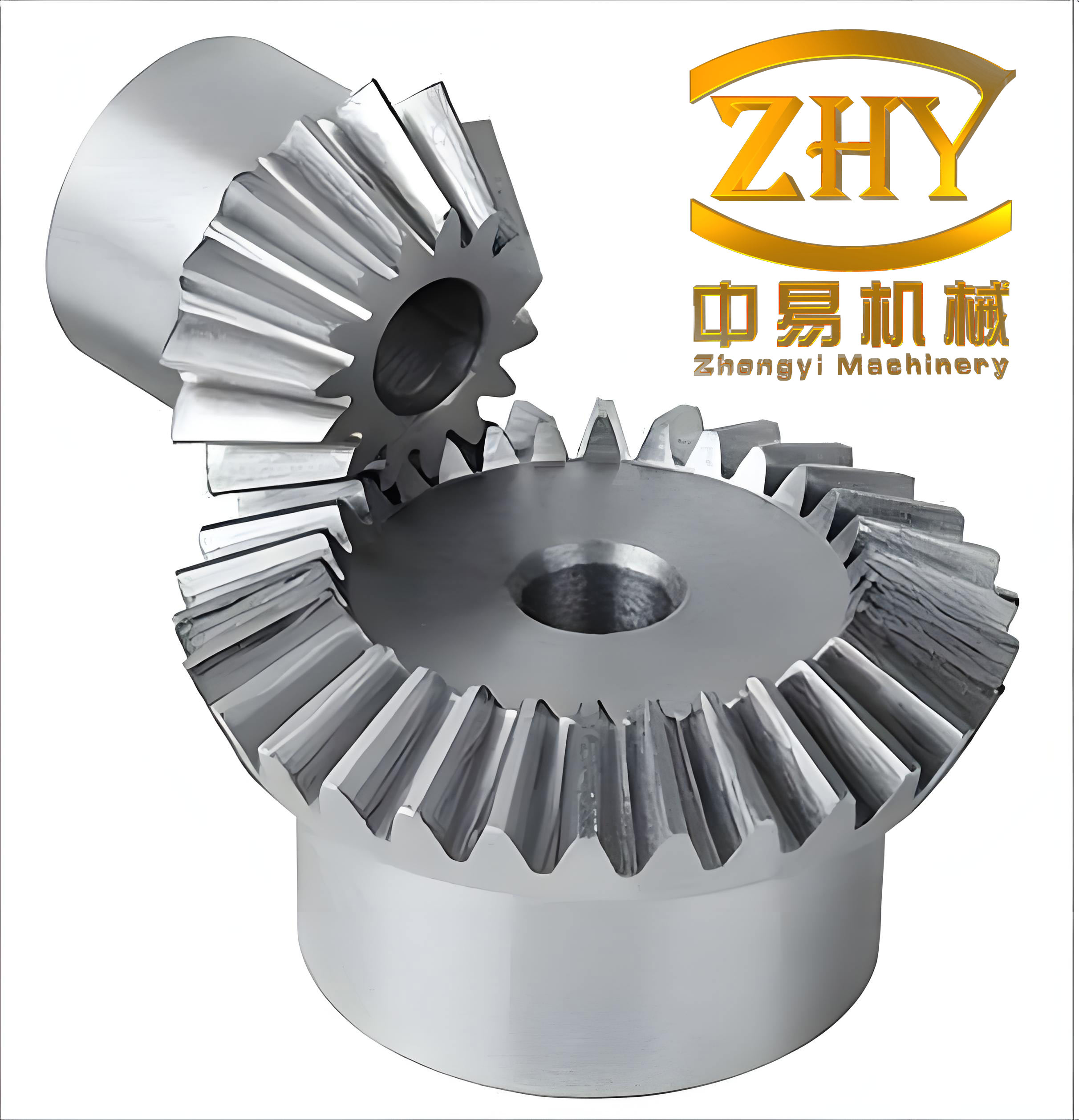
The chosen solution was a multi-stage process. First, a precise electrode with the conjugate tooth form is machined on a standard straight bevel gear milling machine. This electrode is then used to create a forming die via Electrical Discharge Machining (EDM). Finally, the actual gear teeth are formed by extruding a pre-machined blank into this die. This method bypasses the limitations of direct cutting for such small-tooth-count straight bevel gears. The success of this technique hinges on precise geometrical calculations for both the gear itself and the pre-form blank.
Gear Geometry and Design Parameters
The foundational step for manufacturing any precision component is a complete definition of its geometry. For straight bevel gears, this involves a series of trigonometric calculations based on basic design inputs. The key parameters for the subject gear are as follows.
| Parameter | Symbol | Value | Unit |
|---|---|---|---|
| Normal Module | \( m \) | 1.5 | mm |
| Number of Teeth (Pinion) | \( z_1 \) | 8 | – |
| Number of Teeth (Gear) | \( z_2 \) | 44 | – |
| Shaft Angle | \( \Sigma \) | 90 | ° |
| Pressure Angle | \( \alpha \) | 20 | ° |
| Face Width | \( b \) | 7 | mm |
| Addendum Coefficient | \( h_a^* \) | 1.0 | – |
| Dedendum/Clearance Coefficient | \( c^* \) | 0.25 | – |
From these basic parameters, all other necessary dimensions for machining and inspection are derived. The following formulas are essential for defining the geometry of straight bevel gears.
Pitch Cone Angles:
For a 90° shaft angle, the pitch cone angle for the pinion (\( \delta_1 \)) is:
$$ \delta_1 = \arctan\left(\frac{z_1}{z_2}\right) = \arctan\left(\frac{8}{44}\right) \approx 10.304^\circ $$
The gear pitch cone angle is \( \delta_2 = 90^\circ – \delta_1 \approx 79.696^\circ \).
Pitch Diameter and Cone Distance:
The pitch diameter at the major end for the pinion is:
$$ d_1 = m \cdot z_1 = 1.5 \times 8 = 12.0 \text{ mm} $$
The cone distance (\( R \)) or outer cone distance is:
$$ R = \frac{d_1}{2 \sin \delta_1} = \frac{12.0}{2 \times \sin(10.304^\circ)} \approx 33.588 \text{ mm} $$
Addendum, Dedendum, and Working Depth:
The addendum at the major end (\( h_{a1} \)) and dedendum (\( h_{f1} \)) are:
$$ h_{a1} = m \cdot h_a^* = 1.5 \times 1.0 = 1.5 \text{ mm} $$
$$ h_{f1} = m \cdot (h_a^* + c^*) = 1.5 \times (1.0 + 0.25) = 1.875 \text{ mm} $$
The total tooth depth (\( h \)) is therefore \( h = h_{a1} + h_{f1} = 3.375 \text{ mm} \).
Outer Cone Angles:
The root cone angle (\( \delta_{f1} \)) equals the pitch cone angle: \( \delta_{f1} = \delta_1 \approx 10.304^\circ \).
The face cone angle (\( \delta_{a1} \)) is calculated as:
$$ \delta_{a1} = \delta_1 + \arctan\left(\frac{h_{a1}}{R}\right) \approx 10.304^\circ + \arctan\left(\frac{1.5}{33.588}\right) \approx 12.86^\circ $$
Major End Diameters:
The tip diameter (\( d_{a1} \)) and root diameter (\( d_{f1} \)) at the major end are:
$$ d_{a1} = d_1 + 2h_{a1}\cos\delta_1 = 12.0 + 2 \times 1.5 \times \cos(10.304^\circ) \approx 14.952 \text{ mm} $$
$$ d_{f1} = d_1 – 2h_{f1}\cos\delta_1 = 12.0 – 2 \times 1.875 \times \cos(10.304^\circ) \approx 8.310 \text{ mm} $$
Chordal Tooth Thickness and Setting Angle:
The chordal tooth thickness (\( \bar{s} \)) at the major end, an important inspection dimension, is approximately equal to the circular tooth thickness. For a standard gear without substantial modification:
$$ \bar{s} \approx \frac{\pi m}{2} = \frac{\pi \times 1.5}{2} \approx 2.356 \text{ mm} $$
The setting or machine root angle for cutting is typically equal to the root cone angle, \( \delta_{f1} \).
Electrode Design and Machining Setup
Since the final gear teeth are formed by extrusion, the accuracy of the die is paramount. The die is manufactured by EDM using a machined copper electrode. Therefore, the electrode must possess the exact conjugate form of the desired gear tooth space. This electrode is machined on a standard straight bevel gear milling machine capable of handling the low tooth count. The machining parameters for the electrode are critical and were determined as follows.
| Adjustment Parameter | Calculation / Setting | Result |
|---|---|---|
| Cutter Speed Gear Train (\( i_v \)) | Based on machine manual for electrode material (copper) | \( \frac{A_1}{B_1} = \frac{35}{55} \) |
| Feed Rate Gear Train (\( i_s \)) | Selected for a fine finish | \( \frac{A_2}{B_2} = \frac{25}{65} \) |
| Indexing Gear Train (\( i_d \)) | \( i_d = \frac{24}{z_1} = \frac{24}{8} \) | \( \frac{A_3}{B_3} = \frac{70}{30} \times \frac{55}{35} \) |
| Rolling Gear Train (\( i_c \)) | \( i_c = \frac{L \sin \delta_1}{m} \) where \( L=75\text{mm} \) (machine constant) | \( \frac{A_4}{B_4} \times \frac{C_4}{D_4} = \frac{30}{55} \times \frac{25}{65} \) |
| Workpiece Installation Angle (\( \alpha_w \)) | Equal to the root cone angle \( \delta_{f1} \) | \( 10^\circ 18′ \) (approx. 10.3°) |
| Infeed Depth (\( h_m \)) | \( h_m = 2.25m / \cos(\text{Pressure Angle}) \) | \( \frac{3.375}{\cos(20^\circ)} \approx 3.592 \text{ mm} \) |
These settings ensured the electrode was generated to a high degree of accuracy, forming the basis for the precise EDM die. The successful machining of this electrode on a standard machine validated the feasibility of generating the tooth form for these challenging small-tooth-count straight bevel gears indirectly.
Blank Design for the Extrusion Process
The cold extrusion process requires a meticulously calculated pre-form blank. The volume of metal in the blank’s conical section must precisely match the final volume of the extruded gear’s conical section (including teeth), accounting for negligible material loss. The key is to determine the major and minor end diameters of the conical blank prior to extrusion.
Known Final Gear Dimensions (from previous calculations and drawing):
Major end tip diameter, \( d_{a1} = 14.952 \text{ mm} \), with face cone angle \( \delta_{a1} = 12.86^\circ \).
Major end root diameter, \( d_{f1} = 8.310 \text{ mm} \), with root cone angle \( \delta_{f1} = 10.304^\circ \).
Face width (cone length), \( b = 7 \text{ mm} \).
Step 1: Calculate Minor End Diameters of the Finished Gear.
The minor end tip diameter (\( d_{ae1} \)) and root diameter (\( d_{fe1} \)) are found using the cone geometry:
$$ d_{ae1} = d_{a1} – 2b \sin \delta_{a1} \approx 14.952 – 2 \times 7 \times \sin(12.86^\circ) \approx 11.836 \text{ mm} $$
$$ d_{fe1} = d_{f1} – 2b \sin \delta_{f1} \approx 8.310 – 2 \times 7 \times \sin(10.304^\circ) \approx 5.803 \text{ mm} $$
Step 2: Calculate Volumes of the Finished Gear’s Conical Sections.
We model the gear’s conical body as a composite of simpler frustums. The volume of a conical frustum is given by:
$$ V = \frac{\pi h}{3} (R^2 + Rr + r^2) $$
where \( h \) is the height (here, the face width \( b \)), \( R \) and \( r \) are the major and minor end radii, respectively.
a) Volume of the “tip cone” frustum (from tip diameters):
$$ V_{tip} = \frac{\pi \times 7}{3} \left[ \left(\frac{14.952}{2}\right)^2 + \left(\frac{14.952}{2}\right)\left(\frac{11.836}{2}\right) + \left(\frac{11.836}{2}\right)^2 \right] \approx 1172.6 \text{ mm}^3 $$
b) Volume of the “root cone” frustum (from root diameters):
$$ V_{root} = \frac{\pi \times 7}{3} \left[ \left(\frac{8.310}{2}\right)^2 + \left(\frac{8.310}{2}\right)\left(\frac{5.803}{2}\right) + \left(\frac{5.803}{2}\right)^2 \right] \approx 310.1 \text{ mm}^3 $$
c) Volume of one tooth space. This is approximated by subtracting the volume of the root cone from the volume of the tip cone and dividing by the number of teeth, as the tip cone volume includes both the material of the teeth and the spaces.
$$ V_{space} \approx \frac{V_{tip} – V_{root}}{z_1} = \frac{1172.6 – 310.1}{8} \approx 107.8 \text{ mm}^3 $$
d) Total volume of the conical part of the *finished* gear (excluding the shaft shoulder) is simply the volume of the tip cone frustum: \( V_{finished} = V_{tip} \approx 1172.6 \text{ mm}^3 \).
Step 3: Determine Pre-Extrusion Blank Cone Dimensions.
The blank is a simple conical frustum. According to principles of cold extrusion, the semi-cone angle (\( \beta \)) of the blank is typically less than the gear’s root cone angle to facilitate metal flow. A suitable angle was selected through experimentation:
$$ \beta \approx 7^\circ $$
Let the major end diameter of the blank be \( D \). Then its minor end diameter is \( d = D – 2b \tan \beta \).
The volume of this blank frustum is:
$$ V_{blank} = \frac{\pi b}{3} \left[ \left(\frac{D}{2}\right)^2 + \left(\frac{D}{2}\right)\left(\frac{D – 2b \tan \beta}{2}\right) + \left(\frac{D – 2b \tan \beta}{2}\right)^2 \right] $$
Applying the volume constancy principle \( V_{blank} = V_{finished} \), we solve for \( D \):
$$ \frac{\pi \times 7}{3} \left[ \frac{D^2}{4} + \frac{D(D – 14 \tan 7^\circ)}{4} + \frac{(D – 14 \tan 7^\circ)^2}{4} \right] = 1172.6 $$
Substituting \( \tan 7^\circ \approx 0.12278 \), the equation simplifies and solves to:
$$ D \approx 13.8 \text{ mm} $$
Consequently, \( d = D – 2 \times 7 \times 0.12278 \approx 13.8 – 1.72 \approx 12.08 \text{ mm} \).
Therefore, the extrusion blank’s conical section should have a major end diameter of approximately 13.8 mm and a minor end diameter of approximately 12.08 mm, with a semi-cone angle of 7°. This geometry ensures the correct volume of material is present to completely fill the die cavity during extrusion, forming accurate teeth on these small-tooth-count straight bevel gears.
Extrusion Die Design and Process
The extrusion die is a critical component. Its cavity is the negative of the final gear’s entire conical tooth form. The die structure must incorporate robust guidance, a means to eject the formed gear, and a method to secure the blank. The basic design principles are summarized below.
| Component | Function | Design Consideration |
|---|---|---|
| Die Cavity | Forms the gear teeth and conical back surface. | Machined via EDM using the pre-machined electrode. Must have a slight draft angle for part ejection. Surface finish is critical. |
| Upper Punch / Ram | Applies the forming force. | Must be aligned perfectly with the die cavity axis. Hardened to resist deformation. |
| Lower Ejector / Floating Mandrel | Supports the blank’s center and ejects the finished part. | Features a pilot that enters the blank’s center hole for precise radial alignment. It floats to apply uniform ejection force. |
| Blank Locating Surface | Positions the blank axially and radially. | Utilizes the blank’s pre-machined left-end face and major-end outer diameter for positive location before forming. |
| Die Housing | Contains all components under high pressure. | Designed with high stiffness and strength, often using prestressed rings to withstand extreme internal pressures during extrusion of the straight bevel gear. |
During the extrusion process, the blank is placed in the die, located by its outer diameter and end face. The central hole fits over the floating mandrel, ensuring concentricity. The upper punch descends, forcing the soft metal of the blank to flow plastically into the intricate cavity, forming the teeth. After forming, the punch retracts, and the lower mandrel rises to push the finished gear out. This process produces a near-net-shape gear with excellent grain flow and high strength. Some minor distortion of the reference surfaces (like the shaft shoulder face) is expected and is corrected in a subsequent finish-turning operation.
Complete Process Flow and Heat Treatment
The manufacturing of these specialized straight bevel gears follows a comprehensive process route integrating forming, machining, and heat treatment.
1. Process Route:
– Material: Alloy steel (e.g., 20CrMnTi).
– Forging: To achieve a favorable grain structure.
– Annealing: To soften the material for subsequent machining.
– Rough Turning: Machining of all external features to near-final dimensions, leaving extrusion allowance.
– Finish Turning of Conical Section: Machining the pre-form conical blank to the calculated dimensions (D=13.8mm, d=12.08mm, β=7°).
– Gear Tooth Extrusion: Cold forming the teeth using the EDM-fabricated die.
– Heat Treatment: Case carburizing and hardening to achieve a hard, wear-resistant surface (e.g., 0.6-0.8 mm case depth) with a tough core.
– Finish Machining: Precision turning to correct any minor distortion from extrusion/heat treatment and to achieve final dimensions on the shaft shoulder and other non-tooth features.
– Center Hole Refinement: Re-grinding center holes for final grinding基准.
– Grinding: Finish grinding of critical cylindrical surfaces and end faces.
– Pairing/Lapping: Running the pinion with its mating gear under a mild abrasive compound to perfect the contact pattern and reduce noise.
2. Heat Treatment Considerations:
For small, thin-walled straight bevel gears like these, distortion during carburizing and quenching is a major concern. The shallow required case depth (typically 0.6-0.8mm) is beneficial, as it minimizes the thermal and transformational stresses that cause distortion. Furthermore, the extrusion process itself creates a work-hardened and uniform grain flow, which contributes to dimensional stability during heat treatment. Often, controlled atmosphere furnaces or vacuum carburizing with high-pressure gas quenching are employed to minimize oxidation and distortion. The final gear accuracy is achieved through the post-heat-treatment finishing steps, particularly the paired lapping operation.
Conclusion and Discussion
The successful manufacture of ultra-small-tooth-count straight bevel gears with integral shaft shoulders is a multidisciplinary challenge, solved by integrating precise geometric analysis with non-traditional manufacturing processes. The core of the solution lies in decoupling the tooth generation from the final part’s constraints. By machining the conjugate form on an electrode using a standard machine, then transferring that form via EDM to a die, and finally using that die in a cold extrusion process, the limitations of direct gear cutting are elegantly bypassed.
The method hinges on several critical calculations:
- Accurate determination of the finished straight bevel gear’s geometry, including minor-end dimensions.
- Precise volume calculation for the finished gear’s conical body.
- Application of the volume constancy principle to determine the correct pre-form blank dimensions for extrusion.
- Optimal selection of the blank’s semi-cone angle to ensure complete die fill without excessive forming force or defects.
This approach is not limited to gears with shaft shoulders. For small-tooth-count straight bevel gears without such obstructions, direct machining on a capable gear generator might be possible. However, the extrusion process offers distinct advantages: excellent surface finish and compressive residual stresses from cold working, which enhance fatigue life. The production rate for extrusion can also be significantly higher than for cutting once the die is made.
Future exploration could involve finite element analysis (FEA) to simulate the metal flow during extrusion, optimizing the blank shape and die geometry to reduce forming loads and improve tooth form accuracy. Additionally, investigating powder metallurgy followed by sintering and sizing could be an alternative route for mass production of such challenging straight bevel gear geometries. The methodology documented here provides a reliable and effective framework for tackling the manufacturing hurdles presented by specialized, small-tooth-count straight bevel gears.