
In the field of mechanical engineering, spiral bevel gears are widely recognized for their high load-carrying capacity, smooth operation, and low noise levels. These gears are essential components in various industrial applications, such as mining equipment, automotive differentials, and aerospace systems. However, due to their complex tooth geometry and the need for specialized machining equipment, the reverse engineering or mapping of spiral bevel gears poses significant challenges. As an engineer involved in equipment maintenance and repair, I have encountered numerous instances where accurate mapping of spiral bevel gears was crucial for restoring machinery to optimal performance. This article aims to provide a comprehensive guide on the mapping and calculation of key parameters for spiral bevel gears, based on practical experience and theoretical principles. I will delve into methods for determining spiral angle, displacement coefficients, addendum coefficients, and module, while emphasizing the use of formulas and tables to summarize critical data. Throughout this discussion, the term ‘spiral bevel gears’ will be frequently highlighted to underscore their importance in mechanical transmissions.
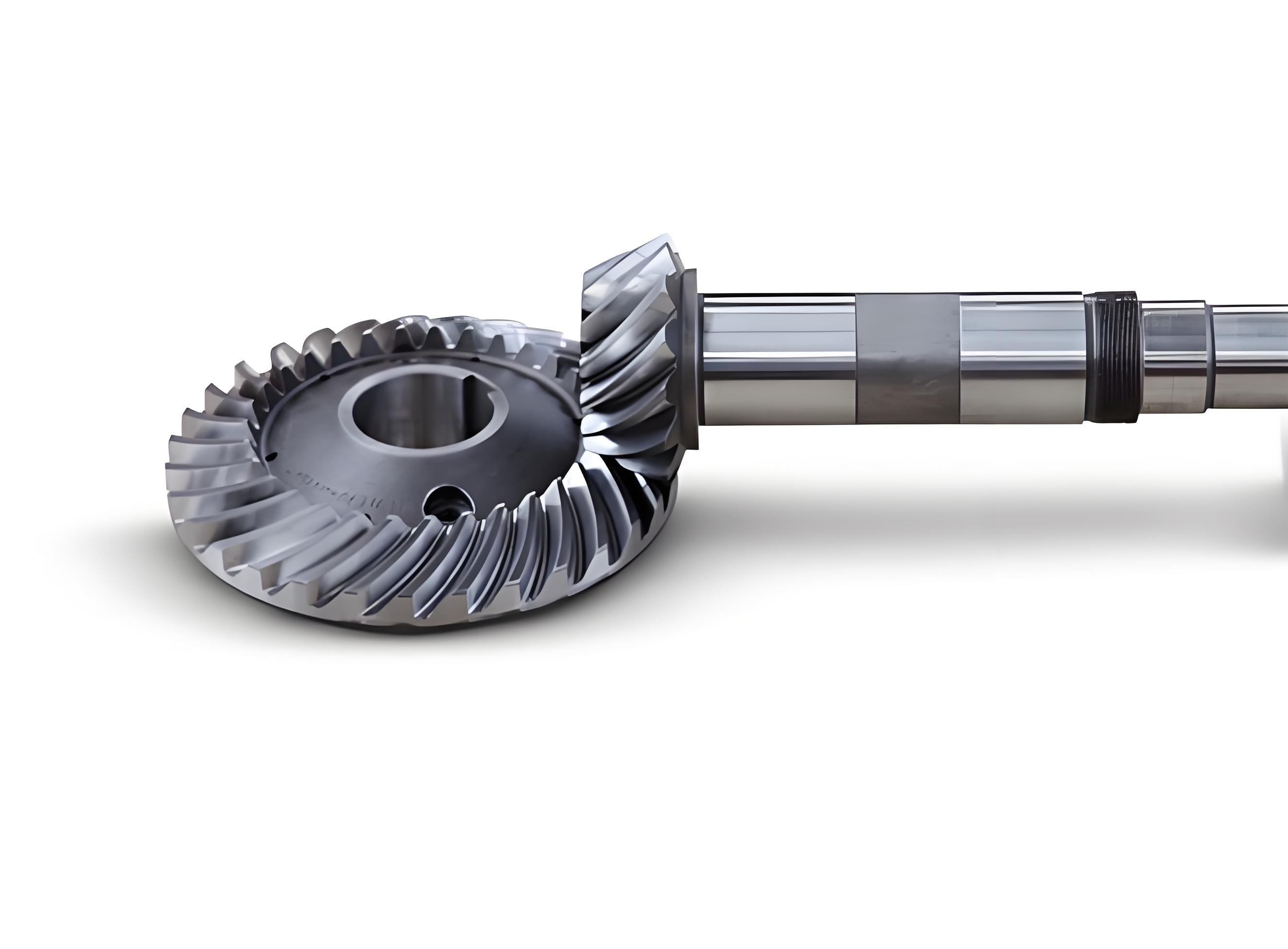
The process of mapping spiral bevel gears begins with a thorough understanding of their geometry. Spiral bevel gears feature curved teeth that are oblique to the gear axis, which allows for gradual engagement and reduced impact forces. This curvature is defined by the spiral angle, a fundamental parameter that influences gear performance. In my work, I have found that accurate determination of the spiral angle is paramount, as it affects tooth contact patterns, noise, and durability. Other parameters, such as displacement coefficients and module, must also be precisely calculated to ensure proper meshing and load distribution. The following sections will explore these aspects in detail, incorporating practical measurement techniques and computational approaches. To aid visualization, I will include an image of a typical spiral bevel gear below, which illustrates the complex tooth form that makes these gears both efficient and challenging to map.
Let me start with the spiral angle, which is often the first parameter assessed during mapping. The spiral angle, denoted as β, is the angle between the tooth trace and the generatrix of the pitch cone at the midpoint of the tooth width. In practice, I use a combination of empirical measurement and mathematical calculation to determine β. Initially, the direction of the spiral must be identified: when facing the tooth surface, if the tooth curves clockwise from the midpoint to the outer end, it is a right-hand spiral; if counterclockwise, it is a left-hand spiral. This distinction is important for assembly and operation. For measurement, I employ the imprint method, which involves coating the tooth surface with a thin layer of marking material, such as Prussian blue or oil, and rolling the gear on paper to obtain a trace. From this imprint, the approximate spiral angle can be measured using geometric constructions. Specifically, I draw two concentric arcs with radii equal to the outer cone distance (L_e) and the mean cone distance (L_m), and then analyze the trace to estimate β. However, this method only yields an approximate value, which must be refined through calculation.
The precise calculation of the spiral angle involves the tool offset number, or cutter number, which is standardized in gear manufacturing systems like the Gleason system. The relationship between spiral angle and cutter number is derived from the need to adjust the pressure angle at the tooth midpoint. For a pair of mating spiral bevel gears, the pressure angle correction Δα is given by:
$$ \Delta\alpha = \frac{\gamma_1” + \gamma_2”}{2} \sin\beta $$
where γ₁” and γ₂” are the root angles of the pinion and gear, respectively. The cutter number N₀ is then defined as:
$$ N_0 = \frac{\Delta\alpha}{10′} = \frac{\gamma_1” + \gamma_2”}{20} \sin\beta $$
Here, the angle is measured in minutes, and the cutter number is standardized in increments of 10 minutes, ranging from 3.5 to 20.5. In mapping, I first compute an initial N₀ using the approximate β from the imprint method, then round it to the nearest standard cutter number. Subsequently, the spiral angle is recalculated accurately using:
$$ \beta = \arcsin\left(\frac{20 N_0}{\gamma_1” + \gamma_2”}\right) $$
To simplify the computation of γ₁” + γ₂”, I have developed a practical formula based on gear geometry. For spiral bevel gears, the sum of root angles can be approximated as:
$$ \gamma_1” + \gamma_2” \approx \frac{2 \sin\phi_1}{z_1} (f_0 + C_0) \times 3438′ $$
where φ₁ is the pitch angle of the pinion, z₁ is the number of teeth on the pinion, f₀ is the addendum coefficient, and C₀ is the clearance coefficient. This formula eliminates the need for direct measurement of root angles, relying instead on tooth counts and standard coefficients. For Gleason-system spiral bevel gears, typical values are f₀ = 0.85 and C₀ = 0.188. The pitch angle φ₁ is calculated from the gear ratio i = z₂/z₁, where z₂ is the gear tooth count:
$$ \phi_1 = \arctan\left(\frac{z_1}{z_2}\right) $$
This approach has proven effective in my mapping projects, yielding spiral angle values that closely match original design specifications. For instance, in a case involving a conveyor reducer, the mapped spiral angle deviated by less than 15 minutes from the designed value, ensuring satisfactory performance after repair.
Next, I turn to displacement coefficients and addendum coefficients, which are critical for tooth profile modification and load distribution. Spiral bevel gears often incorporate profile shifts to balance strength and wear characteristics. The radial displacement coefficients, denoted ξ₁ for the pinion and ξ₂ for the gear, are typically related by ξ₁ = -ξ₂ in Gleason systems. These coefficients, along with tangential displacement coefficients τ, can be sourced from design handbooks based on the gear ratio. In mapping, however, they must be derived from measurements. I use the following relationships to estimate these parameters. The addendum coefficient f₀ is initially approximated by measuring the tooth height h and the module. For spiral bevel gears, the module varies along the tooth length, with the outer module m_s being the reference. A preliminary module value can be obtained from the circular pitch t or cone distance. Then, f₀ is calculated as:
$$ f_0 = \frac{h}{2 m_s} – 0.1 $$
This value is then rounded to standard coefficients depending on the gear system: for Gleason spiral bevel gears, f₀ = 0.85; for other systems, it may vary with spiral angle, such as f₀ = 0.82 for β = 35° or f₀ = 0.92 for β = 25°. To facilitate this process, I have compiled a table summarizing common addendum coefficients for different spiral bevel gear designs:
| Gear System | Spiral Angle β | Addendum Coefficient f₀ | Clearance Coefficient C₀ |
|---|---|---|---|
| Gleason | Typically 35° | 0.85 | 0.188 |
| Other Systems | 0° | 1.00 | 0.20 |
| Other Systems | 25° | 0.92 | 0.20 |
| Other Systems | 35° | 0.82 | 0.20 |
For displacement coefficients, I rely on measurements of tooth thickness and space width. Using a gear tooth caliper, I measure the chordal tooth thickness at the outer and inner ends. From these, the radial displacement can be inferred using formulas that relate tooth thickness to module and displacement coefficient. For spiral bevel gears, the relationship is complex due to the spiral angle, but an approximate formula is:
$$ \xi_1 \approx \frac{s_{m1} – \pi m_s / 2}{m_s \tan\alpha} $$
where s_{m1} is the measured tooth thickness at the mean section, and α is the pressure angle (usually 20°). This method requires careful calibration, but it provides a starting point for further refinement. In many cases, I cross-reference with standard tables based on gear ratio to verify the coefficients. The table below offers typical radial displacement coefficients for spiral bevel gears with a pressure angle of 20°:
| Gear Ratio i = z₂/z₁ | Pinion Displacement ξ₁ | Gear Displacement ξ₂ |
|---|---|---|
| 1:1 to 1.5:1 | 0.00 to 0.10 | -0.00 to -0.10 |
| 1.5:1 to 2.5:1 | 0.10 to 0.20 | -0.10 to -0.20 |
| 2.5:1 to 4:1 | 0.20 to 0.30 | -0.20 to -0.30 |
| Above 4:1 | 0.30 to 0.40 | -0.30 to -0.40 |
Moving on to the module, this parameter is particularly tricky for spiral bevel gears because it is not constant along the tooth; instead, it decreases linearly from the outer to the inner end. The outer module m_s is the standard reference, but it may not be an integer or conform to standard module series. In my mapping practice, I use multiple measurement approaches to estimate m_s and then refine it through back-calculation. First, I measure the outer cone distance L_e, which is the distance from the apex of the pitch cone to the outer edge of the tooth. Using the gear teeth counts, a preliminary module m_s’ can be computed as:
$$ m_s’ = \frac{2 L_e}{\sqrt{z_1^2 + z_2^2}} $$
Alternatively, I measure the circular pitch t at the outer diameter, which gives:
$$ m_s’ = \frac{t}{\pi} $$
Another method involves the outer diameter D_e of the gear. For the pinion, the relationship is:
$$ D_{e1} = m_s (z_1 + 2 f_0 \cos\phi_1 + 2 \xi_1 \cos\phi_1) $$
Rearranging, we get:
$$ m_s’ = \frac{D_{e1}}{z_1 + 2 f_0 \cos\phi_1 + 2 \xi_1 \cos\phi_1} $$
Similar equations apply for the gear. These calculations yield an approximate module value, which is then used to compute the tool tip width W₂, a parameter related to the cutting tool. For spiral bevel gears, W₂ is given by:
$$ W_2 = m_s k_1 k_2 $$
where k₁ and k₂ are factors that account for tooth geometry. Specifically, k₁ depends on the ratio of face width b to cone distance L_e:
$$ k_1 = 1 – 0.5 \frac{b}{L_e} $$
And k₂ is a function of spiral angle, pressure angle, and coefficients:
$$ k_2 = \left(\frac{\pi}{2} + \tau_2\right) \cos\beta – 2 (f_0 + C_0) \tan\alpha $$
Here, τ₂ is the tangential displacement coefficient for the gear. The value of k₂ can also be found in design handbooks. Once W₂ is computed, I round it to the nearest standard tool tip width from manufacturer tables. Then, the module is back-calculated using:
$$ m_s = \frac{W_2}{k_1 k_2} $$
This iterative process ensures that the module aligns with practical tooling standards. To illustrate, I have created a table of common tool tip widths for spiral bevel gears based on typical module ranges:
| Module Range (mm) | Standard Tool Tip Width W₂ (mm) | Applicable Spiral Angle β |
|---|---|---|
| 1 to 3 | 0.5 to 1.5 | 25° to 35° |
| 3 to 6 | 1.5 to 3.0 | 25° to 35° |
| 6 to 10 | 3.0 to 5.0 | 25° to 35° |
| 10 to 15 | 5.0 to 8.0 | 25° to 35° |
In addition to these primary parameters, other factors such as pressure angle, face width, and tooth contact pattern must be considered when mapping spiral bevel gears. The pressure angle α is typically 20° for modern spiral bevel gears, but it can vary. I verify this by measuring the angle between tooth flanks using a profile projector or coordinate measuring machine. Face width b is directly measured with calipers, and it influences the gear’s strength and alignment. Tooth contact pattern analysis is crucial for assessing the quality of gear meshing; I often conduct this by applying marking compound and rotating the gears under light load to observe the imprint on the teeth. This helps in fine-tuning parameters like spiral angle and displacement coefficients.
Throughout my experience, I have applied these mapping techniques to numerous spiral bevel gears in industrial equipment. For example, in mining machinery, accurate mapping of spiral bevel gears has enabled the successful replacement of worn components without the need for original design documents. The key is to combine careful measurement with robust mathematical models. To summarize the mapping process, I have developed a step-by-step procedure that integrates all parameters:
- Count the teeth of both pinion and gear to determine gear ratio and pitch angles.
- Measure outer dimensions, such as outer diameter and cone distance, to estimate module.
- Use the imprint method to approximate spiral angle and direction.
- Calculate root angles using the simplified formula, then compute cutter number and refine spiral angle.
- Determine addendum and displacement coefficients based on tooth height and thickness measurements.
- Back-calculate module using tool tip width standards.
- Verify all parameters through tooth contact pattern testing.
This systematic approach has proven reliable for mapping spiral bevel gears in various conditions. Moreover, the use of formulas and tables, as presented in this article, streamlines the computation and reduces errors. For instance, the formula for spiral angle refinement is essential for achieving precise gear meshing. In practice, I often use software tools to automate calculations, but the underlying principles remain the same.
To further elucidate the relationships between parameters, I have derived a comprehensive set of equations that govern spiral bevel gear geometry. These equations are based on the Gleason system, which is prevalent in industry. The fundamental equations include:
$$ \text{Pitch diameter: } d_1 = m_s z_1, \quad d_2 = m_s z_2 $$
$$ \text{Cone distance: } L_e = \frac{d_1}{2 \sin\phi_1} = \frac{m_s z_1}{2 \sin\phi_1} $$
$$ \text{Addendum: } h_a1 = (f_0 + \xi_1) m_s, \quad h_a2 = (f_0 + \xi_2) m_s $$
$$ \text{Dedendum: } h_f1 = (f_0 + C_0 – \xi_1) m_s, \quad h_f2 = (f_0 + C_0 – \xi_2) m_s $$
$$ \text{Tooth height: } h = h_a1 + h_f1 = (2 f_0 + C_0) m_s $$
These equations facilitate the calculation of dimensions from mapped parameters. Additionally, for quality control, I compute the contact ratio, which indicates the smoothness of gear operation. The contact ratio for spiral bevel gears is given by:
$$ \epsilon = \frac{\sqrt{r_{a1}^2 – r_{b1}^2} + \sqrt{r_{a2}^2 – r_{b2}^2} – a \sin\alpha}{\pi m_s \cos\alpha} $$
where r_a and r_b are the addendum and base circle radii, and a is the center distance. A contact ratio above 1.2 is generally desirable for spiral bevel gears to ensure continuous tooth engagement.
In conclusion, mapping spiral bevel gears is a meticulous process that requires a blend of practical skills and theoretical knowledge. By focusing on key parameters like spiral angle, displacement coefficients, addendum coefficients, and module, engineers can accurately reverse-engineer these complex components. The methods described here, including imprint measurement, formula-based calculations, and standard tables, have been validated through real-world applications in equipment repair and maintenance. Spiral bevel gears, with their unique geometry, demand careful attention to detail, but with systematic approach, successful mapping is achievable. I hope this comprehensive guide aids others in tackling the challenges associated with spiral bevel gears, ultimately contributing to the reliability and efficiency of mechanical systems.
As a final note, I emphasize the importance of documenting all measurements and calculations during the mapping process. This not only ensures accuracy but also provides a reference for future maintenance. Spiral bevel gears will continue to be integral in advanced machinery, and mastering their mapping techniques is a valuable skill for any mechanical engineer involved in reverse engineering or repair work.