
In my extensive work with mining machinery, particularly in the realm of automotive differentials, I have often encountered the need to reverse-engineer bevel gears. These bevel gears are critical components, ensuring vehicle stability, reducing tire wear, and improving fuel efficiency. The process of mapping and designing these bevel gears, however, is fraught with challenges due to manufacturing tolerances, wear, and measurement limitations. Standard mapping methods frequently fall short in precisely reconstructing the original engineering drawings. Based on my hands-on experience mapping bevel gears for a mining truck differential, and through a thorough review of technical literature, I have developed a parallel mapping-design methodology. This logical, iterative correction-based approach allows for the accurate determination of fundamental bevel gear parameters and the subsequent reverse-engineering of their design. This article details this methodology, emphasizing the use of formulas and tables for clarity and reproducibility.
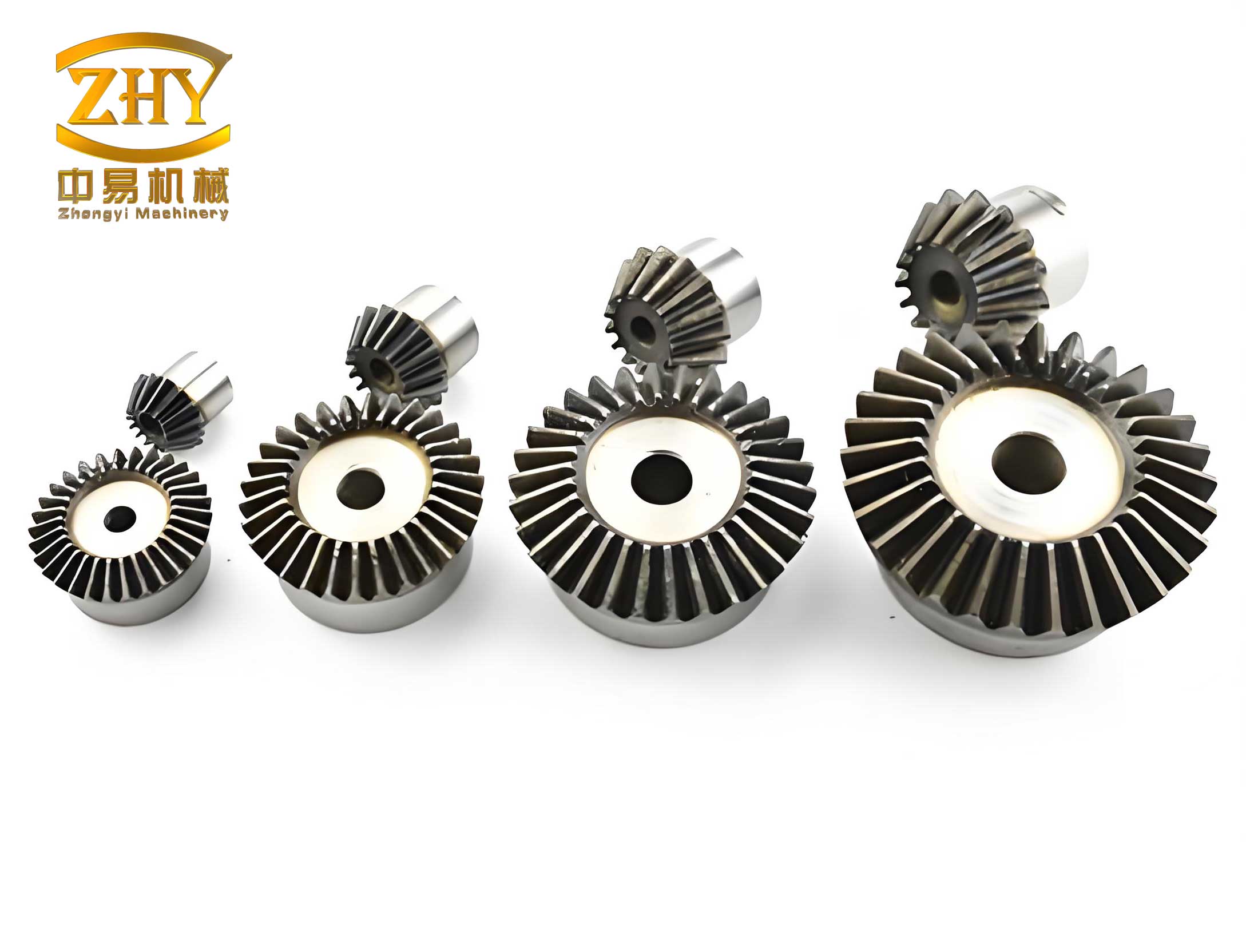
The core of any bevel gear mapping exercise lies in accurately determining its five fundamental parameters: module (m), number of teeth (z), pressure angle (α), addendum coefficient (h*), and dedendum coefficient (c*). All other geometric features of the bevel gears derive from these. Additionally, one must determine the tooth form, system standard, and the presence and type of modification. The methodology I propose intertwines physical measurement with theoretical verification, creating a feedback loop that refines the parameters until a consistent set is achieved.
1. Determining the Module of Bevel Gears
The module is arguably the most crucial parameter. While many mapping techniques exist, they often lack a systematic logical flow. For automotive bevel gears, the module is selected based on vehicle type and load. My initial screening uses the following common ranges:
| Vehicle Type | Typical Module Range (mm) | Common Pressure Angle Range (°) |
|---|---|---|
| Passenger Cars, Light Trucks | 2.5 – 3.5 | 14.5 / 17.5 / 20 |
| Medium Trucks | 3.5 – 4.5 | 20 / 22.5 |
| Heavy Trucks, Mining Vehicles | 4.5 – 6.0 | 22.5 / 25 |
To measure the module of the bevel gears, I employ an improved method over traditional techniques. Using a caliper or a similar measuring tool, I measure the distance from the apex of the pitch cone to the outer edge of the gear blank along the back cone. The key is to ensure the measurement is taken symmetrically. The principle involves adjusting the caliper until distances L1 and L2 from a fixed block to the gear’s back-cone surface are equal. This measured value, Ra, is slightly smaller than the true cone distance, Re. The relationship is given by the empirical formula:
$$ R_e = k \cdot R_a $$
where the correction factor \(k\) typically ranges from 1.01 to 1.02. The theoretical cone distance for a pair of straight bevel gears with shaft angle Σ=90° is:
$$ R_e = \frac{m}{2} \sqrt{z_1^2 + z_2^2} $$
By combining these, the module for the bevel gears can be estimated as:
$$ m \approx \frac{2k R_a}{\sqrt{z_1^2 + z_2^2}} $$
The numbers of teeth \(z_1\) and \(z_2\) (for the pinion and ring gear, respectively) are easily obtained by direct count. This calculated module should be checked against the standard module series and the preliminary range from the vehicle type table.
2. Pressure Angle and Number of Teeth for Bevel Gears
The pressure angle for automotive bevel gears varies significantly. For heavy-duty applications like mining trucks, larger pressure angles (e.g., 22.5° or 25°) are common to increase the bending strength of the gear teeth, allowing for a lower pinion tooth count (often aiming for 10) and promoting equal strength design between the pinion and ring gear. However, this comes at the cost of reduced contact ratio and increased noise. For mapping, after obtaining the tooth count, I determine the pressure angle using an imprint method. I apply a dark substance (like Prussian blue) to the back-cone surface of the bevel gear and press it against a flat white paper to obtain a tooth profile imprint. From this imprint, I measure the distance \(h_\alpha\) from the tip to a point roughly at the pitch line. An approximate relationship helps identify the pressure angle:
| If measured \(h_\alpha\) is approximately… | Then the pressure angle α is likely… |
|---|---|
| \(h_\alpha \approx 0.78m\) | greater than 20° |
| \(h_\alpha \approx 0.75m\) | 20° or less |
For a more precise determination, gear tooth calipers or optical comparators can be used on the imprint. The measured value is then rounded to the nearest standard value (e.g., 20°, 22.5°, 25°). With \(z_1\), \(z_2\), and a 90° shaft angle, the pitch cone angles for the bevel gears are:
$$ \delta_1 = \arctan\left(\frac{z_1}{z_2}\right) \quad \text{for the pinion} $$
$$ \delta_2 = 90^\circ – \delta_1 \quad \text{for the ring gear} $$
3. Addendum and Dedendum Coefficients for Bevel Gears
These coefficients are often standardized. For straight or skew bevel gears, the addendum coefficient \(h^*_a\) is typically 1. The dedendum coefficient \(c^*\) provides clearance and space for lubrication. According to common gear standards, the values are as follows:
| Tooth Line Type | Gear System Standard | Pressure Angle α (°) | Addendum Coeff. \(h^*_a\) | Dedendum Coeff. \(c^*\) |
|---|---|---|---|---|
| Straight/Skew Bevel | Gleason | 14.5 / 20 / 25 | 1 | 0.188 + \(\frac{0.05}{m}\) |
| Straight/Skew Bevel | ISO (B12369-90) | 14.5 / 20 / 25 | 1 | 0.2 |
| Straight/Skew Bevel | ENIMS | 20 | 1 | 0.2 |
To find \(c^*\) empirically, I first create a detailed 2D sketch of the mapped bevel gears using CAD software, based on all directly measurable dimensions like outer diameter, bore diameter, and overall geometry. From this sketch, I accurately measure the total tooth height \(h\) at the large end of the bevel gear. The theoretical total height is:
$$ h = (2h^*_a + c^*) m $$
Rearranging gives the dedendum coefficient:
$$ c^* = \frac{h}{m} – 2h^*_a $$
This calculated \(c^*\) is then compared and rounded to the nearest standard value from the table above. The process of creating this sketch is iterative; as parameters are refined, the sketch is updated.
4. Profile Shift and Modification in Bevel Gears
Automotive bevel gears are rarely standard. Profile shift (modification) is employed to prevent undercutting with low tooth counts, to adjust center distance, and to balance wear and strength between the pinion and ring gear. The first step is to determine if the bevel gears have any modification. Using the total tooth height \(h\) from the sketch, I apply the following rule:
- If \( |h – 2.25m| < 0.1 \), the gears are likely standard or have only profile shift (height modification).
- If \( h – 2.25m \ge 0.1 \), the gears likely have angular modification (both profile and depth changes).
For automotive bevel gears with height modification, the profile shift coefficient \(x\) can be estimated using an empirical formula. For the pinion (assuming it’s the smaller gear):
$$ x_1 \approx 0.37 \left(1 – \frac{1}{u^2}\right) $$
where \(u = z_2 / z_1\) is the gear ratio. For general machinery, the coefficient 0.46 is sometimes used. Alternatively, \(x\) can be derived from the measured addendum \(h_a\):
$$ x = \frac{h_a}{m} – h^*_a $$
The tangential shift coefficient \(x_t\) affects tooth thickness and is smaller in magnitude. It is often determined from standard tables based on the gear ratio and pinion tooth count, as direct measurement of chordal thickness is complex and prone to error.
| Gear Ratio \(u = z_2/z_1\) | Pinion Teeth \(z_1\) | Tangential Shift Coefficient \(x_t\) |
|---|---|---|
| Approx. 1.5 – 1.75 | 11 | 0.105 |
| Approx. 1.75 – 2.0 | 12 – 13 | 0.075 |
These values serve as a guide; the actual design may vary slightly based on specific strength requirements.
5. Identifying the Gear System Standard for Bevel Gears
The gear system (or “tooth system”) dictates the detailed tooth form and the generating machine geometry. Common systems for bevel gears include Gleason (curved teeth, usually spiral), Oerlikon (cyclo-palloid), and Klingelnberg (circular arc). For straight bevel gears, the Gleason system is very prevalent. However, identifying the system purely from a physical sample can be difficult without knowledge of the manufacturing process. The pressure angle, addendum, and dedendum coefficients can offer clues. If the measured parameters match a standard set from the table in Section 3, the system can be tentatively identified. For many mining truck bevel gears, especially those with pressure angles of 22.5° or 25°, they may not conform strictly to a common published standard but are designed as a custom “non-standard” set where the mating pair’s parameters are optimized together. Therefore, the primary goal in mapping is to reconstruct a consistent parameter set that defines the functional geometry of the bevel gears, rather than rigidly classifying the standard.
6. Case Study: Mapping Mining Truck Differential Bevel Gears
I applied this parallel mapping-design methodology to a set of bevel gears from a mining truck differential. The physical gears were worn but intact. The step-by-step process was as follows:
Step 1 – Initial Data: Counted teeth: Pinion \(z_1 = 12\), Ring Gear \(z_2 = 20\). Vehicle type indicated heavy-duty use.
Step 2 – Module Estimation: Using the improved cone distance measurement, I found \(R_a = 58.12 \text{mm}\). Applying a correction factor \(k=1.015\):
$$ R_e = 1.015 \times 58.12 \approx 58.99 \text{mm} $$
$$ m \approx \frac{2 \times 58.99}{\sqrt{12^2 + 20^2}} = \frac{117.98}{\sqrt{544}} \approx \frac{117.98}{23.324} \approx 5.06 \text{mm} $$
This rounded to a standard module of \(m = 5.0 \text{mm}\), fitting the 4.5-6.0 range for heavy trucks.
Step 3 – Pressure Angle: The imprint method yielded \(h_\alpha \approx 3.9 \text{mm}\). Since \(0.78m = 3.9 \text{mm}\), it suggested a pressure angle >20°. Precise measurement on the comparator indicated 23.3°, which was rounded to the common standard of \( \alpha = 22.5^\circ \).
Step 4 – Sketch and Coefficients: A detailed 2D sketch was created from direct measurements. From this sketch, the total tooth height at the large end was measured as \(h = 11.03 \text{mm}\). Using \(m=5.0\), \(h^*_a=1\):
$$ c^* = \frac{11.03}{5.0} – 2 = 2.206 – 2 = 0.206 $$
This was rounded to \(c^* = 0.2\), consistent with the ISO standard.
Step 5 – Modification Check: \(h – 2.25m = 11.03 – 11.25 = -0.22\), whose absolute value is >0.1. This initially suggested possible modification. However, considering the pinion tooth count (12) is less than 17, profile shift is almost certain to avoid undercut. Using the automotive formula for profile shift coefficient \(x_1\):
$$ u = \frac{20}{12} \approx 1.667, \quad x_1 \approx 0.37 \times (1 – \frac{1}{1.667^2}) \approx 0.37 \times (1 – 0.36) \approx 0.2368 $$
From the sketch, the measured addendum for the pinion was \(h_{a1} \approx 6.18 \text{mm}\). Calculating \(x_1\) from this: \(x_1 = 6.18/5.0 – 1 = 1.236 – 1 = 0.236\). The values matched closely, confirming a profile shift of approximately \(x_1 = 0.24\). The tangential shift coefficient \(x_t\) was selected from the table as 0.035 for this gear ratio and pinion count.
Step 6 – Final Parameter Set and Comparison: The final mapped parameters were assembled and compared against the original design parameters (which were later obtained for verification). The results are summarized below:
| Parameter | Symbol | Original Design | Mapped & Rounded Values | Accuracy / Consistency |
|---|---|---|---|---|
| Module | m (mm) | 5.0 | 5.0 | 100% |
| Pressure Angle | α (°) | 22.5 | 22.5 | 100% |
| Pinion Teeth | z₁ | 12 | 12 | 100% |
| Ring Gear Teeth | z₂ | 20 | 20 | 100% |
| Addendum Coefficient | h*ₐ | 1 | 1 | 100% |
| Dedendum Coefficient | c* | 0.2 | 0.2 | 100% |
| Profile Shift Coefficient | x₁ | 0.24 | 0.24 | 100% |
| Tangential Shift Coefficient | xₜ | 0.035 | 0.035 (selected from table) | Matched selection |
The high degree of correspondence validates the methodology. The only notable decision was selecting \(x_t\) from the standard table, which matched the original intent. With these parameters fully defined, complete engineering drawings for the bevel gears could be regenerated, including all derived dimensions such as pitch diameters, cone distances, and tooth angles.
7. Advanced Considerations and Formulas for Bevel Gears
To further elaborate on the design and analysis aspects that complement the mapping process, several key formulas are essential for working with bevel gears. These formulas allow the transition from basic parameters to full manufacturing specifications.
Pitch Diameter: For the pinion and ring gear respectively:
$$ d_1 = m z_1, \quad d_2 = m z_2 $$
Cone Distance (for Σ=90°):
$$ R_e = \frac{m}{2} \sqrt{z_1^2 + z_2^2} = \frac{d_1}{2 \sin \delta_1} = \frac{d_2}{2 \sin \delta_2} $$
Addendum and Dedendum: For straight bevel gears, these are typically calculated at the large end. The addendum \(h_a\) and dedendum \(h_f\) are:
$$ h_a = (h^*_a + x) m, \quad h_f = (h^*_a + c^* – x) m $$
However, note that in bevel gears, these dimensions vary along the tooth length. The above gives values at the large end.
Tip Diameter:
$$ d_a = d + 2 h_a \cos \delta $$
Where \(\delta\) is the respective pitch cone angle.
Root Angle: The root angle \(\delta_f\) is typically:
$$ \delta_f = \delta – \theta_f $$
where \(\theta_f\) is the root angle addendum, calculated as \(\arctan(h_f / R_e)\).
Backlash Considerations: When mapping, measured tooth thickness will include operational backlash. Theoretical circular tooth thickness at the pitch circle large end is:
$$ s = \frac{\pi m}{2} + 2 x m \tan \alpha + x_t m $$
The measured value will be less due to backlash and wear. Estimating original backlash requires experience or design guidelines.
8. Practical Mapping Workflow Summary for Bevel Gears
Based on my experience, I propose the following consolidated workflow for mapping unknown bevel gears:
- Document and Clean: Photograph, label, and thoroughly clean the bevel gear set to remove dirt and grease.
- Count Teeth and Measure Gross Dimensions: Record \(z_1\), \(z_2\), O.D., bore, face width, and overall geometry.
- Estimate Module via Cone Distance: Use the improved \(R_a\) measurement method and formula \(m \approx 2k R_a / \sqrt{z_1^2+z_2^2}\). Round to nearest standard.
- Determine Pressure Angle: Use imprint method and comparator, or approximate via \(h_\alpha\) relationship. Round to common standard (20°, 22.5°, 25°).
- Create Preliminary CAD Sketch: Input all direct measurements to create a 2D layout. This sketch is a living document.
- Measure Tooth Height from Sketch: Extract \(h\) accurately. Calculate \(c^* = h/m – 2\). Round to standard value (0.2, or Gleason formula).
- Check for Modification: Evaluate \(h – 2.25m\). If significant deviation, investigate profile shift. For automotive bevel gears, assume shift is likely if \(z_1 < 17\).
- Determine Shift Coefficients: Estimate \(x\) from empirical formula \(0.37(1-1/u^2)\) or from measured addendum \(h_a\). Select \(x_t\) from standard tables based on \(u\) and \(z_1\).
- Iterate and Refine: Recalculate all derived dimensions (tip diameters, cone angles, etc.) using the parameter set. Update the CAD sketch. Check for consistency with physical sample (e.g., does calculated O.D. match measured O.D. within wear allowance?). Adjust parameters slightly if needed (e.g., fine-tuning \(k\) factor) and iterate.
- Finalize and Generate Drawings: Once all parameters produce a geometry consistent with all measurable features of the bevel gears, the parameter set is final. Produce complete engineering drawings noting all fundamental and derived dimensions, tolerances, and heat treatment requirements if discernible.
This systematic, iterative approach bridges the gap between pure measurement and theoretical design. It acknowledges that measurement alone is insufficient for bevel gears due to inherent errors and wear, but when coupled with design principles in a closed loop, it yields highly reliable results.
9. Conclusion
The reverse engineering of bevel gears for critical applications like mining truck differentials demands a methodology that is both pragmatic and theoretically sound. The common challenges of wear, measurement inaccuracy, and non-standard designs render simplistic mapping procedures inadequate. The parallel mapping-design approach I have described, developed through practical experience, integrates direct physical measurement with iterative theoretical verification. By focusing on the fundamental parameters of module, pressure angle, and coefficients, and using empirical relationships, standard tables, and CAD-assisted refinement, this method allows for the accurate reconstruction of bevel gear geometry. The case study demonstrates its effectiveness, showing near-perfect alignment with original design parameters. This logical framework, emphasizing the consistent application of formulas and systematic checks, provides a valuable and reliable tool for engineers involved in the maintenance, repair, or development of machinery utilizing bevel gears. It underscores that successful mapping of bevel gears is not merely a metrological task but a holistic engineering analysis that blends observation with established design principles for bevel gears.