
The pursuit of optimal power transmission in heavy-duty machinery has consistently driven the development of gear technology. Among the various gear types, the spiral bevel gear stands out for its superior performance and high load-carrying capacity, representing a primary direction in the evolution of bevel gear systems. Within this domain, the Klingelnberg cycloidal spiral bevel gear system has established itself as a benchmark, alongside the American Gleason system, for high-performance applications. The defining feature of a high-quality spiral bevel gear pair is not merely its geometric precision upon manufacture, but the character and location of the contact pattern—the actual area of engagement between the meshing tooth surfaces during operation. This contact pattern is the single most critical indicator of a spiral bevel gear’s operational smoothness, noise level, and service life.
The advantages of the Klingelnberg spiral bevel gear system are well-documented and stem from its unique generation principle. These advantages include exceptionally smooth and quiet operation, even at high speeds; high manufacturing efficiency due to continuous cutting processes; the ability to handle very high loads; the possibility for high transmission ratios with a pinion tooth count as low as five; the capability for hard-finish skiving after case hardening to correct heat-treatment distortion and achieve excellent surface finish; and, crucially, the inherent flexibility to correct the contact pattern through systematic adjustments of the machine settings. This final point is paramount. Relying solely on running-in or lapping operations to improve an unsatisfactory contact pattern is inefficient. The ultimate goal is to produce a spiral bevel gear pair directly from the cutting machine with a near-ideal contact pattern, requiring minimal subsequent correction. This article, drawn from extensive production experience, details the principles and methodologies for achieving this goal.
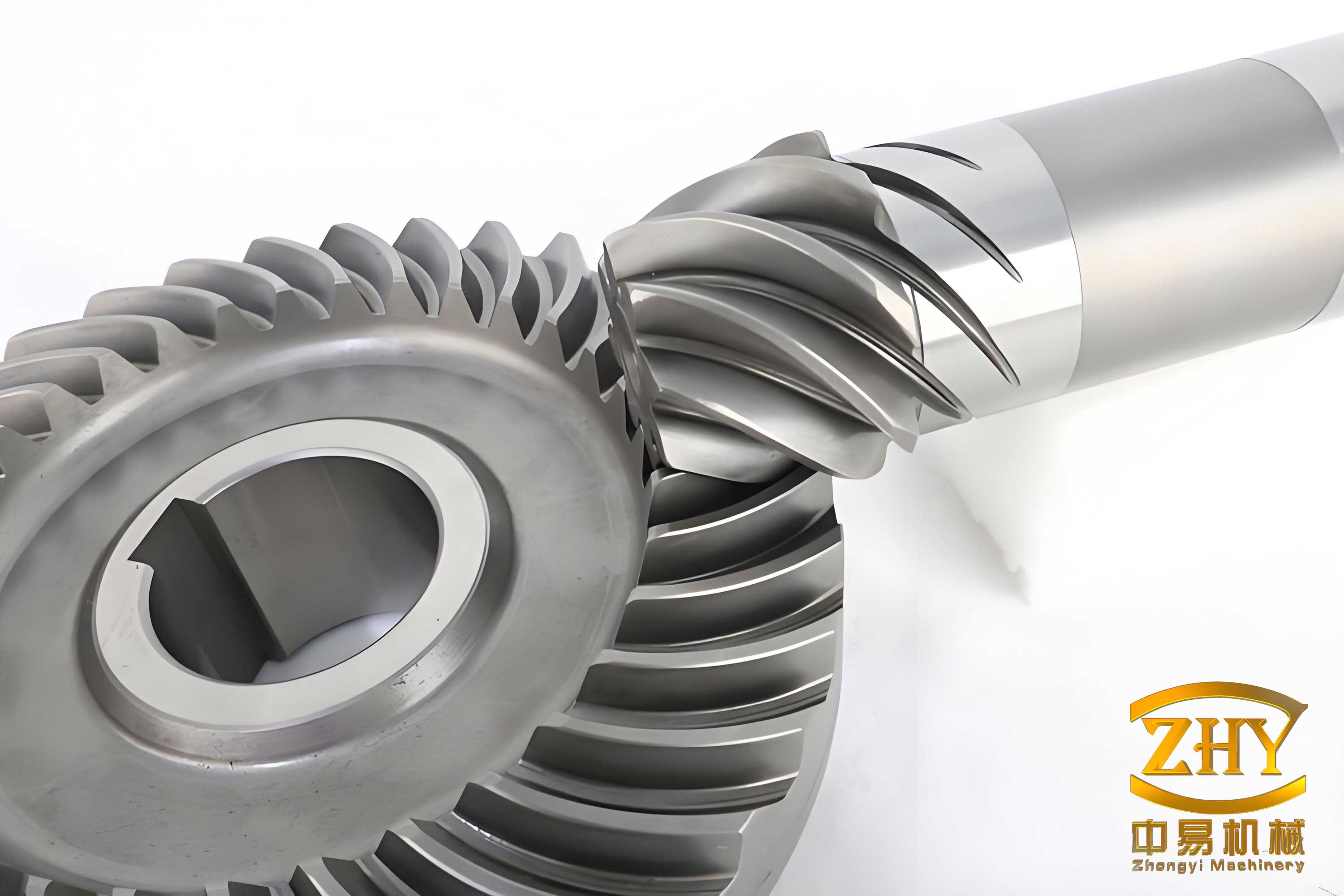
The contact pattern, often called the bearing pattern or contact patch, is the visible imprint resulting from the controlled deflection of the tooth surfaces under a light test load. For Klingelnberg spiral bevel gears, the ideal unloaded pattern is centered on the tooth flank, both in the lengthwise and profile directions. This central positioning is strategic. Under full operational load, the tooth deflection causes the contact area to expand outward in all directions—toward the toe, heel, top, and root. A centrally located starting pattern ensures that under load, the contact spreads evenly without prematurely reaching the edges, which could cause stress concentrations, noise, and reduced life. The pattern on the convex (drive side) and concave (coast side) flanks of the pinion should be symmetrical about the center. The size of the unloaded pattern is controlled by the amount of intentional “crowning” or lengthwise curvature built into the tooth, which is a function of the cutter head setup.
The core principle of contact pattern correction in Klingelnberg spiral bevel gear manufacturing lies in the relationship between machine adjustment parameters and the resulting tooth geometry. The machine settings, derived from the gear design data, dictate the relative motion between the workpiece and the special double-bladed cutter head. When the initial cut gear pair does not exhibit the ideal contact pattern on the testing machine (at the theoretical correct mounting distance), it indicates a deviation between the theoretical and actual gear tooth surfaces. Correction involves selectively altering specific machine parameters to shift or reshape the contact pattern predictably. The primary, most effective parameters for this purpose are the Machine Center to Back Angle (τ) and the Cutter Head Tilt Angle (Δm). The influence of changing Δm is foundational: it directly translates the contact pattern along the length of the tooth. The relationship can be conceptualized as a linear shift proportional to the change in angle.
$$ \text{Pattern Shift} \propto k \cdot \Delta (\Delta m) $$
Where \( k \) is a factor dependent on gear geometry. A positive change in Δm typically moves the pattern toward the heel on the concave flank and the toe on the convex flank for a standard right-hand spiral pinion, and vice-versa.
The correction process is systematic. First, the gear pair must be cut using the nominal calculation sheet data and meticulously inspected on a testing machine under precisely controlled conditions, especially the mounting distance. Only after confirming the nature of the deviation from the ideal pattern should corrections be applied. The following table categorizes common non-ideal contact pattern issues and outlines the primary corrective actions, focusing on adjustments to the pinion.
| Pattern Discrepancy Description | Primary Corrective Action | Typical Adjustment Range | Effect & Notes |
|---|---|---|---|
| Correct pattern on convex flank, but pattern on concave flank is biased toward toe or heel. | Change Cutter Head Tilt Angle (Δm) for the pinion. | ±1° to ±4° (can be larger if needed). | Moves the concave flank pattern lengthwise without significantly affecting the convex flank. The simplest correction. |
| Diagonal contact pattern (pattern runs from toe-top to heel-root or vice-versa). | Change Machine Center to Back Angle (τ) for the pinion or change Δm on the mating gear. | τ: ± few minutes of arc; Δm: ±1° to ±4°. | Changing τ on the pinion rotates the entire tooth flank. The direction of change depends on the spiral hand and diagonal direction. |
| Symmetrical pattern bias (both flanks show pattern too close to toe or heel). | Simultaneously change τ and Δm for the pinion or change Δm in opposite directions on the pinion and gear. | τ: ± few minutes; Δm: ±2° to ±4°. | Combined adjustment corrects for a systematic offset in the gear generation. |
| Pattern position acceptable, but interference at tip or root causing noise. | 1. Increase Installation Cone Angle (δE). 2. Modify generating depth (Tw). 3. Adjust pinion axial mounting distance. 4. Use wedge washers to alter tool pressure angle (α). |
δE: +0.15° to +0.2°; α: ±0.15° to ±0.2°. | Aims to deliberately relieve contact at the interfering edge. Pressure angle change is a fine-tuning method using shims behind the cutter blades. |
To fully master the correction of spiral bevel gear contact patterns, one must understand the detailed application of these adjustments. For a diagonal contact pattern, the specific adjustment depends on the spiral hand of the pinion and the direction of the diagonal. For a right-hand spiral pinion with a diagonal running from the toe-top to the heel-root, decreasing τ by a few minutes of arc will rotate the flank to centralize the pattern. Alternatively, decreasing Δm on the left-hand spiral mating gear by 1° to 4° can achieve a similar correction by altering the mating surface. The mathematical effect of changing τ is more complex than Δm, as it modifies the root line curvature. Its impact can be summarized as a rotational transformation of the flank surface relative to the mating gear’s surface.
$$ \text{Flank Surface}_{\text{new}} = R(\Delta \tau) \cdot \text{Flank Surface}_{\text{original}} $$
Where \( R(\Delta \tau) \) represents a rotation matrix dependent on the change in the τ angle. This rotation is what counteracts the diagonal orientation of the contact pattern.
For symmetrical bias, the combined adjustment of τ and Δm is often most effective. If the pattern on both flanks of a right-hand pinion is toward the toe, one would simultaneously decrease τ (to shift pattern toward heel) and increase Δm (which, for a right-hand pinion, also shifts the concave flank pattern toward the heel). The combined effect powerfully centralizes the pattern. An alternative is to decrease Δm on the right-hand pinion and increase Δm on the left-hand mating gear by equal amounts, which effectively changes the relative curvature between the paired flanks.
The final category—tip or root interference—requires a different approach. Here, the goal is profile relief. Increasing the Installation Cone Angle (δE) effectively tilts the tooth profile, often providing more clearance at the root. Modifying the generating depth (Tw) changes the depth of cut and can alter the involute form slightly. The most targeted method is using wedge washers behind the cutter blades to create a slight difference between the nominal and actual pressure angles. For example, if the tip of the driving pinion convex flank is interfering with the root of the gear concave flank, using a negative wedge shim (e.g., -0.15°) on the pinion’s convex side cutter blade will effectively reduce its pressure angle, removing a tiny amount of material from the pinion tip and gear root area, thus eliminating the interference. This is a precision operation expressed as:
$$ \alpha_{\text{actual}} = \alpha_{\text{nominal}} + \Delta \alpha_{\text{shim}} $$
This micro-adjustment of the spiral bevel gear tooth profile is critical for achieving whisper-quiet operation in high-precision applications.
Beyond these primary levers, other factors can influence the final contact pattern of a spiral bevel gear and must be considered during the correction process. The eccentricity setting (EEXZ) of the cutter head directly controls the amount of lengthwise crowning. If the contact pattern is correctly positioned but too long or too short, revisiting the eccentricity value may be necessary. Furthermore, the absolute accuracy of the machine tool, the rigidity and precision of the workholding fixtures, and the condition of the cutter blades are non-negotiable prerequisites. No amount of parameter correction can compensate for fundamental mechanical inaccuracies. A critical design consideration for Klingelnberg spiral bevel gears is to avoid tooth counts that are multiples of five for both members of the pair, as the standard cutter head has five blades. A multiple-of-five tooth count can align machining errors, causing a cumulative error to manifest on one specific tooth, making consistent contact pattern correction across all teeth nearly impossible.
The process is iterative and requires deep practical understanding. The recommended adjustment ranges are starting points. The exact magnitude of change required for a specific spiral bevel gear pair depends on its module, face width, spiral angle, and diameter. An experienced technician makes an initial adjustment based on the pattern discrepancy, performs a test cut, inspects, and then fine-tunes. The overarching principle is to use the simplest, most direct adjustment that yields the desired result. In most production scenarios, modifying Δm and τ, along with fine-tuning the axial mounting distance during final assembly, resolves over 90% of contact pattern issues. The mastery of this systematic correction methodology transforms the manufacturing of spiral bevel gears from a trial-and-error process into a controlled, predictable engineering practice. It ensures that every spiral bevel gear pair leaving the production line possesses the optimized contact pattern necessary for maximum load capacity, minimum noise, and extended service life, thereby delivering the full performance potential inherent in the superior Klingelnberg design.