
The operational demands placed on mining machinery are extraordinarily severe. Gears within these systems must withstand intense dynamic loading, harsh environmental contaminants like coal dust and corrosive gases, and are expected to deliver unparalleled reliability over extended service lives. With the continuous push for higher productivity, the power ratings of mining equipment have escalated, placing even greater demands on the load-bearing capacity of gear transmission systems. While operating at relatively low circumferential speeds (typically 2-12 m/s), the calculated contact stress ($\sigma_H$) for these gears often exceeds 500 MPa, classifying them as low-speed, heavy-duty applications. To meet these challenges, surface-hardened gears have become the industry standard. This places immense importance on the meticulous selection of materials and the precise execution of heat treatment processes. The core engineering principle is to achieve an optimal combination of a high-toughness gear core and an extremely hard wear-resistant surface. However, the path to this ideal microstructure is fraught with potential pitfalls, where deviations in process control invariably lead to critical heat treatment defects that can compromise the entire gearbox. This article delves into a systematic methodology for material selection and explores advanced heat treatment practices, with a continuous focus on identifying, understanding, and preventing the heat treatment defects that threaten gear performance and mine safety.
The Criticality of Material Selection: A Stress-Based Approach
Historically, there has been a tendency to over-specify high-grade, high-alloy steels for mining gears, leading to unnecessary cost and manufacturing complexity. A more scientific and economical method is to select materials based on the calculated magnitude of service stress. Gears are designed according to the criteria for contact fatigue strength at the tooth flank and bending fatigue strength at the tooth root. The selection process, therefore, hinges on matching the material’s capability to the anticipated load.
A robust framework for this is the strength grading method. Materials are categorized based on their limiting contact fatigue strength ($\sigma_{Hlim}$) and limiting bending fatigue strength ($\sigma_{Flim}$). This classification is visually represented in a grading chart that segregates materials by their intended heat treatment: one group for surface-hardened (e.g., carburized and quenched) gears and another for through-hardened (quenched and tempered) gears. The grading system uses a notation like “Hx,y” for hardened gears, where ‘x’ represents $\sigma_{Hlim}/10$ and ‘y’ represents $\sigma_{Flim}/10$ for pulsating stress cycles.
| Strength Grade | Approx. $\sigma_{Hlim}$ (MPa) | Approx. $\sigma_{Flim}$ (MPa) | Recommended Heat Treatment | Typical Steel Grades | Primary Application Focus |
|---|---|---|---|---|---|
| H16,6 | 1600 | 600 | Carburizing & Quenching | 20Cr2Ni4A, 18Cr2Ni4WA | Ultra-high stress, critical drive stages |
| H14,5 | 1400 | 500 | Carburizing & Quenching | 20CrNiMo, 17CrNiMo6 | High-stress planetary gears, final drives |
| H12,4 | 1200 | 400 | Carburizing & Quenching | 20CrMnTi, 20CrMnMo | Medium-high stress gears |
| H10,3 | 1000 | 300 | Carburizing & Quenching | 20MnCr5, 16MnCr5 | General hardened gears |
| Q10,2.5 | 1000 | 250 | Quenching & Tempering | 42CrMo, 34CrNiMo6 | Nitriding base material, shafts |
| Q7,2 | 700 | 200 | Quenching & Tempering | 35CrMo, 40Cr | Nitrided internal ring gears |
For example, a gear with calculated contact stresses above 1100 MPa would logically fall into the H12,4 or H14,5 grade, guiding the engineer towards steels like 20CrMnMo or 17CrNiMo6. This method prevents the wasteful application of an H16,6 grade steel (e.g., 20Cr2Ni4A) where it is not mechanically justified, thereby also avoiding the more complex and defect-prone heat treatment cycles associated with such high-alloy steels.
Heat Treatment of Surface-Hardened Gears: Processes and Inherent Defect Risks
The predominant heat treatment for mining gear teeth is carburizing followed by quenching. For specific components like internal ring gears in planetary sets, nitriding is often preferred. Each process has a distinct set of quality targets and a corresponding landscape of potential heat treatment defects.
Carburizing and Quenching: Quality Targets and Defect Analysis
The success of carburizing is measured by three key parameters: effective case depth, surface carbon concentration/surface microstructure, and core hardness.
1. Effective Case Depth: This is fundamental to load-bearing capacity, especially contact fatigue strength. The depth must be sufficient to support the sub-surface shear stress maximum, preventing spalling or case crushing. Inadequate depth is a critical heat treatment defect leading to premature failure. The required depth is a function of module ($m_n$).
| Module, $m_n$ (mm) | Effective Depth (mm) | Module, $m_n$ (mm) | Effective Depth (mm) |
|---|---|---|---|
| 2 – 3 | 0.38 – 0.60 | 10 – 14 | 1.80 – 2.30 |
| 3.5 – 5 | 0.70 – 1.00 | 16 – 20 | 2.60 – 3.00 |
| 6 – 8 | 1.20 – 1.50 | 22 – 30 | 3.30 – 4.00 |
2. Surface Carbon Concentration and Microstructure: The aim is a surface carbon content between 0.7% and 1.0%. Deviation outside this range is a root cause of several heat treatment defects. Low carbon leads to low hardness and poor wear resistance. Excessive carbon promotes the formation of massive, brittle carbides at grain boundaries and increases retained austenite ($A_R$), both of which are detrimental heat treatment defects.
3. Core Hardness: The core must have sufficient hardness (and thus strength) to support the hardened case, but not so high as to become brittle. A typical range is 32-40 HRC. An excessively hard core is a heat treatment defect that increases the risk of brittle tooth fracture under impact.
The desired microstructural outcome is a fine, martensitic case with a controlled amount of dispersed carbides and retained austenite, supported by a tough, tempered martensite or bainite core. The cooling rate during quenching is critical and can be modeled. The ideal cooling rate must exceed the critical cooling rate ($V_c$) for the specific steel to form martensite, but not be so fast as to cause excessive distortion or quenching cracks. The temperature gradient can be described as:
$$ \frac{\partial T}{\partial t} = \alpha \nabla^2 T + \frac{q}{\rho c_p} $$
where $\alpha$ is thermal diffusivity, $q$ is the internal heat generation rate (from phase transformation), $\rho$ is density, and $c_p$ is specific heat. Improper quenching media, temperature, or agitation leads to non-martensitic transformation products (like pearlite or ferrite) in the case—a severe heat treatment defect known as soft spots.
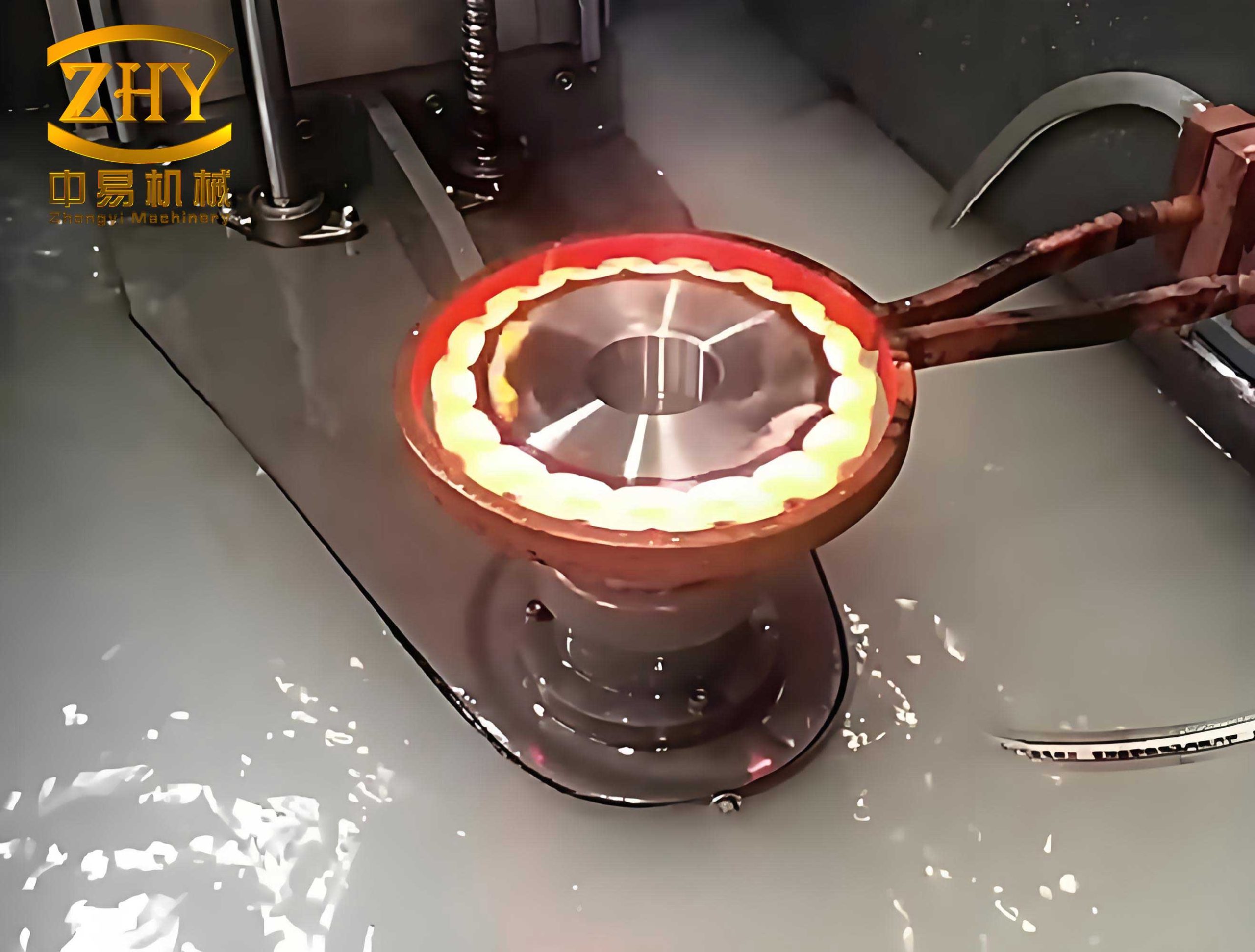
Nitriding for Internal Gears: Precision and Its Pitfalls
Nitriding, particularly ion nitriding, is favored for internal ring gears in planetary drives. It induces high surface hardness with minimal distortion. The base material (e.g., 35CrMo, 42CrMo) must first be quenched and tempered to a core hardness of ~280-320 HB. The key quality parameter is, again, effective nitrided case depth.
| Module, $m_n$ (mm) | Effective Depth Range (mm) |
|---|---|
| 1.5 – 4 | 0.25 – 0.5 |
| 4.5 – 6 | 0.45 – 0.6 |
| >6 (Heavy-duty) | >0.6 – 0.8 |
Common heat treatment defects in nitriding include:
Brittle White Layer: An excessively thick compound layer (ζ-Fe$_2$N, ε-Fe$_{2-3}$N) that is hard but prone to spalling.
Nitride Network: Precipitates of alloy nitrides (e.g., CrN, AlN) along grain boundaries, acting as stress concentrators and crack initiation sites.
Insufficient Case Depth: Arising from incorrect temperature, time, or gas composition during nitriding.
The nitriding process kinetics can be approximated by a parabolic growth law for the diffusion-controlled layer:
$$ d = k \sqrt{t} $$
where $d$ is case depth, $t$ is time, and $k$ is a temperature-dependent rate constant following an Arrhenius relationship. Deviations from the expected depth for a given time indicate a process control issue—a potential heat treatment defect.
Detailed Process Flow and the Quest to Eliminate Defects: A Case Study on High-Alloy Steels
For the most demanding applications (H16,6 grade), steels like 20Cr2Ni4A are selected. Their high Nickel and Chromium content provides superb hardenability and toughness but introduces significant heat treatment complexity, most notably the challenge of high retained austenite after quenching. Retained austenite is a metastable phase that reduces hardness, can transform under load causing dimensional instability, and is a known precursor to grinding cracks—all serious heat treatment defects.
The traditional, defect-mitigating thermal cycle for such steels is elaborate:
- Normalizing & High-Temp Tempering: To refine the forged grain structure and improve machinability.
- Stress Relieving (650°C): After rough machining, to minimize distortion during subsequent high-heat treatment.
- Carburizing (900-930°C): To develop the required case carbon profile.
- High-Temperature Tempering (650-680°C): To transform case austenite to tempered martensite and carbides, softening it for any final machining.
- Re-austenitization & Quenching (850-870°C): To re-harden the gear.
- Sub-Zero Treatment (-70°C to -80°C): The critical step to force the transformation of retained austenite to martensite.
- Low-Temperature Tempering (150-160°C): To temper the fresh martensite, relieve stresses, and achieve final hardness.
The sub-zero (cryogenic) treatment is specifically aimed at eliminating the heat treatment defect of excessive retained austenite ($A_R$). The transformation during cold treatment can be described by the Koistinen-Marburger relationship for athermal martensite formation:
$$ f = 1 – \exp[-\alpha(M_s – T)] $$
where $f$ is the volume fraction of martensite, $\alpha$ is a constant, $M_s$ is the martensite start temperature, and $T$ is the treatment temperature. While effective, this process is energy-intensive and adds cost.
An Innovative, Defect-Preventing Alternative Process
Field practice has demonstrated that a carefully designed thermal cycle can effectively control retained austenite without sub-zero treatment, thereby simplifying the process and reducing a major cost driver while still preventing the associated heat treatment defects. The modified sequence is:
1. Normalizing (940-960°C) + Tempering (680°C)
2. Rough Machining + Stress Relieving (650°C)
3. Carburizing at a Lower Temperature (900-930°C)
4. Triple High-Temperature Tempering (670-690°C) – This is the key innovation.
5. Final Quenching (850-870°C) + Low Tempering (150-160°C)
The rationale is profound. The triple high-temperature tempering after carburizing performs multiple defect-prevention functions:
– It thoroughly decomposes austenite in the high-carbon case into a fine dispersion of alloy carbides in a ferrite matrix.
– It significantly reduces the carbon and alloy content in solid solution within the austenite.
– This chemical depletion raises the Martensite Start ($M_s$) temperature of the remaining austenite substantially.
– Upon final quenching, this raised $M_s$ temperature ensures that virtually all austenite transforms to martensite at room temperature, negating the need for a sub-zero cycle.
The final microstructure achieves the target surface hardness (58-62 HRC) with minimal retained austenite (<10-15%) and the desired core hardness. This process has been validated in production, resulting in gears that meet all performance requirements while eliminating the cost, complexity, and handling risks of cryogenic treatment—a prime example of process optimization targeting the root cause of a specific heat treatment defect.
The effectiveness of this modified cycle can be visualized through simulated or measured hardness profiles. The case hardness remains high due to the fine carbides, while the core maintains its toughness. The absence of the retained austenite plateau is confirmation that this heat treatment defect has been successfully engineered out of the process.
Comprehensive Quality Control: Detecting and Preventing Defects
A robust quality assurance system is non-negotiable. It must be designed to catch heat treatment defects before gears enter service. This involves both destructive and non-destructive testing (NDT).
| Defect Category | Specific Defect | Likely Cause | Detection Method |
|---|---|---|---|
| Microstructural | Excessive Retained Austenite | Low $M_s$ temp, inadequate tempering/quench | X-ray Diffraction, Metallography |
| Brittle Grain Boundary Carbides | Excessive surface carbon, slow cooling from carburize | Metallography (etching) | |
| Soft Spots / Non-Martensitic Phase | Inadequate quenching severity, contamination | Hardness Traverse, Etching | |
| Oxidation/Decarburization | Furnace atmosphere failure | Metallography, Micro-hardness near surface | |
| Geometric/Dimensional | Excessive Distortion (Bend, Twist) | Non-uniform heating/cooling, residual stresses | Gear Rolling Tester, CMM |
| Quenching Cracks | Thermal stress > fracture strength, design stress concentrators | Magnetic Particle Inspection, Dye Penetrant | |
| Grinding Cracks (post-HT) | Grinding burn on a sensitive microstructure (high $A_R$ or untempered martensite) | Nital Etch, Barkhausen Noise Analysis | |
| Property-Based | Insufficient Case Depth | Short carburize/nitride time, low temperature | Hardness Traverse (HV550 method) |
| Low Core Hardness | Incorrect tempering temperature, poor hardenability | Core Hardness Test |
Prevention is always superior to detection. This is achieved through Statistical Process Control (SPC) of key furnace parameters: temperature uniformity ($\pm$10°C), carbon potential (via oxygen probe control), quench oil temperature and agitation, and nitriding gas ratios. Advanced simulation software is now indispensable for predicting distortion and optimizing load patterns in the furnace to minimize this pervasive heat treatment defect.
Conclusion: A Systems Approach to Gear Reliability
The pursuit of reliability in mining gear drives is a multi-faceted engineering challenge. It begins with a rational, stress-based selection of material to avoid over-engineering. It culminates in the precise execution and control of complex thermal processes. Throughout this journey, the specter of heat treatment defects looms large, capable of nullifying the benefits of the best steel alloy. Understanding the metallurgical principles behind these defects—whether it’s retained austenite transformation kinetics, case depth diffusion laws, or thermal stress generation—is the foundation for developing robust processes. The evolution from traditional, costly cycles (involving sub-zero treatment) to optimized, multi-stage tempering processes demonstrates that innovation in heat treatment is continuously focused on defect prevention. By integrating scientific material selection, defect-aware process design, rigorous quality control, and advanced simulation, engineers can consistently produce mining gears that withstand the brutal demands of the underground environment, ensuring safety, productivity, and operational longevity. The battle against heat treatment defects is perpetual, but with a systematic and knowledgeable approach, it is one that can be decisively won.