
As a manufacturing engineer specializing in thermal processes, the transition from conventional through-hardening or carburizing to induction heat treatment for internal gears represents a significant leap in efficiency and component performance. This article consolidates years of practical experience and technical investigation into a comprehensive guide, focusing on the methodologies, challenges, and critical solutions for preventing heat treatment defects. The core of our discussion revolves around the successful application of both high-frequency (HF) and medium-frequency (MF) induction hardening on medium-carbon steel internal gears, a shift that dramatically enhanced durability while reducing production costs.
The fundamental challenge with internal gears lies in the geometry itself. Unlike external gears where the induction coil encircles the outside, heating an internal surface requires placing the coil inside the bore. This inversion leads to a dramatic reduction in thermal coupling efficiency due to the dispersion of magnetic flux lines. For a given power and frequency, the effective heating power on an internal surface can be as low as one-fourth of that achievable on an external gear of comparable size. This inherent inefficiency, if not properly addressed, is the primary source of various heat treatment defects such as insufficient hardness, non-uniform hardening patterns, and excessive distortion.
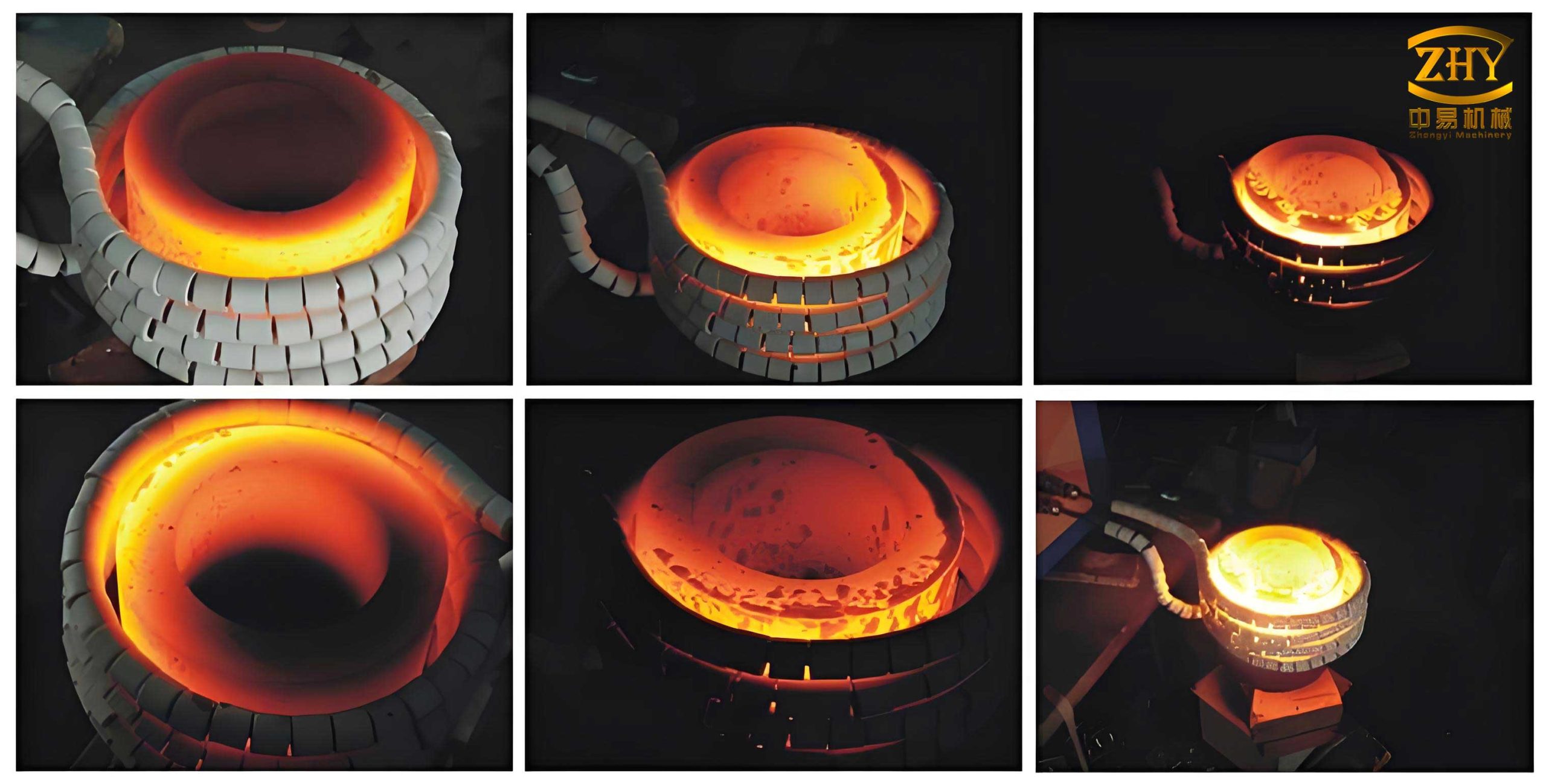
Process Fundamentals and Key Challenges
The physics of induction heating is governed by the skin effect, where alternating current concentrates near the surface of the conductor. The depth of this current penetration, or skin depth (δ), is a critical parameter calculated by:
$$ \delta = 503 \sqrt{\frac{\rho}{\mu_r f}} $$
where \( \rho \) is the electrical resistivity (Ω·m), \( \mu_r \) is the relative magnetic permeability, and \( f \) is the frequency (Hz). For steel at austenitizing temperatures, a simplified approximation is often used. The choice of frequency directly dictates the possible case depth. For gear teeth, the target is to achieve austenitization slightly beyond the root diameter to ensure a continuous hardened profile. Inadequate frequency selection leads to shallow hardening or, conversely, through-heating, both classified as severe heat treatment defects.
For internal gears, the design of the inductor (coil) is paramount. A multi-turn “spring-type” coil is often used for HF applications to distribute heat along the tooth width. However, for MF applications, a single-turn coil augmented with magnetic flux concentrators (often called “impeder” or “field shaper”) is essential to force the magnetic field towards the internal surface, improving efficiency. Failure in coil design directly manifests as localized overheating, soft spots, or uneven case depth—classic heat treatment defects that compromise fatigue life.
| Power Source Type | Frequency Range | Typical Power (kW) | Efficiency (%) | Primary Application & Notes |
|---|---|---|---|---|
| Electronic Tube HF | 100-500 kHz | 5-500 | 60-75 | Small module gears, shallow case (0.5-2 mm). Sensitive to coupling gap. |
| Motor-Generator MF | 1-10 kHz | 15-1000 | 70-85 | Medium module gears, deeper case (2-6 mm). Robust but noisy. |
| Solid-State / SCR MF | 0.1-8 kHz | 15-1000 | 90-95 | Most efficient. Excellent for internal gears with flux concentrators. Wider process window. |
High-Frequency (HF) Quenching Process for Internal Gears
The initial successful implementation for a planetary internal gear made from 1045 steel (analogous to Chinese 45# steel) was achieved using a 100 kW, 200-250 kHz generator. The preprocessing involved normalizing the forging blanks to achieve a uniform ferrite-pearlite structure with a hardness of ~180 HB, providing an ideal substrate for subsequent hardening and minimizing the risk of distortion-related heat treatment defects.
Inductor and Quenching Fixture Design: A two-turn spring-type inductor was constructed from rectangular copper tubing. The radial width of the tubing was minimized to reduce the effective air gap between the coil’s outer surface and the gear’s internal teeth. The total inductor height was strategically chosen to be about 60% of the gear face width to increase the effective power density (kW/cm²). A dedicated “bowl-type” workpiece holder was developed to ensure precise, vibration-free rotation during heating and smooth transfer to the quench station, which is crucial for uniformity and avoiding one-sided heating heat treatment defects.
Quenching System: An internal spray quench ring was positioned concentrically inside the bore. This design directs high-velocity coolant directly onto the heated internal surface immediately after heating ceases. Precise control of quench pressure, flow rate, and duration is vital to prevent cracking (a quench crack is a catastrophic heat treatment defect) and to achieve the desired martensitic transformation without excessive residual stress.
The process parameters were carefully tuned through iterative trials. The gear was rotated at 6-10 rpm and simultaneously traversed vertically along the stationary inductor to ensure even heating across the face width. The final parameters established a stable process window.
| Process Parameter | Value / Range | Remarks |
|---|---|---|
| Anode Voltage (kV) | 12 – 12.5 | Stabilizes power input |
| Anode Current (A) | 6 – 8 | Adjusted for thermal input |
| Grid Current (A) | 1.0 – 1.5 | Oscillator control |
| Heating Time (s) | 35 – 40 | To reach ~900°C austenitization |
| Quench Medium | Water | Internal spray |
| Quench Pressure (MPa) | 0.15 – 0.2 | Prevents soft spots & cracks |
| As-Quenched Hardness (HRC) | 52 – 58 | Measured at tooth tip |
| Tempering | 250°C for 1-1.5 h | Relieves stress, final hardness 45-50 HRC |
This HF process reliably met the technical requirement of 45-50 HRC on the tooth flanks with no quench cracks. However, the case depth at the tooth root was relatively shallow, which, for very high contact stress applications, could be a limiting factor and a potential origin of sub-surface fatigue heat treatment defects.
Medium-Frequency (MF) Quenching: A Deeper Solution
To achieve a deeper and more robust hardened case, especially at the critical tooth root fillet, a move to medium-frequency (8 kHz) induction was pursued. The deeper current penetration, given by the skin effect formula, allows heat to be generated closer to the root area. The core equation for estimating required power (P) considers the surface area (A_s) and the specific power density (p_d):
$$ P \approx A_s \cdot p_d $$
For an internal gear bore surface, \( A_s = \pi \cdot D \cdot W \), where D is the internal pitch diameter and W is the face width. The power density \( p_d \) must be significantly higher for internal heating than for external, often requiring the use of flux concentrators.
The Critical Role of Magnetic Flux Concentrators: In MF internal hardening, a simple single-turn coil is grossly inefficient. Applying a layer of laminated silicon steel or a modern composite ferromagnetic material (the flux concentrator) to the inside of the coil forces the magnetic field outward, dramatically improving the coupling with the gear’s internal teeth. This step is non-negotiable for achieving a uniform temperature profile and avoiding the heat treatment defect of a “banded” or “hollow” hardening pattern where only the middle of the tooth face gets hot.
The inductor height with the concentrator is designed to be slightly greater than the gear face width to ensure coverage and mitigate end-effects that cause softening at the edges. The quenching system remained an internal spray, but the slower heating cycle (tens of seconds versus seconds for HF) required precise synchronization to avoid tempering back of the already-heated areas before quenching—a phenomenon known as “self-tempering” that can lead to soft zones, another type of heat treatment defect.
| Parameter | Setting | Outcome & Significance |
|---|---|---|
| Power (kW) | 75 – 80 | Higher available power density |
| Heating Time (s) | 260 – 270 | Slower, deeper heat penetration |
| Coil Type | Single-turn with Flux Concentrator | Essential for efficiency and pattern control |
| Case Depth at Root (mm) | ≥ 1.0 | Key improvement over HF; enhances bending fatigue resistance |
| Case Depth at Tip (mm) | ~3.0 | Adequate for wear resistance |
| As-Quenched Hardness (HRC) | 55 – 60 | Consistent across tooth profile |
| Distortion (Bore Size Change) | -0.04 to -0.10 mm | Predictable and manageable via pre-setting |
The MF process proved superior in producing a more favorable hardened profile, with a contoured case following the tooth geometry. This profile significantly increases the bending fatigue strength at the root. The process also exhibited higher energy efficiency, greater consistency, and reduced part distortion, effectively mitigating several common heat treatment defects associated with HF processing of thicker sections.
Systematic Analysis and Prevention of Heat Treatment Defects
A successful induction hardening process is defined by its ability to avoid defects. Below is a systematic analysis linking common heat treatment defects in internal gear hardening to their root causes and corrective actions.
| Defect | Primary Causes | Preventive Measures & Remedies |
|---|---|---|
| Insufficient/Non-Uniform Hardness (Soft Spots) | Inadequate power density; Poor magnetic coupling; Incorrect frequency; Quench delay or inadequate quench coverage; Localized decarburization. | Optimize coil-gear air gap; Use flux concentrators (MF); Increase power/cycle time; Ensure immediate, turbulent quench; Verify material surface condition. |
| Excessive or Shallow Case Depth | Incorrect frequency selection; Excessive/Insufficient heating time. | Select frequency using skin depth calculations for target depth. Validate with metallography. Use the relation: Heating time \( t \propto \frac{(Case Depth)^2}{Thermal Diffusivity} \). |
| Cracking (Quench Cracking) | Overheating (excessive austenitizing temp); Too severe a quenchant (e.g., cold water on complex shape); High carbon/content segregation. | Control peak temperature with pyrometer; Use polymer quenchant or warm water; Ensure proper steel grade and homogeneity; Implement immediate tempering. |
| Excessive Distortion (Out-of-Round, Bore Taper) | Non-uniform heating; Residual stresses from prior operations; Non-uniform quenching. | Ensure symmetrical coil and even rotation; Apply stress-relief annealing before hardening; Design symmetrical quench spray pattern. |
| Overheating / Burning | Localized power density too high; Poor coil alignment causing arcing. | Use progressive scanning instead of single-shot; Maintain clean, deburred parts and proper coil alignment. |
The mathematical modeling of the quenching phase is also critical to prevent defects. The cooling rate must exceed the critical cooling rate for martensite formation. The heat extraction during quenching can be modeled using Newton’s law of cooling:
$$ \frac{dQ}{dt} = h \cdot A \cdot (T_s – T_q) $$
where \( \frac{dQ}{dt} \) is the heat transfer rate, \( h \) is the heat transfer coefficient of the quenchant, \( A \) is the surface area, \( T_s \) is the surface temperature of the gear, and \( T_q \) is the quenchant temperature. For water, \( h \) is high, risking cracks; for oils or polymers, \( h \) is lower and more controllable. Selecting the correct quenchant is a direct strategy to mitigate quench crack heat treatment defects.
Process Selection Guidelines and Future Perspectives
The choice between HF and MF induction hardening for an internal gear is not arbitrary. It follows a decision tree based on technical requirements and economics.
Guideline for Selection:
1. High-Frequency (100+ kHz): Best suited for small-to-medium module gears (e.g., module < 3 mm) where a shallow case depth (0.5-1.5 mm) is sufficient, primarily for wear resistance against moderate loads. It is simpler to set up but less efficient for internal gears.
2. Medium-Frequency (1-10 kHz): The preferred choice for medium-to-large module gears, especially those requiring a defined hardened profile extending into the tooth root (case depth > 1 mm). It is mandatory for applications requiring high bending and contact fatigue strength. The use of solid-state (SCR) power supplies and modern flux concentrators makes this the most robust and efficient method, offering the best defense against performance-limiting heat treatment defects.
Material Considerations Beyond Medium-Carbon Steel: While 1045/4140 steels are excellent candidates, the principles extend to low-hardenability steels designed for “contour hardening,” where the case closely follows the tooth profile without hardening the core, offering an excellent alternative to costly carburizing for heavy-duty gears. The formula for estimating the depth of the martensitic layer must account for the material’s hardenability, often expressed via the Ideal Critical Diameter (D_I):
$$ J_{Depth} \propto \sqrt{D_I \cdot t_{eq}} $$
where \( t_{eq} \) is the equivalent time at the quenching intensity.
Future Trends: The integration of computer simulation (Finite Element Analysis for electromagnetic and thermal-stress fields) is becoming standard for coil design and process prediction, virtually eliminating trial-and-error. Advanced monitoring with infrared thermography and in-process distortion sensors allows for real-time closed-loop control, making processes more adaptive and further reducing the occurrence of heat treatment defects. The goal is a zero-defect process where the hardened profile is guaranteed on the first article.
In conclusion, the induction heat treatment of internal gears is a highly viable and superior alternative to traditional furnace-based methods. Its success hinges on a deep understanding of electromagnetic-thermal interactions, precise engineering of the inductor and quenching system, and a meticulous approach to process control. By systematically addressing the root causes of potential heat treatment defects—from insufficient hardness and soft spots to cracking and distortion—manufacturers can achieve exceptional gear performance, significant cost savings, and extended service life, solidifying induction hardening as a cornerstone technology in modern gear manufacturing.