
In the practical world of equipment maintenance and rehabilitation, machinists often encounter unique challenges that demand innovative solutions beyond standard textbook procedures. One such formidable task is the repair or reproduction of a large prime miter gear—a specific type of bevel gear with a 1:1 ratio where the shafts intersect at 90 degrees. I recently faced this exact scenario when a critical large prime miter gear within the transmission system of a planer machine’s tool post failed. Without a ready replacement, the task fell to the workshop to manufacture a new one. Given the available equipment, primarily conventional milling machines, the standard methods for gear cutting proved inadequate due to the gear’s prime number of teeth. This experience led to the development and successful implementation of a reliable method using differential indexing on a vertical milling machine, a technique I will elaborate on in detail.
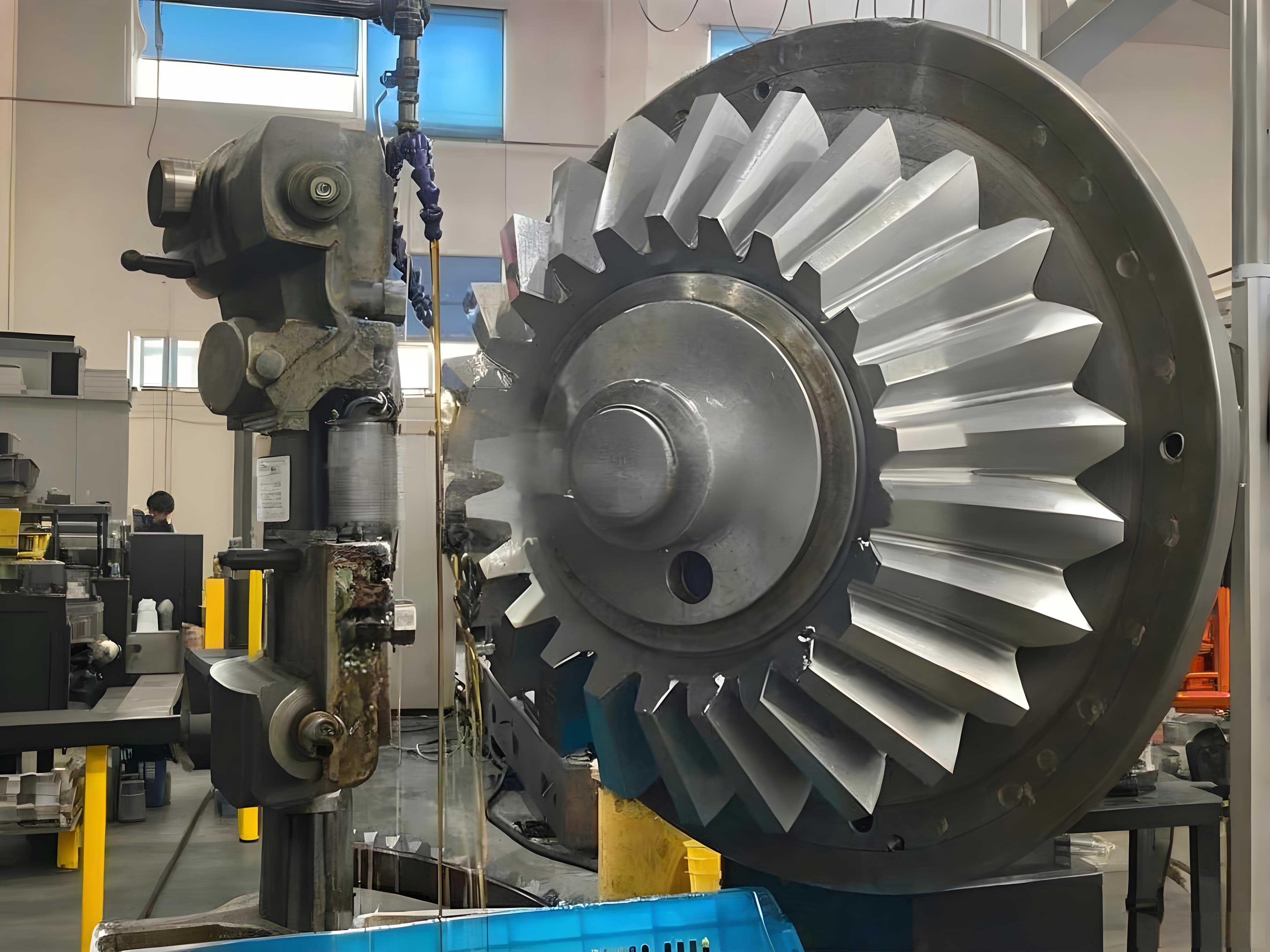
The core challenge with a large prime miter gear, such as one with 73 teeth, lies in the division of the workpiece. Simple indexing, which relies on the direct relationship between the dividing head’s worm gear ratio (typically 40:1) and the number of teeth, becomes impossible when the tooth count is a prime number that does not share a common factor with the available hole circles on the index plates. The solution, differential indexing, ingeniously overcomes this by linking the rotation of the index plate to the movement of the index crank via a train of gears. This allows for the precise subdivision of a circle into any number of parts, making the machining of a large prime miter gear feasible on standard equipment.
The journey to reproduce the large prime miter gear begins long before the first cut is taken. It starts with a meticulous reverse-engineering process of the failed component. Precise measurement of all critical dimensions is paramount to creating an accurate drawing and establishing the machining parameters. For a standard straight bevel miter gear, the key parameters are derived from the module, number of teeth, and shaft angle. The collected data for the gear in question is summarized in the table below:
| Parameter | Symbol | Value | Unit |
|---|---|---|---|
| Number of Teeth | \( z \) | 73 | – |
| Module (at large end) | \( m \) | 3 | mm |
| Shaft Angle | \( \Sigma \) | 90° | degree |
| Pitch Diameter | \( d \) | 218 | mm |
| Addendum | \( h_a \) | 3.0 | mm |
| Dedendum | \( h_f \) | 3.6 | mm |
| Whole Depth | \( h \) | 6.6 | mm |
| Face Width | \( b \) | 50 | mm |
| Pitch Cone Angle (for miter gear) | \( \delta \) | 45° | degree |
| Cone Distance | \( R \) | ~154.2 | mm |
With the gear parameters established, the next phase involves a thorough process analysis. The primary decision is the adoption of the differential indexing method. The fundamental principle is to trick the dividing head into performing a division it normally cannot. We select a number close to the actual tooth count of the large prime miter gear, a number that is factorable with the index plate’s hole circles. This selected number is called the assumed number of divisions, \( Z_0 \). The index crank is turned as if we were dividing into \( Z_0 \) parts. However, because \( Z_0 \) is not the real number \( Z \), an error is introduced. This error is automatically compensated for by mechanically rotating the index plate itself via a gear train connected between the dividing head’s spindle and its side shaft. The mathematical foundation for setting up the differential indexing is as follows:
First, choose an assumed number of divisions, \( Z_0 \), which is close to the actual number \( Z \) and can be factored for simple indexing. For a large prime miter gear with \( Z = 73 \), a suitable choice is \( Z_0 = 70 \).
The basic indexing handle movement is calculated for \( Z_0 \):
$$ n_0 = \frac{40}{Z_0} = \frac{40}{70} = \frac{28}{49} $$
This means for each division, the index handle must be rotated 28 holes on a 49-hole circle.
The gear train ratio \( i \) connecting the dividing head’s spindle to the index plate is critical and is calculated by:
$$ i = \frac{Z_1 \times Z_3}{Z_2 \times Z_4} = \frac{40 (Z_0 – Z)}{Z_0} $$
Substituting our values for the large prime miter gear:
$$ i = \frac{40 \times (70 – 73)}{70} = \frac{40 \times (-3)}{70} = -\frac{120}{70} = -\frac{12}{7} $$
This negative ratio indicates the index plate must rotate in the opposite direction to the handle. A simple gear train, like \( \frac{60}{35} \), can approximate this ratio \( (\frac{60}{35} = \frac{12}{7}) \). An idler gear must be added to achieve the required opposite rotation. The setup calculation can be proceduralized:
| Step | Calculation | Result / Action |
|---|---|---|
| 1. Select \( Z_0 \) | Choose a number near Z=73, factorable with index plate holes. | \( Z_0 = 70 \) |
| 2. Calculate handle turn \( n_0 \) | \( n_0 = 40 / Z_0 \) | \( 40/70 = 28/49 \) (28 holes on 49-hole circle) |
| 3. Calculate gear ratio \( i \) | \( i = 40(Z_0 – Z) / Z_0 \) | \( 40(70-73)/70 = -12/7 \) |
| 4. Select actual gears | Find gears to approximate |i|. Use compound gearing if needed. | Driver Gears (Z1, Z3): 60, 35 or 48, 28 Driven Gears (Z2, Z4): 35, 60 or 28, 48 |
| 5. Determine rotation | If (Z0 – Z) is negative, add one idler for opposite rotation. | Add one idler gear in the train. |
A significant constraint arises when using a universal dividing head on a horizontal mill for bevel gear cutting: the need to tilt the dividing head to the workpiece’s pitch cone angle interferes with the installation of the long differential gear train. This is where the strategic shift to a vertical milling machine becomes the enabling factor. On a vertical mill, the dividing head can be mounted with its axis horizontal but swiveled in the horizontal plane to align with the required cutting angle relative to the table feed direction. This orientation preserves full and unobstructed access to the side of the dividing head for mounting the sometimes-complex differential gear train. This setup is absolutely essential for successfully machining a large prime miter gear using this method.
The milling cutter selection is another crucial step. A straight bevel gear is milled with a form cutter, but its profile is based on the geometry at the small end of the tooth. Therefore, we must calculate the “virtual” or “formative” number of teeth \( Z_v \) that corresponds to a spur gear whose tooth profile matches the bevel gear’s profile on the back cone. For our large prime miter gear with a pitch cone angle \( \delta = 45° \), the calculation is:
$$ Z_v = \frac{Z}{\cos \delta} = \frac{73}{\cos 45^\circ} \approx \frac{73}{0.7071} \approx 103.2 $$
Based on \( Z_v \approx 103 \) and a module \( m=3 \) mm, a standard No. 7 or No. 8 involute gear cutter would be selected from the cutter chart. For bevel gears, a specific “bevel gear milling cutter” set is used, where the cutter number corresponds to a range of virtual tooth counts.
With all planning complete, we move to the execution phase. The detailed machining sequence for the large prime miter gear is outlined below:
| Step | Procedure & Setup | Key Formula / Check |
|---|---|---|
| 1. Workpiece & Machine Setup | Mount and indicate the gear blank. Swivel the dividing head so its axis is at the miter gear’s pitch cone angle (45°) relative to the table’s longitudinal travel. Mount the vertical milling attachment or use the vertical spindle directly. | Align axis to \( \delta = 45^\circ \). |
| 2. Configure Differential Indexing | Install the calculated gear train (e.g., 60/35 with idler). Set the index plate to the 49-hole circle and the sector arms to 28 holes. Ensure the index plate locking pin is disengaged. | Gear Train: \( Z_1/Z_2 = 60/35 \), with idler. Index Setting: \( n_0 = 28/49 \). |
| 3. Cutter Selection & Mounting | Select the appropriate bevel gear cutter based on \( Z_v \) and module. Mount it on a short arbor in the vertical spindle. | \( Z_v = Z / \cos \delta \). |
| 4. Workpiece Centering (Tooth Slot Symmetry) | Use a height gauge to scribe a line on the blank’s conical face slightly below the estimated center. Rotate the blank 180° and scribe a second line at the same height. Align the cutter’s centerline to the midpoint between these two lines. | Visual alignment to ensure symmetrical tooth flanks. |
| 5. Roughing – Milling All Central Slots | Position the cutter at the large end of the blank. Set the milling depth to the full tooth depth \( h = 2.2m = 6.6 \) mm. Using differential indexing, mill all 73 tooth slots to full depth. This creates a uniform, narrow slot from the large to the small end. | Milling Depth: \( h = 2.2 \times m = 6.6 \) mm. |
| 6. Finishing – Milling the First Flank | The central slot leaves excess material on both flanks, tapering from small to large end. To machine the first flank, the workpiece must be rotated and the cutter offset. First, raise the machine table by a calculated amount \( S \). Then, rotate the workpiece (via the index) so the cutter’s inside edge just touches the small end of the slot’s desired flank. Mill all teeth on this flank. | Table Rise \( S \): \( S = \frac{m \times b}{2R} \) For our miter gear: \( S \approx \frac{3 \times 50}{2 \times 154.2} \approx 0.49 \) mm. |
| 7. Finishing – Milling the Second Flank | Reverse the adjustments for the opposite flank. Lower the table by \( 2S \) from the original roughing center position. Rotate the workpiece in the opposite direction to bring the cutter to the other flank of the small end. Mill all teeth on this second flank. | Table Movement: Lower by \( 2S \approx 0.98 \) mm from central position. |
Following the machining of the large prime miter gear, rigorous inspection and verification are necessary to ensure it meets functional requirements. The key parameters to check include chordal tooth thickness at the large end, surface roughness, and crucially, the tooth bearing pattern which indicates correct tooth alignment (spiral error for straight teeth).
Chordal tooth thickness \( \bar{s} \) and chordal addendum \( \bar{h_a} \) for measurement with a gear tooth vernier caliper are calculated using the virtual number of teeth \( Z_v \):
Chordal Tooth Thickness:
$$ \bar{s} = m \cdot Z_v \cdot \sin\left(\frac{90^\circ}{Z_v}\right) $$
Substituting \( m=3 \) and \( Z_v \approx 103.2 \):
$$ \bar{s} \approx 3 \times 103.2 \times \sin(0.872^\circ) \approx 3 \times 103.2 \times 0.01522 \approx 4.71 \text{ mm} $$
Chordal Addendum:
$$ \bar{h_a} = m + \frac{m \cdot Z_v}{2} \left[ 1 – \cos\left(\frac{90^\circ}{Z_v}\right) \right] $$
$$ \bar{h_a} \approx 3 + \frac{3 \times 103.2}{2} \left[ 1 – \cos(0.872^\circ) \right] \approx 3 + 154.8 \times [1 – 0.99988] \approx 3.02 \text{ mm} $$
The most telling test for a miter gear, especially a large prime miter gear machined via this indexing method, is the tooth contact pattern check. This involves coating the teeth of the newly machined gear with a thin layer of marking compound (e.g., Prussian blue) and meshing it with its mating gear under slight load. The resulting imprint on the teeth shows the contact area. For a correctly machined straight bevel miter gear, the pattern should be centered on the tooth flank, running from the toe (small end) to the heel (large end) without breaking out at the edges. Any deviation indicates errors in alignment, depth, or indexing that may need correction via machine adjustment or selective lapping. The successful application of this differential indexing technique demonstrates that high-precision components like a large prime miter gear can be produced on conventional machine tools. It expands the capability of a standard vertical milling machine, offering a cost-effective and practical solution for maintenance, repair, and low-volume production. The method ensures the accurate division necessary for the large prime miter gear, achieves the required tooth form through careful setup and cutter path manipulation, and ultimately yields a functional component that restores equipment to service. This hands-on approach underscores the enduring relevance of fundamental machining principles and innovative problem-solving in modern manufacturing and repair environments.