
In my experience within the automotive transmission manufacturing sector, the demand for high-precision involute splines is paramount. These components are critical for power transfer, requiring excellent centering ability, smooth guidance, and high torque capacity. Among the various production methods, gear shaping stands out as a prevalent and efficient process for generating these splines. However, achieving and consistently maintaining the tight tolerances required by modern designs is a significant challenge. The gear shaping process is a complex system where minute deviations in equipment, tooling, or setup can translate directly into part errors. This analysis, drawn from practical engineering work, delves into the primary error sources affecting spline quality in gear shaping and presents a structured approach for diagnosis and improvement, employing formulas, quantitative models, and practical tables for clarity.
The Principle of Involute Spline Generation by Gear Shaping
The gear shaping process is fundamentally a continuous form of gear generation based on the principle of conjugate action. The cutting tool itself is a precision gear (the shaper cutter) with relieved cutting edges. During operation, the cutter and the workpiece are made to simulate a meshing pair of gears. The primary motions involved are:
- Reciprocating Cutting Stroke: The cutter moves vertically, with the cutting action occurring on the downstroke.
- Rotary Motion (Indexing): The cutter and workpiece rotate in synchronized, timed relation about their own axes. Their rotational speeds are inversely proportional to their number of teeth, maintaining a constant velocity ratio: $$ i = \frac{Z_w}{Z_c} $$ where \( Z_w \) is the workpiece (spline) tooth count and \( Z_c \) is the cutter tooth count.
- Radial Infeed: The cutter feeds radially into the workpiece to achieve the full spline depth.
- Circular Feed: This determines the rate of material removal per stroke, affecting surface finish and chip load.
- Clearance Stroke (Back-off): The cutter retracts slightly on the return stroke to avoid dragging on the finished surface.
The resulting spline tooth form is the envelope of successive positions of the cutter’s cutting edges relative to the workpiece. This generative nature means that errors in the cutter profile or in the kinematic chain of the machine are faithfully reproduced on the workpiece.
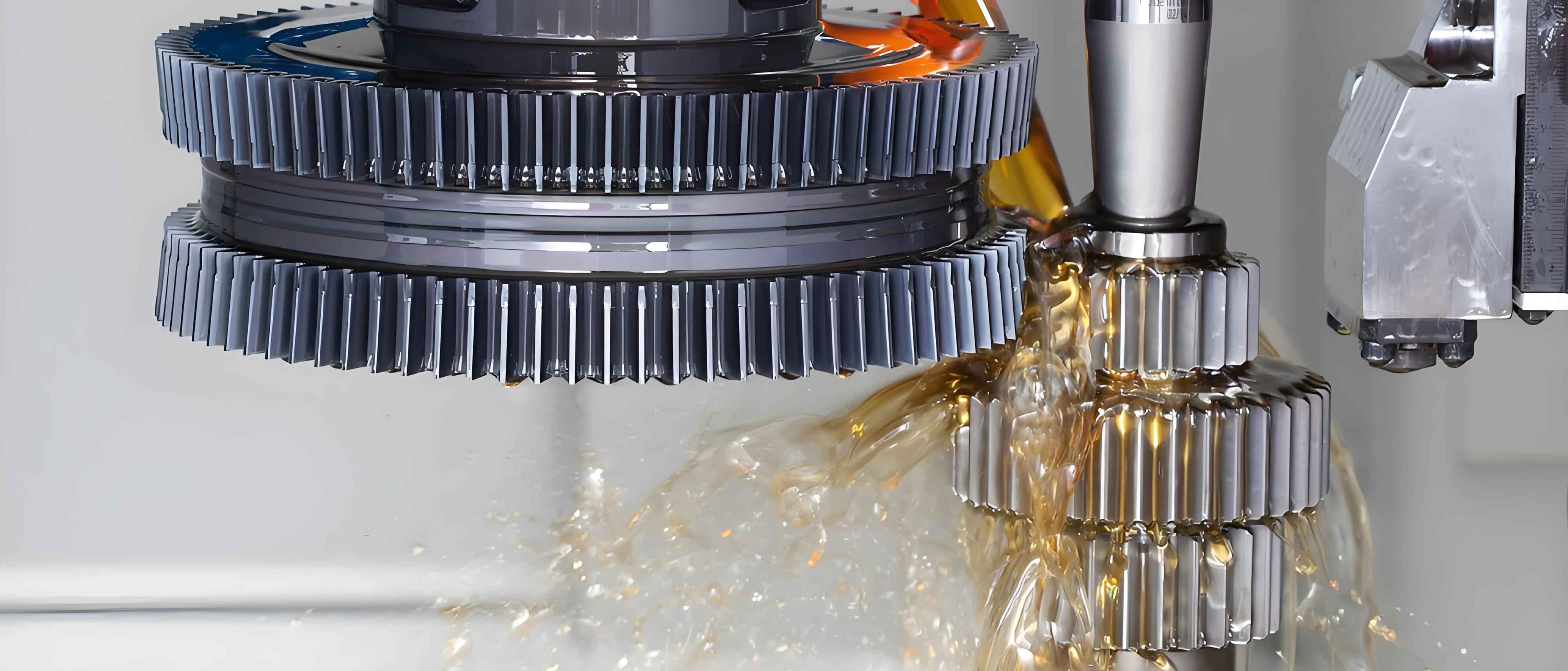
Comprehensive Analysis of Error Sources in Gear Shaping
The pursuit of precision in gear shaping necessitates a systematic deconstruction of the entire process system. In practice, I categorize the primary error sources into four interconnected domains: Machine Tool Errors, Cutter Errors, Workpiece/Tool Installation Errors, and Process Parameter Errors. Their combined effect determines the final spline quality.
1. Machine Tool Errors
The gear shaping machine’s integrity is the foundation of precision. Its errors are often systemic and directly influence the kinematic fidelity of the cutting process.
a) Transmission Chain Error: The mechanical train that ensures the precise velocity ratio between the cutter and workpiece spindle is a potential source of error. Imperfections in components like gears, leadscrews, and most critically, the master worm and worm wheel assembly, introduce cyclical variations. The cumulative pitch error ( \( \Delta F_p \) ) and the total cumulative pitch error ( \( \Delta F_r \) ) of the spline are highly sensitive to these transmission inaccuracies. Wear in these components over time exacerbates the problem, leading to degraded pitch accuracy.
b) Kinematic (or Motion) Eccentricity: This is a critical error often originating from the machine’s indexing system. It is an “apparent” eccentricity caused by an angular velocity fluctuation, typically due to an eccentric mounting or inherent error in the master worm wheel. If the worm wheel axis is offset from the workpiece table’s axis of rotation, it induces a periodic speed variation.
The kinematic eccentricity \( e_k \) can be understood as a base circle eccentricity. Its magnitude can be derived from the machine’s characteristics:
$$ e_k = \frac{\Delta R_y}{2} \cdot \frac{r_{b,w}}{r_{b,y}} $$
where \( \Delta R_y \) is the radial runout of the machine’s master worm wheel, \( r_{b,w} \) is the base circle radius of the workpiece, and \( r_{b,y} \) is the base circle radius of the worm wheel.
This eccentricity primarily causes a tangential error in tooth spacing. Its effect on the meshing line length for left (L) and right (R) flanks of the generated spline tooth is:
$$ \Delta F_{L,k} = e_k \sin(\theta_w + \phi_k) $$
$$ \Delta F_{R,k} = -e_k \sin(\theta_w + \phi_k) $$
where \( \theta_w \) is the angular position of the workpiece and \( \phi_k \) is the phase angle of the kinematic eccentricity. A key diagnostic signature of kinematic eccentricity is its effect on the span measurement (over pins or balls, analogous to gear measurement). The variation in span measurement \( \Delta E \) and its total variation \( \Delta E_W \) are:
$$ \Delta E = \Delta F_{L,k} + \Delta F_{R,k} = -2e_k \sin \alpha \cos(\theta_w + \phi_k) $$
$$ \Delta E_W = \Delta E_{max} – \Delta E_{min} = 4e_k \sin \alpha $$
where \( \alpha \) is the pressure angle. This relationship allows for the indirect quantification of \( e_k \) through careful metrology.
c) Structural Rigidity and Wear: Worn guideways, excessive backlash in drives, and lack of spindle stiffness cause dynamic errors during cutting. This can manifest as poor surface finish, increased profile error, and lead (helix) error. The selection of inappropriate cutting speeds can also promote built-up edge formation, directly increasing surface roughness ( \( R_z \) ).
2. Cutter (Tool) Errors
The shaper cutter is a active participant in the conjugate generation; its imperfections are directly imprinted on the workpiece.
a) Profile Error and Angle Correction: This is the most significant cutter-related error source. A shaper cutter has rake and relief angles to facilitate cutting. Consequently, the projection of its cutting edge onto the normal plane is not a true involute. To compensate, the cutter’s nominal pressure angle must be corrected. The classic formula for this correction at the reference pitch circle is:
$$ \tan \alpha_0 = \frac{\tan \alpha}{1 – \tan \gamma_a \tan \gamma_r} $$
where \( \alpha_0 \) is the nominal pressure angle of the spline, \( \alpha \) is the actual pressure angle ground on the cutter’s reference section, \( \gamma_a \) is the cutter’s top rake angle, and \( \gamma_r \) is the cutter’s top relief angle. For high-precision gear shaping, especially for splines with large pressure angles (30°, 37.5°, 45°), this basic correction may be insufficient, requiring a more sophisticated multi-point profile modification on the cutter to minimize profile deviation ( \( \Delta f_f \) ) across the entire active flank.
b) Manufacturing and Mounting Errors: The cutter’s cumulative pitch error ( \( \Delta F_p,_{cutter} \) ) is transferred almost 1:1 to the workpiece. Radial runout of the cutter on its arbor causes a periodic variation in cutting depth, affecting individual pitch and profile.
c) Wear and Material: Progressive flank and edge wear degrades the cutter’s profile, increasing the workpiece’s profile error and surface roughness. The choice of cutter material (e.g., high-speed steel grades with optimized Co, Mo, V content) and its heat treatment (achieving fine, uniform carbides) are crucial for wear resistance and consistent performance throughout the tool life during the gear shaping process.
3. Installation and Setup Errors
Precision machining can be negated by poor setup. These errors are often preventable with disciplined procedures.
a) Geometric Eccentricity: This is a pure radial offset between the axis of rotation defined by the machine spindle/workholding and the actual axis of the workpiece bore (or cutter). It results from part runout, inaccurate arbors, or dirt/chips on locating surfaces. For the workpiece, geometric eccentricity \( e_g,w \) causes a radially oriented error. Its effect on the meshing line is phase-dependent:
$$ \Delta f_{L,g} = e_{g,w} \sin(\theta_w + \alpha) $$
$$ \Delta f_{R,g} = -e_{g,w} \sin(\theta_w – \alpha) $$
A similar eccentricity \( e_{g,c} \) can exist for the cutter mounting. Geometric eccentricity directly influences radial runout ( \( \Delta F_r \) ) of the spline.
b) Error Compensation: An insightful aspect of error analysis is that kinematic and geometric eccentricities can interact. If deliberately controlled, a specific geometric eccentricity can partially compensate for the machine’s kinematic error. The condition for significant compensation is approximately when \( e_g \approx e_k \cos \alpha \), which can neutralize a substantial portion of the tangential error.
c) Axial Misalignment and Clamping: Face runout of the workpiece against its backstop, or angular misalignment, directly creates a lead (helix) error \( \Delta F_\beta \). The relationship is:
$$ \Delta F_\beta = f_t \cdot \frac{B}{D} $$
where \( f_t \) is the face runout at clamping diameter \( D \), and \( B \) is the spline face width. Non-uniform or excessive clamping force can elastically distort thin-walled components, inducing lead and profile errors that may only become apparent after unclamping.
4. Process and Ancillary System Errors
Parameters beyond the core mechanics play a vital role. Incorrect cutting data (speed, feed rate, depth of cut) can cause chatter, poor finish, or thermal deformation. The effectiveness of the cutting fluid and chip flushing system is critical. Inadequate cooling leads to thermal growth of the workpiece and cutter, impacting size and form. Poor chip evacuation results in recutting of chips, which scores flank surfaces and accelerates tool wear in the gear shaping operation.
| Error Category | Specific Source | Primary Effect on Spline | Key Influenced Parameter (e.g., per ISO 4156) |
|---|---|---|---|
| Machine Tool | Transmission Chain Error | Uneven spacing, cumulative error | Pitch Error ( \( \Delta f_{pt} \) ), Total Cumulative Pitch Error ( \( \Delta F_p \) ) |
| Kinematic Eccentricity ( \( e_k \) ) | Tangential spacing variation, span measurement fluctuation | Total Cumulative Pitch Error ( \( \Delta F_p \) ), Tooth-to-tooth Error | |
| Wear/Lack of Rigidity | Poor surface finish, form instability | Profile Form Error ( \( \Delta f_{f\alpha} \) ), Lead Error ( \( \Delta F_\beta \) ), Surface Roughness ( \( R_z \) ) | |
| Cutter | Uncorrected Profile / Wear | Inaccurate involute form | Profile Form Error ( \( \Delta f_{f\alpha} \) ), Profile Slope Error ( \( \Delta f_{H\alpha} \) ) |
| Cutter Pitch/Runout Error | Spacing errors | Pitch Error ( \( \Delta f_{pt} \) ) | |
| Material/Treatment | Rapid wear, inconsistent finish | Surface Roughness ( \( R_z \) ), Deterioration of all parameters over batch | |
| Installation | Geometric Eccentricity ( \( e_g \) ) | Radial runout, cyclical size variation | Runout ( \( \Delta F_r \) ) |
| Axial Misalignment / Clamping Distortion | Helical tooth alignment | Lead Error ( \( \Delta F_\beta \) ) | |
| Process | Cutting Data / Cooling / Chip Evacuation | Thermal distortion, surface damage, tool life | Size Variation, Surface Roughness ( \( R_z \) ), Secondary effects on form |
Systematic Measures for Error Reduction in Gear Shaping
Based on the error analysis, a targeted improvement plan can be implemented. The following table consolidates actionable measures corresponding to the identified error sources.
| Error Category | Improvement Measure | Technical Rationale & Target |
|---|---|---|
| Machine Tool | 1. Regular maintenance of master worm wheel assembly; adjust axial play and backlash. 2. Laser calibration of indexing accuracy. 3. Monitor and maintain guideway condition and spindle stiffness. |
Minimize kinematic eccentricity \( e_k \) and transmission error. Target worm gear backlash < 0.04 mm, spindle runout < 0.005 mm. |
| Cutter | 1. Procure cutters with advanced profile correction from reputable suppliers. 2. Implement strict incoming inspection for cutter profile and runout. 3. Establish scientific tool life management based on flank wear (VB). 4. Ensure cutter arbor quality: face parallelism < 0.005 mm, fit clearance ~0.01 mm. |
Ensure correct generative geometry. Target cutter mounting runout < 0.008 mm. Prevent machining with worn tools. |
| Installation | 1. Meticulous cleaning of all locating surfaces (workpiece bore/faces, fixture, arbor). 2. Use precision arbors with minimal clearance fit (H6/h5 or similar). 3. Implement low-stress, uniform clamping (e.g., hydraulic diaphragms). 4. Compensate errors: if measurable \( e_k \) exists, adjust part mounting to induce a compensating \( e_g \). |
Eliminate geometric eccentricity and distortion. Target workpiece face runout < 0.015 mm. Exploit \( e_g \approx e_k \cos \alpha \) for compensation. |
| Process | 1. Optimize cutting parameters (v, f, ap) through DOE for each material. 2. Use high-performance, filtered cutting fluid with proper pressure/flow for cooling and chip removal. 3. Implement in-process monitoring (e.g., acoustic emission, power consumption) for anomaly detection. |
Stabilize thermal conditions, ensure clean cutting, prevent built-up edge. Maximize process capability (Cpk). |
Practical Validation: A Case Study in Process Optimization
The efficacy of this structured approach was validated through a specific production challenge. A transmission output shaft required a fine-pitch involute spline with demanding specifications: Module m = 0.8, Pressure Angle α = 30°, Cumulative Pitch Error \( \Delta F_p \) < 0.03 mm, Lead Error \( \Delta F_\beta \) < 0.009 mm.
Initial Condition & Problem: Using a standard setup on a CNC gear shaping machine, the initial parts consistently failed inspection. Analysis showed \( \Delta F_p \) = 0.0443 mm and \( \Delta F_\beta \) = 0.0203 mm, exceeding tolerances. The primary suspects were compounded installation errors and sub-optimal cutting dynamics.
Implemented Improvements: Guided by the error source framework, the following changes were made, focusing on installation and process parameters:
- Cutter & Workpiece Setup: Cutter radial runout was meticulously reduced from 0.015 mm to 0.008 mm. Workpiece radial runout was tightened from 0.015 mm to 0.005 mm through improved cleaning and arbor maintenance.
- Clamping: The tailstock (live center) pressure was reduced from 2.0 bar to 1.5 bar to minimize shaft bending.
- Cutting Parameters: The cutting stroke rate was increased from 400 SPM to 600 SPM, and the circular feed was adjusted from 0.4 mm/stroke to 0.6 mm/stroke. This combination promoted a cleaner, more stable cut with different chip formation characteristics.
- Process Orientation: The machining direction was set to conventional (climb) milling mode relative to the cutter rotation to improve surface finish.
Result: After implementing these targeted measures, the subsequent parts were measured. The results showed a dramatic improvement: \( \Delta F_p \) = 0.0136 mm and \( \Delta F_\beta \) = 0.0076 mm. Both key parameters were now well within the specified tolerance limits, demonstrating the power of a systematic, diagnostics-based approach to troubleshooting the gear shaping process.
Conclusion
Producing high-precision involute splines via gear shaping is a complex interplay of machine, tool, fixture, and process. Errors are not random but stem from identifiable physical causes within this system. By decomposing the problem into fundamental error sources—kinematic and geometric eccentricities, tool profile integrity, installation fidelity, and process stability—one can move from trial-and-error correction to predictive control. Quantitative models, such as those relating eccentricities to measurement variations, provide a powerful diagnostic lens. The implementation of disciplined measures, from precision tooling and clean setup to optimized cutting data, transforms theoretical analysis into tangible quality gains. As evidenced in practice, this structured methodology is essential for achieving and sustaining the levels of precision required in advanced automotive and mechanical power transmission components manufactured through the gear shaping process.