
Spiral bevel gears are a cornerstone of modern power transmission systems, renowned for their smooth, quiet operation and high load-carrying capacity in intersecting shaft applications. Their curved teeth allow for gradual engagement, making them superior to straight bevel gears in high-speed and high-torque environments such as automotive differentials, aerospace transmissions, and heavy industrial machinery. However, achieving perfect meshing quality in these gears is a complex engineering challenge, often compromised by a persistent and detrimental phenomenon known as diagonal contact.
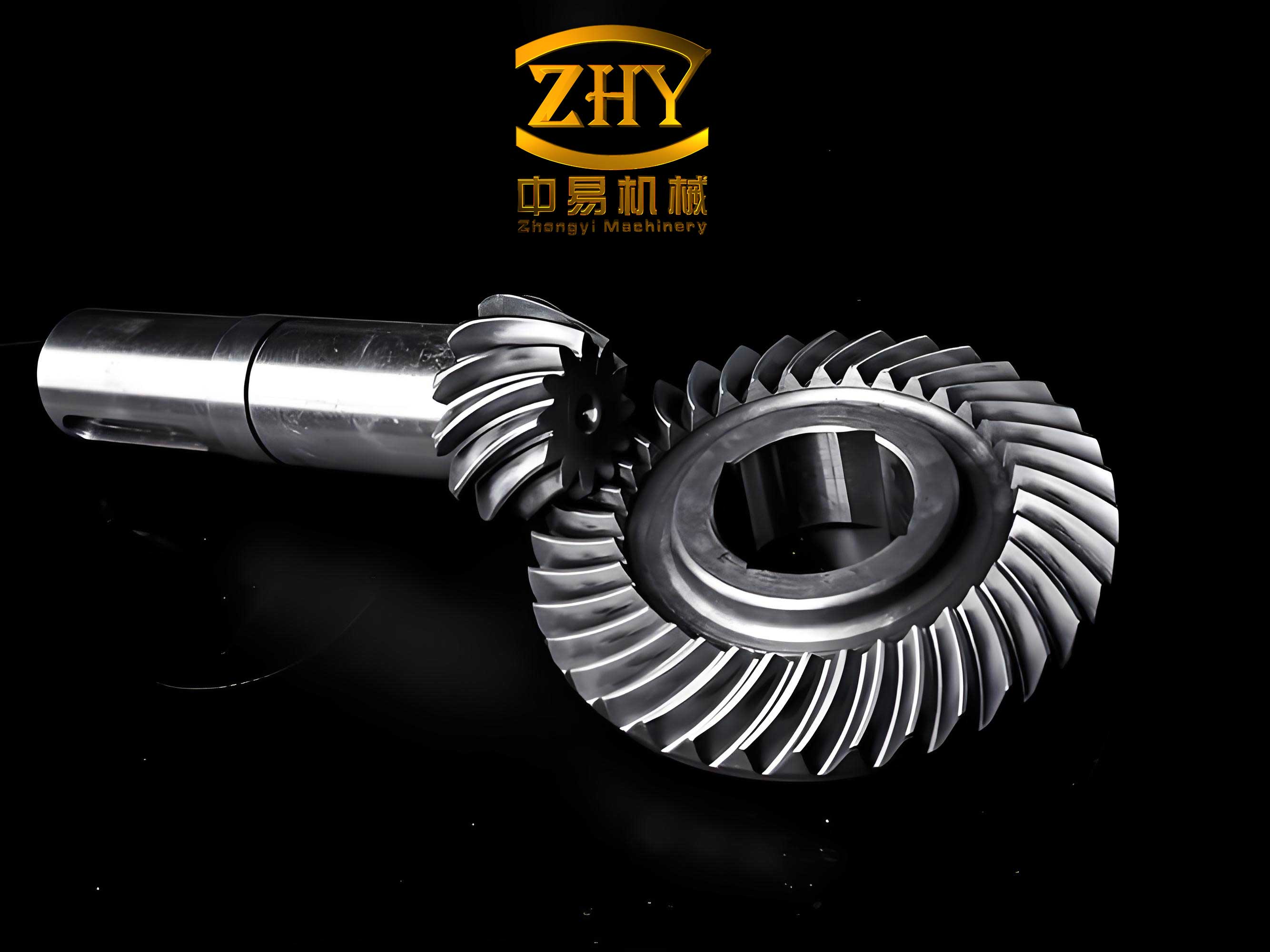
In conventional manufacturing, the gear (larger member) and pinion (smaller member) of a spiral bevel gear set are typically cut using face-milling cutters with the same nominal cutter number. This practice, coupled with the standard setup where the cutter axis is set perpendicular to the root cone of the workpiece, inadvertently leads to a fundamental mismatch: the pressure angles on the pitch cone of the mating tooth flanks are not equal. This inconsistency is the root cause of diagonal contact, where the contact pattern runs from the toe to the heel of the tooth, often leading to edge-loading at the corners. This severely reduces gear strength, increases noise and vibration, and accelerates wear, ultimately compromising the reliability and lifespan of the transmission system.
This article explores an innovative approach to spiral bevel gear design and manufacturing that fundamentally eliminates this problem: the constant-depth tooth design. By rethinking the tooth geometry and the corresponding machining methodology, we can ensure consistent pressure angles on the pitch cone, leading to a centered, well-formed contact pattern and significantly improved gear performance and manufacturing efficiency.
The Genesis of Diagonal Contact: Cutter Number and Tooth Geometry
To understand the solution, one must first grasp the problem’s origin in the traditional “spiroid” or Gleason system for generating spiral bevel gears. The process is based on the “tilted root cone” or “plane generating gear” principle. Here, the gear blank is installed on the machine at its root cone angle. The cutter head, representing the teeth of a generating gear, rotates on the cradle. To machine the tapered (lengthwise crowning) tooth profile of a standard spiral bevel gear, the cutter axis is deliberately set perpendicular to the root cone line of the workpiece.
If the inside and outside blades of the cutter head had identical pressure angles, they would generate equal pressure angles on the root cone. However, the desired operational pressure angle is defined on the pitch cone. Since the root cone and pitch cone are not parallel (they differ by the root angle, $\gamma”$), a correction is necessary. This correction is applied by tilting the cutter blade pressure angles. The outside blade pressure angle is decreased, and the inside blade pressure angle is increased by an amount $\Delta\alpha$ to achieve the target pressure angle on the pitch cone.
The required pressure angle correction is a function of the root angle and the mean spiral angle $\beta_m$:
$$ \Delta\alpha = \gamma” \sin \beta_m $$
This relationship reveals the crux of the issue. Since the gear and pinion have different root angles ($\gamma”_g$ and $\gamma”_p$), they theoretically require different pressure angle corrections, and hence, different cutter heads. The industry standardizes this into a “cutter number” (N0), where:
$$ N_0 = \frac{60 \cdot \Delta\alpha}{10} = 6 \gamma” \sin \beta_m $$
Therefore, the theoretical cutter numbers for the pinion (N0p) and gear (N0g) are:
$$ N_{0p} = 6 \gamma”_p \sin \beta_m $$
$$ N_{0g} = 6 \gamma”_g \sin \beta_m $$
In an ideal world, one would use a specific cutter for the pinion and another for the gear. However, practical manufacturing constraints limit the available standard cutter numbers to a discrete set (e.g., 3.5, 4.5, 5.5, 6, 7.5, 9, 12). To simplify tooling inventory and logistics, manufacturers almost always select a single, commercially available cutter number for machining both members of a spiral bevel gear pair. This compromise means the actual pressure angle correction applied does not perfectly match the theoretical requirement for either the gear or the pinion.
The consequence is a mismatch between the generated pressure angles on the pitch cones of the mating flanks. During operation, the tooth surfaces seek conformity, resulting in a contact ellipse that is not aligned with the tooth’s longitudinal direction but runs diagonally across it. This is the notorious diagonal contact. The table below summarizes the chain of cause and effect.
| Manufacturing Step | Standard Practice | Consequence | Result |
|---|---|---|---|
| Cutter Selection | Single, standard cutter number for both gear and pinion. | Pressure angle correction ($\Delta\alpha$) is a compromise, not ideal for either member. | Mismatched pitch cone pressure angles. |
| Machine Setup | Cutter axis set perpendicular to the root cone. | Generates tapered (coniflex) tooth form with varying depth along the face width. | Inherent geometry that necessitates different cutter numbers for perfect conjugation. |
| Meshing Outcome | Gear and pinion are assembled. | Tooth surfaces have localized contact to compensate for geometric mismatch. | Diagonal Contact Pattern, leading to stress concentration and reduced durability. |
The Constant-Depth Solution: A Paradigm Shift in Tooth Design
The constant-depth tooth design for spiral bevel gears offers an elegant solution to this longstanding problem. The core idea is to modify the basic tooth geometry so that the root cone and face cone become parallel to the pitch cone. In other words, the root angle and face angle are made equal to the pitch angle. This results in a tooth whose depth is constant along the entire face width, hence the name “constant-depth” tooth.
Geometrically, this is equivalent to “untilting” the traditional tapered tooth. At the design point (usually the midpoint of the face width), the tooth profile remains identical to a standard spiral bevel gear. However, moving towards the toe and heel, the tooth depth does not decrease as it does in a standard tapered design. This has important implications:
- Pressure Angle Consistency: With the root and pitch cones parallel, the condition that necessitates different pressure angle corrections ($\Delta\alpha$) for gear and pinion vanishes. If the cutter axis is set perpendicular to the pitch cone (not the root cone), and the cutter blades have the standard, equal pressure angles, they will generate the exact same pressure angle on the pitch cone for both flanks. This is the key to eliminating the root cause of diagonal contact.
- Cutter Number Simplification: Since no special pressure angle correction is needed to account for a tilted root cone, the theoretical required cutter number becomes zero. Therefore, a standard “0-number” cutter head can be used to machine both the gear and the pinion with perfect geometric fidelity.
- Modified Tooth Proportions: A direct shift to constant-depth teeth can increase the risk of tooth pointing (excessive thinning at the tip) at the toe and heel ends, and undercutting at the root. To mitigate this, two complementary strategies are employed:
- Reduced Addendum Coefficient: Adopting a “stub” tooth design by reducing the addendum coefficient increases the tooth root thickness and reduces tip thickness variation across the face width.
- Smaller Cutter Diameter: Using a theoretically smaller diameter cutter head than that used for a comparable tapered gear increases the lengthwise curvature (crowning), which helps control the contact pattern length and further alleviates edge-thinning issues.
The fundamental geometric relationship for a constant-depth spiral bevel gear can be summarized. For both gear and pinion:
$$ \text{Pitch Angle} (\delta) = \text{Face Angle} (\delta_a) = \text{Root Angle} (\delta_f) $$
This equality simplifies the kinematic relationship between the tool and workpiece during generation.
To illustrate, let’s consider the design parameters for a sample spiral bevel gear pair. The following table compares the key blank dimensions of a traditional design with its constant-depth counterpart.
| Parameter | Traditional Tapered Tooth (Example) | Constant-Depth Tooth Design | Notes |
|---|---|---|---|
| Number of Teeth (Pinion/Gear) | 16 / 53 | 16 / 53 | Unchanged. |
| Module (mm) | 12.5 | 12.5 | Unchanged. |
| Pressure Angle (°) | 20 | 20 | Unchanged. |
| Mean Spiral Angle (°) | 26.46 | 26.46 | Unchanged. |
| Pitch Angle, Pinion (°) | 16.798 | 16.798 | Defined by ratio and shaft angle. |
| Face Angle, Pinion (°) | > 16.798 | 16.798 | Made equal to pitch angle. |
| Root Angle, Pinion (°) | < 16.798 | 16.798 | Made equal to pitch angle. |
| Pitch Angle, Gear (°) | 73.202 | 73.202 | Defined by ratio and shaft angle. |
| Face Angle, Gear (°) | < 73.202 | 73.202 | Made equal to pitch angle. |
| Root Angle, Gear (°) | > 73.202 | 73.202 | Made equal to pitch angle. |
| Addendum Coefficient | ~1.0 | 0.8 | Reduced to prevent toe/heel pointing. |
| Theoretical Cutter Number | N0p ≠ N0g ≠ 0 | N0p = N0g = 0 | Major simplification in tooling. |
Advanced Parameter Design: Local Synthesis and TCA
Designing the machining parameters for a constant-depth spiral bevel gear still requires sophisticated methods to ensure optimal meshing characteristics, such as a well-centered contact pattern and controlled transmission errors. The process relies heavily on two advanced computational techniques: Local Synthesis and Tooth Contact Analysis (TCA).
1. Local Synthesis:
Local synthesis is a mathematical method used to design the machine-tool settings so that the mating tooth surfaces achieve predetermined conditions of contact at a chosen reference point (usually the mean point). It allows control over the second-order properties of the gear mesh:
– The orientation and dimensions of the instantaneous contact ellipse.
– The parabolic function of the transmission error, which is critical for noise and vibration control.
The method involves solving a system of equations derived from the conditions of tangency and curvature between the generating surface (cutter) and the generated gear surface, and subsequently between the two gear surfaces. For a spiral bevel gear, the core equations relate the principal curvatures and directions of the surfaces. The goal for our constant-depth design is to synthesize settings that produce a centered, longitudinally oriented contact patch with a mild, parabolic transmission error curve.
2. Tooth Contact Analysis (TCA):
TCA is a simulation technique used to verify the meshing performance of a gear pair under load-free conditions. It solves the system of equations representing the continuous tangency of the two rotating tooth surfaces. The output of TCA includes:
– The path of contact on both tooth flanks.
– The bearing pattern (contact ellipse) under a specified misalignment.
– The function of transmission error ($\Delta \phi_2(\phi_1)$), defined as:
$$ \Delta \phi_2(\phi_1) = \phi_2(\phi_1) – \frac{N_1}{N_2} \phi_1 $$
where $N_1$ and $N_2$ are the tooth numbers of the driving and driven gears, and $\phi_1$, $\phi_2$ are their rotation angles.
TCA acts as the final validation step before physical manufacturing. It confirms whether the parameters derived from local synthesis successfully avoid diagonal contact and produce the desired contact and error characteristics for the spiral bevel gear set.
The following table presents a sample set of machine settings and cutter parameters for a constant-depth spiral bevel gear pair, designed using these advanced methods. Note the universal use of the “0” cutter number.
| Parameter | Gear (Finish) | Pinion (Convex Flank Finish) | Pinion (Concave Flank Finish) |
|---|---|---|---|
| Cutter Diameter (mm) | 457.2 | 453.85 | 458.61 |
| Cutter Blade Pressure Angle | Std. 20° (0-Number) | Std. 20° (0-Number) | Std. 20° (0-Number) |
| Machine Root Angle / Tilt Setting (°) | 73.202 (Pitch Angle) | 16.798 (Pitch Angle) | 16.798 (Pitch Angle) |
| Radial Distance (mm) | 260.332 | 247.637 | 279.522 |
| Angular Position (°) | -51.827 | 53.336 | 51.467 |
| Generating Ratio (Roll) | 1.044574 | 3.315847 | 3.695335 |
The results of the TCA for this parameter set would show a transmission error curve that is low-amplitude and parabolic, and a contact path that is essentially longitudinal and centered on the tooth flank, with no diagonal tendency.
Manufacturing Advantages and Practical Considerations
The shift to constant-depth spiral bevel gears brings several tangible benefits to the manufacturing floor, beyond the fundamental improvement in meshing quality.
1. Tooling Simplification and Cost Reduction:
The most immediate advantage is the elimination of the need for multiple, specialized cutter numbers. A single 0-number cutter head can be used for a wide range of spiral bevel gear pairs, significantly reducing tooling inventory costs and setup complexity. This is a major logistical and economic benefit.
2. Potential for Increased Machining Efficiency:
The theoretical cutter diameter for a constant-depth spiral bevel gear is smaller than that for a traditional tapered gear of the same size. For instance, an 18-inch (457.2 mm) cutter might be used where a 20-inch cutter was previously required. A smaller cutter head has a lower moment of inertia and can be driven at higher speeds with less vibration. This potentially allows for increased cutting speeds and feed rates, reducing cycle time and improving productivity. The relationship for approximate theoretical cutter radius $R_{c0}$ is tied to the gear geometry:
$$ R_{c0} \approx \frac{R_{m}}{\sin \beta_m} $$
Where $R_m$ is the mean cone distance. For constant-depth teeth, the lack of tilt can allow for a slightly smaller $R_{c0}$ for equivalent performance.
3. Process Stability and Accuracy:
Setting the machine tilt angle to the pitch angle (a clearly defined geometric parameter) rather than the root angle can simplify setup and reduce one potential source of error. The more stable machining conditions with a smaller cutter also contribute to improved surface finish and dimensional accuracy of the spiral bevel gear teeth.
4. Contact Pattern Adjustability:
During the trial cutting phase, achieving the desired contact pattern is often more straightforward. Because the fundamental pressure angle mismatch is eliminated, the contact pattern is less prone to inherent diagonal drift. Adjustments made via machine settings (e.g., minor changes to axial position or roll) act more directly on the contact location and shape without fighting an underlying geometric discrepancy.
A practical consideration is the selection of the actual cutter diameter. While the theory may call for a specific size, available tooling may differ. It’s crucial to understand that the cutter diameter significantly influences the lengthwise tooth taper (crowning). Using a cutter larger than the theoretical optimum can lead to excessive tooth taper, thinning the tooth ends. Conversely, a smaller cutter reduces taper. Therefore, for constant-depth spiral bevel gears, it is advisable to use a cutter as close as possible to the theoretical diameter to maintain balanced tooth strength across the face width. The condition to check for toe pointing (thin tip at the heel) can be expressed as a function of gear geometry and cutter radius.
Beyond the Basics: Material, Heat Treatment, and Future Directions
The successful implementation of constant-depth spiral bevel gears involves considerations beyond geometry and machining.
Material Science and Heat Treatment:
High-performance spiral bevel gears are typically made from alloy steels such as AISI 8620, 9310, or 4340. The choice depends on required core strength, case hardenability, and distortion characteristics during heat treatment. The constant-depth design, with its modified stress distribution, may interact differently with residual stresses from carburizing and quenching. Finite Element Analysis (FEA) should be used alongside TCA to model loaded tooth contact and bending stresses, ensuring the new tooth form meets or exceeds the strength and durability of traditional designs.
| Material | Typical Application | Key Properties |
|---|---|---|
| AISI 8620 | Automotive differentials, moderate loads. | Good case hardenability, good core toughness, minimal distortion. |
| AISI 9310 | Aerospace transmissions, high-load applications. | High core strength, excellent fatigue resistance. |
| AISI 4340 | Heavy industrial gears, very high torque. | High strength and toughness, often through-hardened or nitrided. |
Future Research and Development:
The adoption of constant-depth tooth geometry opens several avenues for further research:
1. Dynamic Performance: Comprehensive testing to compare the noise, vibration, and harshness (NVH) characteristics of constant-depth versus traditional spiral bevel gears under real operating conditions.
2. Advanced Manufacturing: Exploring the direct integration of this design philosophy with modern manufacturing technologies like 5-axis CNC grinding or additive manufacturing for prototype or specialized spiral bevel gears.
3. Optimization Algorithms: Developing multi-objective optimization routines that simultaneously optimize local synthesis parameters for mesh quality, FEA-based strength, and manufacturing efficiency specific to the constant-depth spiral bevel gear form.
4. Standardization: Work towards establishing formal design and rating standards for constant-depth spiral bevel gears to encourage wider industry adoption.
Conclusion
The diagonal contact problem in traditional spiral bevel gears is a direct consequence of the compromise forced by standard cutter numbers and the tilted root cone machining setup. The constant-depth tooth design presents a fundamental and effective solution by aligning the root and face cones with the pitch cone. This geometric shift ensures consistent pitch cone pressure angles, allowing for the use of a universal 0-number cutter and eliminating the root cause of diagonal contact at its source.
Supported by advanced design tools like Local Synthesis and Tooth Contact Analysis, this approach not only guarantees superior meshing quality with centered, stable contact patterns but also offers significant manufacturing advantages. These include tooling simplification, the potential for increased machining efficiency through the use of smaller, more stable cutters, and more predictable contact pattern adjustment during setup. While careful attention must be paid to tooth proportions and cutter selection to avoid pointing, the benefits for the performance, reliability, and manufacturability of spiral bevel gears are substantial. As research continues into its dynamic performance and integration with modern materials and processes, the constant-depth design stands as a compelling evolution in the art and science of spiral bevel gear engineering.