
In the realm of power transmission systems, the performance and longevity of gear drives are paramount. Among the various gear types, spiral bevel gears hold a critical position, particularly in applications requiring the efficient transfer of motion and power between intersecting, typically perpendicular, shafts. Their curved teeth allow for gradual engagement, resulting in smoother operation, higher load capacity, and reduced noise compared to their straight-bevel counterparts. However, this geometric complexity introduces significant challenges in manufacturing and quality assurance. The heart of a well-functioning spiral bevel gear pair lies in the quality and consistency of the tooth contact pattern under loaded conditions. An imprecise contact pattern can lead to premature wear, elevated noise, reduced efficiency, and catastrophic failure. Therefore, developing and implementing robust inspection techniques is not merely a quality control step but a fundamental pillar for achieving reliable performance. Throughout my experience in gear manufacturing and validation, one methodology has proven indispensable for preemptively diagnosing and correcting potential contact issues: the V/H Inspection Method.
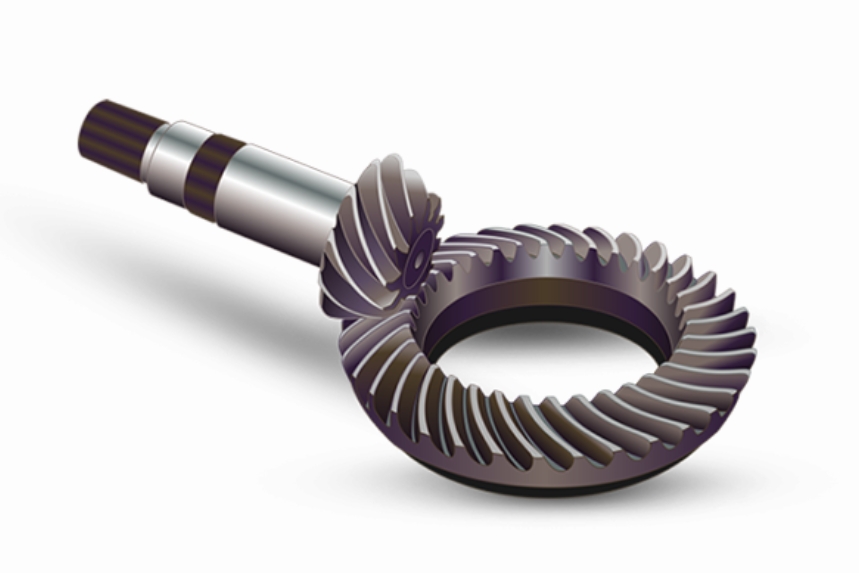
The V/H method is a dynamic rolling test procedure designed to evaluate the contact characteristics of a spiral bevel gear pair before they are put into service. It transcends simple static checks by simulating meshing conditions on a dedicated rolling tester or checking machine. The core principle involves mounting the gear pair on the tester and then deliberately shifting the contact pattern from its nominal working position across the tooth face. This is achieved by precisely moving the gear axes in controlled Vertical (V) and Horizontal (H) directions. By observing how the contact patch (often marked with a thin layer of machinist’s blue or a specialized compound) moves and changes shape in response to these controlled misalignments, we can infer critical information about the gear’s geometry, the quality of the cutting process, and its sensitivity to assembly variations. The insights gained are directly applicable to refining cutting machine settings, ensuring batch-to-batch consistency, and ultimately, predicting performance under real-world loads.
The V/H Inspection Method: Principles and Procedures
The methodology, while conceptually straightforward, requires a systematic approach and a deep understanding of gear geometry. The process begins after the gear teeth have been cut (green state) and before any heat treatment is applied. The gear pair is assembled on the rolling checker with a specified mounting distance and pinion offset, replicating their intended assembly position. A light pre-load is applied to stabilize the setup. The initial contact pattern is recorded—this is the “at position” or nominal contact.
The essence of the V/H inspection lies in the subsequent deliberate displacements. The primary movement is a Vertical (V) displacement of the gear (typically the larger member, or the gear, in a pinion-gear set). This displacement moves the contact zone along the tooth’s profile, from the nominal position towards either the toe (inner end) or the heel (outer end) of the tooth. A key rule must be followed: after this vertical shift, the contact patch will likely be positioned too high or too low on the tooth flank. To recenter it in the middle of the tooth height, a compensatory Horizontal (H) displacement of the pinion must be made. The direction of this horizontal correction is not arbitrary; it is determined by the hand of the spiral bevel gear (left-hand or right-hand spiral) and the direction of the initial vertical move.
The sign convention for these movements is standardized for clear communication. The following table defines the positive and negative directions for V and H adjustments on a standard rolling checker setup.
| Displacement Axis | Positive (+) Direction | Negative (-) Direction |
|---|---|---|
| Vertical (V) – Gear | Gear moves upward, away from the pinion centerline. | Gear moves downward, toward the pinion centerline. |
| Horizontal (H) – Pinion | Pinion mounting distance increases (moves away from gear). | Pinion mounting distance decreases (moves toward gear). |
The required direction for the compensatory H move after a V shift is governed by the spiral hand. The logic can be summarized as follows:
| Initial Vertical Move (Gear) | Spiral Hand of Pinion | Required Horizontal Correction (Pinion) | Goal |
|---|---|---|---|
| +V (Upward) | Left-Hand | -H (Decrease Mounting Distance) | To re-center the contact patch at the mid-point of the tooth height. |
| +V (Upward) | Right-Hand | +H (Increase Mounting Distance) | |
| -V (Downward) | Left-Hand | +H (Increase Mounting Distance) | To re-center the contact patch at the mid-point of the tooth height. |
| -V (Downward) | Right-Hand | -H (Decrease Mounting Distance) |
The procedure is performed twice for each tooth flank (drive and coast sides, often corresponding to convex and concave sides of the gear): once to shift the contact towards the toe, and once to shift it towards the heel. For each of these two target positions (toe and heel), we record two values: the primary Vertical displacement (Vtoe or Vheel) and the compensatory Horizontal displacement (Htoe or Hheel) needed to re-center the pattern in tooth height. This yields a dataset of four key numbers for each flank: V1, H1 (toe shift) and V2, H2 (heel shift).
Mathematical Analysis and Contact Quality Indicators
The raw V and H values are not just recorded; they are analyzed to derive powerful indicators of contact quality for the spiral bevel gear. The two most critical derived parameters are the Total Vertical Travel and the V/H Ratio.
1. Total Vertical Travel (ΣV): This is the absolute magnitude of vertical displacement required to move the contact from the heel-target position to the toe-target position (or vice-versa). It is calculated as the difference between the two recorded V values:
$$ \Sigma V = |V_2 – V_1| $$
A small ΣV indicates that a minor vertical misalignment will cause the contact to run off the edge of the tooth. This signifies a contact pattern that is excessively long and highly sensitive to assembly variations. Conversely, a very large ΣV suggests a very short, concentrated contact, which can lead to high localized stress. An optimal ΣV value ensures the contact pattern is of appropriate length and remains safely within the tooth boundaries under expected operational misalignments.
2. V/H Ratio (ΣV / ΣH): This ratio is the cornerstone for diagnosing “diagonal contact,” a common and undesirable condition in spiral bevel gears where the contact band runs diagonally across the tooth face instead of being parallel to the root line. We first calculate the total horizontal travel, ΣH, analogous to ΣV:
$$ \Sigma H = |H_2 – H_1| $$
Then, the V/H Ratio is:
$$ \text{V/H Ratio} = \frac{\Sigma V}{\Sigma H} $$
The interpretation of this ratio is crucial:
- V/H Ratio ≈ 1: This is the ideal condition. It indicates a symmetrical, non-diagonal contact pattern. The contact expands evenly towards the toe and heel under misalignment.
- V/H Ratio > 1: This indicates “inner diagonal” contact. The contact band slopes from the toe at the top to the heel at the bottom of the tooth. The contact is more sensitive to vertical misalignment (V) than to horizontal misalignment (H).
- V/H Ratio < 1: This indicates “outer diagonal” contact. The contact band slopes from the heel at the top to the toe at the bottom of the tooth. The contact is more sensitive to horizontal misalignment (H).
The magnitude of the deviation from 1 quantifies the severity of the diagonal condition. This ratio provides direct feedback to the gear cutting process; for instance, an inner diagonal (Ratio > 1) on the gear’s convex side might be corrected by adjusting the machine’s tilt or swivel settings during the pinion cutting phase.
Practical Application: A Case Study on an Automotive Spiral Bevel Gear Set
To illustrate the practical application of the V/H inspection for a spiral bevel gear, let’s examine a real-world case from an automotive drive axle application. The basic parameters of the gear set are as follows:
| Parameter | Pinion | Gear |
|---|---|---|
| Number of Teeth (Z) | 10 | 41 |
| Module (m) [mm] | 8.54 | |
| Mean Spiral Angle (β) | 35° | |
| Pressure Angle (α) | 20° | |
| Hand of Spiral | Left | Right |
The gear pair was mounted on a rolling checker, and the V/H procedure was conducted for both the gear’s convex (drive side) and concave (coast side) flanks. The recorded displacement data are summarized below.
| Contact Target Position | Vertical Displacement, V (mm) | Horizontal Displacement, H (mm) |
|---|---|---|
| Toe | +0.40 | -0.30 |
| Heel | -0.30 | +0.20 |
| Contact Target Position | Vertical Displacement, V (mm) | Horizontal Displacement, H (mm) |
|---|---|---|
| Toe | -0.60 | +0.50 |
| Heel | +0.60 | -0.50 |
Data Analysis and Interpretation
Using the formulas established earlier, we can now analyze the contact quality of this specific spiral bevel gear.
For the Convex Flank:
$$
\Sigma V = |(-0.30) – (+0.40)| = 0.70 \text{ mm}
$$
$$
\Sigma H = |(+0.20) – (-0.30)| = 0.50 \text{ mm}
$$
$$
\text{V/H Ratio} = \frac{0.70}{0.50} = 1.40
$$
Analysis: The ΣV of 0.70 mm is a moderate value, but the V/H Ratio of 1.40 clearly indicates a pronounced inner diagonal contact (Ratio > 1). This means the contact band on the convex side slopes inward. Under load, this diagonal contact will tend to concentrate stress along a narrow, diagonally oriented line, potentially leading to premature pitting or scuffing.
For the Concave Flank:
$$
\Sigma V = |(+0.60) – (-0.60)| = 1.20 \text{ mm}
$$
$$
\Sigma H = |(-0.50) – (+0.50)| = 1.00 \text{ mm}
$$
$$
\text{V/H Ratio} = \frac{1.20}{1.00} = 1.20
$$
Analysis: The ΣV is larger at 1.20 mm, suggesting a contact pattern with good length tolerance. However, the V/H Ratio of 1.2 again confirms an inner diagonal condition, albeit slightly less severe than on the convex side. The presence of diagonal contact on both flanks points to a systematic error in the gear tooth geometry, likely originating from the machine settings used during the pinion cutting operation.
Validation Through Load Testing
The V/H analysis provides a predictive diagnosis. Its accuracy and the implications of the identified diagonal contact must be validated under conditions closer to real service. This is achieved through a controlled load test. The procedure is as follows:
- The gears are cleaned, and a fresh, thin, uniform layer of contact marking compound is applied to the gear teeth.
- The gear set is remounted on a power-circulating test rig or a dedicated loaded tester at its nominal assembly position.
- A significant load, typically 80-100% of the designed torque, is applied.
- The gears are run under this load for a sustained period (e.g., several hours in both forward and reverse directions).
- The test is stopped, and the final, stabilized contact pattern under load is examined and photographed.
The results of such a load test for our case study gear set would likely show the theoretical predictions materializing. The contact pattern on the convex flank would not be a nice, rectangular patch centered on the tooth, but rather a diagonal band. Under heavy load, this band might even expand and run off the edge of the tooth at the toe or heel, confirming the sensitivity indicated by the V/H data. This loaded pattern is the ultimate truth-teller, proving the need for corrective action. The correlation between the pre-load V/H predictions and the post-load contact pattern validates the entire inspection methodology. It provides the concrete evidence needed to justify recutting the pinion or gear with modified machine settings to eliminate the diagonal contact.
Corrective Action and Integration into the Manufacturing Process
The true value of the V/H inspection is realized when its findings are fed back into the manufacturing chain. The V/H Ratio and the nature of the diagonal contact provide specific clues for the gear cutter. For example, an inner diagonal contact on the gear convex flank (from our case) often suggests that the generating gear ratio or the cutter head tilt during pinion finishing needs adjustment. Modern CNC bevel gear cutting machines allow for precise correction via so-called “Ease-Off” or “Modified Roll” settings. The data from the V/H check guides the magnitude and direction of these corrections.
A comprehensive V/H-based quality loop involves several stages:
- Green State (Pre-Heat Treat) V/H Check: Performed as described to catch and correct geometry errors while the material is still machinable.
- Cutting Parameter Correction: Analysis of V/H data leads to updated CNC program offsets for recutting.
- Hard State (Post-Heat Treat) V/H Check: After heat treatment, gears are checked again to quantify distortion-induced changes in contact characteristics. The difference between green and hard state V/H data defines the “heat treat distortion signature” for that specific gear design and process, which can be proactively compensated for in future green state cutting.
- Final Load Test & Data Closure: A final validation on a sample from the batch confirms that the corrective actions were successful, closing the quality loop and ensuring the spiral bevel gear set will perform reliably in the field.
Conclusion
The V/H Inspection Method is far more than a simple pass/fail test for spiral bevel gears. It is a profound diagnostic tool that deciphers the language of the contact pattern. By translating controlled axis displacements into quantitative data—ΣV and the V/H Ratio—it provides an objective, repeatable measure of contact zone length, diagonal contact severity, and sensitivity to misalignment. As demonstrated through the detailed case study, this method allows engineers to predict loaded performance issues before the gears ever see service. When integrated with load testing, it forms an irrefutable feedback mechanism for continuously refining manufacturing processes. The ultimate goal is not just to make gears that look good on a rolling checker under no load, but to produce spiral bevel gear pairs that exhibit robust, correctly positioned contact patterns under the full spectrum of operational loads and minor assembly variations. This relentless pursuit of contact quality, guided by methodologies like V/H inspection, is what enables the creation of power transmission systems that are quieter, more efficient, and vastly more durable, forming the reliable backbone of countless industrial and automotive applications worldwide.