
In my decades of experience within the mechanical manufacturing industry, I have continually encountered the intricate challenges associated with producing high-precision straight bevel gears. These components are pivotal in transmitting motion and power between intersecting shafts, and their geometric accuracy directly influences the efficiency, noise, and lifespan of countless mechanical systems. The quest for perfection in machining straight bevel gears has led to the development and refinement of various methods, among which the use of universal templates on form-copying gear planing machines stands out for its versatility and cost-effectiveness. This article delves deeply into the principles, calculations, and practical techniques I have employed to successfully machine straight bevel gears, especially those with non-standard pressure angles, using universal templates. I will elucidate the underlying geometry, provide exhaustive computational frameworks via formulas and tables, and discuss modern quality assurance contexts. Throughout this discussion, the term ‘straight bevel gear’ will be central, as understanding its unique properties is the cornerstone of any successful machining operation.
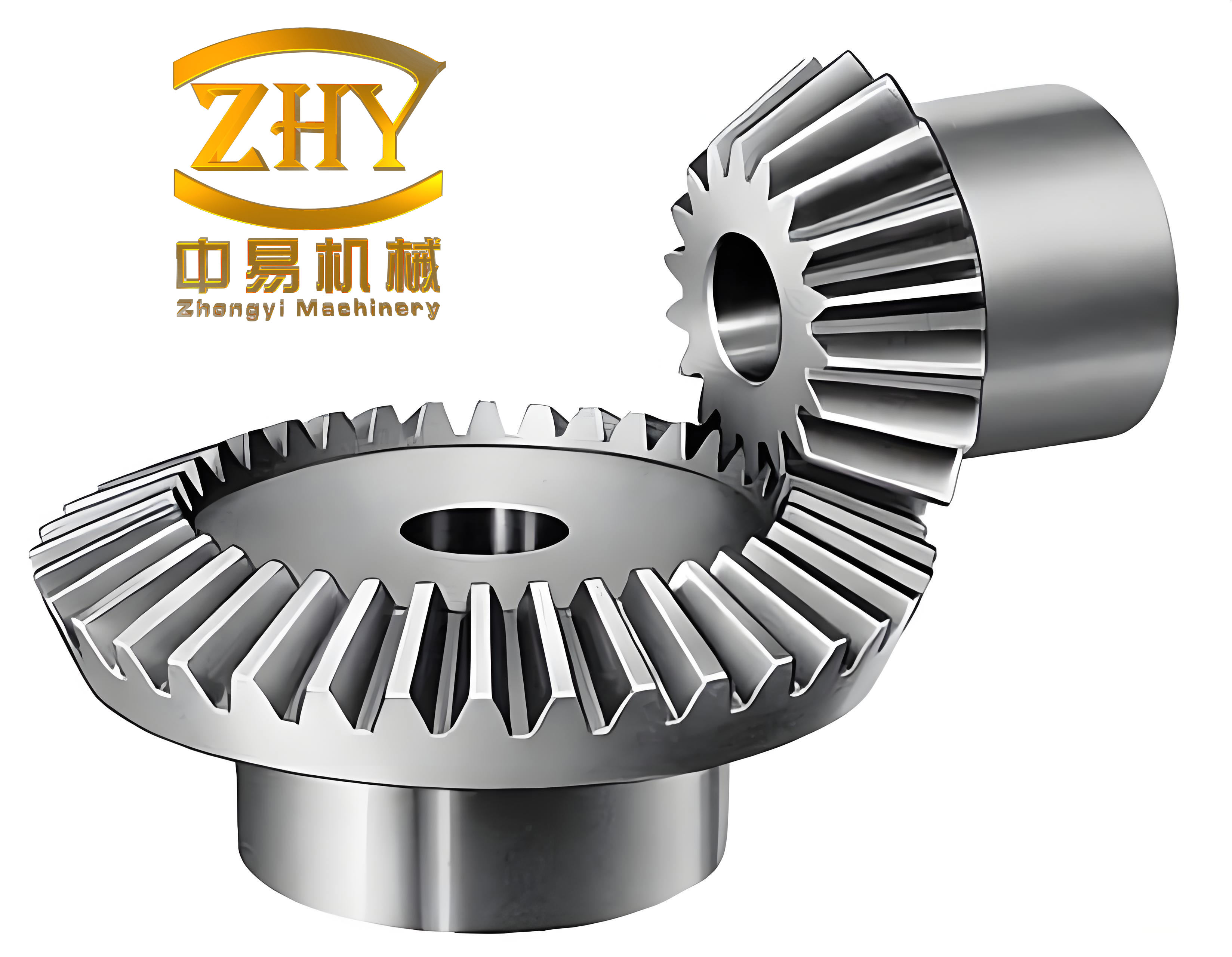
The fundamental challenge in form-copying machining of a straight bevel gear lies in accurately generating its tooth profile. On a typical machine, a universal template is used to guide the cutting tool. This template carries an enlarged involute curve that corresponds to the developed gear on the back cone of the theoretical straight bevel gear. The core principle hinges on the fact that the tooth profile of a straight bevel gear can be approximated by an equivalent spur gear when unfolded from its back cone. The geometry of this equivalent gear is dictated by the straight bevel gear’s key parameters: the pitch cone angle $\phi$, the module $m$, the number of teeth $z$, and the pressure angle $\alpha_0$. The universal template is designed for a specific machine constant—the magnified pitch cone length $R_m$—and a standard pressure angle. Therefore, its base circle radius $R_b$ is fixed by design for a given $\phi$ and $\alpha_0$. The critical formula governing the template’s geometry is:
$$R_b = R_m \sin \phi \cos \alpha_0$$
Here, $R_m$ is a constant for a specific machine (e.g., 200 mm or 250 mm), $\phi$ is the pitch cone angle of the straight bevel gear, and $\alpha_0$ is the standard pressure angle for which the template was manufactured (commonly 20°). This equation reveals that the template is selected based primarily on the pitch cone angle $\phi$ when the gear’s pressure angle matches the template’s standard. However, in practice, one frequently encounters straight bevel gears with pressure angles differing from the standard, such as 14.5° or 25°. This mismatch necessitates a sophisticated adaptation of the universal template method, which I will systematically explain.
To organize the key parameters and symbols used throughout our analysis of straight bevel gear machining, I present the following comprehensive table. This serves as a vital reference for understanding the subsequent formulas and calculations.
| Symbol | Description | Typical Unit |
|---|---|---|
| $\phi$ | Pitch cone angle of the straight bevel gear | Degrees (°) or Radians |
| $\alpha_0$ | Standard pressure angle of the gear (workpiece) | Degrees (°) |
| $\alpha_0’$ | Pressure angle of the universal template | Degrees (°) |
| $R_m$ | Magnified pitch cone length (machine constant) | mm |
| $R_b$ | Base circle radius of the universal template | mm |
| $z$ | Number of teeth on the straight bevel gear | Dimensionless |
| $m$ | Module of the straight bevel gear | mm |
| $r_e$ | Outer cone distance of the straight bevel gear | mm |
| $R_a’$ | Tip circle radius of the equivalent gear on the back cone (magnified) | mm |
| $R_f’$ | Root circle radius of the equivalent gear on the back cone (magnified) | mm |
| $R_a$ | Tip circle radius of the involute curve on the universal template | mm |
| $R_f$ | Root circle radius limit of the involute curve on the universal template | mm |
| $\phi’$ | Virtual pitch cone angle used for template selection | Degrees (°) |
When the pressure angle of the straight bevel gear $\alpha_0$ differs from the template’s standard pressure angle $\alpha_0’$, one cannot directly select the universal template based on the actual pitch cone angle $\phi$. Doing so would introduce significant tooth profile errors in the manufactured straight bevel gear. To overcome this, I employ a calculation method that determines a virtual pitch cone angle $\phi’$. This virtual angle allows us to choose a universal template designed for a different $\phi$ but which will produce the correct tooth form for our specific straight bevel gear. The derivation stems from ensuring the base circle radius of the equivalent gear matches that which the template should produce. The fundamental relationship is:
$$R_b = R_m \sin \phi \cos \alpha_0 = R_m \sin \phi’ \cos \alpha_0’$$
Solving for the virtual pitch cone angle $\phi’$, we obtain the crucial selection formula:
$$\sin \phi’ = \frac{\sin \phi \cos \alpha_0}{\cos \alpha_0′} \quad \text{or} \quad \phi’ = \arcsin\left( \frac{\sin \phi \cos \alpha_0}{\cos \alpha_0′} \right)$$
Thus, to machine a straight bevel gear with parameters ($\phi$, $\alpha_0$) using a universal template set standardized for pressure angle $\alpha_0’$, I first compute $\phi’$. I then select the universal template corresponding to this virtual pitch cone angle $\phi’$ from the available set. This procedural shift is essential for maintaining the geometric fidelity of the straight bevel gear tooth. To illustrate this process across common scenarios, I have prepared the following table, which maps various gear parameters to the required virtual angle for a template system with $\alpha_0′ = 20^\circ$ and $R_m = 250\text{ mm}$.
| Gear Pitch Cone Angle $\phi$ (°) | Gear Pressure Angle $\alpha_0$ (°) | Calculated Virtual Angle $\phi’$ (°) | Recommended Universal Template Index (based on $\phi’$) |
|---|---|---|---|
| 30 | 14.5 | 22.15 | Template for $\phi \approx 22^\circ$ |
| 45 | 14.5 | 35.26 | Template for $\phi \approx 35^\circ$ |
| 30 | 25 | 37.76 | Template for $\phi \approx 38^\circ$ |
| 60 | 20 | 60.00 (no change) | Template for $\phi = 60^\circ$ |
| 20 | 22.5 | 20.56 | Template for $\phi \approx 20.5^\circ$ |
Selecting the correct universal template is only the first step. A critical verification step must follow to ensure the selected template’s involute curve has sufficient length to cover the entire active tooth profile of the specific straight bevel gear. If the template’s involute is too short, the machined gear teeth will have an incorrect shape at the tip or root. The verification involves comparing the tip and root circles of the magnified equivalent gear (representing our workpiece) with the effective limits of the template’s involute curve. The required radii for the equivalent gear on the back cone are calculated as follows. First, the outer cone distance $r_e$ of the straight bevel gear is found from its module and tooth count. The pitch diameter $d$ of the equivalent spur gear on the back cone is $d = m z / \cos \phi$. The tip circle radius $R_a’$ and root circle radius $R_f’$ for the magnified system (scale factor $R_m / r_e$) are:
$$R_a’ = \frac{R_m}{r_e} \left( \frac{m z}{2 \cos \phi} + m \right) \quad \text{and} \quad R_f’ = \frac{R_m}{r_e} \left( \frac{m z}{2 \cos \phi} – 1.25m \right)$$
The template’s involute curve is defined between its base circle radius $R_b$ and its tip circle radius $R_a$. The root limit $R_f$ for the template is often considered at the start of the involute from the base circle. For safe machining, the following two conditions must be simultaneously satisfied:
$$R_a’ \leq R_a \quad \text{and} \quad R_f’ \geq R_b$$
In practice, $R_a$ is a known parameter for each universal template. If $R_a’ > R_a$, the template’s involute is too short to generate the tooth tip, and a custom template must be commissioned. Similarly, if $R_f’ < R_b$, the root portion may not be fully formed. To streamline this验算 process for a batch of straight bevel gears, I often use a consolidated validation table. Below is an example for a set of gears intended to be machined with a universal template having $R_a = 180\text{ mm}$ and $R_b = 120\text{ mm}$, given $R_m = 250\text{ mm}$.
| Gear ID | $\phi$ (°) | $\alpha_0$ (°) | $m$ (mm) | $z$ | $R_a’$ (mm) | $R_f’$ (mm) | Condition $R_a’ \leq 180$ | Condition $R_f’ \geq 120$ | Template Suitability |
|---|---|---|---|---|---|---|---|---|---|
| SBG-01 | 30 | 14.5 | 4 | 20 | 175.2 | 122.5 | Pass | Pass | Suitable |
| SBG-02 | 45 | 20 | 5 | 25 | 182.3 | 118.7 | Fail | Fail | Not Suitable |
| SBG-03 | 25 | 25 | 3 | 30 | 165.8 | 125.1 | Pass | Pass | Suitable |
| SBG-04 | 50 | 14.5 | 6 | 18 | 190.5 | 115.3 | Fail | Fail | Not Suitable |
Once a suitable universal template is confirmed, the actual machining setup on the form-copying planing machine requires precise tool alignment, known as the tool setting or “对刀” method. Based on my hands-on practice, the procedure is meticulous. First, I calculate the circle on the back cone of the workpiece straight bevel gear where the involute pressure angle equals the gear’s pressure angle $\alpha_0$. The radius $r_\alpha$ of this circle on the actual gear is given by $r_\alpha = r_b / \cos \alpha_0$, where $r_b$ is the base radius of the equivalent spur gear ($r_b = (m z \cos \alpha_0) / (2 \cos \phi)$). This circle is then physically scribed onto the gear blank’s back cone surface. After mounting the workpiece on the machine, I install the selected universal template and adjust its mounting height and angle according to the machine’s design parameters. The critical step involves moving the tool carriage until the center of the template follower roller coincides precisely with the intersection point of the template’s pitch circle and its involute curve. At this position, I meticulously adjust the cutting tool so that its tip aligns exactly with the scribed circle on the workpiece. Only when this alignment is perfect can the machine generate the correct tooth profile for the straight bevel gear. This alignment ensures that the kinematic relationship between the template’s curve and the tool path correctly maps onto the gear blank’s geometry.
The mathematics behind the involute generation is worth elaborating. The involute curve on the template, which guides the cutter, is defined parametrically. For a given roll angle $\theta$ from the start of involute, the coordinates on the template ($X_t, Y_t$) are:
$$X_t = R_b (\cos \theta + \theta \sin \theta), \quad Y_t = R_b (\sin \theta – \theta \cos \theta)$$
The corresponding point on the straight bevel gear tooth profile is then derived through a series of geometric transformations involving the pitch cone angle and the machine’s kinematics. The pressure angle $\alpha$ at any point on the involute with radius $r$ is given by:
$$\alpha = \arccos\left( \frac{R_b}{r} \right)$$
This relationship is fundamental for understanding the tooth contact and strength of the final straight bevel gear. The entire process underscores the importance of precision at every step when dealing with straight bevel gear manufacturing.
In modern manufacturing contexts, the production of straight bevel gears does not exist in isolation. The referenced advancement in quality inspection methods, such as mechanical vision systems using X-ray or infrared cameras, represents a parallel revolution. These systems can inspect integrated circuit chips or internal defects in castings and welds in low-light conditions. For straight bevel gear production, similar non-destructive testing technologies are becoming integral. After machining, a straight bevel gear can be inspected for internal material flaws, heat treatment cracks, or case depth consistency using such automated vision systems. This fusion of traditional precision machining with cutting-edge inspection ensures the highest quality standards for critical components like straight bevel gears. The proliferation of such automated inspection equipment is said to be a milestone in mechanical industrial development, with its profound impact being immeasurable. By the year 1990, the adoption rate of such devices reportedly surpassed that of other automation facilities. This trend continues today, with in-line inspection becoming a standard phase in the production line for high-value gears.
To further encapsulate the interdependencies of key variables in straight bevel gear template machining, I have derived a set of consolidated formulas that I routinely use. These are presented below for quick reference and application.
| Aspect | Formula | Notes |
|---|---|---|
| Equivalent Spur Gear Pitch Diameter | $d_{eq} = \frac{m z}{\cos \phi}$ | Based on back cone development |
| Base Radius of Equivalent Gear | $r_b = \frac{d_{eq}}{2} \cos \alpha_0 = \frac{m z \cos \alpha_0}{2 \cos \phi}$ | Fundamental for tooth profile |
| Template Base Circle Radius | $R_b = R_m \sin \phi \cos \alpha_0$ | Core template design equation |
| Virtual Pitch Cone Angle | $\phi’ = \arcsin\left( \frac{\sin \phi \cos \alpha_0}{\cos \alpha_0′} \right)$ | For template selection when $\alpha_0 \neq \alpha_0’$ |
| Magnified Tip Circle Radius | $R_a’ = \frac{R_m}{r_e} \left( \frac{m z}{2 \cos \phi} + h_a^* m \right)$ | $h_a^*$ is addendum coefficient (usually 1.0) |
| Magnified Root Circle Radius | $R_f’ = \frac{R_m}{r_e} \left( \frac{m z}{2 \cos \phi} – h_f^* m \right)$ | $h_f^*$ is dedendum coefficient (often 1.25) |
| Pressure Angle at Any Circle | $\alpha_r = \arccos\left( \frac{r_b}{r} \right)$ | $r$ is radius on equivalent gear |
Throughout my career, I have applied these principles to machine thousands of straight bevel gears for applications ranging from automotive differentials to industrial power transmissions. The universal template method, when mastered with these calculations, offers a remarkable balance between flexibility and precision. However, it is not without limitations. For extremely high-volume production of identical straight bevel gears, dedicated CNC gear cutting or forging might be more economical. Yet, for small batches, prototypes, or repair work, the template method remains invaluable. Each straight bevel gear produced serves as a testament to the intricate dance between theoretical geometry and practical craftsmanship. The satisfaction of achieving a quiet, efficient, and long-lasting gear mesh drives continuous refinement in these techniques. As manufacturing evolves, the core understanding of straight bevel gear geometry will remain essential, whether for programming a 5-axis CNC mill or setting up a classic planing machine with universal templates. The journey of mastering straight bevel gear production is perpetual, filled with both mathematical rigor and hands-on ingenuity.