
In my extensive experience with mechanical power transmission systems, I have found that screw gears, often referred to as worm gear sets, play a pivotal role in transmitting motion and power between non-parallel, non-intersecting shafts. Their compact design and high reduction ratios make them indispensable in countless industrial applications, from conveyor systems to precision machinery. However, their unique geometry and the intense sliding contact inherent in their operation make them susceptible to wear and failure. Consequently, the ability to accurately measure and reverse-engineer these components—a process known as dimensional mapping or surveying—is a critical skill for maintenance engineers and designers. This guide, drawn from years of hands-on practice, details a systematic, first-principles approach to surveying screw gears, emphasizing the interdependence of the worm and the worm wheel. The methodology centers on first determining the worm’s key parameters, from which all dimensions of the mating worm wheel can be derived.
The fundamental challenge in surveying screw gears lies in their distinct kinematic and geometric principles, which differ significantly from those of involute spur or helical gears. While standard gear parameters like module, pressure angle, and addendum coefficient are still used for calculation, the screw gear pair functions on a different meshing logic. A critical insight is that the screw gears are always used as a matched pair. Often, the worm wheel—typically made from a softer material like bronze—wears out first. Therefore, the primary objective of a survey is frequently to manufacture a replacement worm wheel. The geometry of this new wheel is entirely dictated by the parameters of its mating worm. Thus, a successful survey hinges on meticulously measuring the worm. By accurately determining the worm’s core parameters, we unlock the blueprint for the entire screw gear set. This process, while sharing conceptual ground with standard gear measurement, requires specific techniques tailored to the three common worm tooth profiles: the Archimedean (or straight-sided) worm, the involute worm, and the convolute (or straight-sided in normal section) worm.
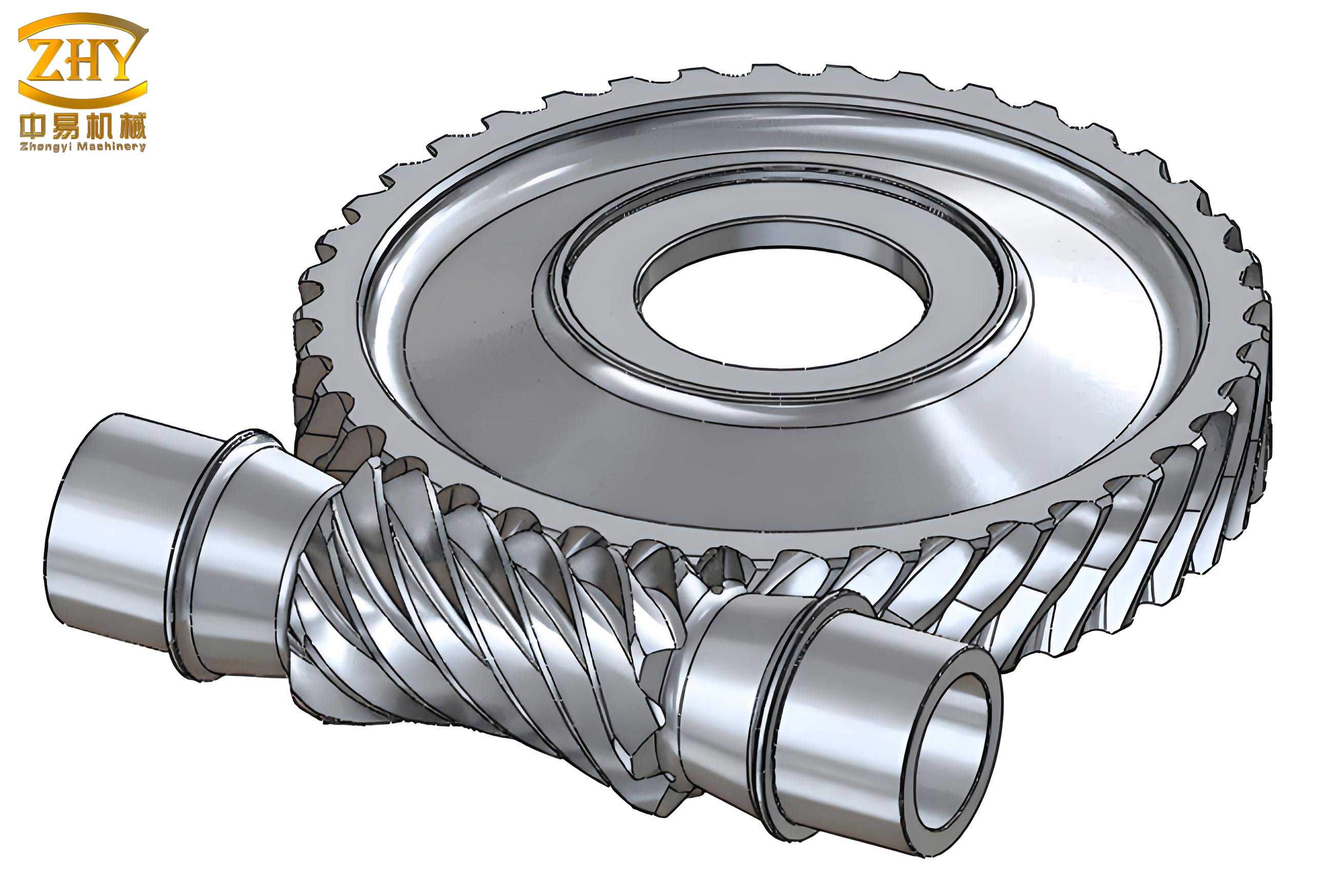
The first and foremost step in my surveying routine is the identification of the worm’s tooth profile and the measurement of its pressure angle. This step is paramount because the correct tooling and setup for manufacturing the replacement worm wheel depend entirely on this identification. In practice, the vast majority of industrial screw gears utilize the Archimedean worm, characterized by a straight-sided profile in the axial cross-section. To verify this, I use a precision angle-measuring gauge or a profile projector. I align the gauge in the axial plane of the worm. If the gauge blade makes full, seamless contact along the tooth flank at a specific angle, that angle is the axial pressure angle ($\alpha_a$), and the worm is confirmed as Archimedean. Common standard values are $20^\circ$ or, less frequently, $15^\circ$ for metric (module) systems. If the fit is poor in the axial plane, I then check the normal plane. A good fit in the normal plane with a standard pressure angle (like $20^\circ$ or $14.5^\circ$) indicates a convolute worm. The involute worm is rare due to complex manufacturing. Misidentifying the profile will lead to incorrect worm wheel generation and catastrophic meshing failure. Therefore, I always cross-check using known standards from the equipment’s country of origin or by comparing with master profile templates.
With the profile and pressure angle ascertained, the next critical parameter is the axial module ($m$). This is the fundamental size parameter for screw gears. The axial pitch ($p_a$)—the distance between corresponding points on adjacent teeth measured parallel to the worm axis—is directly related to the module: $p_a = \pi m$. To measure $p_a$ accurately, I use a vernier caliper or a precision scale to span several axial pitches ($n \cdot p_a$) along the worm’s crest, then divide by the number of pitches ($n$) to get an average value. This minimizes measurement error. The axial module is then calculated as:
$$ m = \frac{p_a}{\pi} $$
If the calculated value does not correspond neatly to a standard module (e.g., 1, 1.25, 1.5, 2, 2.5, 3, 4, 5, 6, 8, 10… mm), the gear might be based on the Diametral Pitch (DP) system, common in imperial units. The conversion is: $DP = \frac{25.4}{m}$. As a secondary check, if the worm wheel is partially intact, measuring its throat diameter ($d_{a2}$) and counting its teeth ($z_2$) can also yield the module, assuming a standard addendum coefficient ($h_{a}^* = 1$): $m \approx \frac{d_{a2}}{z_2 + 2}$. Consistency between these methods builds confidence in the result.
The third key parameter is the worm’s diameter factor or quotient ($q$). This unique parameter for screw gears relates the worm’s reference pitch diameter to the module. It is a critical design choice affecting stiffness and efficiency. To find $q$, I first accurately measure the worm’s outside diameter ($d_{a1}$) using a micrometer. The diameter factor is then derived from:
$$ q = \frac{d_{a1}}{m} – 2 $$
The calculated $q$ should be checked against standard series (e.g., 6.3, 7.1, 8, 9, 10, 11.2, 12.5, 14, 16, 18…). However, it is not uncommon to encounter non-standard values in custom or older machinery. The value of $q$, combined with the number of worm threads or starts ($z_1$), defines the lead angle ($\gamma$), a crucial parameter for understanding the screw gears’ self-locking tendency and efficiency.
The lead angle ($\gamma$) of the worm and the matching helix angle ($\beta$) of the worm wheel are equal ($\gamma = \beta$). This angle is fundamental to the kinematic relationship. It is calculated using the following formula, once $z_1$ and $q$ are known:
$$ \tan \gamma = \frac{z_1}{q} $$
$$ \gamma = \arctan\left(\frac{z_1}{q}\right) $$
For example, a single-start worm ($z_1=1$) with $q=10$ has a lead angle of $\gamma = \arctan(0.1) \approx 5.71^\circ$. A multi-start worm will have a larger lead angle for the same $q$, generally offering higher efficiency but reduced reduction ratio per stage. This calculation is essential for verifying the overall geometry.
The final and most important verification step in surveying screw gears is the center distance ($a$) check. For power transmission screw gears, the center distance is a critical mounting dimension with very tight tolerances. I meticulously measure the actual center distance ($a_{meas}$) in the housing using inside calipers or depth gauges. I then compare it to the calculated theoretical center distance based on the parameters I have determined:
$$ a_{calc} = \frac{m}{2}(q + z_2) $$
If $a_{calc}$ matches $a_{meas}$ within a reasonable tolerance (considering wear and measurement error), the survey is validated. A significant discrepancy typically indicates one of two things: either an error in the measurement or calculation of a key parameter (like $m$, $q$, or $z_2$), or the presence of profile shift (modification) in the original screw gears design. Profile shift is sometimes used to adjust center distance or improve tooth strength. Identifying this requires more advanced analysis of tooth thickness and space width measurements.
Other secondary parameters are determined with relative ease. The addendum coefficient ($h_{a}^*$) is almost universally 1 for screw gears. The dedendum or clearance coefficient ($c^*$) is typically 0.2 for module systems, but can be verified by measuring the total tooth height ($h$) of the worm: $h \approx (2h_{a}^* + c^*)m = 2.2m$. Worm wheel dimensions like throat diameter, root diameter, and outer diameter can be calculated using standard formulas once $m$, $z_2$, $q$, and $\gamma$ are known. For completeness, I often create a summary table of all parameters for the screw gears set.
| Parameter | Symbol | Determination Method | Standard Values / Formula |
|---|---|---|---|
| Axial Module | $m$ | Measure axial pitch $p_a$ | $m = p_a / \pi$; Standard series |
| Pressure Angle | $\alpha$ | Profile identification with gauge | $20^\circ$, $15^\circ$ (axial); $20^\circ$, $14.5^\circ$ (normal) |
| Worm Diameter Factor | $q$ | Measure worm outside dia. $d_{a1}$ | $q = d_{a1}/m – 2$; Standard series |
| Number of Worm Starts | $z_1$ | Direct visual count | 1, 2, 3, 4… |
| Number of Wheel Teeth | $z_2$ | Direct visual count | Typically > 20 |
| Lead / Helix Angle | $\gamma$, $\beta$ | Calculation | $\tan \gamma = z_1 / q$; $\gamma = \beta$ |
| Center Distance | $a$ | Measurement & Verification | $a_{calc} = m(q + z_2)/2$ |
| Addendum Coefficient | $h_{a}^*$ | Assumed / Verified | Typically 1.0 |
| Clearance Coefficient | $c^*$ | Assumed / Verified via tooth height | Typically 0.2, $h \approx 2.2m$ |
To solidify this methodology, let me walk through a detailed hypothetical survey scenario based on common challenges. Suppose I encounter a worn-out worm wheel on a machine of Chinese origin. The mating worm is intact. My first action is to clean the worm thoroughly. Using an optical comparator, I confirm the axial tooth profile is straight and aligns perfectly with a $20^\circ$ template, identifying it as an Archimedean worm with $\alpha_a = 20^\circ$. Next, I use a precision scale to measure 5 axial pitches, getting a total length of 78.55 mm. Thus, $p_a = 78.55 / 5 = 15.71$ mm. The axial module is $m = 15.71 / \pi = 5.00$ mm (a standard value). I then measure the worm’s outside diameter at several points with a micrometer, finding $d_{a1} = 90.00$ mm. The diameter factor is $q = 90.00 / 5.00 – 2 = 18 – 2 = 16$. This is a standard value. I count the worm starts: $z_1 = 2$. The lead angle is $\gamma = \arctan(2/16) = \arctan(0.125) \approx 7.125^\circ$. I count the damaged wheel’s teeth as $z_2 = 31$. The calculated center distance is $a_{calc} = (5/2) \times (16 + 31) = 2.5 \times 47 = 117.5$ mm. I measure the housing bore centers and find $a_{meas} = 117.52$ mm. The excellent agreement confirms my parameter set is correct. With these parameters, I can now generate a complete manufacturing drawing for the new bronze worm wheel, specifying the hobbling data (module, pressure angle, number of teeth, throat diameter, and most importantly, the hob setting angle equal to $\gamma$).
The process of surveying screw gears extends beyond simple measurement into the realm of metrology and design analysis. For instance, determining the tooth thickness of the worm is crucial if one needs to assess wear or calculate backlash. This requires measuring over wires or balls placed in the worm threads, a process governed by complex formulas depending on the profile. For an Archimedean worm, the measurement between two wires of diameter $d_W$ can be related to the normal tooth thickness. The formula involves the axial pressure angle, module, and lead angle:
$$ M = d_{a1} – d_W + \frac{p_a}{2} \frac{\cos \alpha_a}{\cos \gamma} + d_W \frac{1}{\sin \alpha_a} $$
Where $M$ is the measurement over wires. Such precise measurements are essential for high-precision remanufacturing of screw gears. Furthermore, understanding the material and heat treatment of the original worm can inform the choice of material for the new wheel to optimize wear resistance and prevent scoring, a common failure mode in screw gears.
Another advanced consideration is the recognition of non-standard designs. While the method described assumes no profile shift (zero modification), modified screw gears do exist. The sign of profile shift ($x_2$) for the worm wheel can be deduced if the calculated center distance ($a_{calc}$) using standard formulas differs from the measured value ($a_{meas}$), but the worm parameters are verified as standard. The profile shift coefficient is then given by:
$$ x_2 = \frac{a_{meas}}{m} – \frac{q + z_2}{2} $$
A positive $x_2$ indicates the worm wheel teeth are shifted outward, increasing its root thickness and the throat diameter. This modification must be replicated in the new wheel to maintain proper meshing and contact pattern.
In conclusion, the successful dimensional mapping of screw gears is a systematic, knowledge-driven process that blends practical measurement skill with deep theoretical understanding of gear geometry. The cornerstone is the accurate determination of the worm’s parameters: its tooth profile, axial module, diameter factor, and number of starts. From these, like deriving a set of equations, all dimensions of the mating worm wheel flow logically. The center distance serves as the essential checksum for the entire operation. This methodology, honed through practical application, ensures that replacement components will restore the original performance and longevity of the drive system. Whether dealing with common Archimedean screw gears or the less frequent convolute types, a rigorous, step-by-step approach is the key to success. The ability to accurately survey these components not only facilitates maintenance but also contributes to the reverse engineering and improvement of mechanical systems relying on these versatile and efficient screw gears.
The practical implications of mastering screw gears surveying are vast. It empowers maintenance teams to reduce downtime, allows for the reproduction of obsolete parts for legacy machinery, and provides valuable data for redesigning drives for improved performance. As I reflect on numerous field applications, the consistent thread has been the interdependence of the worm and wheel—a perfect embodiment of mechanical synergy. Every measurement, from the coarse axial pitch check with a steel rule to the precise micrometer reading of the worm diameter, builds towards reconstructing the complete digital twin of the physical screw gears set. This guide encapsulates that journey from physical artifact to parametric blueprint, a fundamental process in the stewardship of mechanical power transmission systems.