
In the realm of heavy industrial machinery, such as continuous casting segments, the reliable and precise adjustment of mechanisms is paramount. Often, this critical function is entrusted to a screw gear assembly, more commonly known as a worm and worm gear drive. The manufacturing of these drives presents a unique set of challenges, as they must simultaneously guarantee high torque transmission, accurate linear positioning via an integrated lead screw, and long-term operational stability under demanding conditions. Based on extensive hands-on experience in producing such components, this article delves into the intricate manufacturing and assembly processes required to achieve the necessary precision and performance. The journey from raw forging to final calibrated assembly involves meticulous planning at every stage for each component within the screw gear housing.
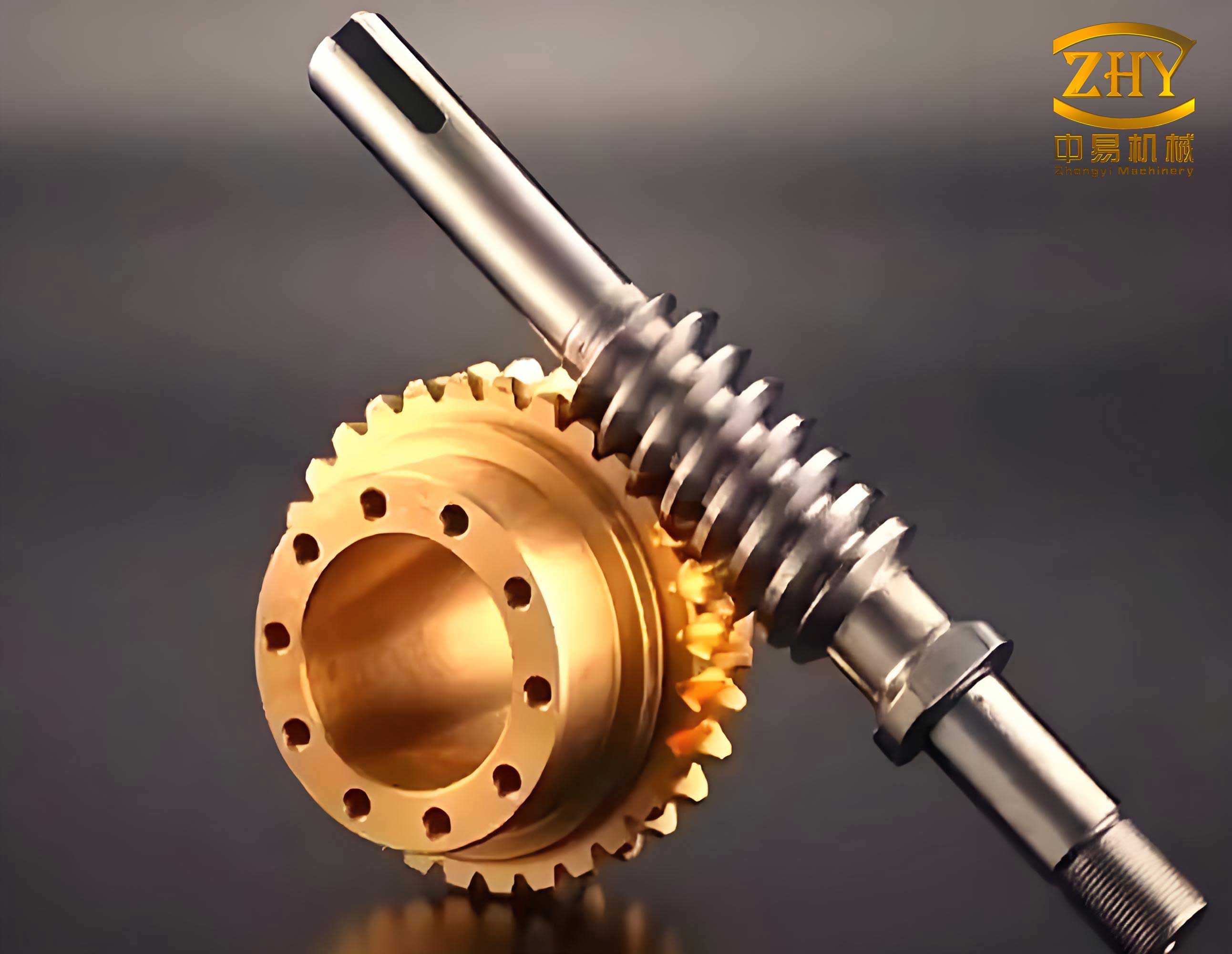
The core function of the discussed screw gear unit is to convert the rotary motion of an input drive into precise vertical displacement of heavy tie rods. This is achieved through a two-stage mechanism: a primary worm-and-gear reduction, followed by a secondary translation via a trapezoidal thread on the output shaft engaging with a nut. The resultant linear motion is used for critical adjustments like roll gap setting. The complexity lies in ensuring both kinematic pairs—the worm/gear mesh and the threaded engagement—operate with minimal backlash and high positional accuracy. The following sections break down the manufacturing journey of key components, highlighting solutions to inherent challenges.
Critical Component Analysis and Manufacturing Strategies
Each component within the screw gear box carries specific functional loads and precision requirements. A generic approach is insufficient; tailored processes are essential.
| Component | Material & Key Challenge | Core Manufacturing Solution | Critical Control Parameters |
|---|---|---|---|
| Tie Rod (Actuator Shaft) | 45 Steel, Class IV Forging. Long, slender part with precision trapezoidal thread and hard-chrome plated section. | Sequential roughing, stress-relieving (normalizing/tempering), semi-finishing, finish grinding of datum diameters, followed by precision thread cutting. Use of master gauges for thread profile verification. | Straightness preservation, trapezoidal thread lead accuracy, concentricity of journal diameters to thread axis. Hardness after plating: 950-1050 HV. |
| Housing | Cast Steel ZG230-450. Multi-bore geometry requiring precise alignment and press-fit bushings. | Establish machined datum planes. Machine bores in a single setup on a milling/boring machine to ensure perpendicularity and center distance accuracy. Cryogenic fitting (< -70°C) of bronze bushings to prevent distortion. | Center distance between worm shaft bore and gear shaft bore: $$200 \pm 0.036 \text{ mm}$$. Perpendicularity of bore axes. Secure press-fit of bushings. |
| Worm Shaft | Case-hardening steel 20CrMnTi. Requires precise helical tooth form and high surface hardness. | Turn & grind datum journals. Hob teeth leaving grinding stock. Case carburize and harden tooth flanks. Finish grind all journals and, crucially, the worm teeth on a precision gear grinder. | Tooth profile and lead accuracy. Surface hardness: 60 ± 2 HRC. Final paired running test with worm gear to check contact pattern and backlash. |
| Worm Gear (Screw Gear) | Casted Bronze ZCuAl10Fe3. Combins a gear rim with an internal trapezoidal thread. | Finish machine the gear blank, ensuring bore and face runout. Hob the gear teeth to final dimensions. Finally, single-point cut the internal trapezoidal thread, matching it to the tie rod’s thread. | Gear tooth accuracy (lead, profile). Internal thread lead and profile accuracy, verified with plug gauges. Center distance tolerance in mesh with worm. |
| Threaded Nut (Adapter) | Alloy Steel. Features external splines and an internal trapezoidal thread. | Machine the part, then cut the internal thread matched to the tie rod. The external splines are milled last, often in a paired operation with the locking plate. | Internal thread accuracy. Spline fit with the locking plate to prevent rotation. |
In-Depth Process Formulation for Key Components
Tie Rod: Managing Stress and Precision
The tie rod is the ultimate output member, translating rotary motion into linear force. Its manufacturing sequence is designed to manage internal stresses and achieve geometric precision.
1. Forging and Initial Verification: Begin with a Class IV forged blank of 45 steel. Immediately after rough machining, perform ultrasonic testing (UT) per standards like DIN EN 10228-3 to identify any subsurface forging defects. Only proceed if UT is clear.
2. Stress Relief and Property Development: Subject the part to quenching and tempering (hardness target: 242-287 HB). A witness coupon from the same forging batch undergoes full mechanical testing to validate the heat treatment cycle. The governing equation for ensuring core strength is tied to the material’s yield point after this treatment.
3. Establishing Precision Datums: After heat treatment, machine center holes at both ends. Subsequently, finish-grind the key journal diameters that will serve as datums for all subsequent threading and milling operations. For the trapezoidal thread section (e.g., Tr180x20), the major diameter is ground to a tight tolerance (e.g., φ180h9). This datum is critical for thread cutting. The thread depth is calculated based on the standard:
$$ H_1 = 0.5 \times P $$
where \( P \) is the pitch (20 mm), so \( H_1 = 10 \) mm. However, the effective or working depth is slightly less. Thread measurement is done via a over-wire/pin method or using a calibrated tooth thickness gauge referenced from the ground major diameter. The measured tooth thickness \( S \) at the pitch diameter should satisfy:
$$ S_{pitch} = \frac{P}{2} – 2 \cdot \left( H_1 \cdot \tan(\alpha/2) \right) $$
where \( \alpha \) is the thread flank angle (30° for metric trapezoidal threads).
4. Final Surface Treatment: The central section is hard chrome plated for wear resistance. Process validation is done using witness samples plated alongside the rod. The final chrome thickness and adhesion are verified.
Worm and Worm Gear: The Heart of the Screw Gear Drive
The kinematic quality of the entire screw gear unit depends on the precision of the worm and gear mesh.
Worm Shaft Manufacturing: After initial turning, key bearing journals and the worm tip diameter are finish-ground. The worm teeth are then hobbled, leaving a consistent stock of 0.3-0.4 mm for final grinding. Following case carburization and hardening of the tooth flanks, the final grinding is performed on a precision worm grinding machine. Setup is critical: the workpiece must be centered with minimal radial runout (< 0.02 mm). The final involute or convolute profile must be ground to ensure a controlled contact pattern with its mating gear. The lead accuracy \( \Delta F_{\beta} \) must be tightly controlled, often within microns over the worm’s length.
Worm Gear (Screw Gear) Manufacturing: The bronze gear blank is first machined to final dimensions for its bore and mounting faces. The gear teeth are generated by hobbing using a worm-type hob matched to the worm’s specifications. The critical parameter is the center distance \( a \) between the gear bore and the future worm axis, which is set during hobbing and must be held to \( 200 \pm 0.036 \) mm. After hobbing, the internal trapezoidal thread is machined. Its axis must be concentric with the gear bore within a very tight tolerance (e.g., < 0.03 mm). This ensures the tie rod passes through without inducing bending moments.
Pairing and Testing: The worm and gear are not considered finished until they are run together as a pair. They are mounted on a test jig simulating the housing bores at the nominal center distance. The contact pattern on the gear teeth is inspected. Requirements are stringent:
- Contact along tooth height: > 55%
- Contact along tooth length: > 50%
- The pattern should be centered slightly towards the exit side of the mesh.
The backlash \( j \) of the worm gear pair is measured and must fall within a specified range, typically 0.03 to 0.05 mm, calculated as:
$$ j = \frac{\Delta \theta \cdot \pi \cdot m_z}{180} $$
where \( \Delta \theta \) is the angular play of the gear when the worm is fixed, and \( m_z \) is the axial module of the worm.
The Precision Assembly Sequence
Assembling the screw gear box is a multi-stage adjustment process where the worm mesh and the thrust bearing preload are interdependent. A rigid, flat surface plate is mandatory.
Stage 1: Worm Shaft and Bearing Preload. Install the worm shaft with its tapered roller bearings (e.g., 30211) into the housing. Adjust the end covers to set a precise axial play (e.g., 0.05-0.1 mm) on the worm shaft, which is verified with a dial indicator. This preload eliminates axial float while preventing bearing overheating.
Stage 2: Worm Gear and Thrust Bearing Adjustment. Install the worm gear assembly onto the housing, sitting on a large thrust ball bearing (e.g., 51156). The critical task is to align the central plane of the worm gear perfectly with the worm’s axis. This is done using shim packs \( S_1 \) under the thrust bearing housing. The worm gear is rotated, and its axial runout \( R_a \) measured relative to the housing face must be minimized (< 0.025 mm). Simultaneously, the worm mesh contact pattern from the earlier test is re-checked and fine-tuned by adjusting \( S_1 \).
Stage 3: Integrating the Thread Mechanism – The Dual Adjustment. This is the most delicate phase, aligning the trapezoidal thread engagement with the established worm gear center. A temporary “process shim” pack \( S_2 \) is placed under the gear’s top flange. The threaded nut adapter is then installed and torqued to a specified value (e.g., 300 N·m) using a special fixture that engages its external splines.
The entire assembly is then inverted. Three dial indicators are placed equidistantly under the thrust collar. A calibrated hydraulic jack applies a defined upward force (e.g., 60 kN) to the tie rod, which loads the entire thread-thrust bearing stack. The deflection \( \delta_i \) is read on each indicator at three rotational positions (120° apart), yielding nine readings. The variation in these readings must be minimal (< 0.03 mm), indicating a concentric and square load path. The average deflection \( \bar{\delta} \) is calculated.
The thickness \( H \) of the final, permanent shim pack is determined by the formula:
$$ H = S_2 + \bar{\delta} – C $$
where \( S_2 \) is the thickness of the temporary process shim, \( \bar{\delta} \) is the average measured deflection under load, and \( C \) is the ideal designed preload/clearance for the system (e.g., 0.13 mm). This calculation ensures that when the permanent shim \( H \) is installed and the nut is torqued, the entire assembly settles into the designed, optimized load state.
Stage 4: Final Verification. With the permanent shim \( H \) installed and all components reassembled, the final comprehensive check is performed. The axial lash or preload in the system is measured again under the defined jacking force. The nine new deflection values \( b_i \) must fall within a specified narrow band (e.g., 0.10 to 0.17 mm) with minimal spread. This confirms that both the screw gear mesh and the thrust/thread stack are correctly preloaded and aligned. For a machine using four identical screw gear units, the average \( b \) value for all units must be within a close tolerance (e.g., 0.04 mm) to ensure synchronized operation.
Conclusion
The manufacture of a high-performance industrial screw gear drive is a symphony of precision machining, heat treatment, metrology, and systematic assembly. Success is not found in a single operation but in the cumulative control of each step: from the forging of the tie rod to the final micron-level shimming during assembly. The interrelationship between the gear mesh and the lead screw mechanism demands a holistic manufacturing philosophy. By decomposing the process into controlled stages with clear verification gates—using precise formulas for calculations, master gauges for inspection, and methodical load-testing during assembly—it is possible to consistently produce screw gear drives that meet rigorous standards for transmission accuracy, positional repeatability, and long-term reliability. This structured approach provides a reliable template for tackling the complex manufacturing challenges inherent in these indispensable power transmission components.