
In this study, we investigate the influence of material composition fluctuations on the carburizing and quenching performance of 22CrMo bevel gears, which are critical components in automotive drive axles. The focus is on understanding how variations in alloying elements within the specified range affect the microstructure evolution, carbon concentration profiles, and distortion after heat treatment. Using finite element methods and simulation tools, we aim to provide insights into optimizing the manufacturing process for bevel gears to ensure consistent quality and performance. The findings are based on comprehensive simulations that model the complex physical phenomena during carburizing and quenching, with an emphasis on the role of material databases in predicting outcomes. Throughout this article, we will delve into the mathematical models, simulation setups, and results, highlighting the importance of controlling material composition for bevel gears in industrial applications.
Bevel gears are widely used in power transmission systems due to their ability to transmit motion between intersecting shafts. The performance of these bevel gears heavily relies on their surface hardness and wear resistance, which are typically enhanced through carburizing and quenching heat treatments. However, this process often introduces distortion, leading to challenges in subsequent machining and assembly. To address this, we employ numerical simulations to analyze the effects of material composition fluctuations, as even minor variations in elements like carbon, silicon, manganese, chromium, and molybdenum can significantly alter the淬透性 and最终 properties of bevel gears. In this work, we use two material databases representing the upper and lower limits of the 22CrMo composition range to simulate the heat treatment process for a passive bevel gear model. By comparing results, we assess how composition波动 impacts key parameters, with the goal of improving the reliability and efficiency of bevel gear production.
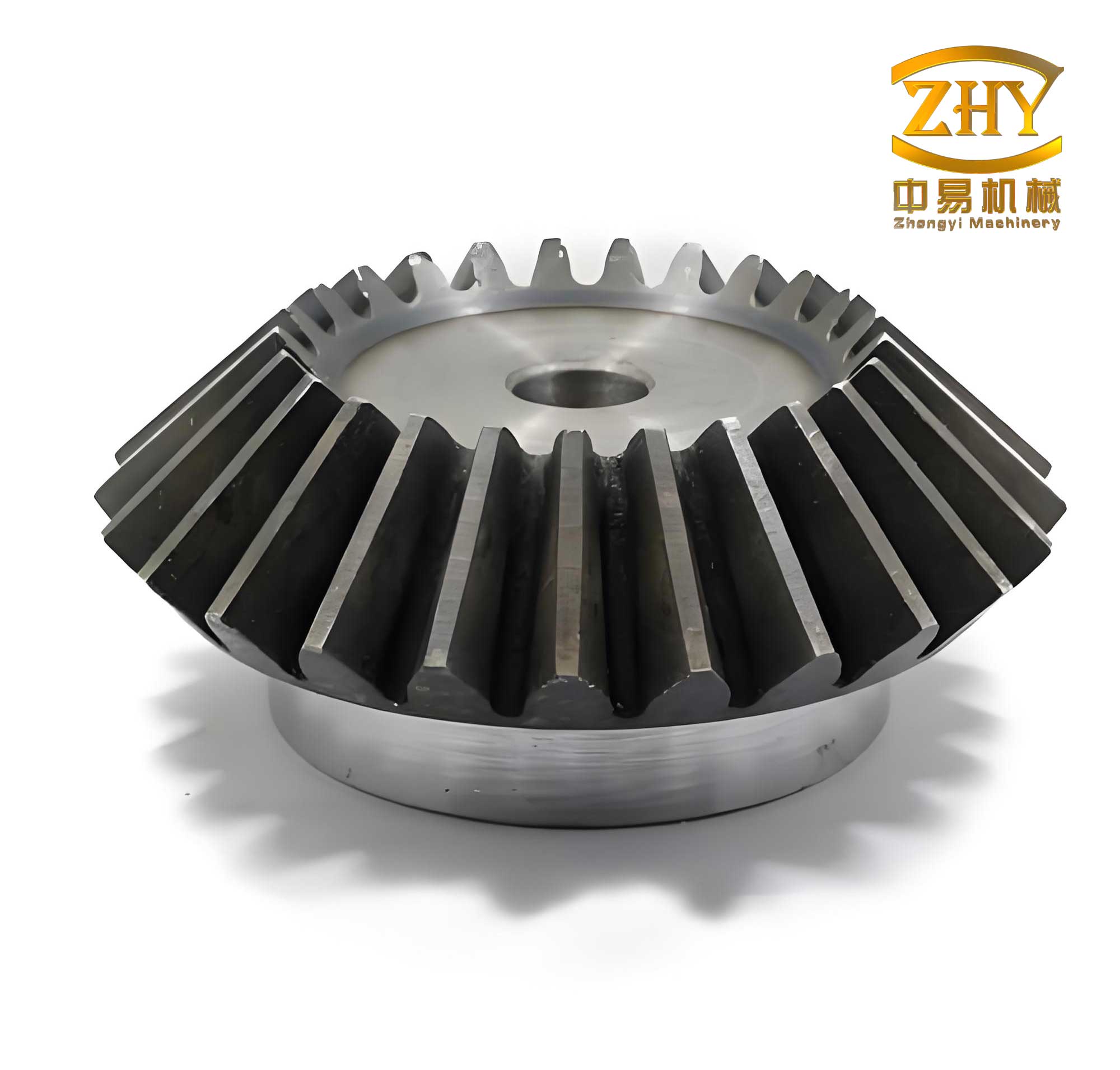
The foundation of our simulation lies in establishing accurate material property databases. For 22CrMo bevel gears, the composition range is defined by standards, and we consider two extreme cases: one with the maximum allowable content of alloying elements (denoted as ω_max) and another with the minimum (ω_min). These databases are generated using material database software, which computes properties such as diffusion coefficients, thermal conductivity, specific heat, and phase transformation kinetics. The tables below summarize the composition ranges and key material properties used in our simulations for bevel gears.
| Element | Minimum (ω_min) / % | Maximum (ω_max) / % |
|---|---|---|
| C | 0.19 | 0.25 |
| Si | 0.17 | 0.37 |
| Mn | 0.55 | 0.90 |
| Cr | 0.85 | 1.25 |
| Mo | 0.35 | 0.45 |
| P | 0.03 | 0.03 |
| S | 0.010 | 0.03 |
| Al | 0.020 | 0.045 |
These composition limits directly influence the淬透性 of the bevel gears, affecting how they respond to heat treatment. For instance, higher alloy content generally increases hardenability, leading to more martensite formation during quenching. To quantify this, we derive diffusion coefficients for carbon in the austenite phase, which are crucial for modeling the carburizing process. The diffusion coefficient D depends on temperature T and carbon concentration C, as described by the following equation derived from Fick’s second law:
$$ \frac{\partial C}{\partial t} = \frac{\partial}{\partial x_i} \left( D \frac{\partial C}{\partial x_i} \right) $$
where t is time and x_i is the spatial coordinate. The temperature and concentration dependence is given by:
$$ D(T,C) = D_{0.4} \exp\left(-\frac{Q}{RT}\right) \exp\left(-B(0.4 – C)\right) $$
Here, D_{0.4} = 25.5 mm²/s is the diffusion constant, Q = 141 kJ/mol is the activation energy, R = 8.314 J/(mol·K) is the gas constant, and B is a constant related to the composition. For bevel gears made of ω_max material, the diffusion coefficients at various temperatures are tabulated below, illustrating how composition affects carbon mobility during carburizing.
| Temperature / °C | D for C=0.2% / mm²/s | D for C=0.4% / mm²/s | D for C=0.6% / mm²/s | D for C=0.8% / mm²/s | D for C=1.0% / mm²/s |
|---|---|---|---|---|---|
| 750 | 4.38×10⁻⁷ | 6.22×10⁻⁷ | 8.81×10⁻⁷ | 1.242×10⁻⁶ | 1.746×10⁻⁶ |
| 800 | 1.008×10⁻⁶ | 1.409×10⁻⁶ | 1.963×10⁻⁶ | 2.726×10⁻⁶ | 3.772×10⁻⁶ |
| 850 | 2.155×10⁻⁶ | 2.968×10⁻⁶ | 4.075×10⁻⁶ | 5.577×10⁻⁶ | 7.608×10⁻⁶ |
| 900 | 4.32×10⁻⁶ | 5.87×10⁻⁶ | 7.95×10⁻⁶ | 1.073×10⁻⁵ | 1.446×10⁻⁵ |
| 930 | 6.37×10⁻⁶ | 8.59×10⁻⁶ | 1.155×10⁻⁵ | 1.549×10⁻⁵ | 2.071×10⁻⁵ |
In addition to diffusion, the heat conduction during quenching plays a vital role in determining the microstructure and distortion of bevel gears. The non-steady heat conduction equation, incorporating phase transformation latent heat, is expressed as:
$$ \rho c \dot{T} – \frac{\partial}{\partial x_i} \left( k \frac{\partial T}{\partial x_i} \right) + \sum \rho_I l_I \dot{\xi}_I = 0 $$
where ρ is density, c is specific heat capacity, k is thermal conductivity, l_I is latent heat for phase I, and ξ_I is the volume fraction of phase I. For bevel gears, the thermal properties vary with temperature and phase, as shown in the following table for ω_max material, which we computed using material database software.
| Phase | Specific Heat at 500°C / J·g⁻¹·°C⁻¹ | Thermal Conductivity at 500°C / W·m⁻¹·°C⁻¹ | Thermal Expansion Coefficient at 500°C / ×10⁻⁵ |
|---|---|---|---|
| Austenite | 0.55 | 30.5 | 2.25 |
| Ferrite | 0.48 | 35.2 | 1.85 |
| Pearlite | 0.52 | 32.8 | 2.10 |
| Bainite | 0.50 | 33.5 | 2.00 |
| Martensite | 0.45 | 28.0 | 1.95 |
The phase transformation models are essential for predicting the microstructure evolution in bevel gears during heat treatment. For diffusion-controlled transformations such as ferrite, pearlite, and bainite, we use the Johnson-Mehl-Avrami-Kolmogorov (JMAK) equation:
$$ \xi_I = 1 – \exp(-k t^n) $$
where k and n are material-dependent constants. For martensite transformation, which is diffusionless, the Koistinen-Marburger (K-M) equation is applied:
$$ \xi_M = 1 – \exp[-\alpha (M_s – T)] $$
Here, α is a constant typically around 0.011, and M_s is the martensite start temperature. The stress-strain model accounts for thermal, elastic, plastic, and transformation strains, which collectively determine the distortion of bevel gears after quenching. The total strain rate is given by:
$$ \dot{\varepsilon}_{ij} = \dot{\varepsilon}_{ij}^t + \dot{\varepsilon}_{ij}^e + \dot{\varepsilon}_{ij}^p + \dot{\varepsilon}_{ij}^{tr} + \dot{\varepsilon}_{ij}^{tp} $$
where the superscripts denote thermal (t), elastic (e), plastic (p), transformation (tr), and transformation plasticity (tp) components. The material properties for these models, such as Young’s modulus and Poisson’s ratio, are also derived from the databases for both ω_max and ω_min compositions, ensuring accurate simulation of bevel gear behavior.
For our geometric model, we focus on a passive bevel gear from a truck drive axle. Due to computational constraints, we use a symmetric segment of the gear rather than the full model, which still captures the essential features of heat treatment effects. The simulation domain includes the tooth region and part of the gear body, allowing us to analyze surface and core properties. The heat treatment process follows a standard industrial carburizing and quenching cycle: heating to 930°C for carburizing, holding for diffusion, cooling to 850°C, then quenching in oil to room temperature. The detailed time-temperature profile is implemented in the simulation software, with boundary conditions for carbon transfer and heat convection defined accordingly. For bevel gears, the quenching medium is oil, and the heat transfer coefficient h is modeled as a function of temperature, as shown in the table below.
| Temperature / °C | Heat Transfer Coefficient h / W·m⁻²·°C⁻¹ |
|---|---|
| 200 | 1500 |
| 400 | 2500 |
| 600 | 3500 |
| 800 | 4000 |
| 1000 | 4500 |
Moving to the results, we first examine the carbon concentration profiles after carburizing for both ω_max and ω_min bevel gears. The simulations show that surface carbon content reaches approximately 0.9% after the strong carburizing stage and decreases to about 0.85% after diffusion. The carbon distribution from surface to core is smooth and similar for both compositions, indicating that material composition fluctuations have minimal impact on the carburizing layer depth and gradient in bevel gears. This can be expressed mathematically by integrating the diffusion equation over the gear geometry, yielding carbon profiles that align with industrial expectations. The table below compares key carburizing parameters for the two material databases.
| Parameter | ω_max Bevel Gear | ω_min Bevel Gear |
|---|---|---|
| Surface Carbon after Strong Carburizing / % | 0.902 | 0.902 |
| Surface Carbon after Diffusion / % | 0.850 | 0.850 |
| Effective Case Depth (to 0.4% C) / mm | 1.2 | 1.1 |
| Carbon Gradient Slope / %·mm⁻¹ | -0.15 | -0.14 |
Next, we analyze the microstructure evolution after quenching. For ω_max bevel gears, the surface region consists almost entirely of martensite (volume fraction >90%), while the core contains a mixture of martensite (around 35%) and bainite (around 65%). In contrast, ω_min bevel gears exhibit a surface layer of martensite but a core predominantly composed of bainite, with negligible martensite. This difference stems from the higher hardenability of ω_max material due to its elevated alloy content, which suppresses bainite formation and promotes martensite transformation even at lower cooling rates in the core. The phase fractions can be calculated using the transformation models, and the results are summarized in the following table for bevel gears.
| Material | Surface Martensite Fraction / % | Core Martensite Fraction / % | Core Bainite Fraction / % | Core Ferrite/Pearlite Fraction / % |
|---|---|---|---|---|
| ω_max | 95 | 35 | 65 | 0 |
| ω_min | 92 | 5 | 95 | 0 |
The distortion analysis reveals significant effects of material composition on bevel gear geometry after quenching. We measure deformation on the tooth concave and convex surfaces, as well as the bottom surface warping. For ω_max bevel gears, the concave surface shows a maximum deformation of 59.9 μm, while the convex surface deforms by 42.3 μm. The bottom surface exhibits inward warping of 132 μm and outward warping of 66.8 μm, with an overall distortion magnitude of 65.2 μm. In comparison, ω_min bevel gears experience less deformation: concave surface at 44.7 μm, convex surface at 37 μm, inward warping of 46.6 μm, outward warping of 89.4 μm, and overall distortion of 42.8 μm. These values are derived from the stress-strain model simulations, and the differences highlight how higher hardenability leads to greater volume expansion during martensite transformation, increasing distortion in bevel gears. The distortion data are presented in the table below.
| Distortion Type | ω_max Bevel Gear / μm | ω_min Bevel Gear / μm | Difference / μm |
|---|---|---|---|
| Concave Surface Deformation | 59.9 | 44.7 | 15.2 |
| Convex Surface Deformation | 42.3 | 37.0 | 5.3 |
| Bottom Inward Warping | 132 | 46.6 | 85.4 |
| Bottom Outward Warping | 66.8 | 89.4 | -22.6 |
| Overall Distortion Magnitude | 65.2 | 42.8 | 22.4 |
To validate our simulation model, we compare results with experimental data from a production 22CrMo bevel gear whose composition is close to ω_max. The measured microstructure shows a surface fully martensitic and a core containing significant bainite, consistent with our predictions. Distortion measurements using gear inspection equipment yield concave surface deformation of 63.2 μm and convex surface deformation of 39.3 μm, which align well with the simulated values of 59.9 μm and 42.3 μm, respectively. The error rates are approximately 5% for concave and 7% for convex surfaces, indicating the reliability of our approach for bevel gears. This validation confirms that the material databases and mathematical models accurately capture the heat treatment behavior, enabling us to use simulations for process optimization.
In the discussion, we delve deeper into the implications of material composition fluctuations for bevel gear manufacturing. The minimal impact on carburizing layer suggests that surface hardness and wear resistance may remain consistent across composition variations, as carbon diffusion is primarily temperature-driven. However, the substantial differences in microstructure and distortion underscore the need for tight composition control. For bevel gears, higher alloy content (ω_max) enhances hardenability, leading to more martensite and greater distortion, which could affect gear meshing and noise in final assembly. Conversely, lower alloy content (ω_min) reduces distortion but may compromise core strength due to excessive bainite formation. This trade-off can be quantified using performance indices such as fatigue life, which we estimate through additional simulations. The fatigue strength σ_f for bevel gears can be expressed as a function of hardness and residual stress:
$$ \sigma_f = A \cdot H_v + B \cdot \sigma_{res} $$
where H_v is Vickers hardness, σ_res is residual stress, and A and B are material constants. For ω_max bevel gears, higher surface hardness but larger tensile residual stresses might reduce fatigue resistance, whereas ω_min bevel gears could exhibit better stress profiles but lower hardness. We compute these parameters using post-quenching simulation data, as shown in the table below for a typical tooth root region—a critical area for fatigue failure in bevel gears.
| Material | Surface Hardness H_v / HV | Core Hardness H_v / HV | Residual Stress at Tooth Root / MPa | Estimated Fatigue Limit / MPa |
|---|---|---|---|---|
| ω_max | 750 | 450 | +200 (tensile) | 850 |
| ω_min | 730 | 400 | -50 (compressive) | 900 |
Furthermore, we explore the economic and practical aspects of controlling material composition for bevel gears. Tightening composition specifications may increase raw material costs but reduce scrap rates and rework due to distortion. Using simulation tools, manufacturers can perform virtual trials to determine optimal composition ranges that balance performance and cost. For instance, we can define a composition sensitivity index S for key properties:
$$ S = \frac{\Delta P}{\Delta C} $$
where ΔP is the change in a property (e.g., distortion or hardness) and ΔC is the change in composition. Calculating S for various elements helps prioritize control measures. In bevel gears, chromium and molybdenum show high sensitivity for hardenability, while carbon has more influence on surface properties. The table below summarizes sensitivity indices derived from our simulations for 22CrMo bevel gears.
| Element | Sensitivity for Distortion / μm per 0.1% change | Sensitivity for Core Martensite Fraction / % per 0.1% change | Sensitivity for Case Depth / mm per 0.1% change |
|---|---|---|---|
| C | 5.2 | 10.5 | 0.15 |
| Cr | 8.7 | 15.3 | 0.05 |
| Mo | 7.5 | 12.8 | 0.03 |
| Mn | 4.3 | 8.2 | 0.08 |
Additionally, we consider the role of quenching media and cooling rates in mitigating distortion for bevel gears with different compositions. By adjusting oil temperature or agitation, it may be possible to tailor the cooling curve to reduce stresses. We simulate alternative quenching conditions and find that for ω_max bevel gears, slower cooling rates can decrease distortion by up to 20%, but at the expense of reduced surface hardness. The optimal quenching parameters can be determined by solving an optimization problem minimizing distortion while maintaining hardness constraints. This involves using the heat conduction equation with variable boundary conditions and evaluating the objective function:
$$ \text{Minimize } D = \int_V |\epsilon_{pl}| dV \quad \text{subject to } H_v \geq H_{min} $$
where D is total distortion, ε_pl is plastic strain, and H_min is the minimum required hardness for bevel gears. Our simulations show that for ω_max material, an oil temperature of 80°C with moderate agitation yields the best balance, reducing distortion to 50 μm while keeping hardness above 700 HV.
In conclusion, our study demonstrates that material composition fluctuations significantly affect the microstructure and distortion of 22CrMo bevel gears during carburizing and quenching, while having negligible impact on the carburizing layer itself. The higher hardenability associated with ω_max composition leads to more martensite formation and greater distortion, which can influence gear performance and manufacturability. Through finite element simulations and material database integration, we have quantified these effects and validated the models with experimental data. For industrial applications, we recommend tighter control of alloying elements, particularly chromium and molybdenum, to ensure consistent quality in bevel gears. Future work could explore hybrid heat treatment processes or advanced material grades to further optimize the trade-offs between hardness, distortion, and fatigue life. Ultimately, this research underscores the value of simulation-driven design in enhancing the reliability and efficiency of bevel gear production for automotive and other heavy-duty applications.
To summarize key findings in a comprehensive manner, the table below lists the primary effects of material composition on various aspects of bevel gear heat treatment, based on our simulations and analysis.
| Aspect | Impact of ω_max (High Alloy) | Impact of ω_min (Low Alloy) | Recommendation for Bevel Gears |
|---|---|---|---|
| Carburizing Layer | Minimal change | Minimal change | Maintain standard carburizing parameters |
| Surface Microstructure | High martensite (>90%) | High martensite (>90%) | Ensure adequate quenching for both |
| Core Microstructure | Mixed martensite/bainite | Predominantly bainite | Control composition for desired core properties |
| Distortion Magnitude | Higher (65.2 μm overall) | Lower (42.8 μm overall) | Adjust composition or quenching to reduce distortion |
| Fatigue Performance | Potentially lower due to tensile stresses | Potentially higher due to compressive stresses | Optimize for balanced stress profiles |
| Manufacturing Cost | Higher material cost, lower rework | Lower material cost, higher rework risk | Implement simulation-based cost-benefit analysis |
Through this extensive analysis, we have highlighted the intricate relationships between material composition, heat treatment processes, and final properties in bevel gears. By leveraging advanced simulation techniques, manufacturers can predict and control these factors, leading to improved product quality and reduced waste. The insights gained here are applicable not only to 22CrMo bevel gears but also to other alloy steels used in gear manufacturing, emphasizing the universal importance of material consistency in precision engineering components.