
In modern engineering, the selection of materials and their subsequent processing are critical to performance, durability, and sustainability. As an engineer deeply involved in this field, I have observed that materials like steel for gearboxes and structural applications, coupled with advanced heat treatment techniques, form the backbone of industries such as automotive and construction. This article explores the intricate details of gear steel chemistry, heat treatment processes—with a focus on avoiding heat treatment defects—and the green construction aspects of steel structures. I will use tables and formulas to summarize key points, ensuring a comprehensive understanding.
The transmission gearbox in automobiles operates under varying service conditions, necessitating diverse material choices. Commonly used materials include cast iron, carbon structural steels (e.g., 20, 30, 35, 40, 45, 50, 55), and alloy structural steels such as 20Cr, 20CrMo, 20CrMnTi, 40Cr, and 38CrMoAl. With the introduction of foreign vehicles, steels like SCr420 and 20MnCr5 have also been adopted. The performance of these steels heavily relies on their chemical composition and heat treatment, which directly influence gear precision and longevity. Similarly, in construction, steel structures have gained prominence due to their lightweight, high strength, and eco-friendly attributes, aligning with global trends in green building.
Understanding the role of chemical elements in gear steel is fundamental to optimizing material properties. Below is a table summarizing the effects of key elements:
| Element | Role in Steel | Effects on Properties | Impact on Heat Treatment Defects |
|---|---|---|---|
| C (Carbon) | Forms solid solutions (e.g., austenite, ferrite) and compounds like Fe3C. | Increases hardness and淬透性 (hardenability); higher carbon raises post-quench hardness. | Excess carbon can lead to brittleness and cracking, common heat treatment defects. |
| Si (Silicon) | 常存元素; forms FeSi and non-metallic inclusions. | Raises γ region, lowers A1 point, increases austenite grain growth, improves淬透性, but reduces toughness and corrosion resistance. | Can cause grain coarsening, contributing to heat treatment defects like distortion. |
| Mn (Manganese) | Forms carbides and non-metallic inclusions. | Enhances淬透性, lowers austenitizing temperature, increases residual austenite, and improves strength and plasticity. | Promotes segregation and回火脆性, leading to potential heat treatment defects. |
| Cr (Chromium) | Added during steelmaking; forms carbides and FeCr compounds. | Lowers γ region, raises A1 point, reduces grain growth, and increases strength and elasticity. | Can cause excessive residual austenite, a heat treatment defect affecting dimensional stability. |
| Mo, V, Ti (Molybdenum, Vanadium, Titanium) | Form stable carbides (e.g., Mo2C, VC, TiC). | Refine grain structure and inhibit grain growth, enhancing toughness. | Help mitigate heat treatment defects by controlling grain size and reducing distortion. |
| Al (Aluminum) | Promotes nitrogen absorption and oxidation resistance. | Used in nitriding processes to improve surface hardness. | Improper Al content can lead to inhomogeneous nitriding, a heat treatment defect. |
The effects of these elements are often quantified using formulas. For instance, the淬火 heating temperature (Tc) for gear steels can be calculated as: $$ T_c (^{\circ}C) = \sum A_i X_i + K $$ where \( A_i \) is a coefficient for each alloying element, \( X_i \) is the element content, and \( K \) is a constant. This formula helps optimize temperatures to minimize heat treatment defects like overheating or insufficient hardening.
Heat treatment processes for transmission gears are complex and varied, including quenching and tempering, surface hardening, carburizing, and nitriding. Each process must be carefully controlled to avoid heat treatment defects, which can compromise gear performance. Common heat treatment defects include distortion, cracking, residual stresses, and inadequate hardness. For example, during quenching, rapid cooling can induce thermal stresses, leading to cracks—a severe heat treatment defect. Similarly, improper tempering may result in brittleness or reduced toughness.
To illustrate, I will delve into specific processes. First, quenching and tempering (调质) involve heating the workpiece to a temperature above Ac3, typically calculated as Ac3 + 30°C to 50°C, followed by quenching and high-temperature回火. The heating and保温 time (\(\tau\)) can be estimated using: $$ \tau = \alpha K D $$ where \(\alpha\) is the heating coefficient, \(D\) is the effective thickness, and \(K\) is a factor related to furnace load. Incorrect time or temperature can cause heat treatment defects such as soft spots or excessive grain growth.
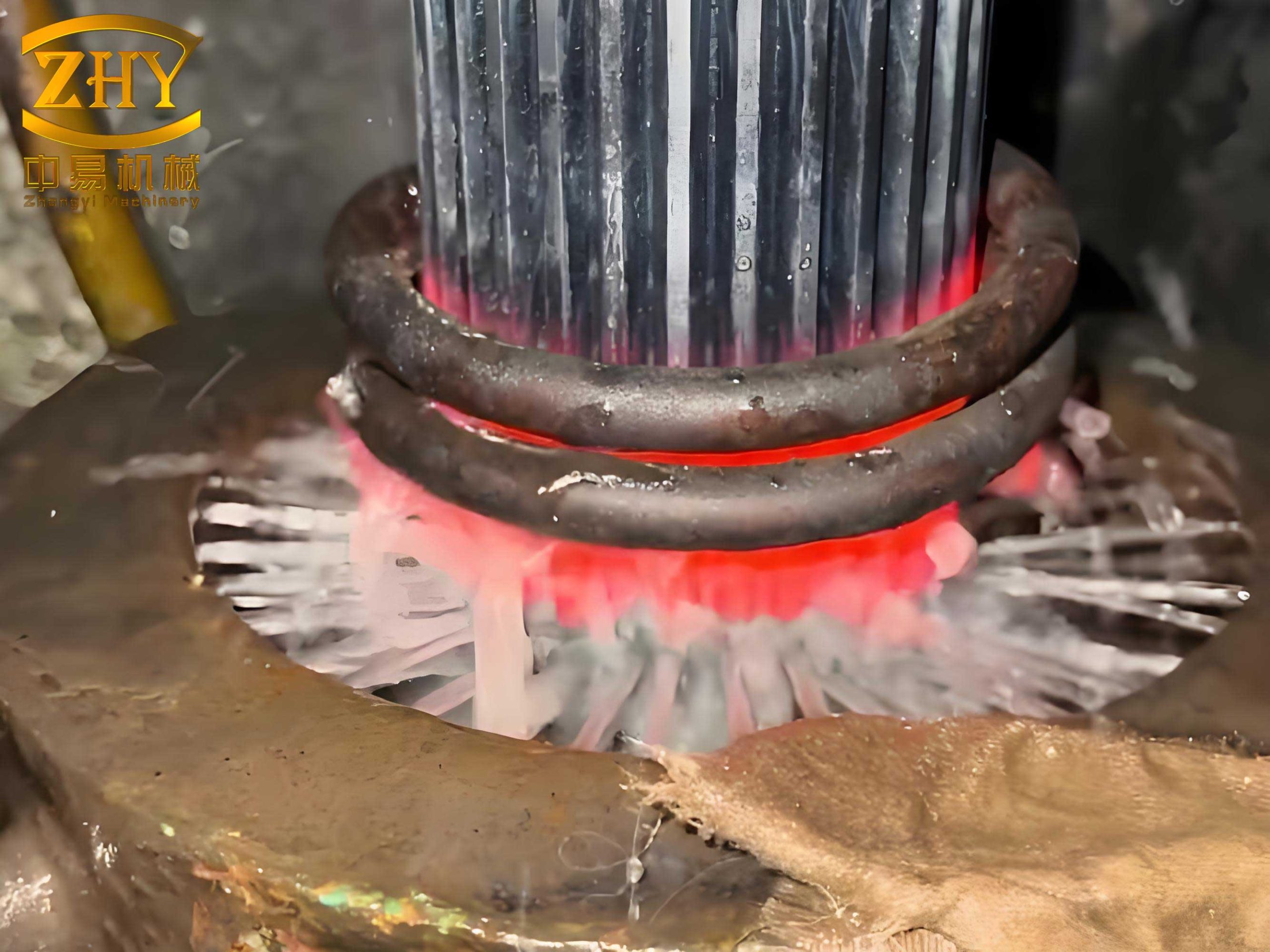
Surface hardening methods, like induction hardening, require precise frequency selection and cooling media choice based on steel composition. For instance, carbon steels often use water, while alloy steels use oil to prevent heat treatment defects like quench cracking. The table below summarizes common heat treatment processes and associated risks of heat treatment defects:
| Heat Treatment Process | Typical Parameters | Key Considerations | Common Heat Treatment Defects |
|---|---|---|---|
| Quenching and Tempering | Temperature: Ac3 + 30-50°C;回火: >500°C | Control cooling rate and回火 temperature to avoid brittleness. | Cracking, distortion, residual stresses. |
| Induction Hardening | Frequency tailored to gear size; cooling with water or oil. | Ensure sufficient power output and proper coil design. | Incomplete hardening, overheating, distortion. |
| Carburizing | Temperature: 920-930°C; atmosphere control with hydrocarbons. | Manage carbon diffusion to achieve desired case depth. | Carbon segregation, excessive case depth, distortion. |
| Nitriding | Temperature: 500-560°C; ammonia as medium. | Control氨 decomposition rate and time for layer thickness. | Brittle white layer, uneven nitriding, distortion. |
In carburizing and carbonitriding, post-treatment淬火 and low-temperature回火 (180-200°C) are essential to relieve stresses and prevent heat treatment defects. For materials prone to distortion, such as those with high chromium and nickel, secondary heating淬火 is employed. Similarly, nitriding and nitrocarburizing offer low-temperature alternatives to minimize heat treatment defects like warping, but they require prior调质 to ensure core strength.
The prevention of heat treatment defects is paramount in gear manufacturing. For instance, during渗碳, if the temperature is too high, it can cause grain coarsening and reduce fatigue resistance—a critical heat treatment defect. Ion nitriding, while faster, may introduce inhomogeneities if not controlled, leading to another heat treatment defect. Overall, meticulous process design, including formula-based calculations and empirical adjustments, is necessary to mitigate these issues.
Transitioning to construction, steel structures exemplify green building principles due to their recyclability, energy efficiency, and reduced environmental impact. As an engineer, I appreciate how steel’s high strength-to-weight ratio allows for lighter foundations and faster construction, reducing resource consumption. The use of eco-friendly materials like insulation panels and fire-resistant coatings further enhances sustainability. However, the production and fabrication of steel involve heat treatment processes, where heat treatment defects such as welding distortions or residual stresses must be managed through techniques like stress relieving and controlled cooling.
In green construction, steel structures are designed for durability and ease of disassembly, promoting circular economy. The table below compares steel structures with traditional materials, highlighting how heat treatment defects in steel components can affect overall building integrity:
| Aspect | Steel Structures | Traditional Materials | Role of Heat Treatment |
|---|---|---|---|
| Weight | Lightweight, reducing load on foundations. | Heavier, requiring more material. | Heat treatment enhances strength, but defects can weaken joints. |
| Construction Speed | Fast assembly due to prefabrication. | Slower, labor-intensive processes. | Welding and annealing must avoid heat treatment defects to ensure safety. |
| Environmental Impact | High recyclability, lower carbon footprint. | Often non-recyclable, higher emissions. | Heat treatment defects in recycled steel can compromise performance. |
| Energy Efficiency | Excellent thermal performance with insulation. | Variable, depending on design. | Heat treatment of steel components affects durability and energy use. |
The integration of heat treatment in steel fabrication is crucial to prevent heat treatment defects that could lead to structural failures. For example, in焊接, improper heat input can cause cracking—a severe heat treatment defect that necessitates repairs and increases waste. By optimizing processes like normalizing or tempering, engineers can mitigate these risks, aligning with green施工 goals of minimizing material waste and energy use.
In conclusion, the synergy between material science and heat treatment is vital for modern engineering. For transmission gears, selecting appropriate steels and applying precise heat treatment processes—while vigilantly avoiding heat treatment defects—ensures reliability and efficiency. Similarly, in construction, steel structures offer sustainable solutions, but their performance hinges on managing heat treatment defects during fabrication. As I reflect on these topics, it is clear that ongoing research and innovation in heat treatment methodologies are essential to address heat treatment defects and advance green engineering practices. By leveraging formulas, tables, and empirical data, engineers can drive progress in both automotive and construction sectors, contributing to a more resilient and eco-friendly future.
Throughout this discussion, I have emphasized the importance of heat treatment defects in various contexts. Whether in gear manufacturing or steel construction, these defects—such as distortion, cracking, or inadequate hardness—pose significant challenges that require careful control of parameters like temperature, time, and cooling rates. By understanding the chemical underpinnings of materials and applying robust heat treatment protocols, we can minimize heat treatment defects and enhance product lifecycles. This holistic approach not only improves technical outcomes but also supports broader sustainability initiatives, making it a cornerstone of modern engineering endeavors.