
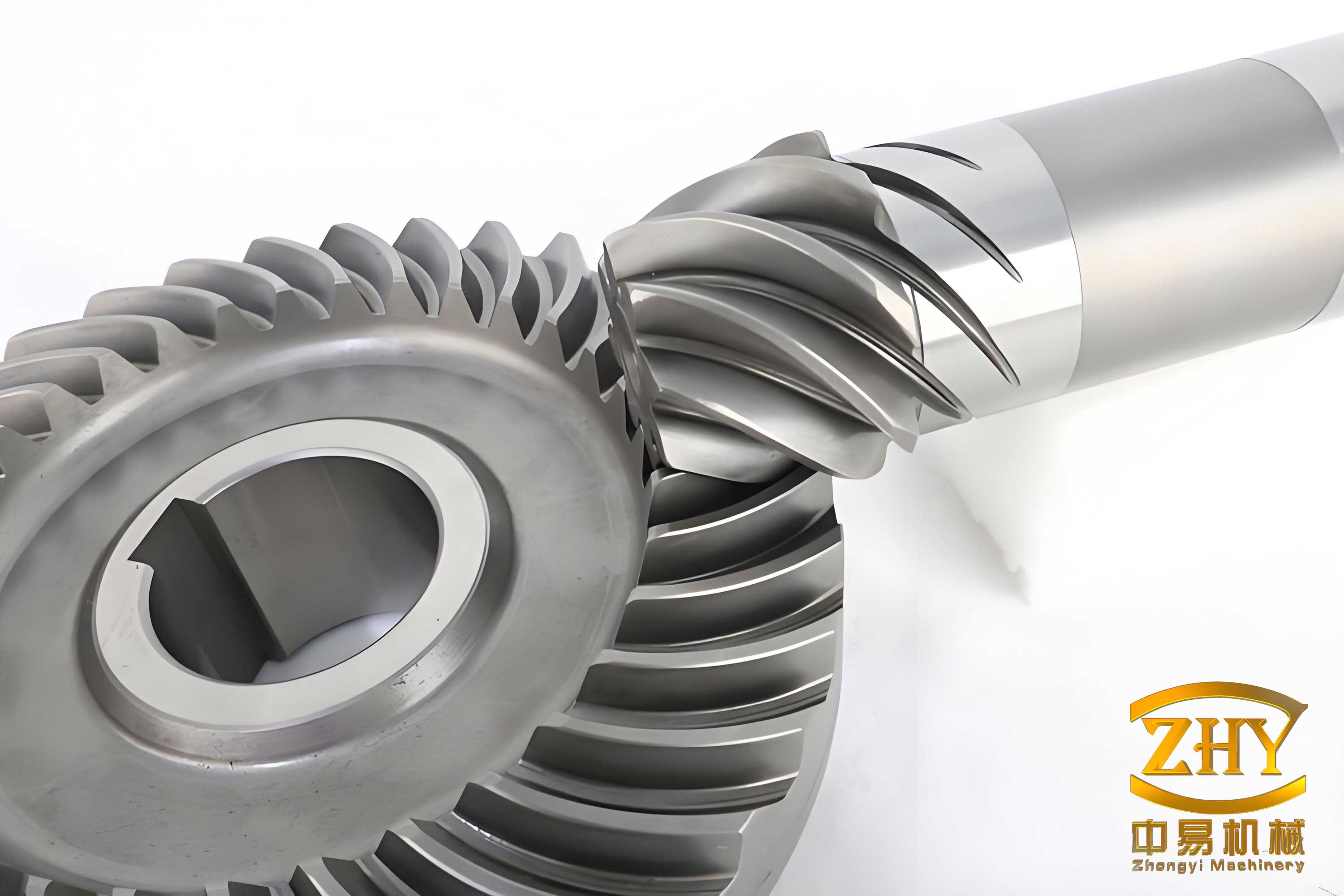
In the field of power transmission, the design and analysis of spiral bevel gear pairs are fundamental to achieving high efficiency, smooth operation, and significant load capacity. The specific tooth geometry dictates the contact pattern, which is the region where force is transmitted between the mating teeth. Understanding this pattern is crucial for predicting performance, durability, and noise characteristics. My analysis focuses on a specific type of spiral bevel gear manufactured using the face-milling process with a continuous indexing method, often associated with specific, high-performance gear systems. The primary objective is to investigate the nature of the tooth surface contact—whether it is theoretically a point or a line contact—through rigorous mathematical modeling and numerical computation.
The fundamental principle behind generating the tooth surfaces of this spiral bevel gear type is based on the concept of a “generating crown gear” or “planar gear.” During the cutting process, the tool blades simulate a theoretical gear, known as the “cutter head,” which envelops the desired tooth profile on the workpiece through a relative rolling motion. Therefore, to analyze the final gear pair’s contact, one must first derive the mathematical equations describing the surfaces of this generating gear.
Using vector calculus and the theory of gearing, the surface of the generating gear can be defined. For a right-hand generating gear used to cut the convex side of a left-hand pinion’s tooth, the surface vector $\mathbf{r}_1$ in a fixed coordinate system $O_m – X_m, Y_m, Z_m$ is derived. The derivation considers the geometry of the cutter head, including the blade profile, cutter radius, and the generating mechanism parameters. The resulting equations are parametric, with parameters $u$ and $\theta$, representing the position along the blade edge and the rotational phase of the generating gear, respectively.
The surface equation for the generating gear’s concave side (for pinion convex side generation) can be expressed in a general vector form. A similar but distinct equation is derived for the convex side of the opposite-hand generating gear, which is used to machine the concave side of the wheel (larger gear) tooth. The mathematical forms of these equations are:
$$\mathbf{r}_1 = \mathbf{r}_1(u, \theta; \phi_1)$$
$$\mathbf{r}_2 = \mathbf{r}_2(u, \theta; \phi_2)$$
where $\phi_1$ and $\phi_2$ are the rotation angles of the respective generating gears, incorporating the relative motion between the cutter and the blank.
To analyze the contact between the final spiral bevel gear pair, we must transform these generating surfaces onto the actual pinion and wheel. This requires establishing multiple coordinate systems: one fixed to the generating gear ($S_m$), one fixed to the pinion ($S_1$), and one fixed to the wheel ($S_2$). The relationships between these systems are defined by the shaft angle, pitch cone angles, and the rotational positions of the gears during operation. The coordinate transformation from $S_m$ to $S_1$, for instance, involves a series of rotations and translations based on the machine setup geometry.
The fundamental law of gear meshing states that for two surfaces to be in continuous contact, their relative velocity at the point of contact must be perpendicular to the common normal vector. This condition yields the *equation of meshing*. For the generating process (generating gear surface $\Sigma_m$ producing pinion surface $\Sigma_1$), the meshing equation is:
$$ \mathbf{n}_m \cdot \mathbf{v}_m^{(m1)} = 0 $$
where $\mathbf{n}_m$ is the unit normal vector to the generating surface $\Sigma_m$, and $\mathbf{v}_m^{(m1)}$ is the relative velocity vector of the generating gear with respect to the pinion, expressed in coordinate system $S_m$. Expanding this using the specific kinematics of the spiral bevel gear generator leads to a specific scalar functional relationship:
$$ f_1(u, \theta, \phi_1) = 0 $$
Similarly, for the generation of the wheel surface $\Sigma_2$ by its corresponding generating gear, we have another meshing equation:
$$ f_2(u, \theta, \phi_2) = 0 $$
By simultaneously solving the surface equation $\mathbf{r}_1(u, \theta)$ with its corresponding meshing equation $f_1(u, \theta, \phi_1)=0$, we obtain a family of contact lines on the generating gear surface, parameterized by $\phi_1$. Applying the coordinate transformation $S_m \rightarrow S_1$ to this family yields the complete tooth surface of the pinion $\Sigma_1$. The same process, using $\mathbf{r}_2$ and $f_2$, yields the wheel tooth surface $\Sigma_2$.
When the actual pinion $\Sigma_1$ and wheel $\Sigma_2$ mesh in operation, they must satisfy a new meshing equation derived from their relative motion. However, due to the nature of their generation from conjugate generating gears that share a theoretical crown gear, the meshing condition simplifies. The key insight is that the instantaneous contact line between $\Sigma_1$ and $\Sigma_2$ is determined by the condition that the corresponding generating parameters are linked through the gear ratio and initial phase. For a given angular position of the pinion $\phi_1$, the corresponding position of the wheel $\phi_2$ is fixed ($\phi_2 = (\frac{Z_1}{Z_2})\phi_1$, where $Z$ denotes tooth numbers). The contact line on the spiral bevel gear pair can be found by solving the system:
$$ \mathbf{r}_1(u, \theta, \phi_1) \text{ (transformed to } S_f \text{)} $$
$$ \mathbf{n}_1 \cdot \mathbf{v}_1^{(12)} = 0 $$
In practice, analyzing the theoretical contact pattern involves selecting a set of discrete pinion rotation angles $\phi_1^{(i)}$, solving for the corresponding $(u, \theta)$ pairs from the meshing condition, and then plotting these points in a common reference frame, often projected onto a plane representing the tooth flank.
Numerical Computation and Case Study
To move from theory to practical insight, a numerical computation was performed for a specific spiral bevel gear pair. The geometric and manufacturing parameters define the unique characteristics of the gears. The primary data for the example gear set is summarized below:
| Parameter | Symbol | Pinion Value | Wheel Value |
|---|---|---|---|
| Number of Teeth | $Z$ | 15 | 41 |
| Pitch Cone Angle | $\delta$ | 20° 4′ 56″ | 69° 55′ 4″ |
| Shaft Angle | $\Sigma$ | 90° | |
| Outer Cone Distance | $R_e$ | 187.652 mm | |
| Face Width | $b$ | 50 mm | |
| Mean Spiral Angle | $\beta_m$ | 35° | |
| Pressure Angle | $\alpha_n$ | 20° | |
| Hand of Spiral | – | Left | Right |
The cutter head and machine tool settings used to generate these spiral bevel gear teeth are equally critical. These parameters control the local curvature and orientation of the tooth surfaces.
| Machine Setting Parameter | Symbol | Value |
|---|---|---|
| Cutter Radius (Mean) | $r_{c0}$ | 114.3 mm |
| Number of Cutter Heads | $N$ | 1 |
| Machine Root Angle | $\alpha_{root}$ | Calculated from $\delta$ |
| Offset / Sliding Base | $E_m$ | Calculated Value |
| Cradle Angle (Basic) | $\theta_0$ | Calculated Value |
Using these parameters, the mathematical models for the generating surfaces $\mathbf{r}_1$, $\mathbf{r}_2$ and their respective meshing equations $f_1$, $f_2$ were programmed into computational software. The algorithm iterated over the surface parameters $u$ and $\theta$ for a sequence of generating gear rotation angles $\phi_1$ and $\phi_2$. For each set, it checked the meshing condition within a specified tolerance. Valid $(u, \theta)$ solutions satisfying $f=0$ represent points on the contact line for that instant. These points were then transformed into the coordinate system of the respective gear (pinion or wheel) and also projected onto a common “unwrapped” tooth flank plane for visualization.
The numerical results produced coordinates for the contact lines on both the generating gear surfaces and the final spiral bevel gear teeth. The contact pattern on the generating gear surface for pinion generation, projected onto a plane approximating the tooth flank, showed a series of nearly straight lines traversing the tooth from the toe to the heel, slightly inclined relative to the root line. Critically, the contact line pattern on the generating gear for wheel generation was found to be virtually identical in shape and orientation for corresponding angular positions.
Analysis of Results and Conclusion
The core finding from the numerical computation is the nature of the contact between the mating spiral bevel gear teeth. Although the theoretical derivation for conjugate surfaces generated by two separate crown gears might suggest a point contact, the computational simulation reveals a significantly different practical reality.
The key evidence is the congruence of the contact lines. For any given angular position of the gear pair in mesh, the instantaneous line of contact calculated on the pinion surface and the corresponding line on the wheel surface coincide perfectly in space when the gears are assembled according to their design geometry. This congruence indicates that the teeth do not just touch at a single point but along a well-defined curve across the tooth flank. This results in a bearing contact or a contact ellipse with a major axis length comparable to the face width under light loads, which effectively behaves as a line contact from an engineering perspective.
The fundamental reason behind this favorable condition lies in the specific design philosophy of this type of spiral bevel gear. The generation process is intentionally designed to produce localized conjugate surfaces that have very similar curvatures in the direction transverse to the tooth trace. While not strictly “line contact” in the classical sense of developable surfaces, the mismatch in principal curvatures is minimal, leading to a highly elongated contact area even under no-load conditions. This characteristic is often enhanced by a slight “crowning” or longitudinal modification, which is controlled by a small parameter $\Delta \xi$ in the machine kinematics, to prevent edge-loading under deflections.
Therefore, the primary conclusion of this mathematical analysis is that the investigated spiral bevel gear system exhibits a meshing behavior that is, for all practical purposes, approximate line contact. This has profound implications for its performance:
- High Load Capacity: The large contact area distributes transmitted forces over a greater portion of the tooth surface, significantly reducing contact stress (Hertzian stress) and increasing the gear set’s ability to transmit high torque and power. This makes this type of spiral bevel gear particularly suitable for heavy-duty applications.
- Improved Durability: Lower contact stress directly contributes to increased resistance to pitting and surface fatigue, leading to longer service life.
- Smooth and Quiet Operation: The gradual engagement of teeth along a line, combined with the spiral angle, ensures a smoother transfer of load from one tooth pair to the next, minimizing vibration and noise generation.
The analysis methodology, combining precise mathematical modeling of the generation process with robust numerical computation, provides a powerful tool for predicting and optimizing the contact characteristics of spiral bevel gear pairs before physical manufacturing. This approach is essential for advancing the design of reliable and efficient gear drives in demanding mechanical transmission systems.