
Straight bevel gears are crucial components in transmitting power between intersecting shafts, typically at a 90-degree angle. They are widely used in various mechanical systems, including automotive differentials, agricultural machinery, and machine tools. The tooth profile of a straight bevel gear is generally approximated as a spherical involute, and due to their straight tooth lines, they exhibit full-length contact during meshing. However, this characteristic makes them more sensitive to installation errors and load variations compared to other types of bevel gears, limiting their application to low-speed, heavy-duty scenarios. With the rapid advancement of computer technology, accurate mathematical modeling and simulation have become indispensable tools in product development and manufacturing. This necessitates the creation of precise mathematical models that faithfully represent real-world products. In this study, we focus on developing a comprehensive methodology for establishing accurate mathematical models of straight bevel gears based on gear meshing principles and gear shaping generation methods, followed by dynamic contact pattern simulation analysis.
The foundation of our approach lies in the generation-based gear shaping principle, which is commonly employed in the machining of straight bevel gears. To achieve this, we developed a specialized software tool using Visual Basic that calculates tooth surface points for modified straight bevel gears. This software incorporates essential parameters and algorithms derived from gear meshing theory, enabling the computation of spatial coordinates for the tooth surfaces. The calculated data serves as the basis for constructing three-dimensional mathematical models in UG software, facilitating subsequent simulation and analysis. The integration of this software with UG allows for a seamless transition from theoretical calculations to practical model creation, ensuring accuracy and efficiency in the design process.
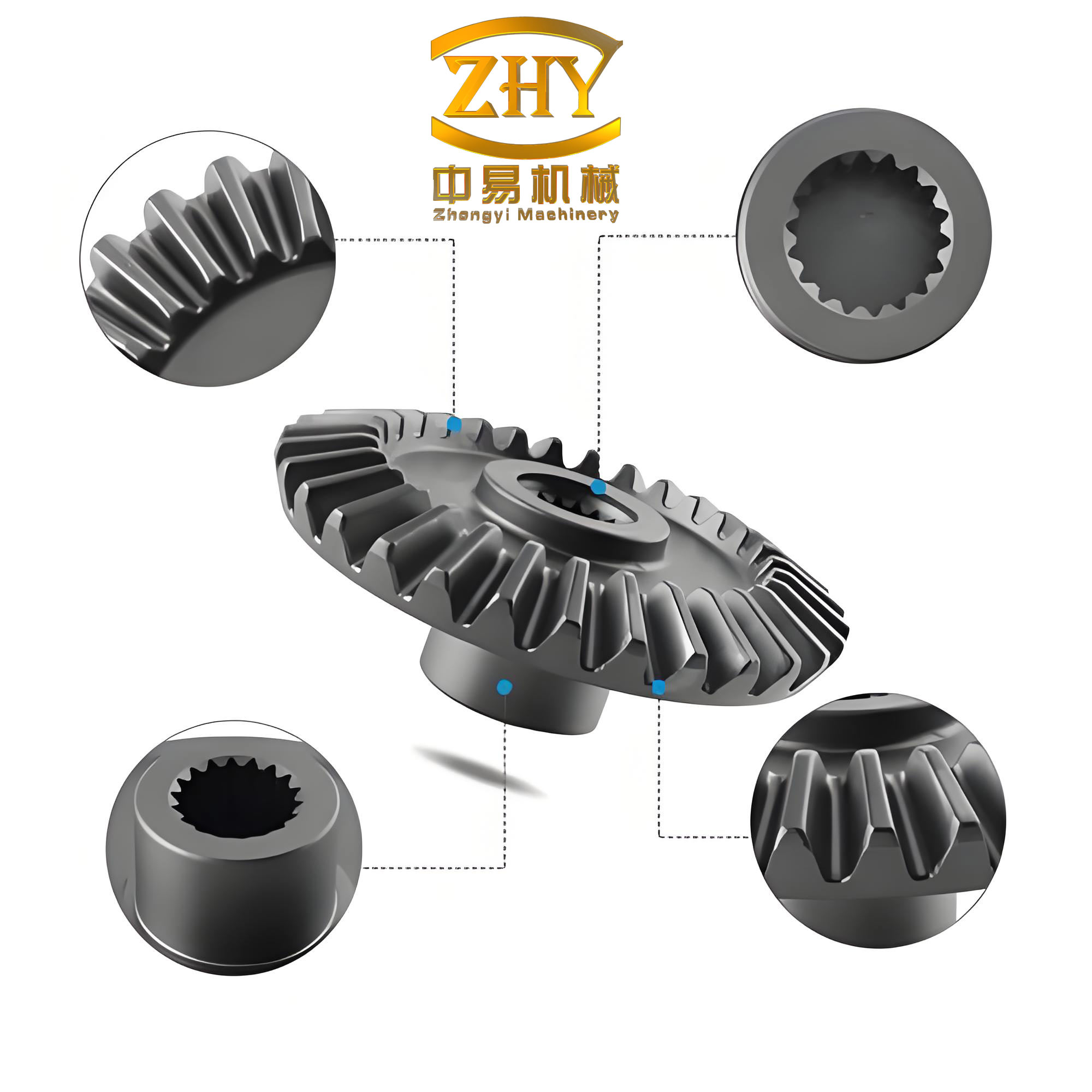
To elucidate the mathematical underpinnings, consider the coordinate systems and transformation matrices involved in the meshing of straight bevel gears. The position vector of a point on the tooth surface can be expressed in the gear coordinate system as follows:
$$ \mathbf{r} = \begin{bmatrix} x \\ y \\ z \end{bmatrix} = \begin{bmatrix} R \sin\theta \cos\phi \\ R \sin\theta \sin\phi \\ R \cos\theta \end{bmatrix} $$
where $R$ is the radial distance, $\theta$ is the polar angle, and $\phi$ is the azimuthal angle. For straight bevel gears, the tooth surface is generated based on the spherical involute profile, which can be parameterized using the gear’s basic parameters such as module, pressure angle, and number of teeth. The equation of the spherical involute is given by:
$$ \mathbf{r}_i(u, v) = \begin{bmatrix} (r_b \cos v + u \sin v) \cos\theta \\ (r_b \cos v + u \sin v) \sin\theta \\ r_b \sin v – u \cos v \end{bmatrix} $$
where $r_b$ is the base radius, $u$ is the generating parameter, $v$ is the roll angle, and $\theta$ is the cone angle. The development of our tooth surface point calculation software leverages these equations to compute precise coordinates for each point on the gear tooth, accounting for modifications such as crowning or profile shifts to enhance performance and reduce sensitivity to installation errors.
The software interface, as illustrated in the figure, allows users to input key parameters of the straight bevel gear, and it outputs a dataset of tooth surface points. These points are then imported into UG software to create a three-dimensional model. The modeling process involves several steps: creating individual tooth surface patches using the imported point data, mirroring these patches to form symmetrical tooth slots, generating the tooth slot bottom surfaces, and finally, assembling the complete gear model by patterning the tooth slots around the gear blank. This method ensures that the mathematical model accurately reflects the theoretical geometry of the straight bevel gear, including any applied modifications.
In our case study, we applied this methodology to the differential straight bevel gears of an东方红 tractor, specifically focusing on the semi-axle gear and planetary gear. The main parameters of these gears are summarized in the table below:
| Parameter | Semi-Axle Gear | Planetary Gear |
|---|---|---|
| Number of Teeth | 19 | 11 |
| Module at Large End (mm) | 6.17 | 6.17 |
| Pitch Angle (°) | 59.93 | 30.07 |
| Face Width (mm) | 23 | 26 |
| Pressure Angle (°) | 22.5 | 22.5 |
Using the software, we computed the tooth surface points for the semi-axle gear, which were then utilized to construct the 3D model in UG. The planetary gear model was developed similarly but without modifications in both the profile and length directions. The resulting models were subjected to dynamic contact pattern simulation within UG’s motion simulation module. By setting up the assembly with the correct gear ratio and motion constraints, we simulated the meshing behavior under no-load conditions. The interference between tooth surfaces was set to 0.005 mm, and the simulation was run for 30 seconds at a speed of 50 RPM. The contact patterns observed at various time instances indicated favorable conditions, with the contact area positioned near the toe end and covering approximately 50% of the tooth length, which aligns with theoretical expectations for straight bevel gears.
The contact pattern simulation is crucial for evaluating the performance of straight bevel gears, as it helps identify potential issues such as edge contact or misalignment. The simulation results showed that the contact ellipse was optimally oriented, reducing sensitivity to installation errors. This is achieved by optimizing the contact ellipse’s major axis through penalty function methods, which minimizes the Gaussian curvature of the difference surface between the two meshing tooth surfaces. The Gaussian curvature $K$ at a point on the tooth surface can be expressed as:
$$ K = \frac{LN – M^2}{EG – F^2} $$
where $E$, $F$, and $G$ are the coefficients of the first fundamental form, and $L$, $M$, and $N$ are the coefficients of the second fundamental form of the surface. By optimizing the contact parameters, we ensure that the contact pattern remains stable even in the presence of minor installation errors, thereby enhancing the durability and noise performance of the straight bevel gear pair.
To validate the accuracy of the mathematical models, we manufactured standard gears using a DMG five-axis machining center. The 3D models were imported into the machine’s software, which generated the CNC programs automatically. The gears were machined from 45 steel using a finger-type milling cutter. The manufactured gears were then inspected on a gear measuring machine, where the actual tooth surfaces were compared against the theoretical models. The inspection involved measuring 45 points around the pitch circle on the tooth surfaces, and the results confirmed that the gears met the required accuracy standards, with a maximum deviation of 0.007 mm from the mathematical model. Furthermore, the gears underwent rolling tests to assess the contact patterns and noise levels under realistic conditions. The actual contact patterns observed during these tests closely matched the simulation results, demonstrating the effectiveness of our modeling approach.
The successful application of this methodology highlights its universality in the modeling and analysis of straight bevel gears. The developed software and modeling techniques can be easily adapted to other gear designs, providing a robust framework for optimizing gear performance and reducing development time and costs. Future work may involve extending this approach to more complex gear types, such as spiral bevel gears, or incorporating advanced simulation techniques to account for dynamic loads and thermal effects.
In conclusion, our study presents a comprehensive method for establishing accurate mathematical models of straight bevel gears and conducting dynamic contact pattern simulations. The key contributions include the development of a specialized software tool for tooth surface point calculation, the creation of precise 3D models in UG, and the validation of these models through physical manufacturing and testing. This approach not only ensures the design of high-performance straight bevel gears but also provides a scalable solution for the gear industry, enabling faster innovation and improved product quality.