
Straight bevel gears are critical components in various mechanical transmission systems, widely used due to their ability to transmit motion and power between intersecting shafts. Traditional machining methods for straight bevel gears, such as milling, planing, and broaching, often involve intermittent indexing, leading to low production efficiency and challenges in achieving high precision due to mechanical transmission chains. In contrast, spiral bevel gear cutting technologies have advanced significantly, offering continuous indexing and improved accuracy. To address the limitations of conventional straight bevel gear processing, this paper explores the cycloid rotational indexing machining method, which leverages space curve approximation to straight conical bus lines. This approach enables continuous indexing, enhances production efficiency, and improves machining precision for straight bevel gears. The mathematical model of the cutting point trajectory is derived, and key parameters are analyzed and optimized to minimize errors between the generated curve and the ideal straight line.
The cycloid rotational indexing machining principle for straight bevel gears is based on the concept of using a space curve to approximate a straight conical bus. In planar geometry, a cycloid is formed when a circle of radius \( r \) rolls without slipping on a base circle of radius \( R \). A point at a distance \( e \) from the center of the rolling circle traces a cycloid, described by the parametric equations:
$$ x = (R – r) \cos\alpha + e \cos(\theta + \beta) $$
$$ y = (R – r) \sin\alpha + e \sin(\theta + \beta) $$
where \( \alpha \) is a reference variable and \( \theta = (1 – R/r) \alpha \). By adjusting parameters \( R \), \( r \), and \( e \), the cycloid can approximate a straight line segment. When this motion is extended to three dimensions with the axes of the generating and base circles inclined at an angle, the resulting space curve can approximate the conical bus of a straight bevel gear. This forms the foundation of the cycloid rotational indexing method, where the tool and workpiece rotate synchronously, and the tool tip follows a cycloidal path to machine the gear teeth continuously.
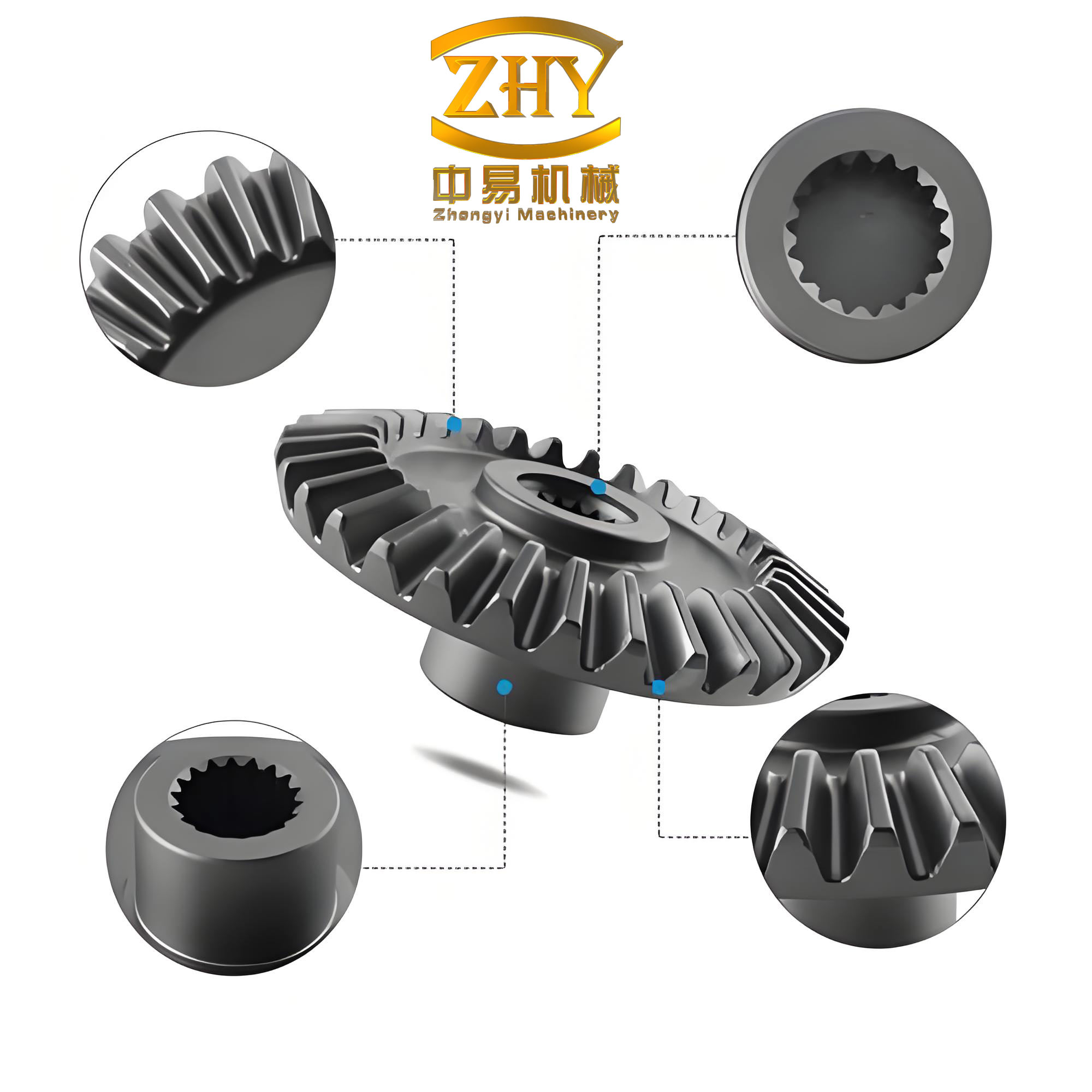
To establish the mathematical model for cycloid rotational indexing machining of straight bevel gears, coordinate systems are defined to describe the relative motion between the tool and workpiece. Let \( S_1 = \{ O_1; X_1, Y_1, Z_1 \} \) represent the initial position of the cutter head, \( S_2 = \{ O_2; X_2, Y_2, Z_2 \} \) the workpiece coordinate system, and \( S_3 = \{ O_3; X_3, Y_3, Z_3 \} \) the cutter head coordinate system after tilting by an angle \( \beta \) around the reference axis. The transformation matrices between these systems are used to derive the trajectory of a point \( M \) on the cutting edge.
The coordinates of point \( M \) in the cutter system are \( (x_c, y_c, z_c) \), where \( x_c = e \sin\phi \), \( y_c = e \cos\phi \), and \( z_c = 0 \), with \( e \) being the cutter radius and \( \phi \) the cutter position angle. The rotation angles of the cutter and workpiece are \( \alpha_1 \) and \( \alpha_2 \), respectively, related by \( \alpha_2 = \eta \alpha_1 \), where \( \eta \) is the speed ratio. The transformation from \( S_3 \) to \( S_1 \) is given by matrix \( \mathbf{M}_{13} \), and from \( S_1 \) to \( S_2 \) by \( \mathbf{M}_{21} \). The overall trajectory of point \( M \) in the workpiece coordinate system is:
$$ \begin{bmatrix} x \\ y \\ z \\ 1 \end{bmatrix} = \begin{bmatrix} \cos\alpha_2 & -\sin\alpha_2 & 0 & 0 \\ \sin\alpha_2 & \cos\alpha_2 & 0 & 0 \\ 0 & 0 & 1 & 0 \\ 0 & 0 & 0 & 1 \end{bmatrix} \cdot \mathbf{M}_{21} \cdot \mathbf{M}_{13} \cdot \begin{bmatrix} \cos\alpha_1 & \sin\alpha_1 & 0 & 0 \\ -\sin\alpha_1 & \cos\alpha_1 & 0 & 0 \\ 0 & 0 & 1 & 0 \\ 0 & 0 & 0 & 1 \end{bmatrix} \cdot \begin{bmatrix} x_c \\ y_c \\ z_c \\ 1 \end{bmatrix} $$
where:
$$ \mathbf{M}_{21} = \begin{bmatrix} \sin\theta & 0 & -\cos\theta & H \sin\theta \\ 0 & 1 & 0 & -e \cos\phi \\ \cos\theta & 0 & \sin\theta & H \cos\theta \\ 0 & 0 & 0 & 1 \end{bmatrix}, \quad \mathbf{M}_{13} = \begin{bmatrix} 1 & 0 & 0 & 0 \\ 0 & \cos\beta & \sin\beta & e \cos\phi + L \\ 0 & -\sin\beta & \cos\beta & S \\ 0 & 0 & 0 & 1 \end{bmatrix} $$
with \( H = R – B – e \sin\phi \), \( L = -e \cos\phi \cos\beta \), and \( S = e \cos\phi \sin\beta \). Here, \( R \) is the workpiece cone distance, \( B \) is the tooth width, \( \theta \) is the workpiece swing angle, and \( \beta \) is the cutter lean angle, which varies with \( \alpha_1 \) as \( \beta = (\beta_{\text{max}} / \alpha_{\text{max}}) \alpha_1 \), where \( \beta_{\text{max}} \) is the maximum lean angle and \( \alpha_{\text{max}} \) is the maximum cutter rotation angle. Expanding this equation yields the explicit mathematical model of the cutting point trajectory for straight bevel gear machining.
The accuracy of the cycloid rotational indexing machining for straight bevel gears depends on several parameters, including the workpiece swing angle \( \theta \), speed ratio \( \eta \), cutter radius \( e \), maximum cutter rotation angle \( \alpha_{\text{max}} \), cutter position angle \( \phi \), and maximum cutter lean angle \( \beta_{\text{max}} \). The following table summarizes the ranges and effects of these parameters:
| Parameter | Symbol | Range/Expression | Effect on Machining |
|---|---|---|---|
| Workpiece Swing Angle | \( \theta \) | \( \delta_f \leq \theta \leq \delta_a \) | Determines the cone angle of the approximated straight bus; directly influences the gear tooth profile. |
| Speed Ratio | \( \eta \) | \( \eta = k_z \cdot z_1 / z \) | Controls the synchronization between tool and workpiece; affects indexing and tooth formation accuracy. |
| Cutter Radius | \( e \) | \( \frac{z_1}{2\pi} \cdot B \leq e \leq 4B \) | Influences the curvature of the cycloid; larger values may reduce approximation error but require more space. |
| Max Cutter Rotation Angle | \( \alpha_{\text{max}} \) | \( \alpha_{\text{max}} \geq B / e \) | Ensures the entire tooth width is machined; affects the length of the approximating curve segment. |
| Cutter Position Angle | \( \phi \) | \( \phi = \arccos \frac{(2e \sin(\alpha_{\text{max}}/2))^2 + B^2 – (2R \sin\theta \sin(\eta \alpha_{\text{max}}/2))^2}{4B e \sin(\alpha_{\text{max}}/2)} – \frac{\alpha_{\text{max}}}{2} \) | Optimizes the tool path relative to the workpiece; critical for minimizing deviations from the straight bus. |
| Max Cutter Lean Angle | \( \beta_{\text{max}} \) | \( \beta_{\text{max}} = \arcsin \frac{R \sin\theta \cos\theta [1 – \cos(\eta \alpha_{\text{max}})]}{2e \sin(\alpha_{\text{max}}/2) \sin(\phi + \alpha_{\text{max}}/2)} \) | Adjusts the tool orientation to match the conical surface; small angles (5°–10°) typically suffice. |
In the expressions above, \( z \) is the number of teeth on the straight bevel gear workpiece, \( z_1 \) is the number of cutter tooth groups, and \( k_z \) is the machining cross-tooth number, an integer not divisible by \( z \) to ensure all teeth are machined. The parameters \( \delta_f \) and \( \delta_a \) represent the minimum and maximum cone angles, respectively, derived from the gear design.
Parameter optimization aims to minimize the error \( \mu \) between the cutting point trajectory and the ideal straight conical bus. The conical bus in the workpiece coordinate system is defined by the equation \( x \tan\theta + z = 0 \) with \( y = 0 \). For any point \( T(x_t, 0, z_t) \) on this bus and a point \( P(x_p, y_p, z_p) \) on the tool trajectory, the distance \( d \) is given by:
$$ d = \sqrt{ \frac{k^2}{1 + k^2} (x_p – x_t)^2 + y_p^2 + \frac{1}{1 + k^2} (z_p – z_t)^2 + \frac{2k (x_p – x_t)(z_p – z_t)}{1 + k^2} } $$
where \( k = \tan\theta \). The maximum value of \( d \) over the curve segment defines the error \( \mu \). Optimization focuses on three key parameters: speed ratio \( \eta \), cutter radius \( e \), and normalized rotation angle \( k_\alpha = \alpha_{\text{max}} e / B \). The effects of these parameters on \( \mu \) are analyzed below:
| Parameter | Effect on Error \( \mu \) | Optimization Guidance |
|---|---|---|
| \( \eta \) | Highest influence; determines the phasing between tool and workpiece motions. | Select \( \eta \) to minimize \( \mu \) first, considering gear tooth count and indexing requirements. |
| \( e \) | Moderate influence; affects the scale of the cycloid path. | Choose \( e \) within the specified range to balance curvature and spatial constraints. |
| \( k_\alpha \) | Least influence; related to the coverage of the tooth width. | Adjust \( k_\alpha \) after optimizing \( \eta \) and \( e \) to further reduce error. |
The optimization process involves solving for \( \eta \), \( e \), and \( k_\alpha \) that minimize \( \mu \). For instance, with a straight bevel gear having cone distance \( R = 100 \, \text{mm} \), tooth width \( B = 20 \, \text{mm} \), and swing angle \( \theta = 20^\circ \), the optimal parameters might be \( \eta = 2.5 \), \( e = 30 \, \text{mm} \), and \( k_\alpha = 1.2 \), yielding \( \mu < 0.01 \, \text{mm} \). This ensures the cutting point trajectory closely approximates the straight bus, achieving high-quality gear teeth.
In conclusion, the cycloid rotational indexing machining method offers a promising alternative for producing straight bevel gears with continuous indexing and improved efficiency. The mathematical model derived for the cutting point trajectory provides a foundation for analyzing and optimizing key parameters. The workpiece swing angle, speed ratio, cutter radius, and related angles significantly impact the machining accuracy, with the speed ratio being the most influential factor. Through parameter optimization, the error between the generated curve and the ideal straight bus can be minimized, enabling precise and efficient manufacturing of straight bevel gears. This approach leverages advanced mathematical modeling to overcome limitations of traditional methods, paving the way for enhanced performance in gear transmission systems. Future work could explore real-time control strategies and experimental validation to further refine the process for industrial applications.