
In the field of high-precision mechanical transmission systems, spiral gears, particularly double helical gears, play a critical role due to their superior load-bearing capacity, high transmission ratios, and elimination of axial forces. These gears are extensively used in applications such as aviation power, marine propulsion, and heavy machinery, where low noise and high efficiency are paramount. However, the manufacturing accuracy of spiral gears directly impacts their performance, including vibration, noise, and load distribution. Traditional measurement methods for spiral gears often treat the left and right helical sections as independent entities, failing to account for their interconnected geometry. This limitation underscores the need for a comprehensive approach to evaluate the alignment of the V-shaped vertices formed by the opposing helical teeth, which is a unique geometric parameter influencing the overall传动 performance.
The alignment deviation of the V-shaped vertices in spiral gears refers to the misalignment of the intersection points where the tooth contact lines of the left and right helical sections meet. This deviation can lead to axial vibrations, uneven load sharing, and increased operational noise, thereby affecting the longevity and reliability of the gear system. Current standards and measurement techniques lack specific methods to assess this parameter, highlighting a gap in the precision control of spiral gears. In this article, I propose a novel measurement and evaluation method based on tooth contact lines, termed the Full Tooth Contact Line Method, to quantify the alignment error of V-shaped vertices in spiral gears. This approach leverages the mathematical modeling of gear tooth surfaces and advanced coordinate measuring techniques to provide a more accurate representation of manufacturing accuracy and传动 performance.
The core of this method lies in defining the V-shaped vertices from the perspective of instantaneous contact lines during gear meshing, rather than relying solely on geometric extensions of the tooth flanks. By doing so, we can capture the dynamic interactions between the helical sections and derive meaningful metrics for alignment deviation. This article will delve into the theoretical foundations, including the derivation of tooth surface equations for spiral gears, the measurement principles using CNC gear measuring centers, and the statistical evaluation of alignment errors. Experimental results from a case study will be presented to validate the effectiveness and practicality of the proposed method. Through this work, I aim to establish a new framework for the comprehensive assessment of spiral gears, contributing to the design and manufacturing of high-precision传动 systems.
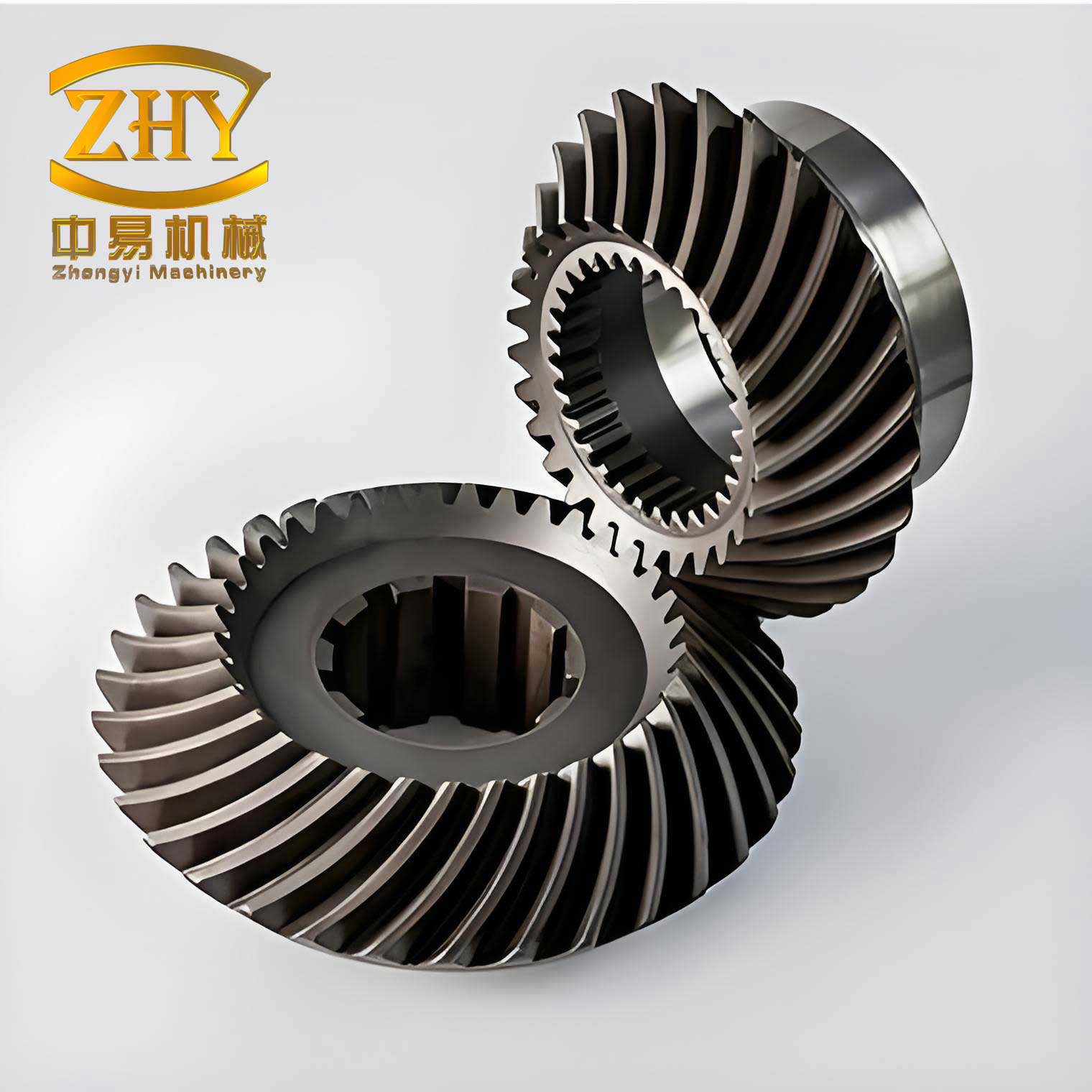
Spiral gears, especially double helical types, are characterized by their symmetric arrangement of left and right helical teeth, which form a V-shaped pattern along the gear axis. The V-shaped vertex is a hypothetical point where the extensions of the tooth contact lines from both helical sections intersect. This vertex is not merely a geometric feature but a critical parameter that affects the axial alignment of the gear during operation. Misalignment of these vertices can cause periodic axial displacements, leading to vibrations and noise, particularly in high-speed applications. Therefore, accurately defining and measuring the V-shaped vertices is essential for optimizing the performance of spiral gears.
Based on the tooth contact line theory, the V-shaped vertex can be defined as the intersection point of the instantaneous contact lines of the left and right helical teeth in a common tangent plane. During meshing, the contact lines are straight lines that lie on the base cylinder and form an angle equal to the base helix angle. For spiral gears, these contact lines from both sides create a V-shape, and their intersection defines the vertex. This definition aligns with the dynamic behavior of spiral gears, as it reflects the actual contact conditions under load, making it more relevant for performance evaluation than static geometric definitions.
To formalize this, consider the tooth surface of a spiral gear. The mathematical model for the right helical tooth surface can be expressed using parametric equations in a Cartesian coordinate system, where the gear axis coincides with the Z-axis. The equations are derived from the geometry of the involute helicoid, which is the surface generated by a straight line (the contact line) performing a helical motion along the base cylinder. For the right helical tooth, the surface parameters are given by:
$$ X(\theta, t) = r_b \cos\theta – t \sin\theta $$
$$ Y(\theta, t) = r_b \sin\theta + t \cos\theta $$
$$ Z(\theta, t) = \frac{P t}{r_b} + P \theta $$
where \( r_b \) is the base radius, \( t \) and \( \theta \) are the surface parameters, \( P \) is the spiral parameter defined as \( P = r_b \cot\beta_b \), and \( \beta_b \) is the base helix angle. These equations describe a family of straight lines that represent the instantaneous contact lines during meshing. Similarly, for the left helical tooth surface, the equations can be derived by adjusting the sign of the spiral parameter or helix angle. This mathematical foundation allows us to analyze the tooth contact lines and their intersections for spiral gears.
The measurement of alignment deviation in spiral gears requires precise instrumentation and a well-defined coordinate system. Typically, a CNC gear measuring center is used, where the gear is mounted on a rotary table aligned with the Z-axis. The probe moves along X, Y, and Z axes, with the origin set at the gear’s rotational axis and the symmetry plane. The measurement process involves scanning the tooth contact lines on both helical sections across multiple teeth to capture the V-shaped vertices. The Full Tooth Contact Line Method involves measuring these contact lines over a specified evaluation interval, which is chosen to minimize the influence of tooth modifications such as profile or lead crowning.
The measurement principle begins with calibrating the coordinate system based on the gear’s reference surfaces, typically the end faces, to establish the symmetry plane as the Z-zero point. For each tooth, the contact lines on the left and right helical sections are measured, resulting in two sets of data points. These points are then fitted using least-squares regression to determine the best-fit lines representing the contact lines. The intersection of these lines for corresponding teeth gives the coordinates of the V-shaped vertices. Specifically, for the i-th tooth, let the measured points on the right helical contact line be \( W_{Ri}(x_{Ri}, y_{Ri}) \) for \( i = 1, 2, \dots, N \), and on the left helical contact line be \( W_{Li}(x_{Li}, y_{Li}) \). The vertex coordinates \( A_i(X_i, Y_i) \) satisfy the following system of equations derived from the line equations:
$$ \frac{ \sum_{R_i=1}^N x_{R_i} \sum_{R_i=1}^N y_{R_i} – N \sum_{R_i=1}^N x_{R_i} y_{R_i} }{ \left( \sum_{R_i=1}^N x_{R_i} \right)^2 – N \sum_{R_i=1}^N x_{R_i}^2 } X_i + \frac{ \sum_{R_i=1}^N x_{R_i}^2 \sum_{R_i=1}^N y_{R_i} – \sum_{R_i=1}^N x_{R_i} \sum_{R_i=1}^N x_{R_i} y_{R_i} }{ N \sum_{R_i=1}^N x_{R_i}^2 – \left( \sum_{R_i=1}^N x_{R_i} \right)^2 } – Y_i = 0 $$
$$ \frac{ \sum_{L_i=1}^N x_{L_i} \sum_{L_i=1}^N y_{L_i} – N \sum_{L_i=1}^N x_{L_i} y_{L_i} }{ \left( \sum_{L_i=1}^N x_{L_i} \right)^2 – N \sum_{L_i=1}^N x_{L_i}^2 } X_i + \frac{ \sum_{L_i=1}^N x_{L_i}^2 \sum_{L_i=1}^N y_{L_i} – \sum_{L_i=1}^N x_{L_i} \sum_{L_i=1}^N x_{L_i} y_{L_i} }{ N \sum_{L_i=1}^N x_{L_i}^2 – \left( \sum_{L_i=1}^N x_{L_i} \right)^2 } – Y_i = 0 $$
Solving these equations yields \( X_i \) and \( Y_i \), where \( Y_i \) represents the axial position of the vertex relative to the symmetry plane. This process is repeated for all teeth to obtain a comprehensive dataset of vertex positions.
From the measured vertex coordinates, several alignment deviation metrics can be calculated to assess the quality of spiral gears. These metrics include:
- Individual Alignment Deviation \( f_{Ai} \): This is the deviation of the i-th vertex’s axial position from the design symmetry plane. It is defined as \( f_{Ai} = Y_i \), with positive values indicating vertices above the plane and negative values below.
- Adjacent Tooth Alignment Difference \( f_{Au} \): This metric captures the variation between consecutive teeth, calculated as the maximum absolute difference between adjacent individual deviations: \( f_{Au} = \max | f_{A(i+1)} – f_{Ai} | \) for \( i = 1, 2, \dots, Z-1 \), where \( Z \) is the number of teeth.
- Total Alignment Deviation \( F_A \): This is the range of individual deviations over all teeth, given by \( F_A = \max(f_{Ai}) – \min(f_{Ai}) \). It reflects the overall misalignment in the spiral gear.
- Symmetry Deviation \( f_{As} \): This is the arithmetic mean of all individual deviations, \( f_{As} = \frac{1}{Z} \sum_{i=1}^Z f_{Ai} \), indicating the average offset from the symmetry plane.
To demonstrate the application of the Full Tooth Contact Line Method, an experimental study was conducted on a double helical gear with specific parameters. The gear had a normal module of 2.5 mm, 27 teeth, a normal pressure angle of 20°, a helix angle of 30°, a single tooth width of 30 mm, and a gap width of 20 mm. The gear was mounted on a CNC gear measuring center, and the contact lines were measured over an evaluation interval from 16 mm to 34 mm from the symmetry plane for the right helical teeth and from -34 mm to -16 mm for the left helical teeth. This interval was chosen to avoid regions affected by tip relief or other modifications.
The measurement results for the spiral gear are summarized in the table below, which shows the individual alignment deviations for each tooth, along with calculated metrics. The data were obtained by scanning all 27 teeth and applying the least-squares fitting procedure to derive the vertex positions.
| Tooth Number (i) | Individual Alignment Deviation \( f_{Ai} \) (mm) | Adjacent Difference \( |f_{A(i+1)} – f_{Ai}| \) (mm) |
|---|---|---|
| 1 | -0.0285 | 0.0012 |
| 2 | -0.0297 | 0.0023 |
| 3 | -0.0274 | 0.0015 |
| 4 | -0.0289 | 0.0031 |
| 5 | -0.0258 | 0.0026 |
| 6 | -0.0284 | 0.0019 |
| 7 | -0.0265 | 0.0028 |
| 8 | -0.0293 | 0.0041 |
| 9 | -0.0252 | 0.0037 |
| 10 | -0.0289 | 0.0024 |
| 11 | -0.0265 | 0.0018 |
| 12 | -0.0283 | 0.0030 |
| 13 | -0.0253 | 0.0029 |
| 14 | -0.0282 | 0.0051 |
| 15 | -0.0231 | 0.0060 |
| 16 | -0.0291 | 0.0025 |
| 17 | -0.0266 | 0.0022 |
| 18 | -0.0288 | 0.0033 |
| 19 | -0.0255 | 0.0027 |
| 20 | -0.0282 | 0.0020 |
| 21 | -0.0262 | 0.0034 |
| 22 | -0.0296 | 0.0028 |
| 23 | -0.0268 | 0.0021 |
| 24 | -0.0289 | 0.0035 |
| 25 | -0.0254 | 0.0023 |
| 26 | -0.0277 | 0.0046 |
| 27 | -0.0323 | — |
From the table, the individual alignment deviations range from -0.0323 mm to -0.0231 mm. The total alignment deviation is calculated as \( F_A = (-0.0231) – (-0.0323) = 0.0092 \) mm. The adjacent tooth alignment difference reaches a maximum of 0.0060 mm between teeth 15 and 16, indicating a localized misalignment. The symmetry deviation is \( f_{As} = \frac{1}{27} \sum_{i=1}^{27} f_{Ai} \approx -0.0274 \) mm, showing a slight average offset below the symmetry plane. These results confirm that the spiral gear meets typical design requirements, with deviations within acceptable limits for high-precision applications.
The measurement data were further analyzed by plotting the contact line errors and vertex positions. The least-squares fitted contact lines for both helical sections showed consistent patterns, with some anomalies in specific teeth, such as tooth 15, which exhibited a larger error likely due to grinding adjustments during manufacturing. This highlights the sensitivity of the Full Tooth Contact Line Method in detecting process variations in spiral gears. The method’s efficiency and accuracy make it suitable for routine inspection and quality control in gear production.
The alignment of V-shaped vertices in spiral gears is crucial for minimizing axial vibrations and ensuring even load distribution. The proposed measurement method provides a quantitative basis for evaluating this parameter, enabling manufacturers to optimize gear design and machining processes. For instance, by monitoring the individual and total alignment deviations, corrective actions can be taken during grinding or honing to improve the symmetry of spiral gears. Additionally, the mathematical model derived from tooth contact lines can be integrated into simulation tools for predicting the dynamic behavior of gear systems under various operating conditions.
In conclusion, the Full Tooth Contact Line Method offers a robust framework for measuring and evaluating the alignment error of V-shaped vertices in spiral gears. By leveraging tooth contact line theory and advanced metrology, this approach addresses the limitations of traditional measurement techniques and provides a comprehensive assessment of gear quality. The experimental results demonstrate the method’s effectiveness in capturing alignment deviations, with metrics such as total alignment deviation and symmetry deviation serving as key indicators for performance evaluation. Future research could explore the impact of circumferential vertex distribution on the传动 behavior of spiral gears, as well as the integration of this method with real-time monitoring systems for adaptive manufacturing. Overall, this work contributes to the advancement of high-precision spiral gear technology, supporting applications in demanding industries where reliability and efficiency are critical.
The mathematical modeling of spiral gears can be extended to include more complex tooth modifications, such as tip relief or lead crowning, which are common in high-performance gears. The general form of the tooth surface equations can be modified to account for these variations. For example, introducing a profile modification function \( \Delta X(\theta, t) \) and a lead modification function \( \Delta Z(\theta, t) \) can refine the model:
$$ X'(\theta, t) = r_b \cos\theta – t \sin\theta + \Delta X(\theta, t) $$
$$ Y'(\theta, t) = r_b \sin\theta + t \cos\theta $$
$$ Z'(\theta, t) = \frac{P t}{r_b} + P \theta + \Delta Z(\theta, t) $$
These modifications allow for more accurate simulations of the contact lines and vertex positions under loaded conditions. Additionally, the measurement process can be automated using CNC programs that scan multiple teeth simultaneously, reducing inspection time and increasing throughput for spiral gears production.
To further illustrate the importance of alignment in spiral gears, consider the dynamic equations of motion for a gear pair. The axial vibration \( \delta_z \) can be related to the alignment deviation \( f_A \) through a stiffness matrix \( K \) and damping matrix \( C \). For a simplified model, the equation of motion in the axial direction is:
$$ m \ddot{\delta}_z + c \dot{\delta}_z + k \delta_z = F(t) – k f_A $$
where \( m \) is the effective mass, \( c \) is the damping coefficient, \( k \) is the axial stiffness, \( F(t) \) is the external force, and \( f_A \) represents the alignment deviation as a forcing term. This equation highlights how misalignment in spiral gears can excite axial vibrations, leading to noise and fatigue. By minimizing \( f_A \) through precise measurement and control, the dynamic performance of spiral gears can be significantly improved.
In practice, the measurement of spiral gears requires careful calibration of the coordinate system. The following table summarizes the key parameters for setting up the measurement on a CNC gear measuring center:
| Parameter | Description | Typical Value for Spiral Gears |
|---|---|---|
| Base Radius \( r_b \) | Radius of the base cylinder | Derived from module and teeth count |
| Helix Angle \( \beta \) | Angle of tooth spiral | 20° to 45° |
| Evaluation Interval | Range for contact line measurement | 60% to 80% of tooth width |
| Number of Points per Line \( N \) | Sampling density on contact lines | 50 to 100 points |
| Probe Radius Compensation | Correction for probe tip geometry | Based on probe calibration |
By adhering to these parameters, the measurement accuracy for spiral gears can be ensured, leading to reliable alignment deviation data. The Full Tooth Contact Line Method thus provides a systematic approach for quality assurance in the manufacturing of spiral gears, enabling producers to meet stringent industry standards.
Overall, the alignment error measurement and evaluation method for spiral gears based on tooth contact lines represents a significant step forward in gear metrology. It bridges the gap between theoretical design and practical manufacturing, offering insights that can drive innovations in gear technology. As the demand for high-efficiency, low-noise传动 systems grows, such advanced measurement techniques will become increasingly vital for the production of precision spiral gears.