
In modern industrial applications, straight bevel gears are widely used in automotive, machine tool, and engineering machinery sectors due to their ease of processing, low cost, and ability to change transmission direction. However, with increasing demands for high performance, low consumption, and high reliability in these fields, the precision requirements for straight bevel gears have become more stringent. Traditional methods for inspecting tooth shape errors in straight bevel gears, such as contact pattern testing, suffer from limitations like difficulty in quantitative description of geometric errors and poor traceability. These methods rely on subjective judgments based on operator experience, which hinders effective process improvement and error diagnosis in manufacturing. To address these issues, we propose a novel measurement and evaluation method for tooth shape errors in straight bevel gears based on the electrical generating principle. This approach leverages advanced CNC gear measurement centers to achieve automated, high-precision assessments with excellent traceability and efficiency.
The tooth shape of a straight bevel gear is theoretically defined as a spherical involute. However, in practical engineering, the spherical involute cannot be developed into a plane, leading to the use of an approximate method where the back cone involute is employed to model the gear tooth. This substitution is justified because the back cone can be unfolded into a plane, and the error introduced by this approximation is minimal. The key idea is to use the tooth profile of the equivalent gear to represent the theoretical tooth shape on the spherical surface of the straight bevel gear’s large end. Thus, the measurement of tooth shape error in straight bevel gears is essentially performed on the back cone involute. Common tooth shape errors in straight bevel gears include issues like “thick top and thin root,” “thin top and thick root,” uneven tooth surfaces, and deviations in pressure angle. These errors adversely affect transmission stability and instantaneous velocity ratio, often stemming from limitations in machine tool accuracy or inappropriate processing parameters.
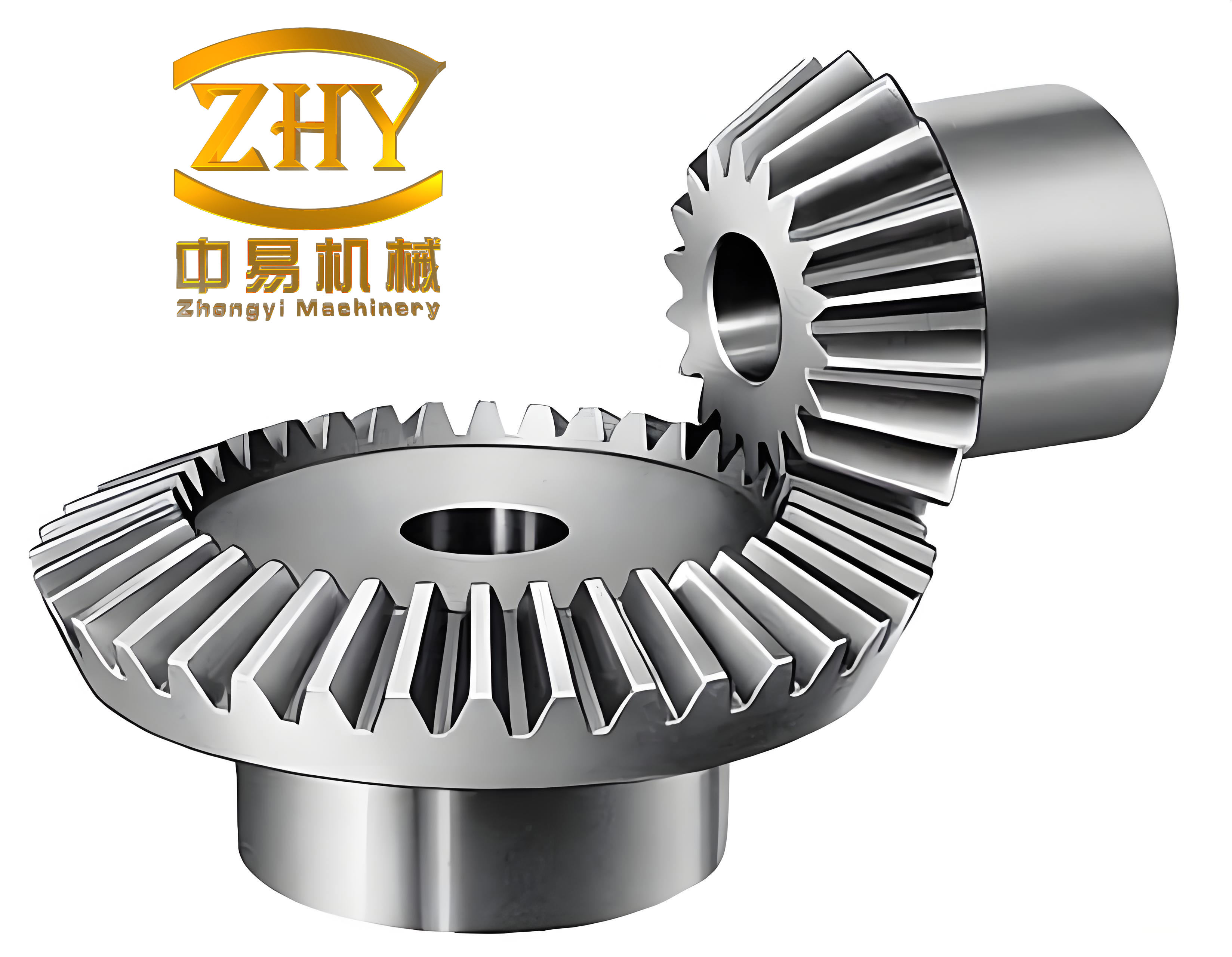
To establish a mathematical model for tooth shape error measurement, we consider the definition of tooth shape error as the normal distance between two theoretical tooth profiles that encompass the actual tooth profile within the working part of the gear. This measurement is typically conducted at the middle of the tooth width. The sensor probe trajectory during measurement follows the theoretical tooth curve, which is derived from the back cone involute. The base circle used for this purpose is the equivalent base circle on the back cone surface. Based on spherical trigonometry, the unfolding angle at any point on the tooth profile can be calculated. For a point P on the tooth surface, the unfolding angle φ_p is given by the length PQ on the spherical surface, which represents an angle. The formula is as follows:
$$ \phi_p = \arccos \left( \frac{\cos \delta_p}{\cos \delta_b} \right) $$
where δ_p is the cone angle at point P, and δ_b is the base cone angle. The unfolding angle at the measurement endpoint, denoted as φ_a, is calculated by replacing δ_p with the tip cone angle δ_a:
$$ \phi_a = \arccos \left( \frac{\cos \delta_a}{\cos \delta_b} \right) $$
The unfolding angle at the measurement start point, φ_1, is determined using a method analogous to that for planar gear engagement, similar to the calculation for cylindrical gears engaging with a rack. The formula for φ_1 is:
$$ \phi_1 = \arccos \left( \frac{\cos \delta_1}{\cos \delta_b} \right) $$
Here, δ_1 is the working cone angle when engaging with a planar gear, which can be derived from spherical trigonometry as:
$$ \delta_1 = \arccos (\cos \delta \cos x + \sin \delta \sin x \sin \alpha) $$
with
$$ \sin x = \frac{\sin \theta_a}{\sin \alpha_0} $$
and
$$ \theta_a = \delta_a – \delta $$
where δ is the pitch cone angle, α is the pitch cone pressure angle, and δ_a is the tip cone angle. The base cone angle δ_b is computed as:
$$ \delta_b = \arcsin (\sin \delta \cos \alpha) $$
This method for calculating the start point unfolding angle is generally applicable when the parameters of the mating gear are unknown, ensuring reliable and reasonable measurement range for the tooth profile. If δ_1 is less than δ_b, φ_1 is set to 0°.
The electrical generating method replaces mechanical generating devices with a computer-controlled system comprising controllers, servo drives, and transmission mechanisms to form specific curve trajectories, such as tooth profiles. In this approach, the CNC system operates under closed-loop control, and the gear measurement instrument typically includes a rotatable turntable and a probe holder capable of three-dimensional movement. For straight bevel gears, the measurement involves controlling the main axis W along with Y and Z axes to simulate the theoretical tooth curve on the back cone. The probe trajectory is perpendicular to the generatrix of the pitch cone, and during continuous scanning, the system collects real-time coordinate data from the probe and motion axes. This data is processed to plot error curves and automatically evaluate tooth shape errors.
Our software system is developed using object-oriented programming principles, encapsulating data and methods into modular components. This modular design enhances system maintainability, scalability, and reduces coupling between modules. The key parameters involved in the measurement process are summarized in the table below:
| Parameter | Symbol | Description |
|---|---|---|
| Cone Angle at Point P | δ_p | Angle at any point on the tooth surface |
| Base Cone Angle | δ_b | Angle of the base cone |
| Tip Cone Angle | δ_a | Angle at the tip of the tooth |
| Pitch Cone Angle | δ | Angle of the pitch cone |
| Pitch Cone Pressure Angle | α | Pressure angle on the pitch cone |
| Unfolding Angle at Point P | φ_p | Calculated angle for point P |
| Unfolding Angle at Endpoint | φ_a | Angle at the measurement endpoint |
| Unfolding Angle at Start Point | φ_1 | Angle at the measurement start point |
To validate the proposed method, we conducted experiments on a 3906T-type CNC gear measurement center. The straight bevel gear was mounted between the upper and lower centers of the instrument, and a coordinate system was established. The gear parameters used in the experiment are as follows:
| Parameter | Value |
|---|---|
| Number of Teeth | 20 |
| Module | 4 mm |
| Pitch Cone Angle | 30° |
| Tip Cone Angle | 35° |
| Pressure Angle | 20° |
| Face Width | 25 mm |
During the measurement, the sensor probe was controlled to scan along the theoretical tooth curve on the back cone surface. The continuous scanning process provided sensor readings that were used to determine the tooth shape error. The error evaluation was performed using the least squares method, which computes the total profile deviation, form deviation, and slope deviation. The pressure angle error, which indicates the deviation from the theoretical value, can be calculated using the formula:
$$ \Delta \lambda = \arctan \left( \frac{f_{H\alpha}}{L} \right) $$
where Δλ is the pressure angle error in degrees, f_{Hα} is the profile slope deviation in millimeters, and L is the evaluation length in millimeters. For instance, in our experiment on the right tooth surface, we obtained f_{Hα} = -0.1591 mm and L = 23.457 mm, leading to:
$$ \Delta \lambda = \arctan \left( \frac{-0.1591}{23.457} \right) = -0.388^\circ $$
This result indicates that the pressure angle of the measured straight bevel gear is larger than the theoretical value by 0.388°, which can be corrected by adjusting machine tool parameters. The measurement results for the tooth shape error are summarized below:
| Error Type | Symbol | Value (mm) |
|---|---|---|
| Total Profile Deviation | F_α | 0.210 |
| Profile Form Deviation | f_fα | 0.095 |
| Profile Slope Deviation | f_{Hα} | -0.159 |
The electrical generating method for straight bevel gear tooth shape error measurement offers several advantages over traditional approaches. It enables automated, high-precision measurements on existing CNC gear measurement centers, with improved efficiency and traceability. The method’s reliance on mathematical models and real-time data acquisition ensures objective and quantitative error assessment, facilitating better process control and quality improvement in straight bevel gear manufacturing. Moreover, the modular software design allows for easy maintenance and upgrades, making it adaptable to various industrial requirements.
In conclusion, our proposed method based on the electrical generating principle effectively addresses the limitations of traditional tooth shape error inspection for straight bevel gears. By establishing accurate mathematical models and leveraging CNC technology, we achieve reliable measurement and evaluation of tooth shape errors. Experimental results confirm the method’s feasibility, with high automation levels and excellent traceability. This approach not only enhances the quality control of straight bevel gears but also contributes to the advancement of gear measurement technology, supporting the development of high-performance transmission systems in critical industries.
Further research could focus on extending this method to other types of bevel gears, such as spiral bevel gears, and integrating artificial intelligence for predictive error correction. The continuous improvement of measurement algorithms and hardware systems will further solidify the role of electrical generating methods in precision gear manufacturing, ensuring that straight bevel gears meet the evolving demands of modern engineering applications.