
In modern manufacturing, the precision of spur gears is critical for ensuring the efficiency and reliability of mechanical systems. Coordinate Measuring Machines (CMMs) are widely used for dimensional inspection due to their versatility and high accuracy. However, measuring complex components like spur gears often requires specialized software to handle the intricate geometries and deviations. This paper presents a comprehensive method for measuring cylindrical spur gears on CMMs, including the development of dedicated software. We focus on evaluating profile deviations and pitch deviations, which are essential for assessing gear quality according to international standards. The approach involves mathematical modeling of spur gears, probe calibration, coordinate system establishment using an iterative method, and path planning for the probe. A custom software solution is developed to generate measurement programs compatible with PC-DMIS, enabling automated measurement and evaluation. Experimental results demonstrate the effectiveness of our method, with comparisons to gear measuring centers showing strong consistency. This work highlights the potential for CMMs to perform precise gear inspections through software customization, offering a reference for secondary development in complex part measurement.
The measurement of spur gears on CMMs begins with understanding their geometric properties. Spur gears are characterized by their straight teeth parallel to the axis, and deviations in profile and pitch can lead to noise, vibration, and reduced lifespan. Our method addresses these issues by deriving theoretical coordinates and normal vectors for key feature points. For profile deviations, points are sampled along the tooth flank in the mid-plane of the gear width, while pitch deviations are measured at the pitch circle. The mathematical model is based on gear parameters such as module, pressure angle, and number of teeth. For instance, the theoretical coordinates of a point on the tooth profile for spur gears can be expressed using involute functions. Let \( r_b \) be the base radius, \( \phi_j \) the roll angle, and \( \epsilon_i \) the angle related to tooth position. The coordinates \( (x_{T\alpha ij}, y_{T\alpha ij}, z_{T\alpha ij}) \) for the left flank (with \( f = 1 \)) or right flank (with \( f = -1 \)) are given by:
$$ x_{T\alpha ij} = r_b \cos(\epsilon_i – f \phi_j) – f r_b \phi_j \sin(\epsilon_i – f \phi_j) $$
$$ y_{T\alpha ij} = r_b \sin(\epsilon_i – f \phi_j) + f r_b \phi_j \cos(\epsilon_i – f \phi_j) $$
$$ z_{T\alpha ij} = -\frac{b}{2} $$
where \( b \) is the face width. The normal vector \( \mathbf{n}_{T\alpha ij} = (i_{T\alpha ij}, j_{T\alpha ij}, k_{T\alpha ij}) \) is derived as:
$$ i_{T\alpha ij} = \cos \beta \cos(\epsilon_i + f(-\phi_j + \pi/2)) $$
$$ j_{T\alpha ij} = \cos \beta \sin(\epsilon_i + f(-\phi_j + \pi/2)) $$
$$ k_{T\alpha ij} = H \sin \beta $$
Here, \( \beta \) is the helix angle (zero for spur gears), and \( H \) indicates the hand of the helix (0 for spur gears). Similarly, for pitch deviation measurements, points on the pitch circle are defined with coordinates \( (x_{Tpi}, y_{Tpi}, z_{Tpi}) \) and normal vectors \( \mathbf{n}_{Tpi} \). For spur gears, the calculation simplifies due to \( \beta = 0 \). The angle \( \theta_i \) for each tooth is computed based on the tooth number and gear parameters.
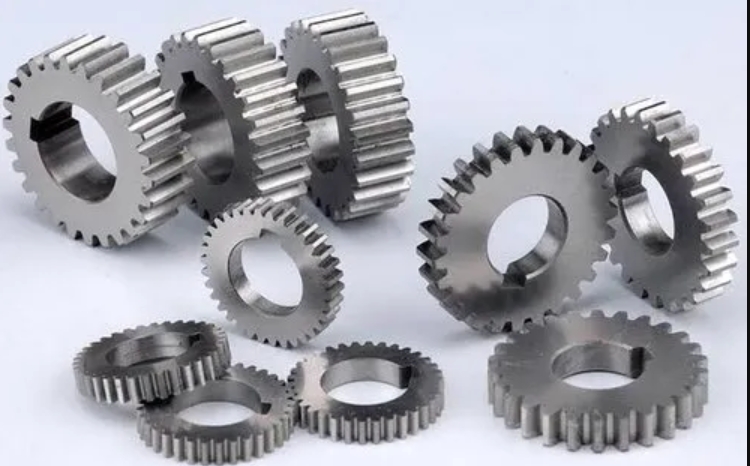
Probe calibration is a crucial step in CMM measurements to account for the probe ball’s actual diameter and ensure accurate radius compensation. We use a reference sphere of known radius \( R_C \) and collect at least five points on its surface. The probe ball radius \( r_p \) is then calculated as \( r_p = R_f – R_C \), where \( R_f \) is the fitted sphere radius from least-squares minimization. This process reduces errors in point coordinates, which are adjusted using the normal vector. For a measured point with probe ball center \( (x_S, y_S, z_S) \) and normal vector \( (i_Q, j_Q, k_Q) \), the actual contact point \( (x_Q, y_Q, z_Q) \) is given by:
$$ x_Q = x_S – i_Q r_p $$
$$ y_Q = y_S – j_Q r_p $$
$$ z_Q = z_S – k_Q r_p $$
Establishing the workpiece coordinate system (WCS) for spur gears involves both rough and fine alignment. Initially, we manually rough-align the WCS by measuring points on the gear’s top face and inner bore to define the Z-axis and origin. The X-axis is approximated by symmetrically sampling points on a tooth’s left and right flanks. Fine alignment uses an iterative method to refine the X-axis direction. We define a convergence criterion \( \epsilon \) (e.g., 1 μm) and measure points on the left and right flanks of a tooth in the current WCS. The Y-coordinates of these points, \( y_{Lk} \) and \( y_{Rk} \), are checked for symmetry. If \( |y_{Lk} + y_{Rk}| > \epsilon \), we update the X-axis by projecting the line from the origin to the midpoint of the flank points. This iteration continues until convergence, ensuring precise alignment for accurate measurement of spur gears.
Path planning for the probe is essential to avoid collisions and ensure efficient measurement. For spur gears, we use a fixed probe angle (e.g., A0B0) and plan movements between teeth. For example, in pitch deviation measurement, the probe moves from a safe point to approach a feature point, touches it, retracts, and moves to the next tooth. This sequence is automated in the measurement program to cover all teeth. The generated path includes approach points, touch points, and retraction points, optimizing the measurement time while maintaining accuracy.
Our dedicated software for spur gear measurement on CMMs is developed using Python and integrates with PC-DMIS through dynamic link libraries. The software structure includes modules for gear parameter input, path planning, program generation, deviation evaluation, and report export. Users can input gear parameters such as module, pressure angle, number of teeth, and face width, and the software computes the theoretical feature points and normal vectors. It then generates PC-DMIS-compatible measurement code, which is executed on the CMM. After measurement, the software processes the data to evaluate profile and pitch deviations according to standards like GB/T 10095.1-2022 (equivalent to ISO 1328-1:2013). The interface allows users to view results in tables and graphs, facilitating quick analysis.
To validate our method, we conducted experiments on a HXG GLOBAL S CMM with a spur gear having 24 teeth, 4.5 mm module, 20° pressure angle, -0.5 profile shift coefficient, and 20 mm face width. The CMM has a measurement volume of 1200 mm × 1500 mm × 1000 mm and a maximum permissible error of 2.1 + 2.8L/1000 μm. We used a probe with a 90 mm stem and 3 mm ball, calibrated to an actual diameter of 3.000 mm with a standard deviation of 0.2 μm. After probe calibration, we established the WCS using the iterative method, achieving convergence in three iterations with \( |y_{L3} + y_{R3}| = 0.2 \mu m \). We then measured profile and pitch deviations automatically.
For pitch deviations, we performed five repeated measurements across all teeth. The results, summarized in Table 1, show the mean single pitch deviation \( f_p \) and total cumulative pitch deviation \( F_p \) for left and right flanks. The standard deviations indicate good repeatability. Based on GB/T 10095.1-2022, the pitch accuracy is graded as level 7.
| Measurement | Left Flank \( f_p \) (μm) | Left Flank \( F_p \) (μm) | Right Flank \( f_p \) (μm) | Right Flank \( F_p \) (μm) |
|---|---|---|---|---|
| 1 | 9.5 | 41.3 | 8.0 | 33.1 |
| 2 | 9.5 | 42.9 | 7.6 | 36.4 |
| 3 | 9.0 | 43.0 | 7.7 | 35.1 |
| 4 | 8.7 | 40.7 | 8.7 | 32.9 |
| 5 | 8.7 | 39.9 | 7.6 | 32.1 |
| Mean | 9.1 | 41.6 | 7.9 | 33.9 |
| Std. Dev. | 0.4 | 1.4 | 0.5 | 1.8 |
For profile deviations, we measured four teeth evenly distributed around the gear and repeated the process five times. Table 2 presents the mean values of total profile deviation \( F_\alpha \), profile form deviation \( f_{f\alpha} \), and profile slope deviation \( f_{H\alpha} \), along with their standard deviations. The results show that the profile accuracy is graded as level 9, with \( F_\alpha = 26.7 \mu m \), \( f_{f\alpha} = 13.9 \mu m \), and \( f_{H\alpha} = -18.6 \mu m \) for the worst-case tooth.
| Tooth | Flank | \( F_\alpha \) (μm) | \( \sigma_\alpha \) (μm) | \( f_{f\alpha} \) (μm) | \( \sigma_{f\alpha} \) (μm) | \( f_{H\alpha} \) (μm) | \( \sigma_{H\alpha} \) (μm) |
|---|---|---|---|---|---|---|---|
| 1 | Left | 20.2 | 0.3 | 11.4 | 0.4 | -13.3 | 0.4 |
| Right | 19.1 | 0.6 | 8.8 | 0.4 | -12.1 | 1.0 | |
| 7 | Left | 15.7 | 0.5 | 12.4 | 0.3 | -7.9 | 0.7 |
| Right | 15.6 | 0.6 | 12.4 | 0.5 | -4.8 | 0.8 | |
| 13 | Left | 23.0 | 0.4 | 13.9 | 0.3 | -15.8 | 0.8 |
| Right | 16.6 | 0.9 | 10.6 | 0.3 | -7.0 | 0.5 | |
| 19 | Left | 15.9 | 0.9 | 11.5 | 0.4 | -9.2 | 0.6 |
| Right | 26.7 | 0.5 | 11.3 | 0.4 | -18.6 | 0.7 |
We compared our CMM results with those from a Klingelnberg P100 gear measuring center. The P100 measurements, shown in Table 3 for pitch deviations and Table 4 for profile deviations, exhibit similar accuracy grades. The differences between CMM and P100 results are minimal, with the maximum absolute difference in pitch deviations being 1.3 μm and in profile deviations being 1.9 μm. This consistency validates our method for spur gear measurement on CMMs.
| Instrument | Left Flank \( f_p \) (μm) | Left Flank \( F_p \) (μm) | Right Flank \( f_p \) (μm) | Right Flank \( F_p \) (μm) |
|---|---|---|---|---|
| CMM | 9.1 | 41.6 | 7.9 | 33.9 |
| P100 | 8.9 | 41.3 | 9.2 | 34.5 |
| Difference | 0.2 | 0.3 | -1.3 | -0.6 |
| Tooth | Flank | \( \Delta f_{H\alpha} \) (μm) | \( \Delta F_\alpha \) (μm) | \( \Delta f_{f\alpha} \) (μm) |
|---|---|---|---|---|
| 1 | Left | -1.7 | 0.4 | -0.4 |
| Right | -0.7 | 0.9 | 0.8 | |
| 7 | Left | -1.9 | 1.0 | 0.8 |
| Right | -0.9 | 1.0 | 1.0 | |
| 13 | Left | -1.6 | 0.1 | -0.1 |
| Right | -0.7 | 0.8 | 0.4 | |
| 19 | Left | -1.2 | 0.3 | 0.5 |
| Right | -1.1 | 1.2 | 0.9 |
In conclusion, we have developed a robust method for measuring cylindrical spur gears on CMMs, incorporating mathematical modeling, probe calibration, iterative coordinate system alignment, and path planning. The dedicated software enables automated measurement and evaluation of profile and pitch deviations, with results consistent with specialized gear measuring centers. This approach demonstrates the feasibility of using CMMs for precise spur gear inspection through software customization, providing a foundation for further developments in complex part measurement. Future work could extend this method to helical gears or other gear types, enhancing the versatility of CMMs in industrial applications.