
In my years of working with mechanical power transmission systems, I have frequently encountered the need to measure and replicate worn or damaged Archimedes cylindrical worm gears. These gears, also known as ZA-type worm gears, are widely used in heavy machinery such as metallurgical equipment, mining conveyors, and cranes due to their high reduction ratios, compact design, and relative ease of manufacturing. However, when they fail, accurate measurement is critical for replacement or repair. In this article, I will share my systematic approach to measuring Archimedes cylindrical worm gears, covering both the worm and the worm wheel, with detailed formulas, tables, and a real-world example. The focus is on practical shop-floor techniques that yield reliable results without requiring expensive coordinate measuring machines.
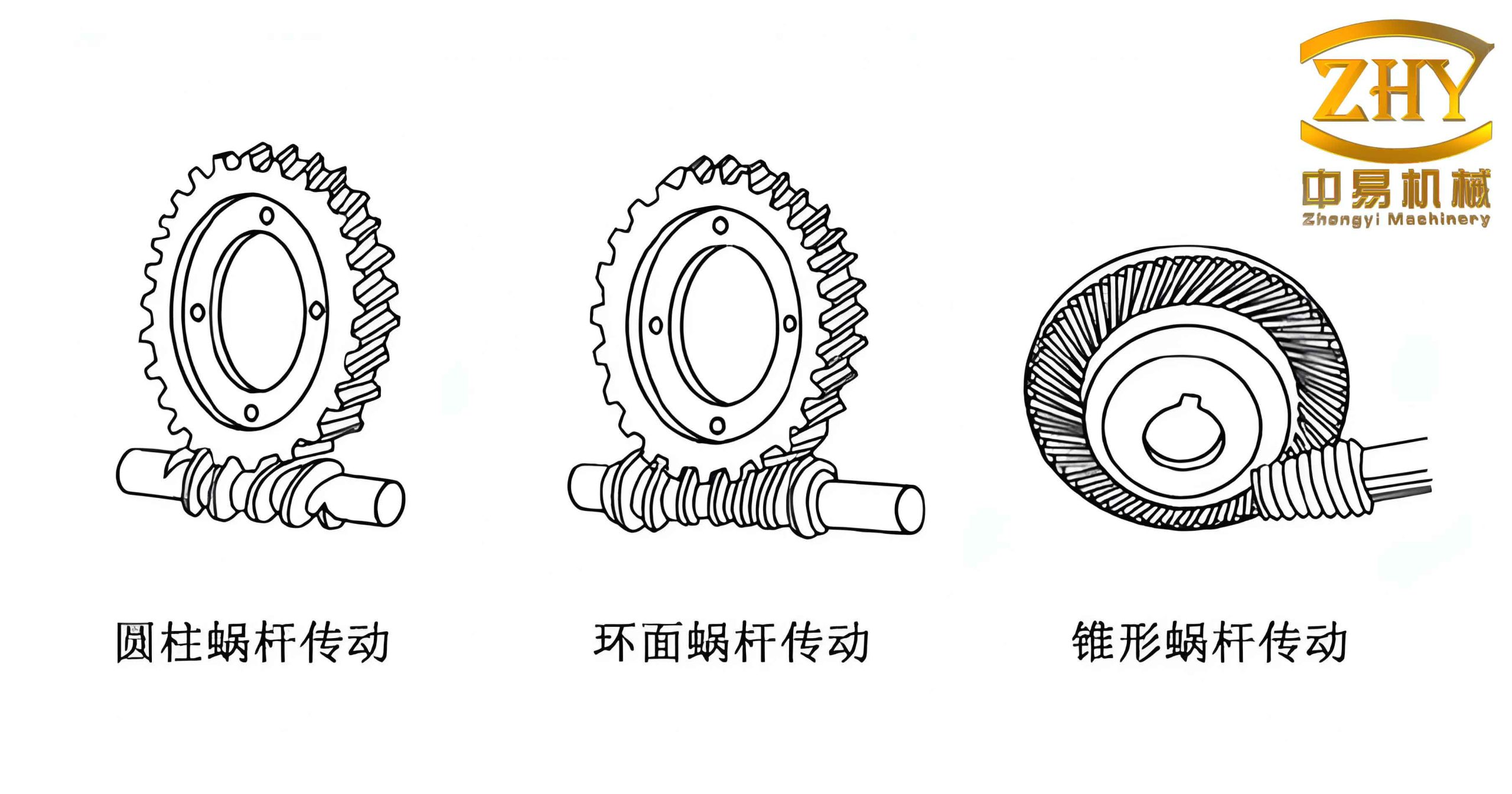
Identifying the Archimedes Worm Gear Type
The first step in measuring any worm gear is to confirm it is indeed an Archimedes cylindrical worm. The defining characteristic is that the axial tooth profile is a straight line. I typically use a precision steel ruler placed along the axial direction of the worm. If the ruler fits snugly against the tooth flank without visible gaps, the gear is of the Archimedes type. This simple test distinguishes it from other helical or involute worm forms. Once confirmed, I proceed with detailed parameter extraction.
Measuring the Axial Profile Angle
The profile angle α (or pressure angle) is a fundamental parameter. For metric module worm gears, the standard axial profile angle is 20°. For diametral pitch systems, values like 14.5° or 20° are common. I use a universal bevel protractor or a standard tooth profile template. Placing the template against the axial section of the worm tooth, I observe the fit. If the template for 20° matches perfectly, α = 20°. Alternatively, when machining a replacement worm, I can set the lathe compound rest to the desired angle and check with the template. According to many standards (such as GB/T 10086-1988), the recommended axial profile angle for Archimedes worms is 20°. The measured value is recorded for later calculations.
Determining the Axial Module
The axial module m is derived from the axial pitch px. Using a steel rule or a vernier caliper, I measure the axial distance across several tooth spaces. To improve accuracy, I measure over k pitches (e.g., 5 or 6 pitches) and then divide by that number. Let total measured length be Lp over n pitches. Then:
$$p_x = \frac{L_p}{n}$$
The axial module is then:
$$m = \frac{p_x}{\pi}$$
If the calculated value does not match a standard module (e.g., 1, 1.25, 1.5, 2, 2.5, 3, 4, 5, 6, 8, 10, 12, 16, 20, 25, 32, 40, 50 mm), I check for diametral pitch (DP) systems using the conversion:
$$DP = \frac{25.4}{m}$$
I then round to the nearest standard DP value and recalculate m accordingly. Below is a table of common standard modules and corresponding diametral pitches for quick reference.
| Module m (mm) | Diametral Pitch DP (in⁻¹) |
|---|---|
| 1 | 25.4 |
| 1.25 | 20.32 |
| 1.5 | 16.933 |
| 2 | 12.7 |
| 2.5 | 10.16 |
| 3 | 8.467 |
| 4 | 6.35 |
| 5 | 5.08 |
| 6 | 4.233 |
| 8 | 3.175 |
| 10 | 2.54 |
| 12 | 2.117 |
For example, if my measured axial pitch is 9.424 mm, then m = 9.424/π ≈ 3.00 mm, which is a standard module. In practice, I repeat the measurement in three different locations along the worm and take the average to minimize wear effects.
Calculating the Lead Angle
The lead angle γ (also called the helix angle at the pitch cylinder) is critical for meshing. It depends on the module m, the number of starts (threads) z1 of the worm, and the pitch circle diameter d1. First, I measure the worm tip (outside) diameter da1. For a standard worm, the addendum is equal to m, so the pitch circle diameter is:
$$d_1 = d_{a1} – 2m$$
Then the lead angle is given by:
$$\tan\gamma = \frac{m z_1}{d_1} = \frac{m z_1}{d_{a1} – 2m}$$
I can also measure the lead directly by marking one tooth and measuring the axial advance over one complete revolution of the worm. Let L be the lead (distance traveled axially in one turn). Then:
$$\tan\gamma = \frac{L}{\pi d_1}$$
Both methods should agree. In my experience, the tooth tip diameter measurement is more accessible. For example, if da1 = 72 mm, m = 3 mm, and z1 = 2, then d1 = 72 – 6 = 66 mm, and tanγ = (3 × 2)/66 = 6/66 = 0.09091, so γ ≈ 5.19°. The computed lead angle is then used to determine the worm pitch circle diameter precisely. Note that standards like GB/T 10086-1988 define a coefficient q (diameter quotient) such that q = d1/m. But in field measurement, non-standard q values are common; the lead angle calculation is always valid.
Measuring the Worm Wheel (Gear)
For the mating worm wheel, I first check the number of teeth z2 by counting them. Then, the pitch circle diameter of the worm wheel (without profile shift) is:
$$d_2 = m z_2$$
However, many worm gear sets employ profile shift (addendum modification) to achieve a desired center distance or to improve contact characteristics. Therefore, I measure the actual center distance am using a surface plate, height gages, and appropriate fixtures. Place the worm and worm wheel in their approximate meshing position on the plate, measure the distances from their respective centers to a reference datum, and compute the center distance. If the worm is still assembled in its housing, I measure the housing bore centers directly.
Let a0 be the theoretical center distance for a non-shifted pair:
$$a_0 = \frac{d_1 + d_2}{2} = \frac{m}{2}\left(\frac{z_1}{\tan\gamma} + z_2\right)$$
Alternatively, using the measured d1 and d2 from the worm measurement, compute a0. If the measured center distance am ≠ a0, then the worm wheel is profile-shifted. The shift coefficient x (addendum modification coefficient) for the worm wheel is:
$$x = \frac{a_m – a_0}{m}$$
A positive shift means the worm wheel is moved outward, common for achieving center distances larger than standard. The formula can also be written as:
$$x = \frac{a_m}{m} – \frac{1}{2}\left(\frac{z_1}{\tan\gamma} + z_2\right)$$
I always verify that the worm diameter and module are consistent. For example, if the worm lead angle is known, the worm pitch diameter can be recalculated as d1 = m z1 / tanγ. This should match the value obtained from tip diameter minus 2m. If discrepancies appear, I re-measure the axial pitch and tip diameter.
Comprehensive Parameter Table for a Measured Worm Gear Set
During a typical field measurement, I record all parameters in a structured table. Below is an example template that I use, filled with values from a real sawing machine worm gear set I once worked on.
| Parameter | Symbol | Measured Value | Unit | Notes |
|---|---|---|---|---|
| Worm thread starts | z₁ | 2 | – | Counted |
| Worm wheel teeth | z₂ | 45 | – | Counted |
| Axial profile angle | α | 20 | ° | Checked with template |
| Total axial pitch over 3 pitches | Lp | 28.27 | mm | Measured with vernier caliper |
| Axial pitch (Lp/3) | px | 9.4233 | mm | Average of 3 measurements |
| Axial module | m | 3.00 | mm | px/π = 9.4233/π |
| Worm tip diameter | da1 | 72.0 | mm | Measured with micrometer |
| Worm pitch diameter | d1 | 66.0 | mm | d1 = da1 – 2m |
| Worm lead angle | γ | 5.20 | ° | tanγ = m z₁ / d₁ = 6/66 |
| Worm wheel pitch diameter (non-shifted) | d2 | 135.0 | mm | d2 = m z₂ = 3×45 |
| Measured center distance | am | 105.0 | mm | Measured on surface plate |
| Theoretical center distance (non-shifted) | a0 | 100.5 | mm | (d₁+d₂)/2 = (66+135)/2 |
| Center distance difference | Δa | 4.5 | mm | am – a0 |
| Worm wheel shift coefficient | x | 1.50 | – | Δa / m = 4.5/3.0 |
This table captures all essential parameters. The shift coefficient x = 1.5 indicates a significant addendum modification. I then verify that the worm wheel blank dimensions (tip diameter, root diameter) match the calculated values for x = 1.5. If not, I check for wear or previous non-standard repairs.
Detailed Measurement Steps and Practical Considerations
Let me walk through a complete measurement procedure step by step:
- Step 1 – Visual inspection and tooth count: Clean the worm gears thoroughly. Count the number of starts on the worm (z₁) and teeth on the wheel (z₂). Note the hand of helix (right-hand or left-hand). Both must be the same.
- Step 2 – Profile angle verification: Use a standard 20° template and a straightedge along the axial plane of the worm. For the wheel, I use a gear tooth caliper to check the pressure angle on the normal plane, but since the wheel is usually cut with a hob that matches the worm, the axial profile angle of the worm determines the wheel tooth shape. If the template does not fit, try other standard angles (14.5°, 15°, 25°).
- Step 3 – Measuring axial pitch and module: As described, measure over multiple pitches. For worn teeth, use the unworn portions closer to the root. I prefer using a caliper with a sharp jaw for better contact. Record three sets of measurements and average.
- Step 4 – Worm outside diameter: Measure at two or three locations along the worm length, avoiding any damage or burrs. Use a micrometer. The difference between max and min should be within 0.02 mm for a good worm.
- Step 5 – Lead angle calculation: Compute d₁ = da1 – 2m, then tanγ = m z₁ / d₁. Alternatively, measure the lead directly: mark a point on one tooth, rotate the worm exactly one revolution, measure the axial movement (lead L). Then tanγ = L / (π d₁). Comparing both methods gives confidence.
- Step 6 – Worm wheel pitch diameter: Since the wheel is often worn or has unknown shift, I do not rely on measuring its tip diameter directly. Instead, I use the module and tooth count: nominal d₂ = m z₂. But for shifted wheels, the actual operating pitch circle is not the same. The center distance measurement is the key.
- Step 7 – Center distance measurement: I set the worm and wheel on a precision surface plate. For the worm, I mount it on V-blocks and measure the height of the centerline. For the wheel, I place it on a mandrel or use its bore if clean. Use height gages and a dial indicator to find the center of each. The difference in heights gives the vertical center distance. To ensure accuracy, I repeat with the worm rotated 180°. The measured center distance am is then compared with a0. If am > a0, the worm wheel has positive shift; if smaller, negative shift (rare).
- Step 8 – Shift coefficient calculation: x = (am – a0) / m. This x is used to compute all other wheel dimensions from standard formulas.
- Step 9 – Verification using wheel blank dimensions: Measure the wheel tip diameter da2 and root diameter df2. For a standard wheel with shift, da2 = m (z₂ + 2 + 2x) and df2 = m (z₂ – 2.5 + 2x) (assuming addendum = m, dedendum = 1.25m). If the measured values match the calculated ones (within wear allowances), the measurements are consistent.
- Step 10 – Final checks: Ensure the worm lead angle equals the wheel helix angle. The helix angle β of the wheel at its pitch cylinder is given by tanβ = π d₂ / (lead of wheel). Since the wheel lead is equal to the worm lead (L = m z₁ π / tanγ? Actually careful: For a single-thread worm, lead = px * z₁. The wheel’s helical lead is same as worm lead. The helix angle β satisfies tanβ = L / (π d₂) = (m z₁ π / tanγ) / (π d₂)? Let’s derive: L = π d₁ tanγ? No, lead = axial advance per revolution = z₁ * px = z₁ * π m. Also, tanγ = px z₁ / (π d₁) = (π m z₁) / (π d₁) = m z₁ / d₁. So L = π d₁ tanγ = π m z₁. Then for wheel, tanβ = L / (π d₂) = (π m z₁) / (π m z₂) = z₁ / z₂. So β is not equal to γ in general; rather the helix angle of wheel complements γ? Actually, for crossed axes shafts at 90°, the worm lead angle γ and wheel helix angle β satisfy γ + β = 90°. So check that γ + β ≈ 90°. For the example, γ = 5.2°, so β should be 84.8°. But β = arctan(z₁/z₂) = arctan(2/45) ≈ 2.545°, clearly not 84.8°. The correct relationship is that the worm lead angle γ and the wheel helix angle at its pitch cylinder are complementary only when the shaft angle is 90° and the worm diameter is not too large? Actually, standard relation: tanγ = (m z₁) / d₁, and for wheel, tanβ = (m z₂) / d₂. They are not complementary. Instead, the sum γ + β = 90° holds when the shaft angle is 90° and the worm and wheel pitch cylinders are tangent? No, the correct condition is that the helix angles on the two components are measured on their respective pitch cylinders. For crossed helical gears with shaft angle Σ, we have β₁ ± β₂ = Σ, where β₁ is the helix angle of the worm (which is 90° – γ for a worm? Actually, worm has a lead angle γ, and its helix angle is 90° – γ. For the worm wheel, its helix angle is β. For Σ = 90°, we have (90° – γ) + β = 90°, so β = γ. Yes! Because the worm’s helix angle (angle between tooth and axis) is 90° – γ. The worm wheel’s helix angle (same definition) is β. The shaft angle is 90°, so (90° – γ) + β = 90° => β = γ. So the worm wheel helix angle β equals the worm lead angle γ. This is a key check. In my example, γ = 5.2°, so β must also be 5.2°. Then tanβ = tanγ = 0.0909. But tanβ also equals (π m z₂) / (lead of wheel)? Actually, the wheel lead (axial advance per revolution of wheel) is L₂ = π d₂ tanγ. Since d₂ = m z₂, L₂ = π m z₂ tanγ = π m z₂ * (m z₁ / d₁) = something. But the relationship simplifies: verifying that the wheel teeth have the correct helix angle can be done by measuring the wheel’s outside diameter and root diameter and checking against the calculated ones using the shift coefficient. The consistency test is more practical: use a gear tooth vernier to measure the chordal tooth thickness at the pitch circle. The standard tooth thickness for a shifted gear can be computed. If the measured chordal thickness matches within 0.1 mm, the parameters are correct.
Practical Example – A Worn Saw Machine Worm Gear Set
I encountered a case where a sawing machine had a severely worn worm gear pair. The worm had 2 starts and the wheel had 45 teeth. Initially, I could not find any identification marks. I proceeded as follows: using a 20° template, the axial profile fit exactly, confirming Archimedes type. I measured three axial pitches: 9.40 mm, 9.45 mm, 9.42 mm, average 9.4233 mm, giving module = 3.00 mm. Worm tip diameter was 72.0 mm, so d₁ = 72 – 6 = 66.0 mm. Then tanγ = (3×2)/66 = 0.09091, γ = 5.20°. The wheel had 45 teeth, so nominal d₂ = 3×45 = 135.0 mm. The measured center distance was 105.0 mm, while theoretical a₀ = (66+135)/2 = 100.5 mm. Thus shift coefficient x = (105-100.5)/3 = 1.5. I then calculated the wheel tip diameter for x=1.5: da2 = m(z₂ + 2 + 2x) = 3(45+2+3)=3×50=150 mm. I measured the wheel tip diameter and got 149.8 mm, close considering wear. The root diameter: df2 = m(z₂ – 2.5 + 2x) = 3(45 – 2.5 + 3) = 3×45.5 = 136.5 mm. Measurement gave 136.3 mm. These close agreements validated the data. I then ordered a new wheel cut with the same shift and a new worm with the same module and lead angle. The replacement set worked perfectly.
Common Errors and How to Avoid Them
In measuring worm gears, several pitfalls exist. First, wear on the tooth flanks can reduce the measured axial pitch, especially if the worm has been operating with misalignment. I always measure on the dedendum side where wear is minimal. Second, for the worm wheel, the teeth may be worn at the tips; thus using the tip diameter to determine shift is unreliable. Center distance measurement is more robust. Third, the profile angle may not be exactly 20° if the worm was manufactured to an old standard; using a set of templates (14.5°, 15°, 20°, 25°) helps. Fourth, when measuring the worm tip diameter, ensure the micrometer contacts the true tip, not a burr. I often polish the tip lightly with fine emery cloth.
Summary of Key Formulas
For quick reference, I list all important formulas used in my measurement procedure:
| Parameter | Formula |
|---|---|
| Axial module m | $$m = \frac{p_x}{\pi}$$ where px = measured axial pitch |
| Worm pitch diameter d₁ | $$d_1 = d_{a1} – 2m$$ |
| Worm lead angle γ | $$\tan\gamma = \frac{m z_1}{d_1} = \frac{m z_1}{d_{a1} – 2m}$$ |
| Worm wheel pitch diameter (non-shifted) d₂ | $$d_2 = m z_2$$ |
| Theoretical non-shifted center distance a₀ | $$a_0 = \frac{d_1 + d_2}{2}$$ |
| Worm wheel shift coefficient x | $$x = \frac{a_m – a_0}{m}$$ |
| Wheel tip diameter da2 (with shift) | $$d_{a2} = m (z_2 + 2 + 2x)$$ |
| Wheel root diameter df2 (with shift) | $$d_{f2} = m (z_2 – 2.5 + 2x)$$ |
| Wheel helix angle β (should equal γ) | $$\tan\beta = \frac{\pi m z_2}{\text{lead of wheel}}$$ but easier: β = γ (for 90° shaft angle) |
Conclusion
Measuring Archimedes cylindrical worm gears requires a methodical approach combining simple hand tools with algebraic verification. By focusing on the axial profile, pitch, tip diameter, and center distance, I can reliably determine all essential parameters including module, lead angle, and profile shift. The use of tables and formulas ensures consistency and reduces errors. This method has served me well in many field repairs and replacement machining jobs. Worm gears are robust but precise; careful measurement guarantees that the new components mesh smoothly, extending the life of the machinery. I hope this detailed guide helps others facing similar challenges in the workshop.